Light Intensity and the Inverse Square Law (HSC SSCE Physics): Revision Notes
📚Revision Notes
Light Intensity and the Inverse Square Law
Understanding light intensity
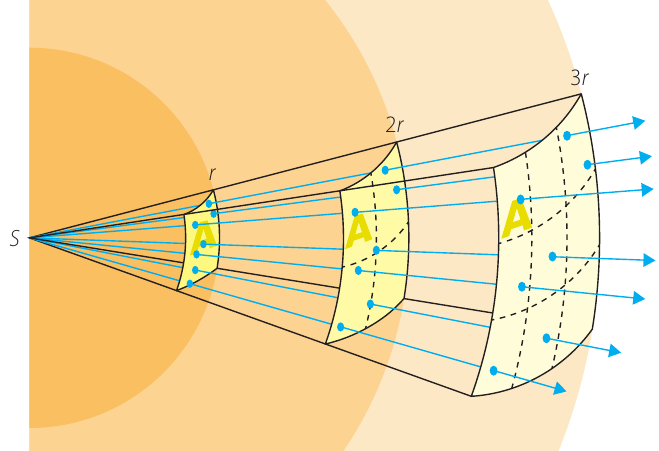
When light emanates from a point source, it radiates uniformly in all directions into the surrounding space. As the light travels further from its source, the same amount of energy becomes distributed across increasingly larger areas. This fundamental behaviour of light leads to an important relationship between distance and intensity.
Light intensity () is defined as the energy per second passing through each unit of surface area. It is measured in watts per square metre (). The intensity depends on two key factors: the strength of the source and the distance from that source.
Note
The diagram above illustrates how light from a point source spreads outward. At distance , the light covers a certain area. At distance , the same light energy is spread over a much larger area. By distance , the area is larger still. This geometric spreading is the key to understanding why light intensity decreases with distance.
The inverse square law
Derivation of the law
Consider a point source of light with source strength . The source strength represents the total energy emitted per second by the source, measured in watts () or joules per second ().
The light spreads outward in all directions, forming an expanding sphere. At any distance from the source, the light is distributed over the surface of a sphere with area:
The intensity at this distance is the source strength divided by the surface area:
This can be rearranged to show:
From this equation, we can identify two important proportional relationships:
Note
Intensity is proportional to source strength:
This means if you double the power of the light source, you double the intensity at any given distance.
Important
Intensity is inversely proportional to the square of the distance:
This is the inverse square law. If you double the distance from the source, the intensity becomes one-quarter of its original value. If you triple the distance, the intensity becomes one-ninth of its original value.
The constant in the formula indicates that the light spreads over the surface of a sphere. This inverse square relationship appears in other areas of physics, including gravitational fields, electrostatic forces, and sound intensity.
Comparing intensities at different distances
When working with practical problems, we often need to compare the intensity of light at two different distances from the same source. Using the inverse square law:
Taking the ratio of these intensities:
Rearranging this gives the useful formula:
Note
This equation allows us to calculate the intensity at one distance if we know the intensity at another distance from the same source. Notice that we don't need to know the source strength - it cancels out when we take the ratio.
Worked examples
Example
Worked Example 1: Calculating intensity at a closer distance
Problem: At a distance of from a light source, the intensity is . What is the intensity at from the source?
Solution:
Given data:
Formula:
Rearranging:
Substituting values:
Answer: I₂ = 9.6 × 10² W m⁻²
Explanation: The distance has been halved, so according to the inverse square law, the intensity should increase by a factor of . Indeed, , confirming our answer.
Example
Worked Example 2: Comparing sunlight on different planets
Problem: Earth is million km from the Sun. Mars is million km from the Sun. What is the ratio of sunlight intensity on Earth compared to Mars?
Solution:
Given data:
- (Earth's distance)
- (Mars' distance)
- (ratio of intensities)
Formula:
Rearranging:
Substituting values:
Answer: Sunlight on Earth is 2.31 times more intense than on Mars.
Explanation: Mars is further from the Sun, so it receives less intense sunlight. The ratio has no units because it is comparing two intensities. This calculation assumes both planets receive light from the same source (the Sun) and that the Sun acts as a point source.
Investigation: Testing the inverse square law
Aim
To measure the variation in light intensity with distance from the source and verify the inverse square law experimentally.
Hypothesis
Students should write a hypothesis predicting that light intensity will vary inversely with the square of the distance from the source. For example: "The intensity of light will decrease proportionally to the square of the distance from the source."
Materials
- Point source of light (such as a light globe)
- Black curtain or fabric
- Measuring tape
- Light meter (or suitable smartphone app) to measure light intensity
- Graph paper or computer with spreadsheet program
Risk assessment
| What are the risks in doing this investigation? | How can you manage these risks to stay safe? |
|---|---|
| The room will be darkened, so items on the floor may present trip hazards. | Remove any potential trip hazards. |
| Staring at the light source may temporarily hurt your eyes. | Avoid staring directly at the light source. |
Note
Students should also consider other risks specific to their setup, such as electrical hazards from the light source or heat from the globe if it becomes hot during extended use.
Method
- Darken the room as much as possible to reduce ambient light interference.
- Place the point source of light in front of a black curtain or fabric. This prevents reflected light from walls or other surfaces from reaching the light meter, ensuring you measure only direct light from the source.
- Set up the light meter at a measured distance from the source.
- Record measurements of light intensity at approximately 10 different distances, ranging from to .
- For each measurement, record the distance and the corresponding intensity .
- The actual units for intensity readings from your light meter are not critical - relative values are sufficient for this investigation.
Important
Ensure the light meter is perpendicular to the light rays at each measurement position to get accurate readings. The black curtain background is essential to prevent reflected light from affecting your measurements.
Recording results
Record your data in a table with the following column headings:
| (m) | (units) | (m) | (m) |
|---|---|---|---|
After collecting your data, calculate the values for the third and fourth columns:
- is the reciprocal of the distance
- is the reciprocal of the distance squared
Analysis of results
Note
Creating your graph:
-
Using graph paper or spreadsheet software, plot a graph with on the horizontal axis and on the vertical axis.
-
If the inverse square law holds true (), your graph should show a linear relationship - the points should lie approximately on a straight line passing through the origin.
-
Any deviation from a straight line indicates experimental error or limitations in the equipment or setup.
Discussion points
When writing up your investigation, consider:
1. Do your results support the inverse square law? If your graph shows a linear relationship between and , this confirms the inverse square law. Discuss how well your data points fit a straight line.
2. Comment on the scatter in your data points. Perfect alignment is unlikely due to experimental uncertainties. Identify possible sources of error such as:
- Ambient light not completely eliminated
- Reflected light from surfaces
- Imprecise distance measurements
- Variations in light source output
3. Suggest improvements to reduce errors:
- Use a darker room or better light shields
- Take multiple readings at each distance and calculate averages
- Ensure the light meter is perpendicular to the light rays
- Use a more stable light source
- Increase the range of distances measured
Conclusion
Your conclusion should reference your hypothesis and state whether the experimental data supports the inverse square law. A good conclusion might read: "The investigation supports the inverse square law for light intensity. The graph of intensity versus shows a linear relationship, confirming that light intensity is inversely proportional to the square of the distance from the source."
Applications and significance
The inverse square law has important practical applications:
1. Photography and lighting design: Understanding how light intensity decreases with distance helps photographers and lighting designers position lights effectively. Moving a light source twice as far away reduces the illumination to one-quarter of its original intensity.
2. Astronomy: The inverse square law allows astronomers to calculate the luminosity of stars from their observed brightness. It also explains why planets further from the Sun receive less solar radiation, as demonstrated in the Mars example above.
3. Safety considerations: High-beam headlights can dazzle oncoming drivers when close, but become less problematic at greater distances. When a car is several hundred metres away, the light intensity reaching your eyes is dramatically reduced according to the inverse square law. At 10 times the distance, the intensity is reduced to of its close-range value.
4. Other forms of radiation: The inverse square law applies not only to visible light but to other forms of electromagnetic radiation, including radio waves, X-rays, and gamma rays. It also applies to sound intensity and gravitational and electrostatic forces, making it one of the fundamental relationships in physics.
Summary
Key Points to Remember:
-
Light from a point source spreads uniformly in all directions over the surface of an expanding sphere with area .
-
Intensity () is the power per unit area, measured in watts per square metre ().
-
The inverse square law states that intensity is inversely proportional to the square of the distance: .
-
The mathematical formula for comparing intensities at two distances is: .
-
Doubling the distance from a light source reduces the intensity to one-quarter; tripling the distance reduces it to one-ninth.
-
The inverse square law applies to all electromagnetic radiation, as well as to gravitational forces, electrostatic forces, and sound intensity.