Vibration in Air Columns (HSC SSCE Physics): Revision Notes
📚Revision Notes
Vibration in Air Columns
Introduction to air column vibration
Standing sound waves form in pipes through resonance. These waves can occur in two types of pipes:
- Open pipes: pipes that are open at both ends
- Closed pipes: pipes that are open at only one end (closed at the other)
Resonance happens when the wavelength of a sound wave corresponds exactly to one of the natural frequencies of the pipe. The resonance pattern depends on the pipe's length and the speed of sound in air, which varies with temperature.
Note
The type of pipe (open or closed) fundamentally changes which harmonics can resonate. This difference is crucial for understanding musical instruments and acoustic applications.
Reflection of sound waves in pipes
Sound waves travel through pipes as plane waves, just as they do in open air. Understanding how these waves reflect at the ends of pipes is crucial to understanding resonance.
Reflection at open ends
When a compression travels along a pipe and reaches an open end:
- The compression is no longer confined
- It expands rapidly into the surrounding air
- This expansion creates a rarefaction that reflects back down the pipe
- Result: compression reflects as a rarefaction (similar to fixed-end reflection in strings)
When a rarefaction reaches an open end:
- Higher pressure air from outside the pipe rushes into the low-pressure region
- This creates a compression that travels back down the pipe
- Result: rarefaction reflects as a compression
Reflection at closed ends
At a closed end, waves reflect differently:
- A compression reflects as a compression (similar to free-end reflection in strings)
- A rarefaction reflects as a rarefaction
- The closed end creates a boundary condition for the standing wave
Important
Key Reflection Behaviors:
At open ends: Compressions reflect as rarefactions, and rarefactions reflect as compressions
At closed ends: Compressions reflect as compressions, and rarefactions reflect as rarefactions
This difference creates the characteristic standing wave patterns in each type of pipe.
Nodes and antinodes in pipes
The standing wave pattern creates specific points in the pipe:
- Displacement antinode: maximum air displacement (occurs at open ends)
- Displacement node: zero air displacement (occurs at closed ends)
- Pressure node: minimum pressure variation (occurs at open ends)
- Pressure antinode: maximum pressure variation (occurs at closed ends)
Note
Important Phase Relationship:
Particle displacement () and pressure variation () are out of phase. Where displacement is maximum, pressure variation is minimum, and vice versa. This means displacement antinodes coincide with pressure nodes, and displacement nodes coincide with pressure antinodes.
Stationary waves in open pipes
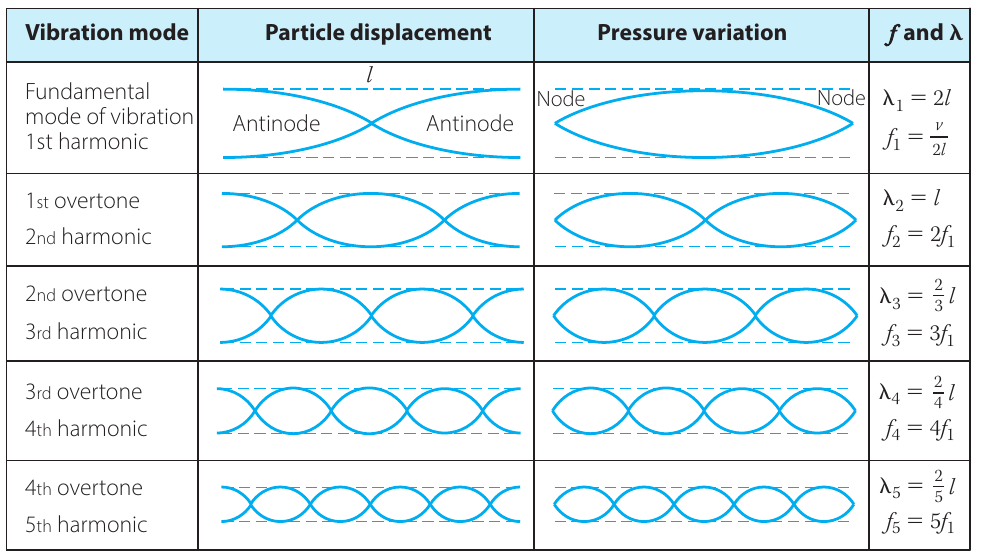
In pipes open at both ends, standing waves form with specific patterns. We can describe these patterns using either particle displacement () or pressure variation ().
Harmonics in open pipes
Open pipes support all harmonics. This means every integer multiple of the fundamental frequency can resonate in the pipe.
The relationship between pipe length () and wavelength () is:
where:
- = length of the pipe
- = wavelength of the th harmonic
- = harmonic number ()
Note
Memory Aid: "OPEN = ALL"
Open pipes produce all harmonics because both ends are antinodes. This allows standing wave patterns with , , , , and so on, to fit within the pipe length.
Frequency calculations for open pipes
The fundamental frequency (first harmonic) is:
where:
- = fundamental frequency
- = speed of sound in air
- = length of the pipe
Higher harmonics follow the pattern:
- 2nd harmonic (1st overtone):
- 3rd harmonic (2nd overtone):
- 4th harmonic (3rd overtone):
In general: for all positive integers .
Note
Remember the Pattern:
For open pipes, divide by 2:
Each successive harmonic is simply an integer multiple of the fundamental frequency, making calculations straightforward.
Worked example: Open pipe length calculation
Example
Worked Example: Calculating Open Pipe Length
Problem: Calculate the length of a pipe open at both ends whose fundamental frequency is , when the speed of sound in air is .
Solution:
Given data:
Step 1: Use the formula for fundamental frequency in an open pipe:
Step 2: Rearrange to solve for length:
Step 3: Substitute values:
Step 4: Calculate:
Answer: The pipe must be 0.53 m long to produce a fundamental frequency of 320 Hz.
Stationary waves in closed pipes
Pipes closed at one end have different resonance characteristics than open pipes. This affects the sounds they can produce.
Harmonics in closed pipes
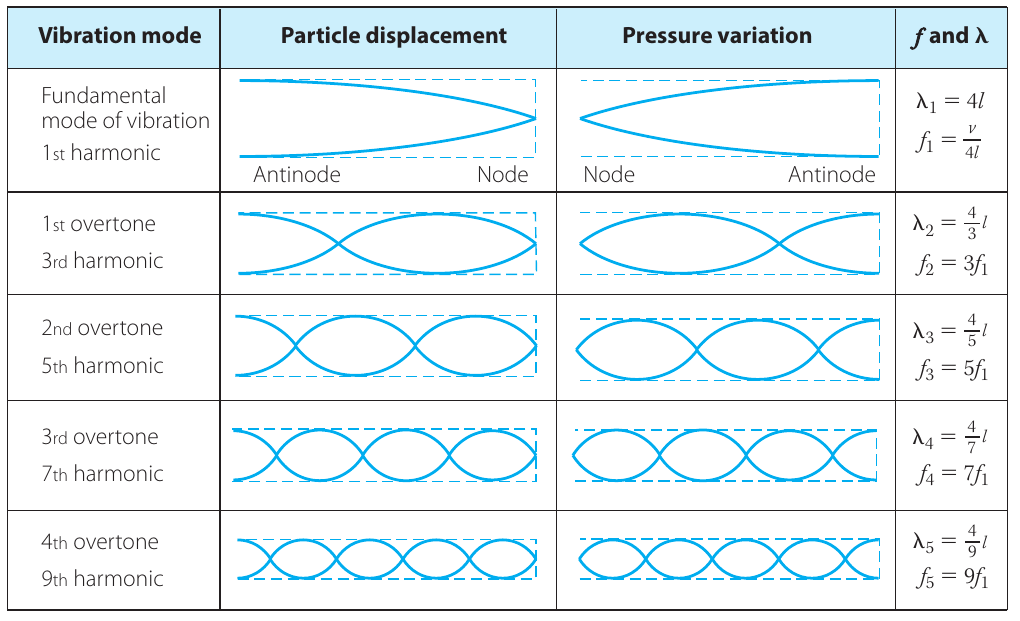
Closed pipes support only odd harmonics. This is a crucial difference from open pipes.
The relationship between pipe length and wavelength is:
where:
- = length of the pipe
- = wavelength
- = positive integer ()
The term always produces an odd number:
- When : (1st harmonic)
- When : (3rd harmonic)
- When : (5th harmonic)
Important
Memory Aid: "CLOSED = ODD"
Closed pipes produce only odd harmonics (1st, 3rd, 5th, 7th, etc.) because the boundary conditions require an antinode at the open end and a node at the closed end. This constraint means only odd multiples of quarter wavelengths can fit in the pipe.
The absence of even harmonics gives closed pipe instruments their distinctive timbre!
Frequency calculations for closed pipes
The fundamental frequency for a closed pipe is:
Notice this is half the fundamental frequency of an open pipe of the same length.
The overtones are:
- 1st overtone (3rd harmonic):
- 2nd overtone (5th harmonic):
- 3rd overtone (7th harmonic):
In general: for odd harmonics only.
Note
Comparing Open and Closed Pipes:
For the same length pipe:
- Open pipe fundamental:
- Closed pipe fundamental:
The closed pipe has a fundamental frequency exactly half that of the open pipe. Remember: "Closed pipes divide by 4."
Musical implications
The fact that closed pipes only produce odd harmonics has an important consequence: musical instruments with closed pipes can only play certain notes. They produce a different timbre (sound quality) compared to open pipe instruments, as they're missing all the even harmonics.
Worked example: Comparing open and closed pipes
Example
Worked Example: Comparing Open and Closed Pipe Frequencies
Problem: When the air is at , the speed of sound in air is . What will be the fundamental frequency, , and the frequency of the first two overtones, and , for an organ pipe long if it is:
- Open at both ends?
- Closed at one end?
Solution:
Part 1: Open at both ends
Given:
Step 1: Use the fundamental frequency formula for open pipes:
Step 2: Calculate overtones (all harmonics are possible):
- First overtone (2nd harmonic):
- Second overtone (3rd harmonic):
Part 2: Closed at one end
Step 3: Use the fundamental frequency formula for closed pipes:
Step 4: Calculate overtones (only odd harmonics are possible):
- First overtone (3rd harmonic):
- Second overtone (5th harmonic):
Key observation: The closed pipe has a fundamental frequency exactly half that of the open pipe of the same length. Additionally, the closed pipe only produces odd harmonics.
Investigation: Finding the speed of sound by air column resonance
This investigation uses resonance in a closed pipe to experimentally determine the speed of sound in air.
Aim
To find the speed of sound in air in your classroom.
Materials
- Large graduated cylinder
- Glass tube (approximately in diameter and about long)
- Tuning fork with a fundamental frequency of
- Ruler
- Marking pen that can write on wet glass
Risk assessment
| What are the risks in doing this investigation? | How can you manage these risks to stay safe? |
|---|---|
| The glass tube may break and produce sharp edges | Take care when handling the glass equipment |
Important
Consider any other risks associated with your investigation and how you can manage them. Always conduct a thorough risk assessment before beginning practical work.
Method
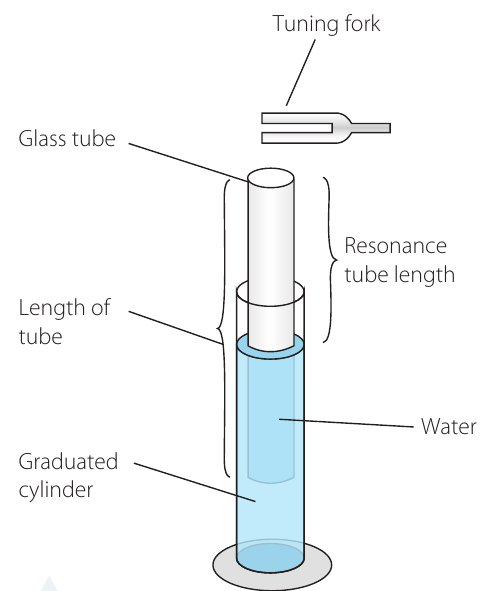
- Set up the equipment as shown in the diagram. The glass tube fits inside the graduated cylinder and can be moved up and down to vary the length of the air column inside.
- Fill the graduated cylinder with water to just below the top.
- Lower the glass tube until the top is just above the surface of the water.
- Strike the tuning fork on a surface that will get it oscillating strongly and hold it near the open end of the tube.
- Raise the tube slowly until it begins to resonate. You will hear the sound become noticeably louder.
- Using the marking pen, mark the base of the tube where it contacts the water when the loudest resonance is detected.
- Measure the length of the air column from the top of the tube to the water level. This is the resonance length.
- Repeat the procedure twice more and calculate the average of the three measurements.
- Analyse the results using the relationship for the fundamental frequency in a closed pipe: .
Note
Why Repeat Measurements?
Taking multiple trials and averaging them helps reduce random errors and improves the reliability of your results. This is good scientific practice in any experimental investigation.
Results
Record your results in the table below:
| Data | Trial 1 | Trial 2 | Trial 3 | Average |
|---|---|---|---|---|
| Frequency of the tuning fork | ||||
| First resonance length |
Analysis of results
- Calculate the speed of sound using your data:
- Since , the wavelength is
- Using , calculate:
- Include the uncertainty in your calculated value
- Compare your result with the accepted value of :
- Calculate the percentage difference between your value and the accepted value
- Percentage difference
Note
Understanding Your Results:
A percentage difference of less than 5% indicates good accuracy. Larger differences suggest systematic errors in the experiment or significant environmental factors affecting the speed of sound.
Discussion
- Atmospheric conditions: What atmospheric conditions (temperature, humidity, air pressure) may have affected your result? The speed of sound increases with temperature, so if the room was warmer than standard conditions, your measured speed would be higher.
- Temperature effects: If you conducted the experiment on a hotter day, the speed of sound would be greater. This would result in a longer resonance length for the same frequency, as shows that length is directly proportional to the speed of sound.
- Improving accuracy: Changes to improve accuracy could include:
- Using a longer tube to reduce percentage error in measurements
- Taking more trials and averaging them
- Using a more precise method to measure the tube length
- Controlling room temperature more carefully
- Different gases: If you replaced the air with carbon dioxide, the speed of sound would change. Sound travels at different speeds in different media depending on the medium's properties (density and elasticity). Carbon dioxide is denser than air, so sound would travel more slowly in it.
- Pressure diagram: When resonating at the fundamental frequency, there is a displacement antinode (pressure node) at the open top of the tube and a displacement node (pressure antinode) at the closed bottom where the water surface is.
- Higher frequency tuning fork: If you used a tuning fork with a higher fundamental frequency, the first resonance would occur in a shorter air column. This is because the relationship shows that length is inversely proportional to frequency - as frequency increases, the required resonance length decreases.
Important
Key Relationship:
The resonance length is inversely proportional to frequency:
This means:
- Higher frequency → shorter resonance length
- Lower frequency → longer resonance length
Conclusion
Write a conclusion that:
- States your calculated value for the speed of sound
- Compares it to the accepted value
- Discusses the accuracy of your result
- Identifies the main sources of error
- Relates your findings back to the aim of the investigation
Exam tips
Note
Essential Exam Tips:
- Remember the key difference: Open pipes support ALL harmonics; closed pipes support only ODD harmonics
- Formula memory aid: Open pipes divide by 2 (); closed pipes divide by 4 ()
- When drawing standing wave patterns, always put antinodes at open ends and nodes at closed ends for particle displacement
- The speed of sound in air is approximately at room temperature, but this can vary with temperature
- In calculations, always show your working and include units at every step
Remember!
Summary
Key Points to Remember:
-
Resonance occurs when sound waves match the natural frequencies of a pipe, creating standing waves with specific wavelengths
-
Open pipes (both ends open) produce all harmonics with the fundamental frequency , and the resonance condition
-
Closed pipes (one end closed) produce only odd harmonics with the fundamental frequency , and the resonance condition
-
At open ends, compressions reflect as rarefactions and vice versa, creating displacement antinodes (pressure nodes)
-
At closed ends, compressions reflect as compressions and rarefactions as rarefactions, creating displacement nodes (pressure antinodes)
-
The speed of sound can be experimentally determined using resonance in air columns, with the relationship for the fundamental frequency in a closed pipe
Memory Aids:
- "OPEN = ALL" - Open pipes produce all harmonics
- "CLOSED = ODD" - Closed pipes produce only odd harmonics
- "Open pipes: divide by 2" -
- "Closed pipes: divide by 4" -