Refraction of Waves (HSC SSCE Physics): Revision Notes
📚Revision Notes
Refraction of Waves
What is refraction?
When waves travel from one material into another, their speed often changes. For example, light slows down when it moves from air into water, and slows even more when entering glass. Waves can also change speed when the properties of a single medium change - like water waves moving from deep to shallow water.
Refraction is the change in direction that occurs when a wave enters a new medium at an angle (not perpendicular). This direction change happens because one part of the wave speeds up or slows down before the other part, causing the wave to bend.
Note
Practical Applications of Refraction
Refraction has many practical applications in everyday life:
- Lenses in glasses, cameras, and telescopes use refraction to bend light and form images
- The lens and cornea in your eye use refraction to help you see
- Fibre optic cables use a consequence of refraction (total internal reflection) to carry internet data as beams of light
Key principles of wave refraction
When a wave undergoes refraction, three important things happen:
- The speed changes - this is what causes refraction in the first place
- The frequency stays the same - the frequency of a wave is determined by its source, which doesn't change
- The wavelength changes - because speed changes but frequency doesn't, the wavelength must change proportionally
This relationship is described by the wave equation:
where is the wave speed, is the frequency, and is the wavelength.
Rearranging this formula to solve for wavelength:
Important
Direction Change Requires an Angle
If a wave meets the boundary between two media at a right angle (perpendicular), it will change speed and wavelength but will NOT change direction. Direction change only occurs when the wave hits the boundary at any other angle.
Refraction of sound waves
Sound waves refract when they pass between regions with different temperatures, because temperature affects the density of the air and therefore the speed of sound. Sound travels faster in warm air than in cool air.
Consider what happens when sound waves travel between layers of warm and cool air:
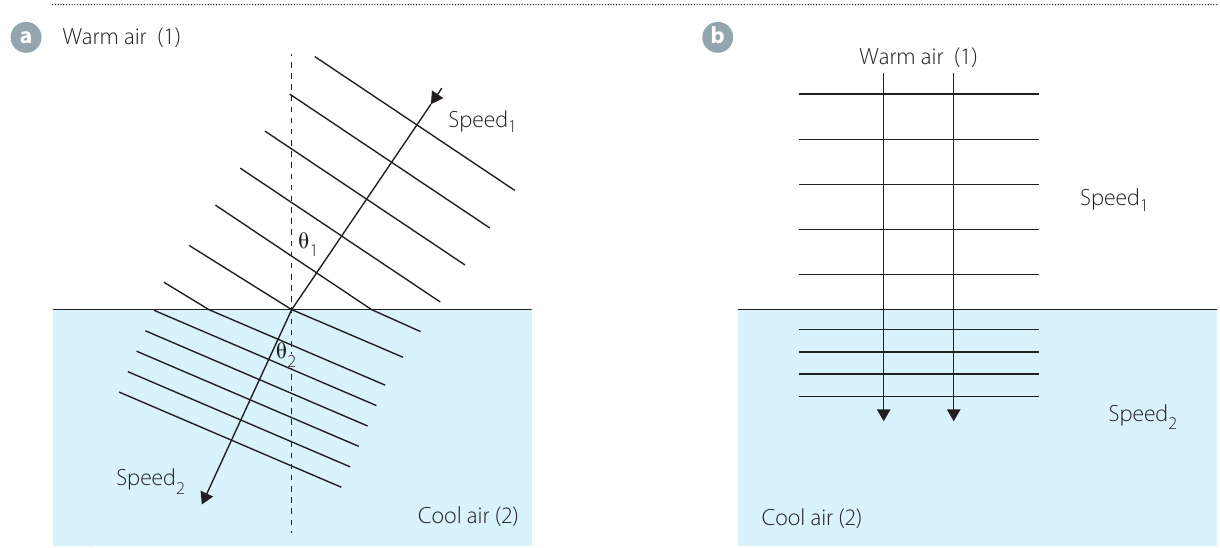
In diagram (a), the sound wave approaches the boundary between warm and cool air at an angle. Because the wave travels at different speeds in the two layers, it changes direction (refracts). The angles and show the wave's direction in each layer.
In diagram (b), the wave enters perpendicular to the boundary. Even though the speed and wavelength change, there is no change in direction because the entire wavefront enters the new medium at the same time.
Calculating wavelength changes
We can use the wave equation to calculate how wavelength changes when a wave's speed changes.
Example
Worked Example: Wavelength Changes in Sound Waves
Sound waves from a source vibrating at are travelling through air at .
Part 1: What is the wavelength of these sound waves?
Given: and
Using :
Part 2: The sound waves enter cooler air and slow to . What is the wavelength now?
Given: (frequency remains constant!) and
Using :
Notice that the wavelength decreased when the speed decreased, but the frequency stayed at 680 Hz throughout.
Temperature gradients and atmospheric refraction
Sound refraction occurs in the atmosphere wherever there are gradual changes in temperature with height. This creates what we call a temperature gradient.
Temperature inversions
Normally, air temperature decreases as you go higher in the atmosphere. However, sometimes the opposite occurs - a temperature inversion - where the air higher up is actually warmer than the air near the ground. This commonly happens on winter nights when the ground cools quickly, cooling the air immediately above it.
How temperature gradients affect sound
During the day, the ground is warm, heating the air close to the surface. Temperature decreases with height. Since sound travels faster in warmer air, the bottom edge of a sound wave travels faster than the top edge. This causes the wave to bend (refract) gently upward, away from the ground.
Note
Why Sounds Are Clearer at Night
At night, during a temperature inversion, the opposite happens. The ground is cooler than the air above it, so sound waves bend downward toward the ground. This is why sounds from distant sources often seem clearer and louder at night - the sound waves are being refracted down toward you rather than away.
Wavefronts
A wavefront is a line perpendicular to the direction of wave propagation along which all points on the wave are at the same part of their cycle (oscillation). In simpler terms, it's a line connecting all the wave crests or all the wave troughs.
Note
You can easily see wavefronts when you look at ocean waves approaching a shore. The lines of waves you see are the wavefronts.
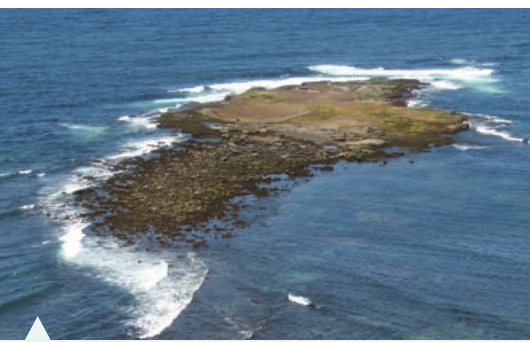
This photograph shows ocean waves approaching a rocky island. Notice how the wavefronts bend around the island. This bending happens because waves travel more slowly in the shallower water near the island than in the deeper water farther away. The speed difference causes refraction, making the wavefronts curve toward the island.
When ocean waves approach a shoreline at any angle other than perpendicular, the wavefronts always bend toward the shore for the same reason - the part of the wave in shallower water slows down while the part in deeper water continues at its original speed.
Investigation: Observing everyday refraction
Aim
To observe the refraction of light in everyday examples
Materials
- Reading glasses or magnifying lens
- Beaker of water
- Stick or rod
- Power pack
- Ray box kit with lenses
Risk assessment
Important
Safety First: Working with Electricity
What are the risks? Power packs use 240 V mains electricity, which can be dangerous.
How to stay safe: Keep all devices plugged into mains power well away from water.
Consider what other risks might exist in your investigation and how you can manage them safely.
Method
- Place a stick in a beaker of water. Observe the stick from different angles and notice how it appears to be bent at the water's surface.
- Hold a pair of reading glasses or a magnifying lens at arm's length. Observe how objects viewed through the lens appear distorted or magnified - this is because light is being bent (refracted) as it passes through the lens.
- Set up a ray box to shine light rays through a convex lens and then through a concave lens. Carefully trace the path of the light rays on paper. Notice how the rays bend toward the normal (an imaginary line perpendicular to the surface) where they first strike the lens surface.
- Take photographs of your observations to create a permanent record of the investigation.
Results
Record all your observations. Keep your traces of the light rays passing through the lenses with your notes, clearly labeling which traces are for the convex lens and which are for the concave lens.
Discussion
For each situation you observed (stick in water, magnifying lens, ray box with lenses), describe exactly where the light is being refracted. Is it when light enters the medium, exits the medium, or both?
Conclusion
Write a conclusion that refers back to the aim of the investigation. Based on your observations, what can you conclude about the refraction of light in everyday situations?
Remember!
Summary
Key Points to Remember:
- Refraction is the change in direction that occurs when a wave enters a new medium at an angle, caused by a change in the wave's speed.
- When a wave refracts, its frequency stays constant but its speed and wavelength change according to the equation .
- Waves only change direction if they enter the new medium at an angle other than perpendicular (90°). Perpendicular entry causes speed and wavelength changes but no direction change.
- Sound waves refract in the atmosphere due to temperature gradients. Sound travels faster in warm air, causing waves to bend away from warmer regions and toward cooler regions.
- Wavefronts are lines perpendicular to wave propagation where all points are at the same part of their cycle. You can observe wavefronts bending due to refraction in ocean waves approaching a shore.