Resonance in Mechanical Systems (HSC SSCE Physics): Revision Notes
📚Revision Notes
Resonance in Mechanical Systems
Introduction to resonance
When air flows across the opening of a bottle, it causes the air inside to vibrate, producing a musical note. The pitch of this sound is determined by the bottle's dimensions. This sound results from the free vibrations of the air column within the bottle.
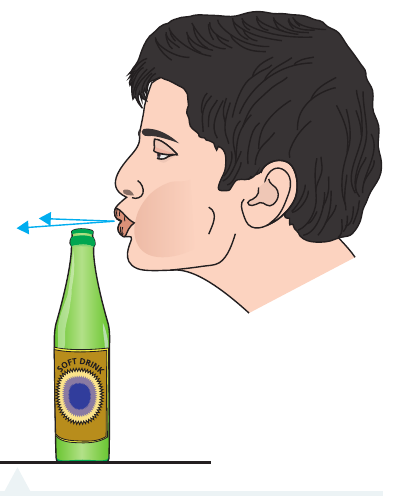
When you purse your lips and blow air without whistling, you produce a rushing sound containing many different frequencies. This type of sound is called white noise, similar to white light which contains many different frequencies of light combined together.
Note
White noise contains a mixture of all audible frequencies at roughly equal intensities, similar to how white light contains all visible wavelengths. This makes it an ideal source for exciting the natural frequency of an object.
As you blow air across the bottle's opening, you provide sound waves of many different frequencies to the air column inside. Most of these frequencies transfer energy inefficiently to the air column. However, one particular frequency - the natural or resonance frequency - transfers energy very efficiently and establishes a standing wave in the bottle. This standing wave frequency is what you hear as the musical note.
Free vibrations
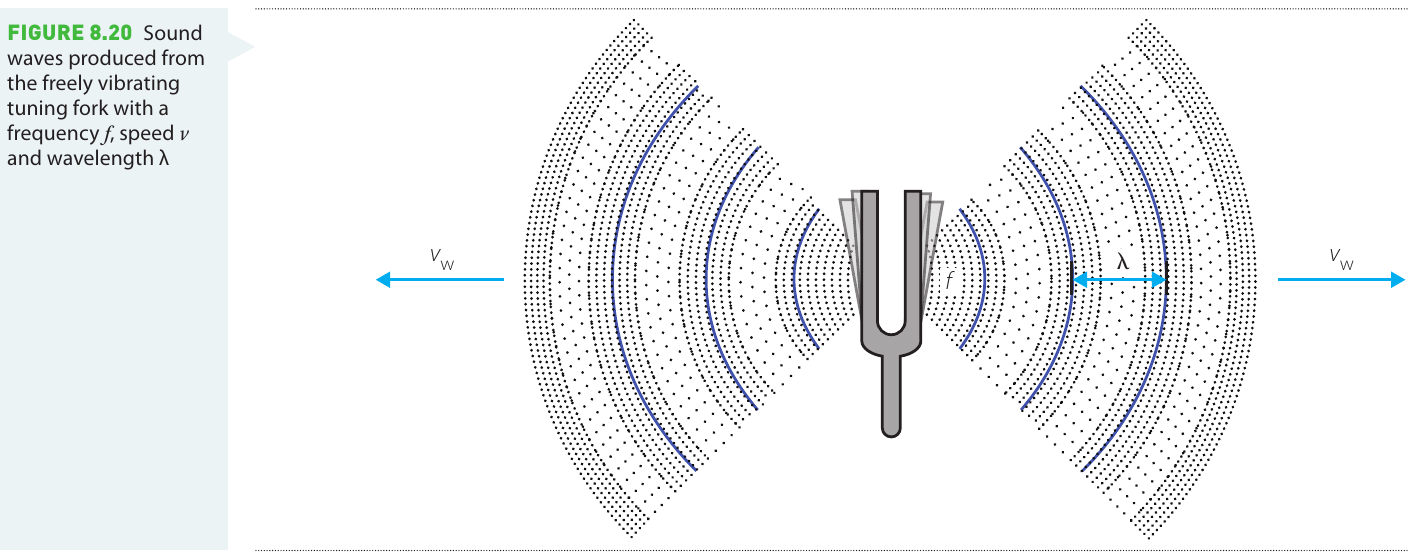
Free vibrations (also called natural vibrations) happen when an object is displaced from its equilibrium position and then left to vibrate by itself. Restoring forces cause the vibrating object to accelerate back towards its rest position.
When a tuning fork is struck, its prongs vibrate about their average position. Elastic restoring forces pull the prongs back and forth strongly. The tuning fork vibrates at its natural frequency.
Examples of free vibrations
Common examples of objects that exhibit free vibrations include:
- Guitar strings
- Organ pipes
- Wind instruments
- Drums
- Pendulums
- Masses attached to springs (such as in bungee jumping)
All these systems have their own natural frequencies of vibration.
Properties affecting natural frequency
The frequency (and period) of vibration depends on the properties of the vibrating object. For instance, a plucked guitar string vibrates at different natural frequencies depending on:
- Its length
- Its mass per unit length
- The tension in the string
Example
Worked Example: Guitar String Frequency
Consider how changing a guitar string's properties affects its natural frequency:
Case 1: A standard guitar string
- Length: 65 cm
- Vibrates at natural frequency: 196 Hz (G note)
Case 2: Same string, pressed down at 12th fret
- Length reduced to: 32.5 cm (half the original)
- New frequency: 392 Hz (G note, one octave higher)
This demonstrates that halving the length doubles the frequency, showing the inverse relationship between string length and natural frequency.
The only energy driving a free vibration comes from the initial displacement. Over time, these vibrations decrease in amplitude because friction causes energy to transfer to the surroundings. This process is called damping.
Forced vibrations
Forced vibrations arise when one vibrating object causes another object to vibrate. Consider a tuning fork struck on a rubber stopper - it produces a quiet sound that is difficult to hear. However, if the same vibrating tuning fork is held with its base on a wooden bench or tabletop, the sound becomes loud enough to hear throughout a classroom.
The sound is louder when the fork contacts the bench because the fork forces the bench to vibrate at the same frequency. The benchtop has a much larger vibrating surface area than the tuning fork. As a result, these forced vibrations disturb a greater volume of air and produce a louder sound.
Note
The key difference between free and forced vibrations is the source of energy:
- Free vibrations: Energy comes from the initial displacement only
- Forced vibrations: Energy is continuously supplied by the driving oscillator
Resonance
Resonance occurs when the frequency of the forced vibration matches the natural (free) vibration frequency of the object. The source of the forced vibration amplifies the free vibrations of the object, causing them to increase dramatically in amplitude. The amplitude of resonant vibrations can become very large and, in certain circumstances, cause damage to the vibrating object.
Important
Critical Condition for Resonance
Resonance only occurs when the driving frequency exactly matches the natural frequency of the object. Even small differences in frequency will result in much less efficient energy transfer and smaller amplitudes.
Wine glass demonstration
When sound waves are projected towards a wine glass at a frequency matching the resonant frequency of the glass, it is possible to shatter the glass without physically touching it. This demonstrates the powerful effects of resonance.
Resonance of vibrating objects can be observed in the laboratory using a strobe light to 'freeze' or slow down the apparent motion of the vibrating object.
Key characteristics of resonance
- The amplitude of vibration increases dramatically when resonance occurs
- Resonance only happens when the driving frequency matches the natural frequency exactly
- When an object resonates, energy transfers very efficiently from the driving oscillator to the driven oscillator
Energy transfer within a system
When the frequency of the forced vibration matches the natural frequency of the system, energy transfers with maximum efficiency. In these cases, a standing wave forms. This phenomenon is called resonance.
Note
Standing Waves at Resonance
A standing wave is characterized by:
- Fixed points called nodes where there is no motion
- Points of maximum displacement called antinodes
- The pattern appears stationary, though energy is still present in the vibration
Standing waves form because the driving frequency creates waves that interfere constructively with the reflected waves in the system.
The energy from a speaker placed in front of a wine glass transfers to the wine glass with maximum efficiency if the sound from the speaker has the same frequency as the natural resonance of the glass. This is why the glass can shatter - the efficient energy transfer causes the amplitude of vibration to become so large that the glass structure fails.
Energy transfer between oscillating systems
Consider two tuning forks mounted on sounding boxes, as shown below. The sounding boxes are designed to vibrate at a resonant frequency equal to their tuning fork's resonant frequency.
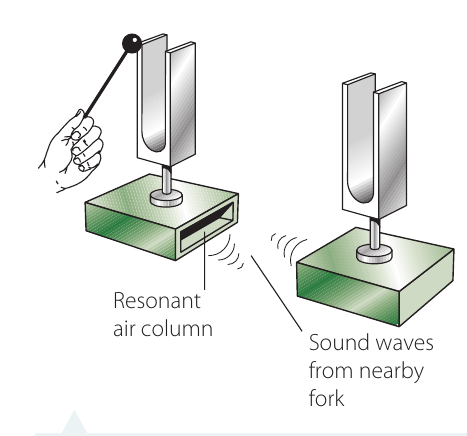
When one tuning fork is struck, energy transfers from the struck tuning fork and its sounding box to the adjacent system, causing the second tuning fork to vibrate as well. This energy transfer happens efficiently if both tuning forks have the same resonant frequency.
Example
Demonstration: Sympathetic Vibration Between Tuning Forks
Setup: Two identical 256 Hz tuning forks on sounding boxes
Procedure:
- Strike the first tuning fork
- Allow it to vibrate for several seconds
- Stop the first fork by touching it
- Listen carefully to the second fork
Observation: The second tuning fork is now vibrating and producing sound, even though it was never struck directly.
Explanation: Energy transferred through the air from the first vibrating system to the second. Because the frequencies matched perfectly, resonance occurred and the energy transfer was highly efficient.
When the frequencies of the two tuning forks differ, the same effect is not observed. Resonance in the second tuning fork fails because the forced vibration frequency does not match the free vibration frequency of the second tuning fork. Energy transfer is inefficient when frequencies don't match.
Investigation 8.8: Resonance
Aim
To observe objects vibrating at their resonant frequency.
Materials
- Wine glass
- Beaker of water
- Sonometer or guitar string
- Strobe light with adjustable frequency
- Frequency analyser (or suitable app on a smartphone)
- Digital camera or recording device (e.g. phone, tablet or laptop)
Risk assessment
Important
Safety Considerations
| What are the risks in doing this investigation? | How can you manage these risks to stay safe? |
|---|---|
| A strobe light may induce seizures in some susceptible people. | Ensure that no class member is susceptible to seizures or has a history of epilepsy. |
| Wine glasses are made from delicate glass that, if broken, will form very sharp pieces. | Ensure that all present are wearing enclosed shoes and that instructions on how to handle broken glass are given prior to this investigation. |
Method
- Moisten your finger (using water from the beaker) and then rub your finger gently around the rim of the wine glass until the glass begins to 'sing' at its resonant frequency.
- Use the frequency analyser or smartphone app to measure this resonant frequency.
- Darken the laboratory. Set the strobe light to the same frequency as the resonant frequency of the wine glass.
- Repeat step 1 with the strobe light illuminating the wine glass as it 'sings'. Adjust the frequency of the strobe light until the glass appears to move slowly. Observe carefully and record your observations on a phone, tablet or laptop.
- Pluck a guitar or sonometer string and again use the frequency analyser to measure the frequency of the resonant vibration.
- Set the frequency of the strobe light to this measured frequency.
- In the darkened laboratory, illuminate the vibrating guitar or sonometer string and adjust the frequency of the strobe until the string is observed to be moving from side to side slowly. Again, record the motion on a suitable available device.
- Repeat these steps for the glass and then for the string, but this time set the strobe light frequency to twice the measured resonant frequencies of the glass and string. Observe carefully.
Results
- Observe where nodes and antinodes occur within the glass and along the string when they vibrate at their resonant frequencies.
- Discuss whether the vibrations observed are examples of travelling waves or standing waves.
Note
Observing the Stroboscopic Effect
When the strobe light frequency matches the vibration frequency, each flash illuminates the object at the same point in its cycle. This creates the illusion that the object is stationary or moving very slowly. This technique allows you to observe the pattern of nodes and antinodes clearly.
Discussion
- Discuss why the vibrating objects appear to 'freeze' or move only slowly when the strobe light frequency is set to match the frequency of the sound produced.
- Explain why doubling the strobe light frequency can also produce 'freezing' of the vibrating objects.
Conclusion
With reference to the data obtained and its analysis, write a conclusion based on the aim of this investigation.
Investigation 8.9: Energy transfer in resonating systems
Aim
To observe the transfer of energy from one resonating system to another.
Materials
- Several tuning forks mounted on sound boxes, two of which need to have the same frequency
- Ruler
- Audio signal generator or a signal generator app on a smartphone
- Speaker that can be wired into the signal generator or smartphone
Method
- Use the ruler to measure the length of the sound box from the opening to the back of the box.
- Place the two identical tuning forks on sounding boxes facing each other.
- Strike one tuning fork and listen carefully to the other tuning fork. Touch the other fork gently to feel for vibrations. Record your observations.
- Repeat with two tuning forks of different frequencies and record your observations after listening and touching carefully.
- Set the frequency of the audio generator or smartphone app to the frequency of one of the tuning forks (usually stamped on the tuning fork itself).
- With the speaker from the audio generator facing the opening of the sound box, play a sound of a single frequency into the sound box. Observe by listening and gently touching the tuning fork.
- Vary the frequency of the source of the sound so that it is:Observe the strength of the vibration of the tuning fork at these frequencies.
- double
- triple, and then
- five times the frequency of the tuning fork
Results
Record your observations in a suitable table with headings 'Frequency of sound', 'Observations of tuning fork' and 'Wavelength of sound'.
Analysis of results
- Using , calculate the wavelength, , of the sound waves for each frequency used in the investigation. Assume that the speed of sound in air, .
- Compare the wavelengths calculated with the physical length of the sound box (as measured from the opening to the back of the box).
Note
Using the Wave Equation
The wave equation relates:
- = wave speed (in m·s⁻¹)
- = frequency (in Hz)
- = wavelength (in m)
Rearranging for wavelength:
For sound in air at room temperature, use
Discussion
- In which cases did energy transfer occur most efficiently?
- Is there a mathematical pattern observed that relates the wavelengths that cause resonance to the length of the sound box? If so, what is this relationship?
Note
Hint for Analysis
Look for relationships between the wavelength and the sound box length. Consider:
- When does the wavelength equal twice the box length?
- Are there other whole number relationships that produce resonance?
- These patterns relate to the formation of standing waves with nodes at specific positions.
Conclusion
With reference to the data obtained and its analysis, write a conclusion based on the aim of this investigation.
Remember!
Summary
Key Points to Remember:
-
Free vibrations occur when an object is displaced and allowed to vibrate naturally at its own frequency, with energy gradually dissipating due to friction.
-
Forced vibrations happen when one vibrating object causes another to vibrate at the driver's frequency, often producing louder sounds through larger vibrating surfaces.
-
Resonance occurs when the driving frequency matches an object's natural frequency, resulting in maximum energy transfer and dramatically increased amplitude.
-
Energy transfers most efficiently between systems when their natural frequencies match, forming standing waves and enabling phenomena like sympathetic vibration between tuning forks.
-
Resonance can be both useful (musical instruments, radio tuning) and destructive (shattering glass, earthquake damage to buildings), making understanding of natural frequencies important in design and engineering.