The Mechanical Wave Model (HSC SSCE Physics): Revision Notes
📚Revision Notes
The Mechanical Wave Model
Introduction to mechanical waves
Mechanical waves occur when energy moves through a material without the material itself being transported from one place to another. Examples of mechanical waves include water waves, sound waves, and seismic waves.
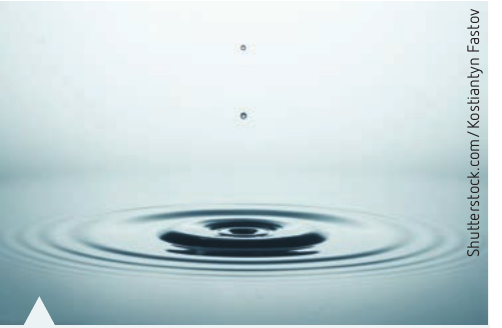
When mechanical waves pass through a material (called the medium), the medium vibrates briefly but does not travel with the wave. After the wave passes, the medium returns to exactly the same condition it was in before. Importantly, no matter is transferred from one location to another—only energy moves through the medium.
Note
Visualizing Wave Motion: The Duck on a Pond
A helpful way to visualise this is to imagine a duck floating on a pond. As ripples pass by, the duck bobs up and down but stays in its original position. It does not travel with the wave. The water (the medium) vibrates as the wave passes but remains in place once the wave has moved on.
Types of mechanical waves
Mechanical waves exist in two distinct forms: transverse waves and longitudinal waves. Understanding the difference between these types is essential for studying wave behaviour.
Transverse waves
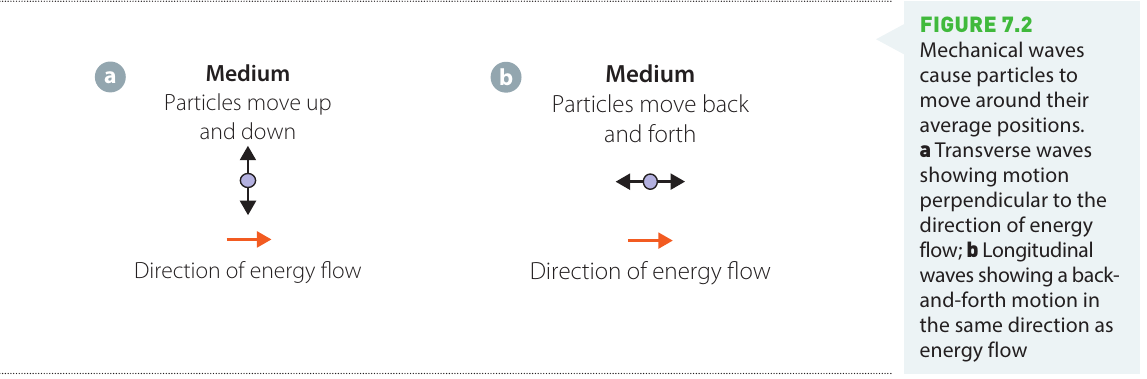
In transverse waves, particles in the medium move perpendicular (at right angles) to the direction the wave travels. Water waves are a common example of transverse waves. As a water wave moves horizontally across the surface, water particles move up and down vertically.
Longitudinal waves
In longitudinal waves, particles in the medium move parallel to the direction the wave travels—back and forth along the same line as the wave's movement. Sound waves are the most common example of longitudinal waves.
When you speak, your vocal cords vibrate and create regions of compression (where air particles are pushed closer together) and rarefaction (where air particles spread further apart). These alternating regions of compression and rarefaction travel through the air, carrying sound energy to a listener's ear.
Example
How Sound Reaches Your Ears
As sound waves travel through air, the air particles vibrate back and forth. The sound energy continues forward, eventually reaching our eardrums. The vibration of our eardrums is converted into electrical signals that our brain interprets as sound. Crucially, the air itself does not travel from the sound source to your ear—only the wave energy does.
Key differences
Important
Fundamental Distinction Between Wave Types
The fundamental distinction between transverse and longitudinal waves lies in the direction of particle motion relative to the wave's direction of travel:
- Transverse: particle motion is perpendicular to wave direction
- Longitudinal: particle motion is parallel to wave direction
The role of the medium
The properties of the medium determine how quickly waves can travel through it. Sound waves provide an excellent example of this principle.
Speed of sound in different materials
The table below shows how the speed of sound varies dramatically depending on the medium:
| Medium | Speed of sound () |
|---|---|
| Air | |
| Water | |
| Sandstone | |
| Steel |
Why speeds differ
Several factors explain these large variations in wave speed:
Note
In gases (like air): The particles are widely spaced and move randomly at high speeds (around for air molecules). Wave energy must be transferred through collisions between particles. Because particles are far apart, these collisions happen relatively infrequently, resulting in slower wave propagation. At , sound travels through air at approximately —actually slower than the individual particle speeds.
In liquids and solids: Particles are much closer together and can influence neighbouring particles by exerting forces on each other (both pushing and pulling). These forces allow energy to transfer more efficiently between particles. In gases, forces between particles only occur during collisions, making energy transfer much less efficient.
Important
Dramatic Speed Differences
The difference is striking: sound travels nearly 20 times faster in steel than in air. This demonstrates how crucial the medium's properties are to wave propagation.
Investigation 7.1: The role of the medium in propagation
Aim
To investigate the role of the medium in the propagation of mechanical waves.
Materials
- 2 tin cans
- Small drill
- File (for sharp edges)
- 5 m length of string
Risk assessment
| What are the risks? | How can you manage them? |
|---|---|
| Sharp edges on tin cans may cut you | Take care handling the tins and file down any sharp edges |
Consider what other risks might be associated with your investigation and how you can manage them.
Method
- Using the drill, make a small hole in the base of each tin can. File any sharp edges carefully.
- Pass one end of the string through the hole in one tin can. Tie a knot in the string so it cannot be pulled back out. Repeat with the other end of the string and the second can.
- With the string pulled tight between the two cans, speak into one can while a partner listens through the other. Observe how clearly your voice is transmitted through the string.
- While staying the same distance apart, speak directly to your partner at the same volume without using the string and cans. Compare how clearly you heard the voice compared to when using the cans and string.
- Using a long bench in your laboratory, have your partner place their ear on one end of the bench while you tap on the bench at the other end. Compare what is heard to when your partner's ear is not touching the bench.
Results
Record your observations in a suitable table.
Discussion
- Discuss your observations regarding the role of the two different mediums for transmitting sound waves by comparing:
- Whether the sound energy was spreading out as it travelled or if it was directed and concentrated in one direction
- The material that made up the medium—solid versus gas
- In this investigation, which medium was best at transmitting sound over a distance (clearest and loudest) and what reasons might there be for this?
Conclusion
With reference to the data obtained and its analysis, write a conclusion based on the aim of this investigation.
Transfer of energy by mechanical waves
Mechanical waves can transfer substantial amounts of energy from their source to distant locations. The vibrations of particles in the medium propagate outward, carrying energy as they travel.
Note
Seismic waves and ocean waves (tsunamis) caused by undersea earthquakes provide dramatic examples of energy transfer through mechanical waves. These waves can convey enormous quantities of energy from the earthquake's source (called the focus), causing devastation hundreds or thousands of kilometres away.
Seismic waves
When an earthquake occurs, energy radiates outward in waves from the focus through Earth's crust. These waves are called seismic waves.
Types of seismic waves
Important
Primary waves (P waves): These are longitudinal waves that travel through rock. Particles in the rock move back and forth parallel to the wave's direction. P waves travel fastest and arrive first at distant locations.
Secondary waves (S waves): These are transverse waves. Particles in the rock move perpendicular to the wave's direction. S waves travel more slowly than P waves and arrive second.
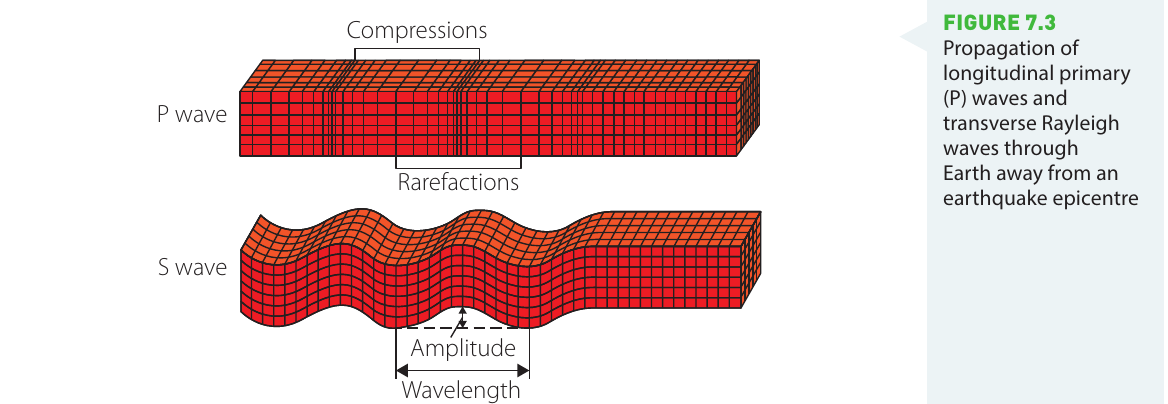
Surface waves: The most destructive seismic waves travel along Earth's surface rather than through its interior. Two main types exist:
- Love waves: These cause horizontal shaking
- Rayleigh waves: These result from a combination of many transverse waves and cause both vertical and horizontal motion. Buildings move up and down and tilt as Rayleigh waves pass, causing extensive damage
The energy in Rayleigh waves disperses (spreads out) quickly as the waves move away from the epicentre (the point on the surface directly above the underground focus).
Case study: The 2004 Indian Ocean tsunami
Example
Energy Transfer in the 2004 Tsunami
The 2004 Indian Ocean earthquake off the coast of Sumatra, Indonesia, released an enormous amount of energy—equivalent to hundreds of millions of tonnes of explosives. Because the earthquake's focus was offshore, relatively little damage occurred on land from the ground shaking itself.
However, the movement of massive sections of the ocean floor generated another mechanical wave through the ocean—a tsunami. This tsunami travelled at speeds exceeding , carrying energy from the earthquake to coastlines thousands of kilometres away.
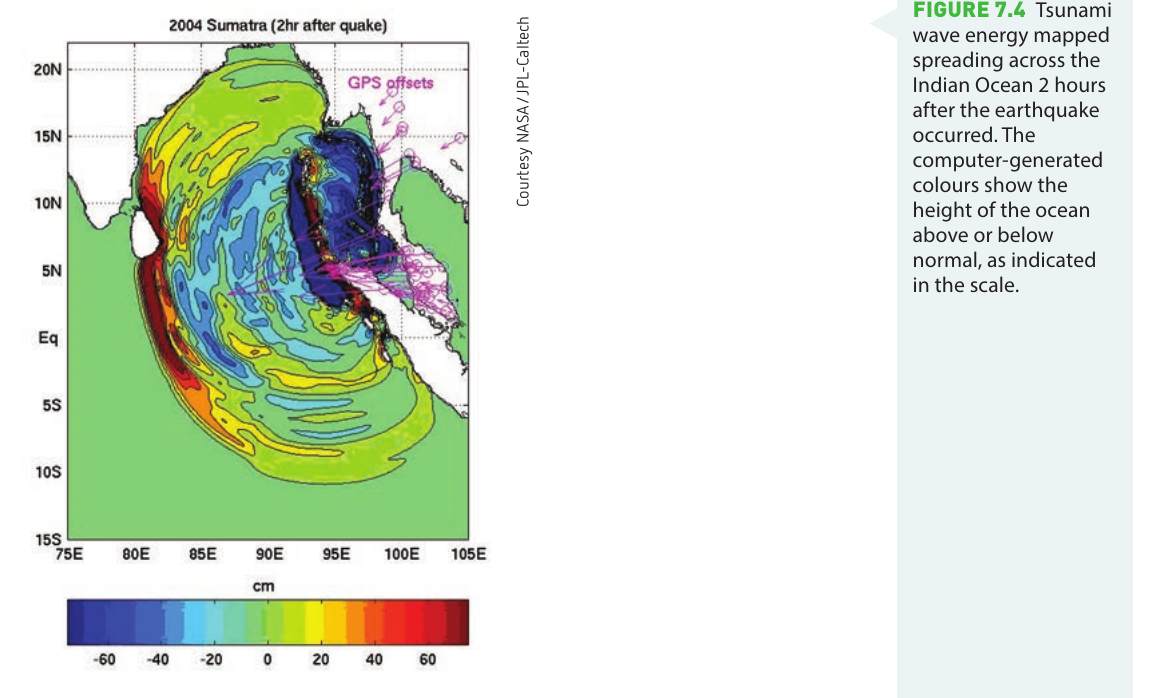
The figure above shows a computer-generated map of the tsunami's propagation across the Indian Ocean two hours after the earthquake. The colours indicate the height of the ocean surface above or below normal levels. As the wave spread outward, its energy distributed over a wider area, reducing its intensity. Despite this energy spreading, the wave still caused catastrophic damage and loss of life in many countries. In some locations, waves over 20 metres high surged inland for 3 kilometres.
This tragic event demonstrates how mechanical waves can transfer energy across vast distances through a medium.
Investigation 7.2: Investigating energy transfer
Aim
To observe how energy can be transferred by a mechanical wave.
Materials
- Slinky springs
- Ribbons
- Chalk or non-permanent marker
- Shallow water tray
- Corks
- Optional: laptop with video editing software, tablet, or phone
Risk assessment
| What are the risks? | How can you manage them? |
|---|---|
| The spring may flick back and hit your eye | Wear safety glasses when working with springs |
Consider what other risks might be associated with your investigation and how you can manage them.
Method
- Place the stretched slinky spring on a floor with a smooth surface.
- Tie two ribbons around coils of the spring, each about 0.5 m from either end.
- With one person at each end of the spring, have one person move the spring quickly back and forth, and then from side to side.
- Observe the motion within the spring and the movement of the ribbons in each case.
- Using chalk or a non-permanent marker, measure out marks on the floor 1 cm apart, starting at each ribbon's position when the spring is at rest. These marks should continue on both sides of the ribbons, both along the spring's direction and perpendicular to it.
- Repeat steps 3 and 4, this time carefully recording the distances each ribbon moves.
- Half-fill a shallow tray with water.
- Place a cork in the water at one end of the tray. At the other end, dip your finger in and out of the water repeatedly.
- Observe how the energy of the wave causes the cork to move.
Results
Draw diagrams showing the motion of the ribbons in the spring. Record your observations of the cork's movement in the water. You may wish to record the motion using a laptop with video editing software, a tablet, or a phone.
Discussion
- Using diagrams, describe how energy in the two mediums travels from one place to another to cause motion without the medium itself travelling with the wave.
- Compare the motion of the two ribbons in the spring. Which ribbon moves further from its resting position? Suggest reasons why this might be happening.
Conclusion
With reference to the data obtained and its analysis, write a conclusion based on the aim of this investigation.
Remember!
Summary
Key Points to Remember:
-
Mechanical waves transfer energy through a medium without transporting the medium itself. Particles vibrate but return to their original positions after the wave passes.
-
Two types of mechanical waves exist: transverse waves (particle motion perpendicular to wave direction) and longitudinal waves (particle motion parallel to wave direction).
-
The medium's properties determine wave speed. Sound travels much faster through solids like steel () than through air () because particles in solids can exert forces on each other more effectively.
-
Seismic waves demonstrate energy transfer. P waves are longitudinal and travel fastest; S waves are transverse and travel more slowly. Surface waves like Rayleigh waves cause the most destruction.
-
Real-world applications matter. Understanding mechanical waves helps explain phenomena like earthquakes, tsunamis, and sound transmission, which have important practical and safety implications.