Plant Vascular Tissues (VCE SSCE Biology): Revision Notes
📚Revision Notes
Plant Vascular Tissues
Vascular plants have evolved specialised transport systems to move water, nutrients, and other essential materials throughout their structure. Understanding how these systems work helps explain how plants can grow to enormous heights and survive in diverse environments.
Introduction to vascular tissues in plants
Why plants need vascular tissues
Water is essential for all plants. It serves multiple critical functions including:
- Enabling metabolic reactions such as photosynthesis
- Transporting nutrients and removing waste products throughout the plant
- Cooling plants through evaporation to prevent overheating
- Maintaining proper cell tonicity (water balance)
- Preventing wilting and damage from dehydration
Note
Simple plants like mosses and liverworts have a high surface area to volume ratio, allowing substances to diffuse across small distances without specialised transport systems.
However, larger and more complex plants such as trees and shrubs can grow over 100 metres tall. These plants require nutrients and water to reach every cell efficiently, which passive diffusion alone cannot achieve.
Important
To solve this challenge, vascular plants have evolved specialised cells, tissues, organs, and systems that actively transport materials around, into, and out of the plant body.
The two types of vascular tissue
Vascular plants contain two main types of vascular tissue that work together to transport materials:
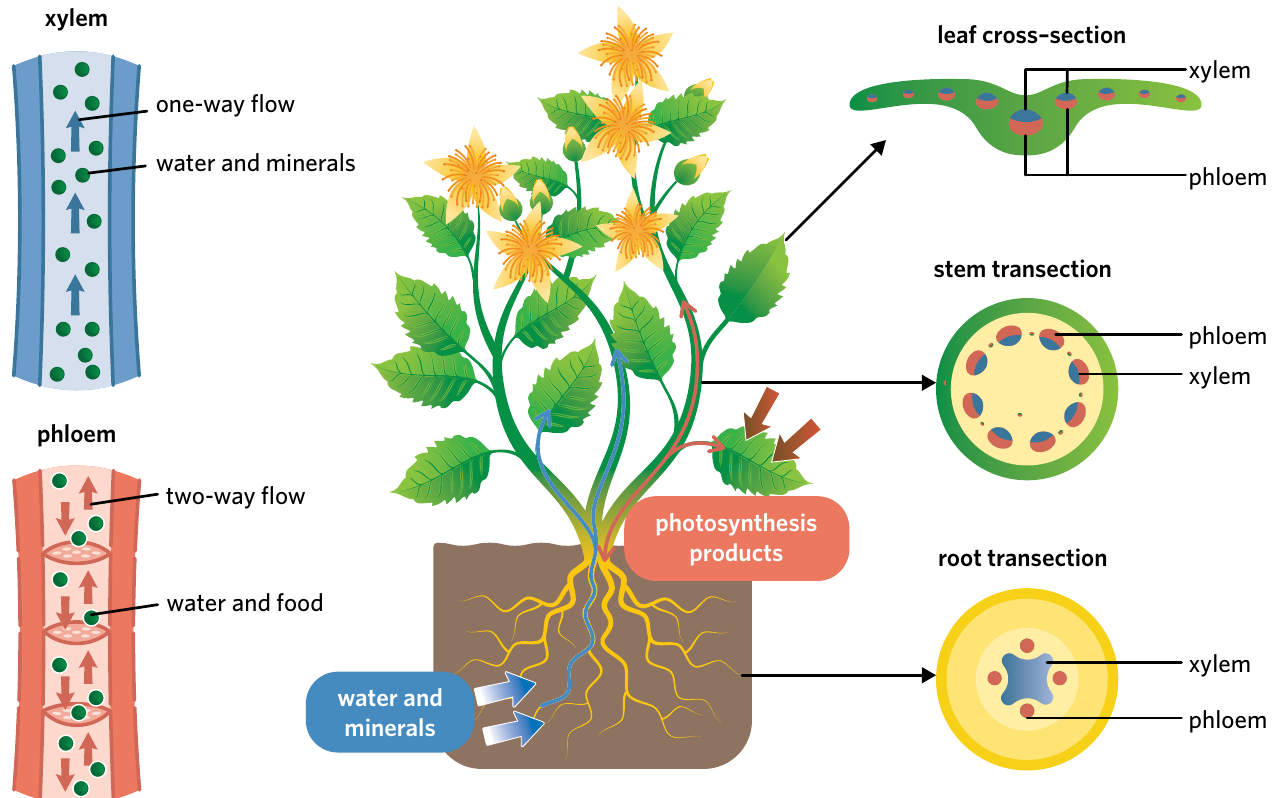
Xylem tissue consists of hollow tubes that transport water and dissolved minerals (such as potassium, nitrogen, and phosphorus) in one direction only—from the roots upward to the leaves.
Phloem tissue comprises tubes that transport sugars and other nutrients throughout the plant in both directions, delivering these products to wherever they are needed.
Important
These two tissue types are bundled together in structures called vascular bundles. The arrangement of vascular bundles varies between plant species and differs in roots, stems, and leaves.
Note
In flowering plants called dicots (which include eucalypts, fruit trees, and roses), vascular bundles are located in the centre of roots and just beneath the bark in stems and trunks. In leaves, vascular bundles branch out extensively, forming the visible veins you can see on leaf surfaces.
Mechanisms of water and nutrient movement in plants
Intake of water and nutrients by roots
The root system performs two major functions: providing stability and support to anchor the plant in the ground, and absorbing water and minerals from the soil that are essential for plant survival.
The structure of roots is specifically adapted to maximise absorption. Rather than forming one large, simple structure, roots branch extensively to increase the total surface area available for absorption. Additionally, specialised root hair cells possess finger-like projections that extend outward into the soil, further increasing the surface area for water and nutrient uptake.
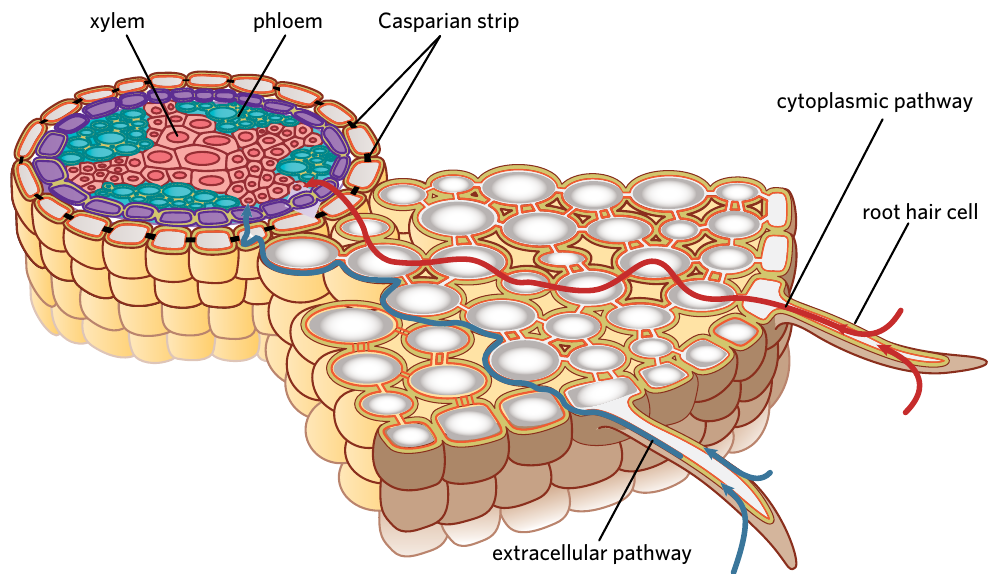
Water and nutrients enter the root through two distinct pathways:
Extracellular pathway (apoplastic route): Water and the solutes dissolved within it diffuse into the roots through the gaps between cells. When this water reaches the Casparian strip—a hydrophobic (water-repelling) barrier—the water and solutes are forced to enter the cytoplasm of cells. This allows the plasma membrane to selectively control which specific substances can enter the xylem tissue.
Cytoplasmic pathway (symplastic route): Mineral ions and a small amount of water either passively diffuse directly into the cytoplasm or are actively transported into root hair cells. Active transport requires energy but allows the plant to accumulate ions against their concentration gradient. This process can concentrate ions within root hair cells to levels 100 times greater than the surrounding groundwater and soil.
Important
The Casparian strip acts as a critical checkpoint, forcing all water and solutes to pass through cell membranes. This ensures the plant can selectively control exactly which substances enter the xylem tissue.
Structure of the xylem and phloem
Understanding how xylem and phloem transport materials requires knowledge of their cellular structure. Both tissues consist of long, tube-like cells, but they differ significantly in their composition and characteristics.
| Xylem structure | Phloem structure |
|---|---|
| Composed of two cell types: vessel elements and tracheids | Composed of two cell types: sieve cells and companion cells |
| Cells are hollow—as they mature, the nucleus and cytoplasm disintegrate, leaving empty dead cells | Sieve cells are hollow—the nucleus and cytoplasm disintegrate, but the cells remain living |
| Cell walls are lignified—strengthened with woody lignin deposits that provide structural support to the entire plant | Cell walls are not lignified |
| Vessel elements are large cells that stack end-to-end with no end walls, forming continuous tubes for vertical water flow | Sieve cells stack end-to-end, separated by sieve plates (perforated plates) that allow vertical water flow |
| Tracheids are smaller cells with tapered, overlapping ends. Water must travel horizontally through pits between tracheids before continuing vertically | Horizontal pits between adjacent sieve cells allow sideways water movement |
| Only transports water and minerals upward | Adjacent companion cells regulate nutrient entry into the phloem and keep sieve cells alive |
Note
Key Structural Differences:
The xylem consists of dead, lignified cells that form rigid tubes for one-way water transport upward. In contrast, the phloem contains living cells that require companion cells for support and can transport nutrients in both directions throughout the plant.
Movement in the xylem
Transpiration
Important
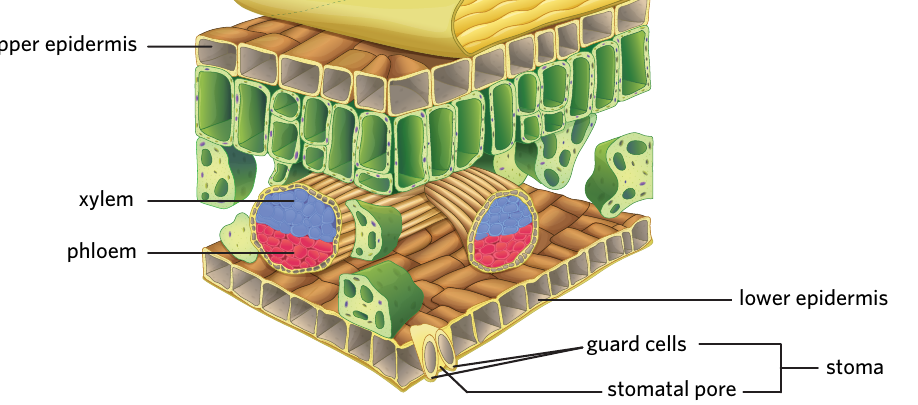
Although water moves up through the xylem to the leaves, only about 1% of this water is actually used during photosynthesis. The vast majority of water entering the leaves evaporates and exits through small pores called stomata during gas exchange.
This gas exchange is essential for photosynthesis—oxygen is released as a waste product while carbon dioxide is absorbed as a raw material.
The movement of water up the xylem and its subsequent evaporation through stomata is called transpiration. This process serves multiple important functions beyond supporting photosynthesis: it helps regulate temperature and water balance, distributes nutrients throughout the plant, and prevents wilting and cellular damage.
How transpiration works
When water evaporates from leaf cells and exits through stomata, the air pressure inside the leaf becomes lower than the pressure in the roots. This pressure difference creates a pulling force that draws water upward from the xylem.
The cohesive properties of water molecules enhance this effect. Cohesion refers to the tendency of water molecules to stick together. Because of cohesion, when some water molecules are pulled upward, they drag additional water molecules along with them.
Example
Worked Example: Understanding the Transpiration Pull
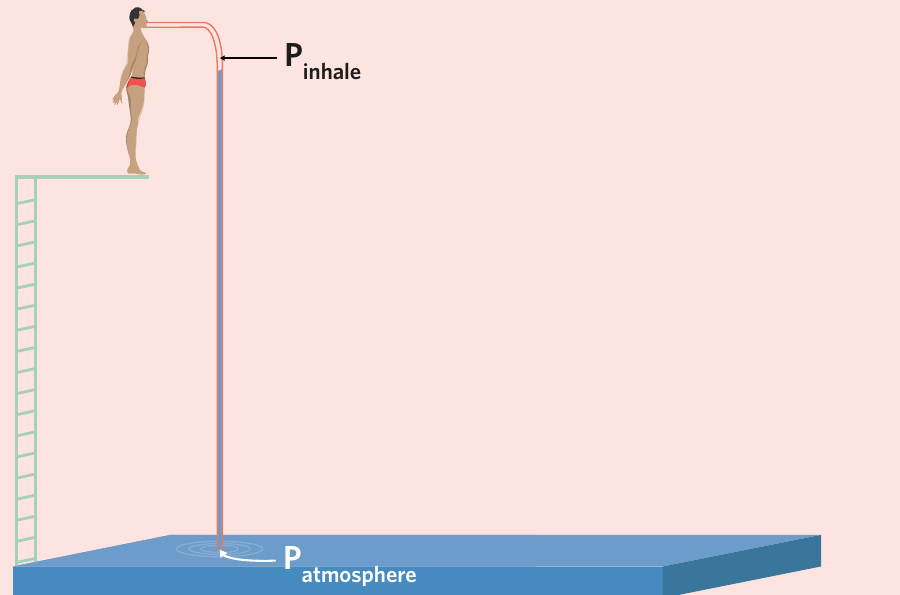
Think of drinking through a straw: When you suck on a straw, you create lower pressure in your mouth compared to atmospheric pressure. This pressure difference causes liquid to move up the straw against gravity.
Similarly, transpiration creates lower pressure at the top of the plant (in the leaves) compared to the bottom (in the roots), pulling water upward through the xylem.
Another force called capillary action also contributes to water movement in the xylem. Capillary action results from adhesion—the attraction of water molecules to the surface of the xylem walls. This is the same force that causes a meniscus (curved surface) to form when water climbs up the side of a narrow test tube.
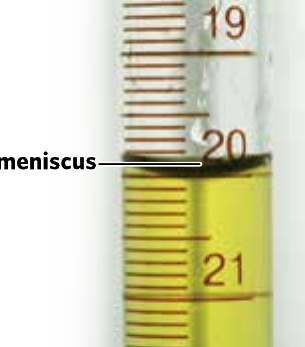
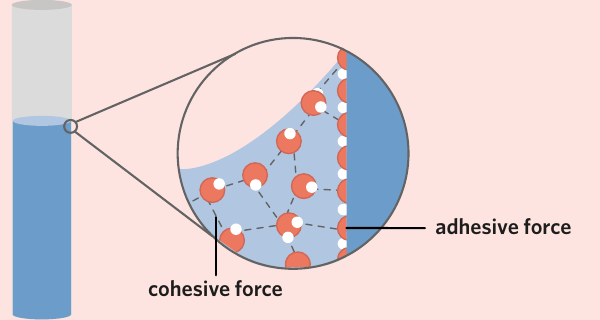
In sufficiently narrow tubes, adhesive forces become strong enough to effectively pull water up the tube. The average radius of a xylem vessel is approximately 20 micrometres (0.00002 metres)—thinner than a human hair. At this diameter, capillary action is very effective.
Note
How Water Reaches Great Heights:
These two forces—transpiration-driven pressure differences and capillary action—work together to enable water and dissolved minerals to travel from the roots to the leaves, even in extremely tall trees.

Current estimates suggest the theoretical maximum height for trees is between 122 and 130 metres. The tallest known tree species, the Californian redwood (Sequoia sempervirens), reaches 115.55 metres—close to this theoretical limit.
Movement in the phloem
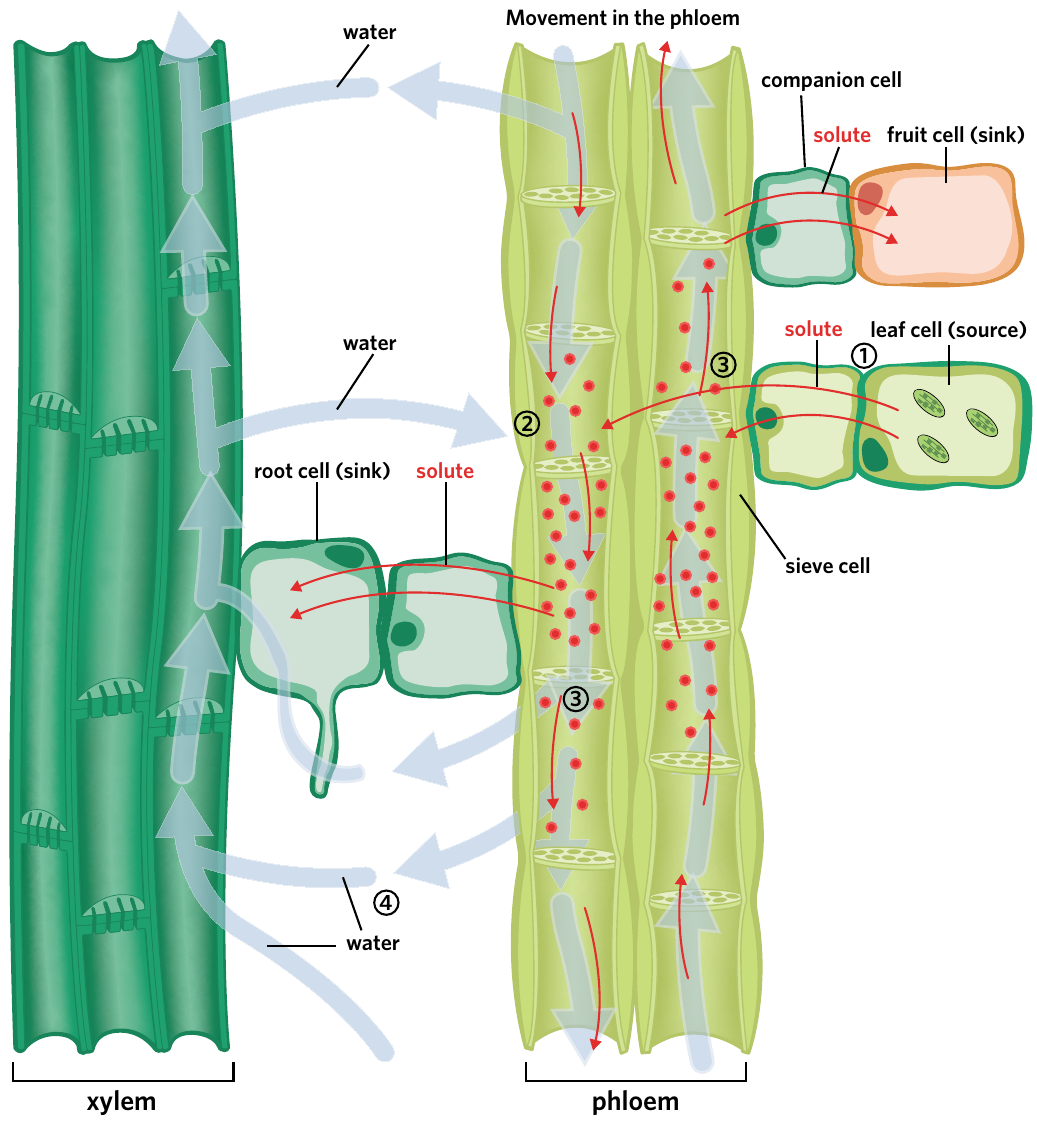
Translocation is the movement of nutrients produced in the leaves to other areas of the plant. This process occurs in the phloem tissue and follows a source-to-sink pattern.
A source is any tissue where substances are produced or enter the plant (such as photosynthesising leaves). A sink is any tissue where substances are stored or used (such as roots, fruits, or developing flowers).
Example
Worked Example: The Translocation Process
Translocation of glucose in the phloem occurs through four main steps:
Step 1: Loading at the source Glucose is produced in leaf cells (the source) through photosynthesis. It is then actively transported into companion cells, from where it diffuses into the sieve cells of the phloem.
Step 2: Pressure build-up The increased concentration of glucose in the sieve cells causes water to diffuse in from the nearby xylem via osmosis. This increases the turgor pressure (internal water pressure) within the sieve cells.
Step 3: Mass flow and unloading The increase in turgor pressure pushes the liquid in the phloem throughout the plant. When the phloem reaches areas requiring glucose, the glucose is actively transported into the required cells (the sinks). These sink cells might include root cells, fruit cells, or other growing tissues.
Step 4: Pressure reduction Once glucose is unloaded into sink cells, the concentration of solutes in the phloem decreases. This causes water to diffuse back out of the phloem and into the xylem.
Note
Other solutes, such as amino acids and essential minerals, travel through the phloem using a similar mechanism.
Regulating transpiration
Factors affecting transpiration rate
While transpiration is essential for all vascular plants, it represents a significant avenue of water loss. Excessive water loss leads to high solute concentrations, reduced turgidity (water pressure in cells), and can cause plant damage or wilting.
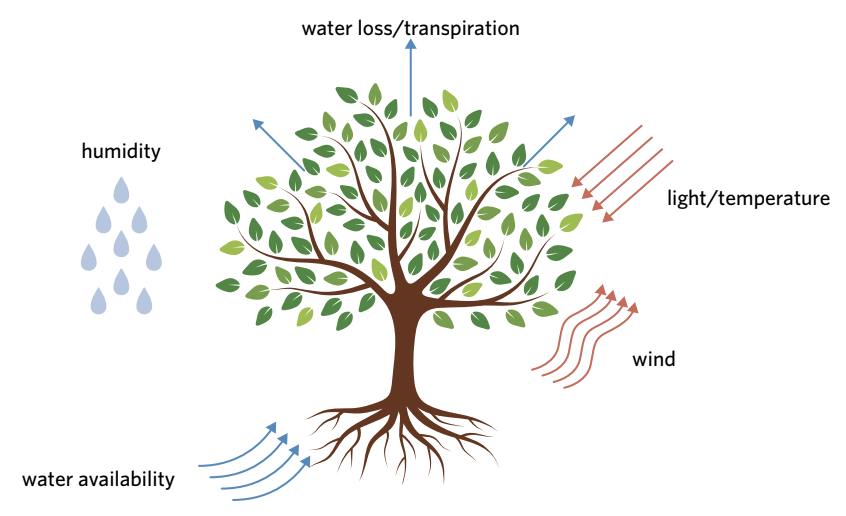
The rate of water loss through transpiration depends heavily on environmental conditions:
Note
Temperature: At higher temperatures, more water evaporates from leaf surfaces, increasing transpiration rate.
Note
Light intensity: In bright light conditions, stomata open wider to increase carbon dioxide absorption for photosynthesis. This simultaneously increases the amount of water lost through transpiration.
Note
Humidity: At any given temperature, air can hold a maximum amount of water vapour (the saturation point). As humidity increases, less water can evaporate into the surrounding air. At 100% relative humidity, water cannot evaporate at all and transpiration stops. Low humidity increases transpiration because water moves from areas of high water concentration (inside the leaf) to areas of low water concentration (the dry air outside).
Note
Wind: On calm days, water released from stomata remains near the leaf surface, creating a humid layer of air. On windy days, this humid layer is blown away, maintaining a steep concentration gradient that encourages more water vapour to exit the leaf.
Note
Water availability: When water availability in the soil is high, roots absorb more water. The plant can then tolerate a higher rate of transpiration and greater water loss.
Guard cells regulate transpiration
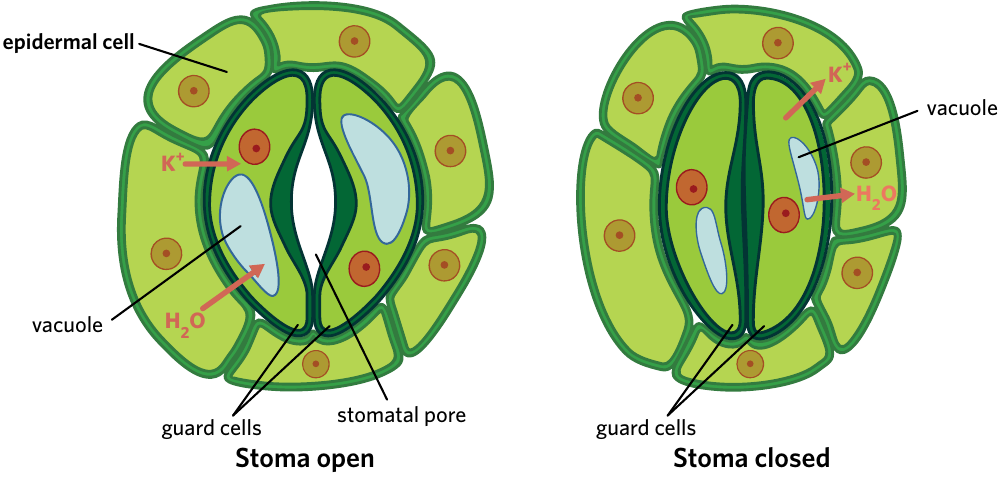
Two specialised guard cells surround each stomatal opening (the stomatal pore). These guard cells regulate whether stomata are open or closed, thereby controlling gas exchange and water loss.
When stomata are open:
- Water vapour freely exits the leaf as part of transpiration
- Carbon dioxide freely enters the leaf for use in photosynthesis
- Oxygen exits the leaf after being produced during photosynthesis
When stomata are closed:
- Gases cannot freely enter or exit the leaf
- The rate of photosynthesis, transpiration, and water loss all decrease
Example
Worked Example: Opening Stomata to Increase Transpiration
Step 1: Ion pumping Guard cells actively pump potassium ions () into their cytoplasm, greatly increasing the concentration of solutes inside the cells.
Step 2: Water uptake Water diffuses into the guard cells via osmosis in response to the increased solute concentration.
Step 3: Cell swelling The vacuoles inside guard cells swell with water, making the cells turgid (swollen with water pressure).
Step 4: Pore opening Turgid guard cells curve into a bean-like shape, which opens the stomatal pore between them.
Example
Worked Example: Closing Stomata to Reduce Transpiration
Step 1: Ion export Guard cells actively pump potassium ions out of their cytoplasm.
Step 2: Water loss Water diffuses out of the vacuoles and guard cells.
Step 3: Cell deflation Each guard cell becomes flaccid (lacking water pressure).
Step 4: Pore closing Flaccid guard cells straighten and press together, closing the stomatal pore.
Important
This mechanism allows plants to respond dynamically to changing environmental conditions, opening stomata when water is plentiful and closing them during hot, dry conditions to conserve water.
Remember!
Summary
Key Points to Remember:
- Vascular plants contain specialised transport tissues—xylem and phloem—that move water, minerals, and nutrients throughout the plant
- Xylem tissue transports water and minerals upward from roots to leaves through hollow, lignified vessel elements and tracheids
- Phloem tissue transports sugars and nutrients in both directions through living sieve cells and companion cells
- Water enters roots via two pathways: the extracellular pathway (mainly water) and the cytoplasmic pathway (mainly minerals and nutrients)
- Transpiration moves water up the xylem through a combination of pressure differences, cohesion between water molecules, and capillary action caused by adhesion to xylem walls
- Translocation moves nutrients through the phloem from sources (where they are made) to sinks (where they are needed) via pressure-driven mass flow
- Environmental factors affecting transpiration include temperature, light, humidity, wind, and water availability
- Guard cells regulate water loss by opening and closing stomata in response to water availability—opening when turgid and closing when flaccid