The Excretory System (VCE SSCE Biology): Revision Notes
📚Revision Notes
The Excretory System
Introduction
The excretory system is essential for removing waste materials from the body and maintaining a stable internal environment. As cells carry out their normal metabolic processes, they produce various waste products that must be eliminated. These include carbon dioxide from cellular respiration, toxins, and nitrogenous waste from protein breakdown. The excretory system removes these substances whilst carefully regulating water and ion concentrations in the blood and tissues.
Note
The excretory system must perform a delicate balancing act - removing harmful waste products whilst preserving essential water and ions needed for cellular function. This balance is crucial for survival.
Purpose of the excretory system
Excretory system: the collection of organs and tissues that remove excess, waste materials from the body.
Excrete: to separate and eliminate waste from the body.
During cellular activities, waste materials accumulate in cells. The main types of waste include:
- Carbon dioxide - produced during cellular respiration
- Toxins - harmful substances that need to be removed
- Nitrogenous waste - produced from the breakdown of proteins
The body must remove these waste products without disrupting the delicate balance of water and ions in the blood and tissues. The excretory system performs this vital function through several organs working together.
Components of the excretory system
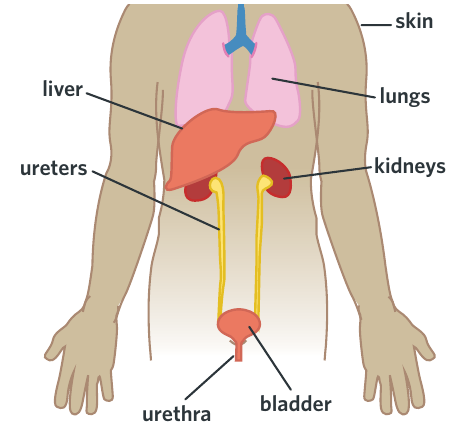
The excretory system comprises several organs and tissues:
- Lungs - remove carbon dioxide
- Liver - breaks down toxins
- Kidneys - filter blood and produce urine
- Skin - excretes some waste through sweat
- Bladder - stores urine
- Ureters and urethra - transport urine
Important
If the excretory system stopped working, waste products would build up rapidly in the body. The accumulation of toxins and nitrogenous waste would poison cells, interfere with metabolic reactions, and eventually be fatal.
The kidneys and the urinary tract
Urinary tract: the series of channels in which urine is produced and excreted from the body.
The urinary tract is a major component of the excretory system. It filters waste materials from the blood and excretes them in urine.
Why do we urinate?
Mammals need protein in their diet to obtain amino acids. However, amino acids cannot be stored in the body, so they must be used immediately or converted into other molecules.
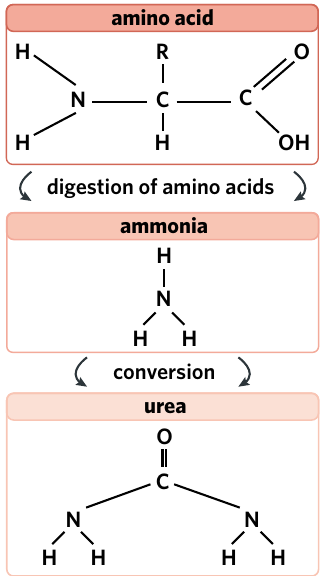
When we consume excess amino acids, they are transported from the small intestine to the liver. Here, an important process called deamination occurs:
Example
Deamination Process: Converting Amino Acids to Urea
Step 1: The amine group () is removed from amino acids
Step 2: This is converted to ammonia ()
Step 3: Ammonia is toxic to cells, so it is further broken down into urea
Result: Urea is less toxic than ammonia and can be safely transported in the bloodstream to the kidneys for excretion.
Liver: a large organ found in the abdomen that is involved in many metabolic processes including the breakdown of toxins.
Urea: the main nitrogenous product of protein breakdown in mammals. Excreted in urine.
Urea is less toxic than ammonia and can be safely transported in the bloodstream. However, it still must be removed from the body. The kidneys filter urea from the blood and mix it with water and other solutes to form urine, which is then excreted.
Components of the urinary tract
The urinary tract consists of four main parts:
- Kidneys - filter blood and produce urine
- Ureters - tubes that carry urine from kidneys to bladder
- Bladder - stores urine until excretion
- Urethra - duct through which urine exits the body
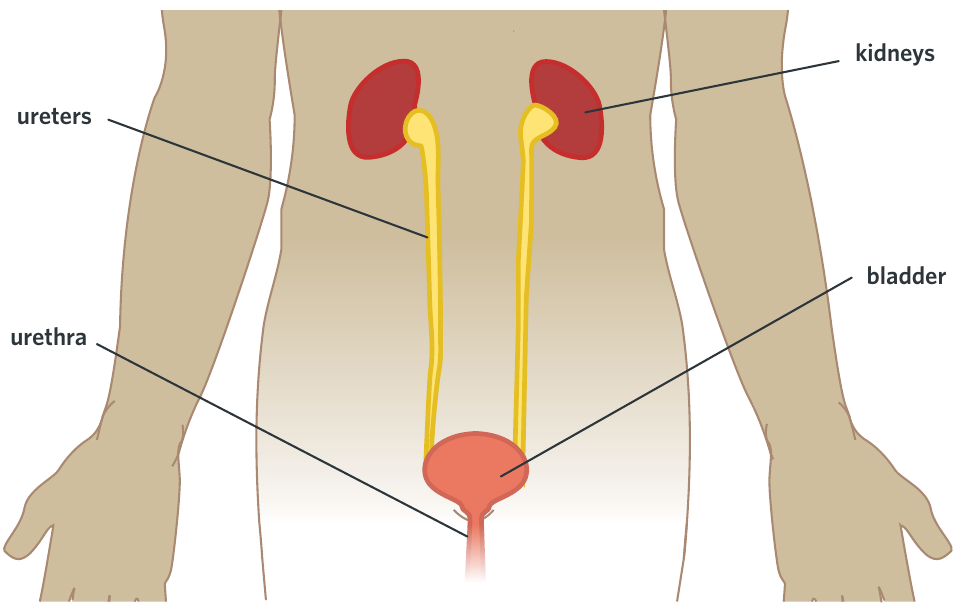
Kidneys: a pair of bean-shaped organs that are responsible for removing waste substances from the blood and the production of urine.
Urine: a fluid formed by the kidneys and stored in the bladder. One of the body's major ways to remove excess water, solutes, and waste substances from the blood.
Ureter: the tube through which urine passes from the kidney to the bladder.
Bladder: the hollow muscular organ that receives urine from the kidney and stores it for excretion.
Urethra: the duct through which urine is excreted from the bladder and out of the body.
Note
Mnemonic for urinary tract flow: "Kids Use Both Urethras"
- Kidneys → Ureters → Bladder → Urethra
This helps you remember the path urine takes from production to excretion!
Kidney structure
The kidneys are two bean-shaped organs located in the upper back on either side of the spine. They have three main functions:
- Filter blood to remove waste
- Reabsorb useful substances from the filtrate
- Secrete unwanted substances into urine
Filter: to pass a substance through a porous material.
Reabsorb: to absorb a substance that has undergone filtration.
Filtrate: the fluid filtered from blood that passes through the nephron.
Secrete: to discharge a substance from a cell or tissue.
Blood is delivered to the kidneys through the renal arteries. The blood supply is large and constant - kidneys can hold up to 25% of a person's total blood volume at any time. The unfiltered blood contains nitrogenous waste such as urea and uric acid, as well as creatinine.
Renal arteries: arteries that deliver blood from the heart to the kidneys.
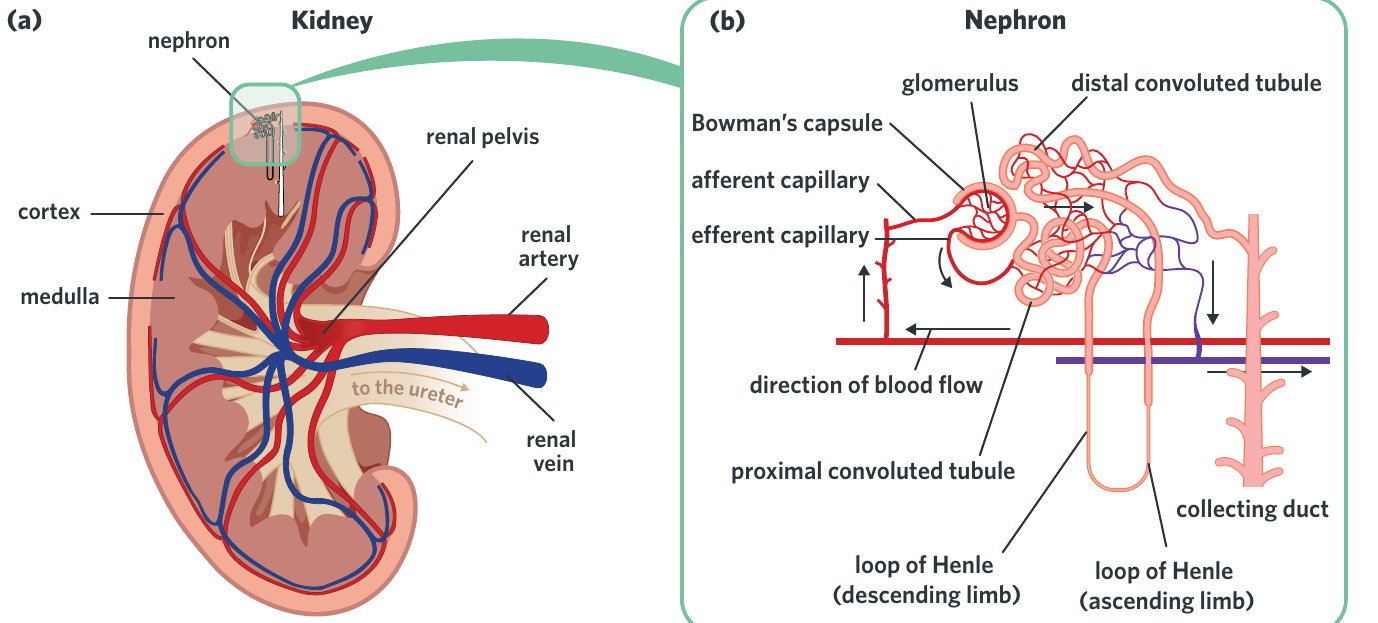
Each kidney has two distinct regions:
- Cortex - the outer region
- Medulla - the inner region
Nephron structure
Nephron: a functional unit of the kidney consisting of a glomerulus and tubule system through which filtrate passes and urine is produced.
Important
A single kidney contains millions of nephrons. They are the functional units where blood filtration and urine production occur. Each nephron acts like a tiny filtering system, processing blood to remove waste while retaining useful substances.
The renal artery branches into tiny capillaries that deliver blood to each nephron:
- Afferent capillary: incoming capillaries that deliver blood to the glomeruli of nephrons
- Efferent capillary: outgoing capillaries that carry blood away from the glomeruli of nephrons
Each nephron has the same basic structure with several distinct parts:
- Glomerulus - a network of capillaries that deliver blood to the Bowman's capsule
- Bowman's capsule - the first section of the nephron which collects filtered blood from the glomerulus
- Proximal convoluted tubule - the portion of the nephron tubule that lies between the Bowman's capsule and the loop of Henle
- Loop of Henle - a u-shaped loop of the nephron that recovers water and salts from filtrate
- Distal convoluted tubule - the portion of the nephron tubule that lies between the loop of Henle and the collecting duct
- Collecting duct - the final section of the nephron tubule that collects urine and delivers it to the bladder for excretion
Note
Mnemonic for nephron structure: "Big Pigs Love Dirty Caves"
- Bowman's capsule → Proximal convoluted tubule → Loop of Henle → Distal convoluted tubule → Collecting duct
The nephron spans both kidney regions. The glomerulus, proximal convoluted tubule, and distal convoluted tubule are located in the cortex. The loop of Henle and collecting duct extend into the medulla.
Nephron function in detail
Each part of the nephron has a specific role in filtration, reabsorption, or secretion. The table below summarises the function of each structure:
Important
Three Key Processes in the Nephron:
- Filtration - separating fluid and small molecules from blood (occurs in Bowman's capsule)
- Reabsorption - taking back useful substances from the filtrate into blood (occurs throughout the tubule)
- Secretion - actively moving waste substances from blood into the filtrate (occurs throughout the tubule)
Remember: FRS → Filtration, Reabsorption, Secretion
| Structure | Function | Details |
|---|---|---|
| Bowman's capsule | Filtration | • High blood pressure in the glomerulus forces fluid through capillary walls into the Bowman's capsule • Only small molecules and water can pass through - blood cells and large proteins remain in the blood • The filtered fluid is called the primary filtrate |
| Proximal convoluted tubule | Reabsorption: ions, amino acids, water, glucose Secretion: ammonia, toxins | • Glucose, specific ions, and amino acids are reabsorbed into capillaries by active transport • About 65% of water is reabsorbed via osmosis as solutes leave the filtrate • Some urea is incidentally reabsorbed by passive transport • Ammonia and some drugs are secreted into the nephron |
| Loop of Henle | Reabsorption: water Secretion: urea | • The ascending limb actively pumps ions out of the tubule • This creates high concentration around the descending limb, so water exits via osmosis and ions diffuse in down their concentration gradient • Water cannot exit the ascending limb as it is impermeable to water • The concentration gradient is maintained, leading to continuous water reabsorption • Some urea is secreted into filtrate |
| Distal convoluted tubule | Optional reabsorption: ions, water Secretion: ions, toxins | • Fine-tunes filtrate composition according to body's needs • May reabsorb more water and ions • May secrete more ions and toxins into filtrate |
| Collecting duct | Optional reabsorption: water Secretion: urea, ions, ammonia, toxins | • Further fine-tunes filtrate composition • May reabsorb more water • Secretes waste like ammonia into the duct |
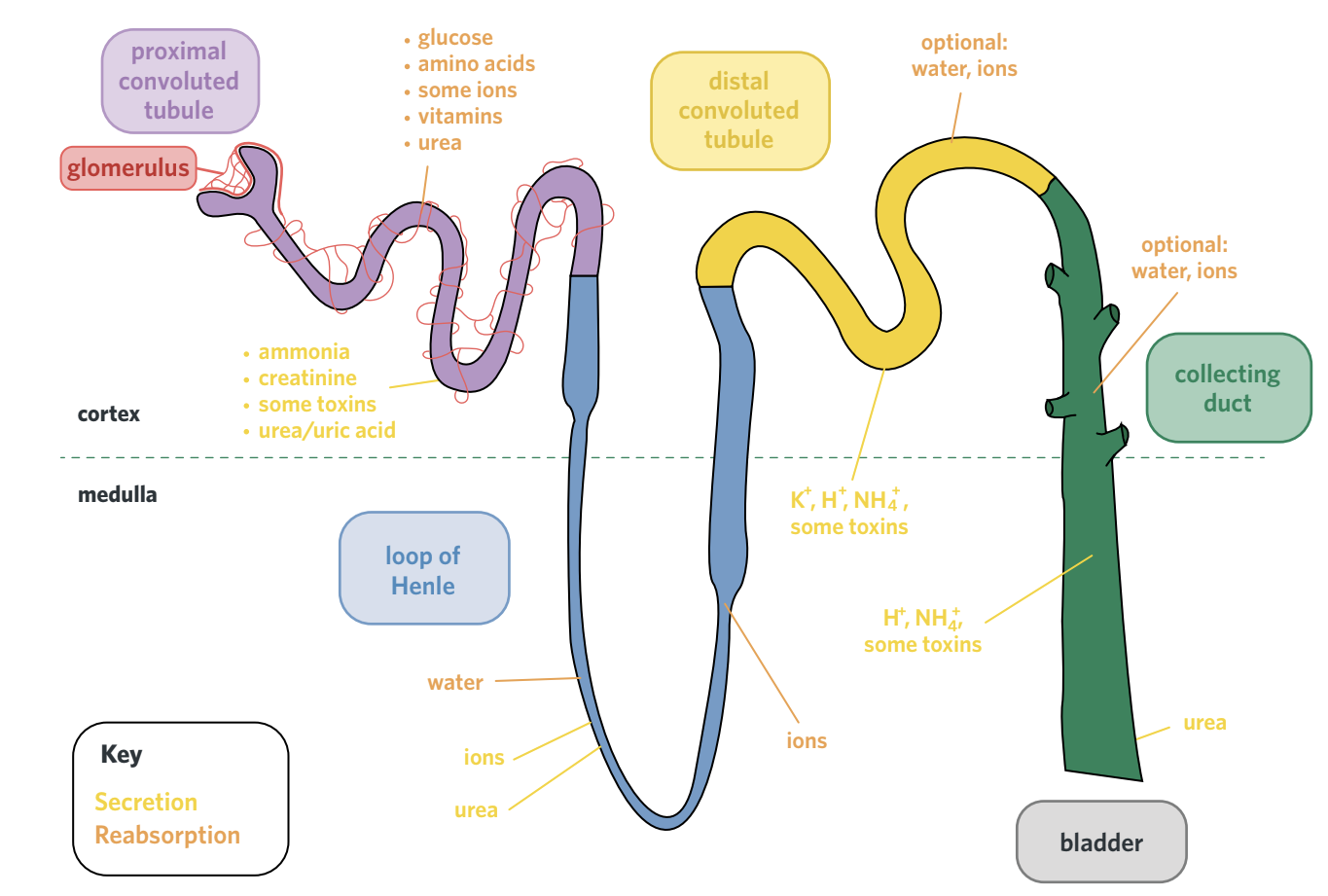
The kidneys play an important role in regulating water balance. When you drink lots of water, the distal convoluted tubule and collecting duct reabsorb less water, producing dilute urine. Conversely, if you lose water through sweat or don't drink enough, these structures reabsorb more water, producing concentrated urine with higher urea levels.
Note
Because they filter blood and control water content in urine, the kidneys also help regulate blood pressure and blood pH. This demonstrates how the excretory system is interconnected with other body systems to maintain homeostasis.
The bladder
After urine is produced in the kidneys, it leaves through a tube called the ureter. The ureters carry urine to the bladder, where it is stored until ready to be emptied. When the bladder empties, urine exits the body through the urethra.
Additional excretory organs of the body
Whilst the urinary tract is the main component of the excretory system, other organs also play excretory roles:
Note
While the kidneys and urinary tract are the primary excretory organs, the body has several other organs that contribute to waste removal. Each organ handles specific types of waste, creating a comprehensive excretory system.
Lungs
Lungs: a pair of organs situated within the rib cage responsible for the process of oxygenation and excretion of carbon dioxide in humans.
During cellular respiration, cells produce carbon dioxide as a waste product. This carbon dioxide is released from cells into the bloodstream. It travels to the lungs, where it crosses respiratory membranes and is exhaled into the environment.
Skin
Skin: the thin layer of tissue covering the outer region of the body of vertebrates.
A small amount of nitrogenous waste and ions are removed from the body through sweating. However, it's important to remember that sweating is primarily a method of temperature control, not waste removal.
Liver
The liver breaks down toxins and other waste materials in the blood. These breakdown products are then carried to the kidneys via the urinary tract and excreted in urine.
Digestive tract
Digestive tract: the pathway of organs that food and liquids travel through after being swallowed, leading to digestion and elimination. Also known as the gastrointestinal tract or alimentary canal.
Sometimes waste material is released into the digestive tract and eliminated in faeces. This means the digestive tract can also play a role in excretion.
Understanding urine colour and hydration
The colour of your urine provides useful information about your hydration status. Urine is often darker yellow in the mornings or after exercise. This occurs because the kidneys work to conserve water during these times.
When you sleep, you don't drink for approximately 8 hours. When you exercise, you lose water through sweat. In both cases, the kidneys conserve water by reabsorbing more in the distal convoluted tubule and collecting duct. This produces more concentrated urine with less water and more waste products, resulting in a darker yellow colour and stronger smell.
Note
The distinctive smell of urine is not from urea itself - urea is odourless. The smell comes from ammonia (a harsh, chemical smell) and trimethylamine (a fishy smell), which are breakdown products of urea. Diet also affects urine smell.
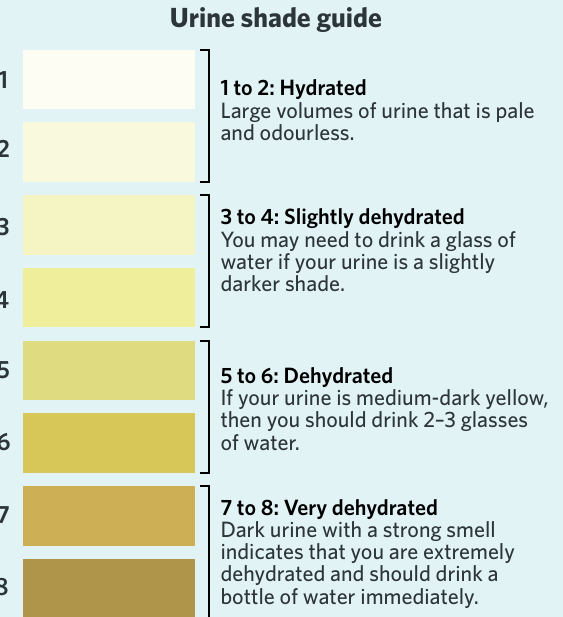
Hydration guide:
- Levels 1-2 (Hydrated): Large volumes of pale, odourless urine
- Levels 3-4 (Slightly dehydrated): May need to drink a glass of water
- Levels 5-6 (Dehydrated): Medium-dark yellow urine - drink 2-3 glasses of water
- Levels 7-8 (Very dehydrated): Dark urine with strong smell - drink water immediately
Summary
Key Points to Remember:
-
The excretory system removes waste materials from the body whilst maintaining stable water and ion concentrations.
-
The kidneys and urinary tract are the main excretory organs, filtering blood and producing urine.
-
Nephrons are the functional units of the kidneys, performing filtration (Bowman's capsule), reabsorption (throughout tubule), and secretion (throughout tubule).
-
Each part of the nephron has a specific role: Bowman's capsule filters blood, the proximal convoluted tubule reabsorbs useful substances, the loop of Henle recovers water, and the distal convoluted tubule and collecting duct fine-tune the final composition.
-
Other excretory organs include the lungs (carbon dioxide), skin (nitrogenous waste via sweat), liver (toxin breakdown), and digestive tract (waste in faeces).