Detecting Pathogens (VCE SSCE Biology): Revision Notes
📚Revision Notes
Detecting Pathogens
The immune system protects the body by identifying and destroying pathogens. To do this effectively, it must distinguish between the body's own cells and foreign invaders while recognizing millions of different types of pathogens. The key to this recognition system lies in molecules called antigens.
Understanding Antigens
An antigen is any molecule that may trigger an immune response.
Antigens can take many different forms, including proteins, sugars, and DNA or RNA molecules. They may be attached to cells or pathogens, or exist as free-floating molecules in the body. Antigens are classified into two main categories: self-antigens and non-self antigens.
Note
The ability to recognize antigens is what allows the immune system to distinguish between the body's own cells and foreign substances. This recognition system is so specific that it can detect even subtle differences in molecular structure.
Self-Antigens
Self-antigens mark the body's cells as belonging to that individual, preventing the immune system from attacking them. In humans and other vertebrates, the most important self-antigens are major histocompatibility complex (MHC) markers, which are "a group of proteins present on the surface of all self-cells that enables the immune system to distinguish it from non-self material."
MHC Class I Markers
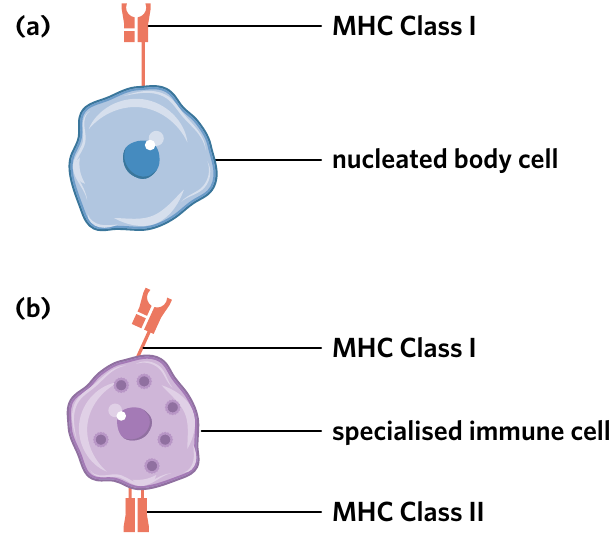
Major histocompatibility complex class I (MHC Class I) markers are "expressed on all nucleated cells in the body. These mark cells as 'self' so that the immune system doesn't attack them."
This means virtually every cell in the human body displays MHC Class I markers, with the exception of cells without a nucleus, such as red blood cells.
MHC Class II Markers
Major histocompatibility complex class II (MHC Class II) markers are "expressed on antigen-presenting cells, which interact with T helper cells in the process of antigen-presentation."
These markers are found only on specialized cells of the immune system that have specific roles in coordinating immune responses.
Important
Understanding the Difference Between MHC Classes:
The key distinction between MHC Class I and Class II markers lies in their distribution and function:
- MHC Class I: Present on ALL nucleated cells - serves as a universal "self" identification tag
- MHC Class II: Present ONLY on specialized immune cells - plays a role in coordinating immune responses
This difference is critical for proper immune system function.
The diagram above shows the difference between a regular nucleated body cell (which has only MHC Class I markers) and a specialized immune cell (which has both MHC Class I and MHC Class II markers).
Non-Self Antigens
A non-self antigen is "a molecule from outside the body that is recognised by the immune system and initiates an immune response."
When the immune system detects non-self antigens within the body, it activates and attempts to eliminate them. For example, when a bacterium enters the body, the immune system recognizes specific bacterial proteins on its surface as foreign and launches an attack against them.
Individual Variation in MHC Markers
MHC markers differ between individuals. This has important implications for organ transplantation. When a person receives a donated organ, the MHC Class I markers on the donor organ will differ from the recipient's own MHC Class I markers. The recipient's immune system may recognize the transplanted organ as non-self and attempt to reject it. To prevent this, organ transplant recipients must take immunosuppressant medications that reduce immune system activity.
Note
Organ Transplantation and MHC Matching
The closer the match between donor and recipient MHC markers, the lower the risk of organ rejection. This is why siblings and close relatives are often preferred as organ donors - they are more likely to have similar MHC markers. However, even with closely matched organs, most recipients still need lifelong immunosuppressant therapy.
Blood Type Antigens
Red blood cells don't have MHC markers but instead display different glycoproteins that serve as self-antigens. These glycoproteins determine blood type:
- Type A individuals display the A antigen on red blood cells
- Type B individuals display the B antigen on red blood cells
- Type AB individuals display both A and B antigens on red blood cells
- Type O individuals display neither A nor B antigens on red blood cells
Example
Practical Application: Blood Transfusion Compatibility
During blood transfusions, blood types must be carefully matched. If a person receives blood with different antigens, their immune system will recognize the foreign antigens as non-self and attack the transfused blood cells.
For instance:
- A person with Type A blood can only receive Type A or Type O blood
- A person with Type O blood can only receive Type O blood
- A person with Type AB blood can receive any blood type (universal recipient)
- Type O blood can be given to anyone (universal donor)
Mismatched transfusions can cause severe illness or death due to the immune system attacking the foreign red blood cells.
Malfunctions Involving Antigens
Autoimmune Diseases
An autoimmune disease is "a disease in which an individual's immune system initiates an immune response against their own cells."
Autoimmune diseases occur when errors in the immune system cause it to recognize self-antigens as non-self. This leads to the immune system attacking the body's own cells, causing significant damage.
Important
Common Autoimmune Diseases:
Autoimmune diseases can affect virtually any part of the body. Examples include:
- Rheumatoid arthritis: The immune system attacks joint tissues
- Lupus: The immune system attacks multiple organ systems
- Type 1 diabetes: The immune system destroys insulin-producing cells in the pancreas
- Multiple sclerosis: The immune system attacks the protective coating of nerve fibers
These conditions demonstrate what happens when the body's self-recognition system malfunctions.
Allergies
Allergies represent another type of malfunction in antigen recognition. An allergen is "a non-pathogenic antigen that triggers an allergic reaction."
An allergic reaction is "an overreaction of the immune system to a non-pathogenic antigen."
Allergens are substances that cannot actually cause harm to the body, yet the immune system treats them as dangerous foreign invaders. Common allergens include pollen, dust, and peanuts.
.png)
Mild allergic reactions may cause symptoms such as:
- Itchy rash
- Runny nose
- Sneezing
- Shortness of breath
- Swelling
Note
Severe allergic reactions, known as anaphylaxis, can be life-threatening and require immediate medical attention. During anaphylaxis, the immune response becomes so intense that it causes:
- Constriction of airways
- Increased permeability of blood vessels
- Difficulty breathing
- Decreased blood pressure
People with severe allergies often carry emergency medication (such as epinephrine) to counteract these dangerous reactions.
Types of Pathogens
A pathogen is "an agent that causes disease."
Pathogens vary enormously in size, structure, and complexity. They can be broadly categorized as cellular or non-cellular.
Cellular Pathogens
A cellular pathogen is "a pathogen that has a cellular structure and exhibits the processes of a living organism."
Cellular pathogens include bacteria, fungi, worms, and protozoa. These organisms are considered living because they have cellular structures and carry out life processes.
Bacteria
Bacteria are unicellular prokaryotic organisms that can infect almost any part of the body. They cause disease through the production of toxins and enzymes that either disrupt cell function or cause cell death.
Reproduction: Bacteria typically reproduce asexually through binary fission, where one cell divides into two identical daughter cells.
Examples of bacterial diseases:
- Neisseria meningitidis causing meningitis
- Clostridium tetani causing tetanus
Fungi
Fungi are eukaryotic organisms that include yeasts and moulds. They contain long, branching filaments called hyphae, which are "branching filaments of a fungus which help absorb nutrients from the environment."
Reproduction: Fungi reproduce through both asexual and sexual reproduction via spore formation. Spores are released into the environment and can develop into new organisms.
Examples of fungal diseases:
- Thrush
- Trichophyton species causing athlete's foot (Tinea pedis)
- Ringworm (Tinea)
Worms
Worms are multicellular invertebrate parasites – organisms that live "in or on another organism, usually deriving nutrition from the host organism."
Worm development includes egg, larval, and adult stages. They vary greatly in length, with the longest worms reaching over 55 meters.
Reproduction: Worms reproduce sexually via a complex life cycle that typically involves multiple developmental stages.
Examples of worm diseases:
- Tapeworm infection leading to malnutrition
- Roundworm (Ascaris) infection
Protozoa
Protozoa are single-celled eukaryotic organisms that can be free-living or parasitic. They have diverse mechanisms for causing disease, including inhibiting nucleic acid synthesis, protein synthesis, and various stages of cellular respiration.
Reproduction: Protozoa reproduce through both asexual and sexual reproduction.
Examples of protozoan diseases:
- Plasmodium species causing malaria
Note
Cellular Pathogen Diversity
The four types of cellular pathogens represent an enormous range of biological complexity:
- Bacteria: Simple prokaryotic cells (no nucleus)
- Fungi: More complex eukaryotic cells with specialized structures
- Worms: Highly complex multicellular organisms with organ systems
- Protozoa: Single-celled eukaryotes with sophisticated internal structures
Despite these differences, all are classified as cellular pathogens because they have cellular organization and carry out life processes independently.
Non-Cellular Pathogens
A non-cellular pathogen is "a pathogen that neither has a cellular structure nor exhibits the processes of a living organism."
Non-cellular pathogens include viruses and prions. These are not considered living organisms because they lack cellular structures and cannot independently carry out life processes.
Viruses
Viruses are infectious agents composed of genetic material (DNA or RNA) enclosed within a protein coat called a capsid. Some viruses also have a lipid envelope surrounding the protein coat.
Viruses cannot reproduce independently. Instead, they insert their genetic material into a host cell and hijack the cell's machinery to replicate themselves.
Viruses cause disease through several mechanisms:
- Lysis ("the disintegration or rupturing of a cell") during viral replication
- Altering gene expression to promote cancer formation
- Over-stimulating the immune system, leading to organ damage
Examples of viral diseases:
- Rhinovirus causing the common cold
- Influenza virus causing the flu
- Ebola virus causing ebola
- SARS-CoV-2 causing COVID-19
Prions
Prions are abnormally folded proteins with the ability to induce nearby normal proteins to become misfolded. They only occur in mammals and affect the brain and other neural structures. Prions are unique as the only known infectious agents that don't contain nucleic acids.
Reproduction: Prions don't reproduce in the traditional sense. Instead, they spread by inducing misfolding in nearby proteins, creating more prions throughout the tissue.
Examples of prion diseases:
- Creutzfeldt-Jakob disease
- Bovine spongiform encephalopathy (mad cow disease)
Important
Why Viruses and Prions Aren't Considered "Alive"
Non-cellular pathogens lack the fundamental characteristics of life:
- No cellular structure: They don't have membranes, organelles, or cellular organization
- No independent metabolism: They cannot produce energy or synthesize molecules on their own
- No independent reproduction: Viruses require host cells; prions simply induce protein misfolding
- No growth or development: They don't increase in size or complexity
This makes them fundamentally different from cellular pathogens, even though both can cause disease.
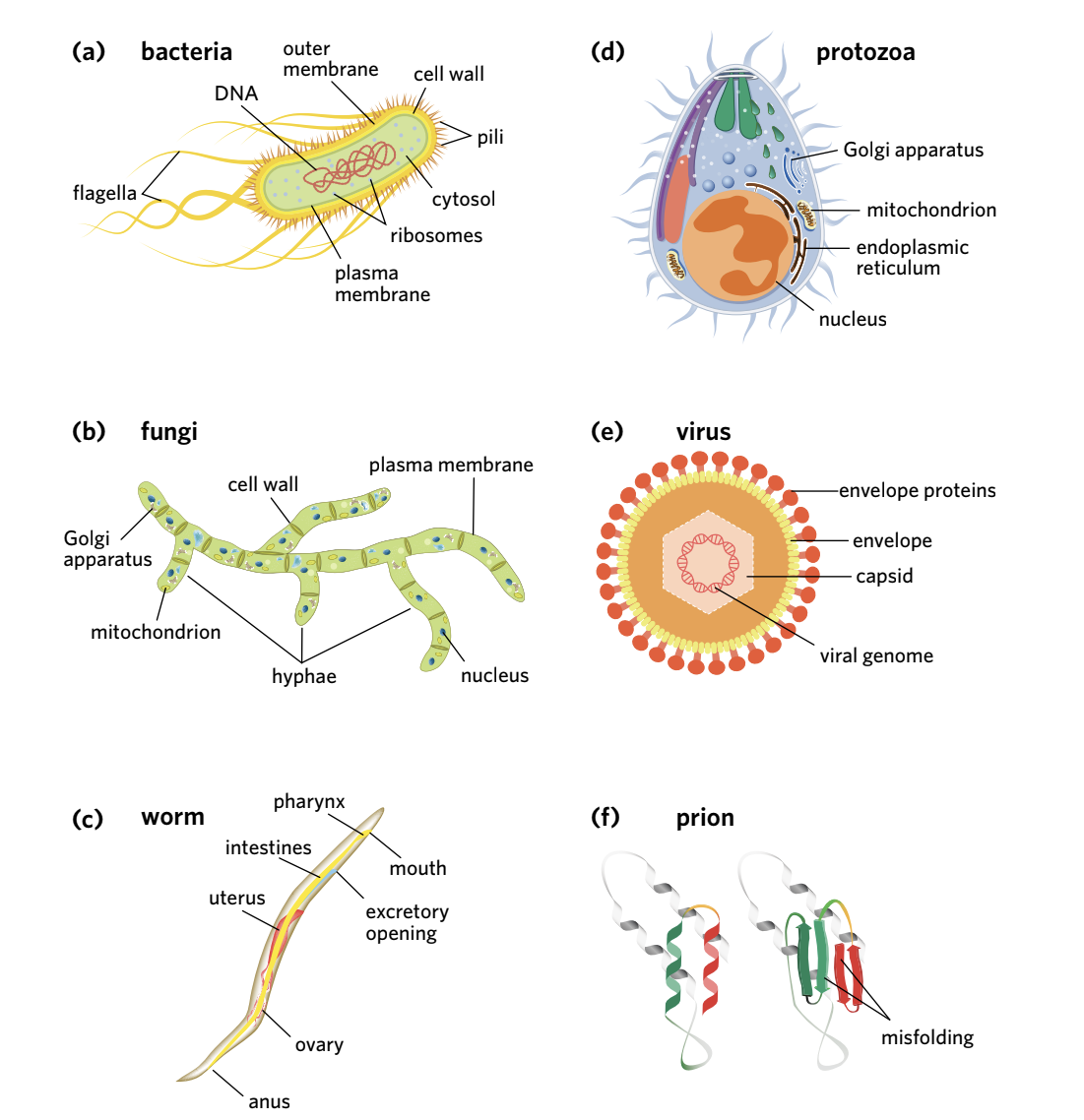
The diagram above shows the structural features of different pathogen types, illustrating the diversity in their organization and complexity.
Pathogen Size Comparison
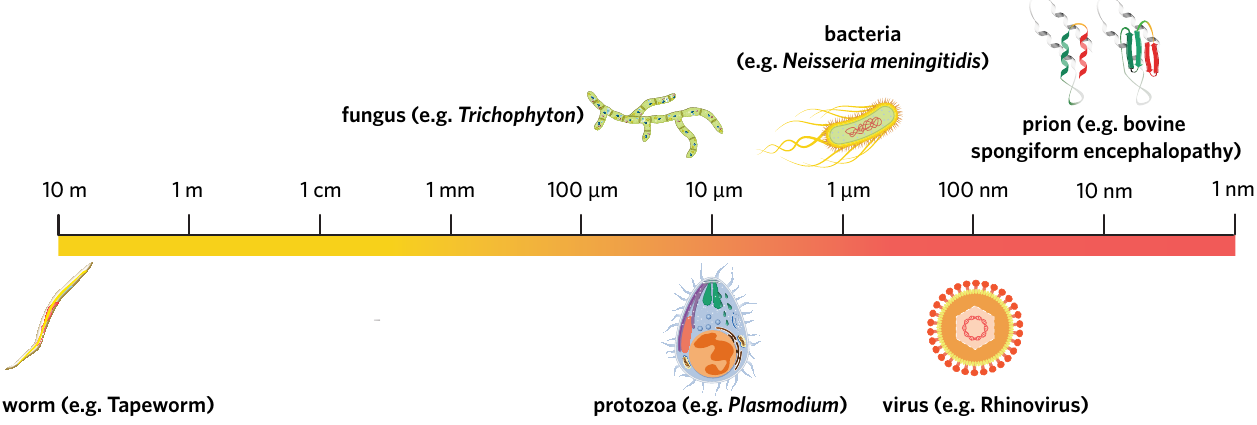
Pathogens vary dramatically in size, spanning several orders of magnitude:
- Worms (e.g., tapeworm): up to 10 meters in length
- Fungi (e.g., Trichophyton hyphae): approximately 100 micrometers
- Protozoa (e.g., Plasmodium): approximately 10 micrometers
- Bacteria (e.g., Neisseria meningitidis): approximately 1 micrometer
- Viruses (e.g., rhinovirus): approximately 100 nanometers
- Prions (causing bovine spongiform encephalopathy): approximately 10 nanometers
Note
To put these size differences in perspective: a tapeworm can be 10 million times longer than a prion! This enormous range reflects the diversity of pathogen types and their different strategies for causing disease.
Extracellular and Intracellular Threats
Pathogens can also be classified by where they pose threats:
- Extracellular threats are found outside cells but can interfere with cell functioning (e.g., many bacteria)
- Intracellular threats are found within cells and interfere with their functioning (e.g., viruses)
Summary of Self vs Non-Self Recognition
The immune system uses antigens to distinguish between self and non-self:
Identifying self:
- All nucleated cells display MHC Class I markers
- Specialized immune cells display both MHC Class I and MHC Class II markers
- Red blood cells display blood type antigens (A, B, or neither)
Identifying non-self:
- Cellular pathogens (bacteria, fungi, worms, protozoa) display foreign antigens
- Non-cellular pathogens (viruses, prions) display foreign antigens
- Allergens are non-pathogenic antigens that trigger excessive immune responses
When non-self antigens are detected, the immune system initiates a response to eliminate the threat.
Summary
Key Points to Remember:
- Antigens are molecules that can trigger immune responses and are the basis for distinguishing self from non-self
- MHC Class I markers appear on all nucleated cells, while MHC Class II markers appear only on specialized immune cells
- Self-antigens identify the body's own cells; non-self antigens identify foreign substances
- Cellular pathogens (bacteria, fungi, worms, protozoa) have cellular structures and are living organisms
- Non-cellular pathogens (viruses, prions) lack cellular structures and are not considered alive
- Autoimmune diseases occur when the immune system mistakenly attacks self-cells by misidentifying self-antigens as foreign
- Allergies are immune overreactions to harmless substances (allergens) that pose no actual threat
- Pathogens range in size from meters (worms) to nanometers (prions) and cause disease through various mechanisms
- The proper functioning of antigen recognition is essential for immune system effectiveness and overall health