The First Line of Defence (VCE SSCE Biology): Revision Notes
📚Revision Notes
The First Line of Defence
Introduction to the innate immune system
The human immune system protects us from pathogens through multiple layers of defence. The first layer is called the innate immune system, which provides immediate, non-specific protection against all types of pathogens.
Innate immune system: a component of the immune system that is composed of generalised and non-specific defences and/or responses to pathogens. Also known as the non-specific immune system.
First line of defence: a component of the innate immune system characterised by the presence of physical, chemical, and microbiological barriers to keep pathogens out of the host organism.
The innate immune system has two main components:
- First line of defence: barriers that prevent pathogens from entering the body
- Second line of defence: responses that activate when pathogens breach the first line barriers
Note
Both mechanisms of the innate immune system share important characteristics that distinguish them from other immune responses:
- They are non-specific, meaning they respond the same way to all pathogens regardless of type
- They act immediately, beginning to limit infection within minutes to hours
- They provide rapid, generalised protection before more targeted immune responses develop
Non-specific: describes a component of the immune system that responds the same way to all pathogens.
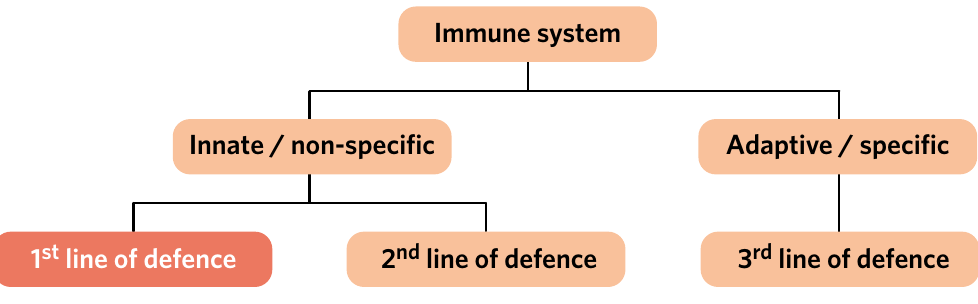
The diagram above shows how the immune system is organized into innate (non-specific) and adaptive (specific) components, with the first line of defence forming the initial barrier to infection.
Barriers in plants
Overview of plant defences
Plants face constant threats from pathogens and herbivores (animals that eat plants) but cannot move away from danger. Unlike animals, plants also lack the advanced forms of immunity that characterize animal immune systems. Therefore, prevention is crucial for plant survival. The first line of defence is particularly important for plants because it represents their primary strategy for avoiding infection.
Important
Since plants are immobile and cannot flee from threats, they rely almost entirely on prevention through physical and chemical barriers. This makes the first line of defence more critical for plants than for animals, which have additional immune mechanisms and the ability to escape danger.
Plants employ two main types of barriers:
- Physical barriers: structural obstacles that prevent or impede pathogen entry
- Chemical barriers: substances that inhibit growth or destroy pathogens
Physical barrier: a component of the first line of defence that features solid or fluid obstacles that block pathogen entry such as skin or mucus.
Chemical barrier: a component of the first line of defence that features the use of enzymes, toxins, and acids to protect against pathogen invasion.
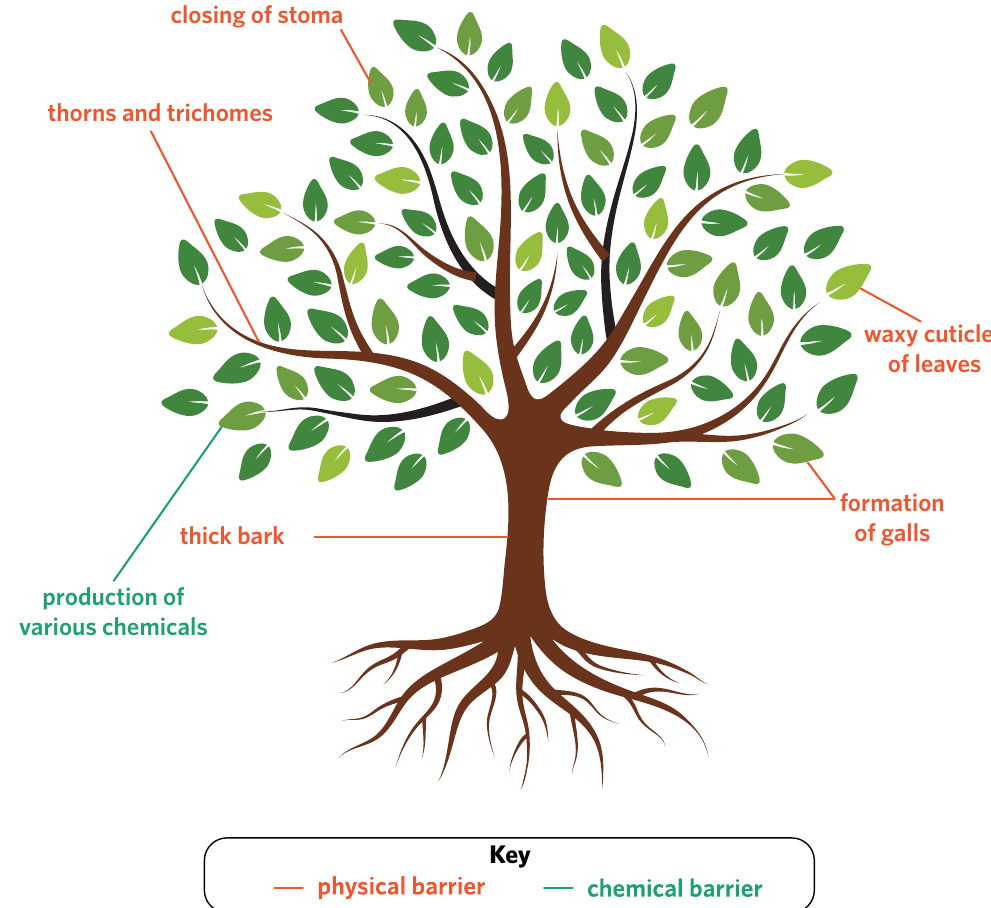
Physical barriers in plants
Physical barriers create structural obstacles that make it difficult for pathogens to enter plant tissues.
Thick bark
- Provides a tough, protective covering for stems and trunks
- Acts as a physical barrier that pathogens must penetrate to reach living tissue
- The thick, dead outer layer is difficult for most pathogens to breach
Waxy cuticles
- Waxy coating covers the surface of leaves and stems
- Creates a water-resistant barrier
- Prevents pathogens from directly contacting the plant's living cells
- Makes it difficult for pathogens to establish infection
Cuticle: a waxy protective film covering the surface of a plant leaf.
Formation of galls
- Galls are abnormal tissue outgrowths produced by plants in response to infection
- The plant isolates the pathogen within the gall structure
- Prevents the pathogen from spreading to healthy tissue
- Sacrifices a small area to protect the rest of the plant
Gall: an abnormal outgrowth of tissue in plants designed to limit the spread of an invading pathogen.
Thorns and trichomes
- Thorns are sharp, pointed structures that deter larger herbivores
- Trichomes are small hairs on plant surfaces
- Both structures make it physically difficult for insects and animals to reach the plant surface
- Trichomes can also trap small pathogens and insects
Trichomes: small hairs on the surface of plants used to deter pathogens and/or insects.
Closing of stomata
- Stomata are small pores on leaf surfaces used for gas exchange
- Plants can close these pores when pathogen invasion is detected
- Prevents pathogens from entering through these natural openings
- This defense must be balanced against the plant's need for carbon dioxide
Stoma (pl. stomata): a small pore on the leaf's surface that opens and closes to regulate gas exchange.
Note
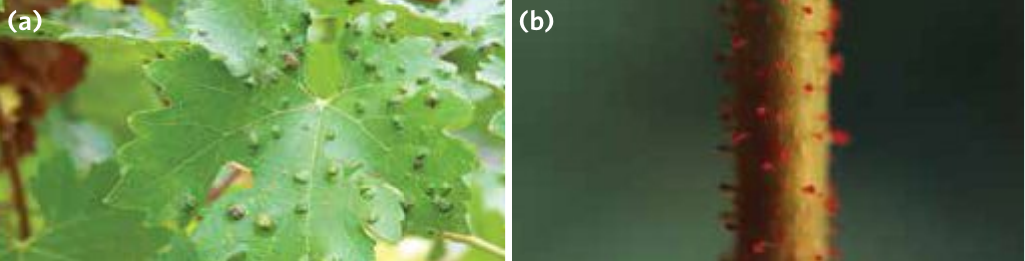
The images above show examples of plant defence structures: (a) galls on a grape leaf appearing as abnormal bumps, and (b) trichomes on a rose stem appearing as fine hairs with reddish coloring. These visible structures demonstrate how plants have evolved physical adaptations to protect themselves from invasion.
Chemical barriers in plants
Chemical barriers involve the production of substances that inhibit pathogen growth, development, or survival. These include both toxic compounds and enzymes that interfere with pathogen function.
Chitinases
- Enzymes that break down chitin
- Chitin is a major component of fungal cell walls
- Found in many different plant species
- Provide antifungal protection by destroying fungal structure
Phenols
- Chemical compounds secreted by wounded plants
- Toxic or repellent to many microorganisms
- Kill or repel invading pathogens at the site of injury
- Also deter some herbivores
Defensins
- Small peptide molecules (short protein chains)
- Toxic to various microbes and fungi
- Disrupt pathogen cell membranes or interfere with cellular processes
- Provide broad-spectrum antimicrobial protection
Saponins
- Complex chemical compounds
- Disrupt the cell membranes of various fungi
- Create holes in pathogen membranes, causing cell death
- Effective against multiple types of fungal pathogens
Oxalic acid
- Acidic compound that can be toxic if ingested
- Protects against herbivores and some pathogens
- Makes plant tissue unpalatable or harmful to animals
Glucanases
- Enzymes that break down glucans
- Glucans are polysaccharides found in fungal cell walls
- Defend plants against fungal infection
- Work by destroying structural components of fungi
Example
How Plant Chemical Defences Work Together:
Consider a plant under fungal attack. The plant responds with multiple chemical defences simultaneously:
- Chitinases attack the chitin in the fungal cell wall, weakening its structure
- Glucanases break down glucans, further compromising the cell wall integrity
- Defensins disrupt the fungal cell membrane, creating leaks
- Saponins create additional holes in the membrane
The combined effect of these chemical barriers is far more effective than any single defence, leading to complete destruction of the invading fungal pathogen.
Barriers in animals
Overview of animal defences
Animals have more diverse first line defences than plants. While plants use only physical and chemical barriers, animals employ three types of barriers:
- Physical barriers: structural obstacles blocking pathogen entry
- Chemical barriers: enzymes, acids, and toxins that inhibit or destroy pathogens
- Microbiological barriers: beneficial bacteria that compete with pathogens
Microbiological barrier: a component of the first line of defence in which the presence of normal flora limits the growth of pathogenic bacteria. Also known as microbiota barrier.
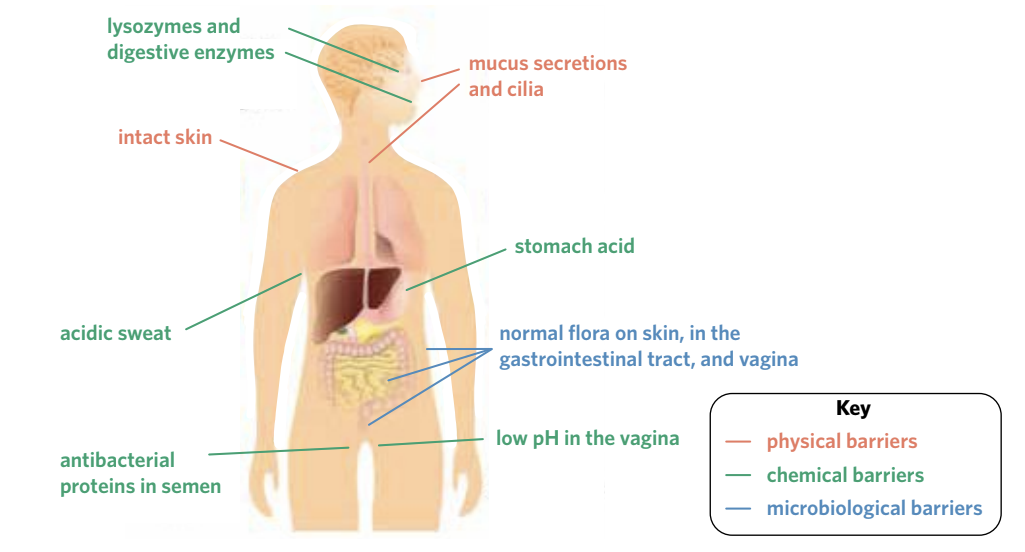
Physical barriers in animals
Intact skin
- The largest physical barrier in the human body
- Multiple layers of tightly packed cells create an impenetrable barrier when undamaged
- Prevents pathogens from reaching internal tissues
- Breaks in the skin (cuts, wounds) compromise this barrier and increase infection risk
- Also includes other surfaces between external and internal environments (respiratory, gastrointestinal, and genitourinary tract linings)
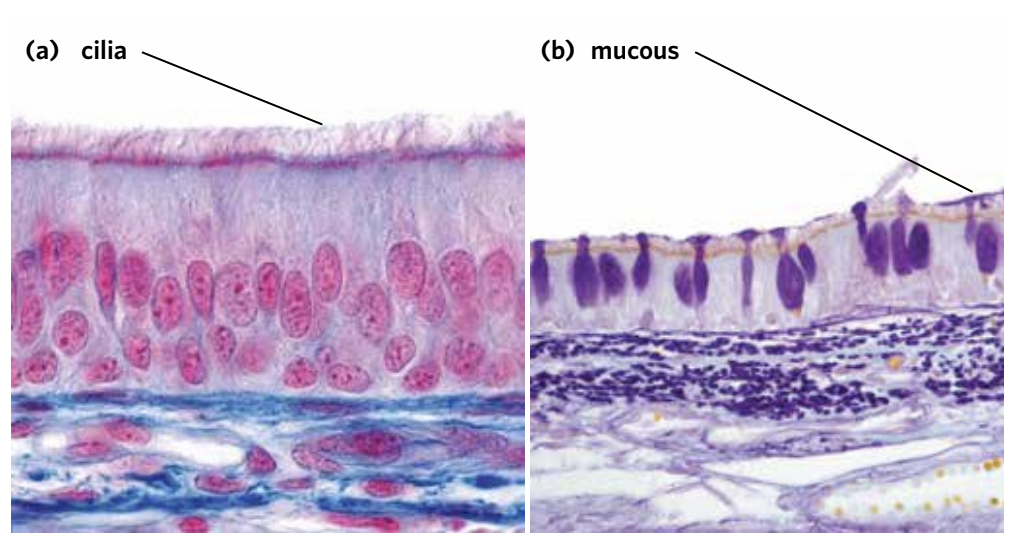
Mucous secretions and cilia
- Mucous is a thick, sticky fluid secreted by cells lining airways and other passages
- Traps pathogens and particles before they can penetrate deeper into the body
- Cilia are tiny, hair-like projections on cells lining the respiratory tract
- Cilia beat in coordinated waves to sweep trapped pathogens toward the throat
- Once in the throat, mucus and trapped pathogens are swallowed
- Stomach acid then destroys the pathogens
Cilium (pl. cilia): thin, hair-like projection that protrudes from eukaryotic cells.
Note
The mucous-cilia system works like a conveyor belt: mucous traps the pathogens, and cilia continuously move the mucous upward toward the throat. This process, called the mucociliary escalator, removes hundreds of pathogens every day before they can cause infection.
Chemical barriers in animals
Chemical barriers use enzymes, acids, and antibacterial compounds to create hostile environments for pathogens.
Lysozyme enzymes
- Found in tears, saliva, and other body fluids
- Break down bacterial cell walls
- Destroy bacteria before they can establish infection
- Provide constant antimicrobial protection to eyes and mouth
Acidic sweat
- Sweat has a low pH (acidic)
- Creates an inhospitable environment on skin surface
- Destroys or inhibits pathogens attempting to colonize the skin
- Particularly effective against bacteria
Stomach acid
- Highly acidic environment (pH around 1.5-3.5)
- Destroys most pathogens that are swallowed
- Provides crucial protection against foodborne and waterborne pathogens
- One of the body's most effective chemical barriers
Important
Stomach acid is so strong (pH 1.5-3.5) that it can destroy the vast majority of pathogens within minutes. This is why we can safely consume most foods and water - the stomach acts as a powerful sterilization chamber. However, some hardy pathogens like Helicobacter pylori have evolved mechanisms to survive in this harsh environment.
Antibacterial compounds in earwax
- Earwax contains substances that kill bacteria
- Protects the delicate ear canal from infection
- Traps foreign particles and pathogens
Antibacterial proteins in semen
- Semen contains proteins with antimicrobial properties
- Provides protection against pathogens in the reproductive tract
- Helps maintain reproductive health
Low pH in the vagina
- The vagina maintains an acidic environment
- Prevents growth of many pathogenic bacteria and fungi
- Beneficial bacteria help maintain this acidic pH
- Disruption of this pH balance can lead to infections
Microbiological barriers in animals
Microbiological barriers involve populations of harmless bacteria called normal flora that naturally inhabit certain parts of the body.
Flora: naturally occurring, non-pathogenic bacteria present in an organism.
How normal flora provides protection:
- Normal flora colonize areas like skin, lower gastrointestinal tract, and vagina
- These beneficial bacteria compete with pathogenic bacteria for space and nutrients
- By occupying available ecological niches, they prevent harmful bacteria from establishing themselves
- Some normal flora also produce substances that inhibit pathogen growth
- This competition is called competitive exclusion
Example
Competitive Exclusion in Action:
Imagine the surface of your skin as a neighborhood with limited houses (attachment sites) and resources (nutrients).
- Normal flora are the established residents who occupy most of the houses and use most of the resources
- Pathogenic bacteria are newcomers trying to move into the neighborhood
- Since normal flora already occupy the space and consume available nutrients, there's no room for the pathogenic bacteria to establish themselves
- Result: The pathogenic bacteria cannot colonize and are forced to leave or die
This is why maintaining healthy populations of normal flora is essential for preventing infections.
Important locations of normal flora:
- Skin: large populations of bacteria that prevent pathogenic colonization
- Gastrointestinal tract: particularly the large intestine, hosts trillions of beneficial bacteria
- Vagina: beneficial bacteria help maintain acidic pH and compete with pathogens
Important
Normal flora can become harmful if they enter areas of the body where they don't normally live, or if the immune system becomes compromised. For example, E. coli is beneficial in the intestines but can cause serious infection if it enters the urinary tract or bloodstream.
Comparison of plant and animal first line defences
While both plants and animals use first line defences to prevent pathogen invasion, there are important differences in their strategies.
Physical defences comparison
| Category | Plant | Animal |
|---|---|---|
| Physical defences | • Thick bark • Waxy cuticles • Formation of galls • Presence of thorns and trichomes • Closing of stomata | • Intact skin • Mucous secretions and cilia |
Plants have more diverse physical barriers because they cannot move and must rely on structural defences. Animals can move away from threats and have fewer types of physical barriers, but these barriers (like skin) cover the entire body surface.
Chemical defences comparison
| Category | Plant | Animal |
|---|---|---|
| Chemical defences | • Chitinases • Phenols • Defensins • Saponins • Oxalic acid • Glucanases | • Lysozymes in tears and saliva • Acidic sweat • Stomach acid • Antibacterial compounds in earwax • Antibacterial proteins in semen • Low pH in the vagina |
Both plants and animals use enzymes and acids as chemical defences. Plants focus on compounds that are permanently present in tissues or produced at wound sites. Animals use chemical barriers that are constantly secreted or present in specific body locations.
Microbiological defences comparison
| Category | Plant | Animal |
|---|---|---|
| Microbiological defences | None | • Normal flora on skin, in lower gastrointestinal tract, and in vagina |
This is the key difference between plant and animal first line defences. Only animals have microbiological barriers. Plants do not harbor beneficial microorganisms as part of their first line defence strategy. Animals benefit from populations of harmless bacteria that compete with pathogens for resources and space.
Exam tips
Note
Exam Success Strategies:
- Remember that the first line of defence is non-specific - it responds the same way to all pathogens
- Be able to distinguish between physical, chemical, and microbiological barriers
- Know which organisms (plants or animals) have which types of barriers
- Understand that plants lack microbiological barriers and advanced immune responses
- Be prepared to give specific examples of each barrier type
- Remember that normal flora can become harmful if they access parts of the body where they don't normally live
- Understand the mechanisms by which barriers work (e.g., lysozyme breaks down bacterial cell walls, normal flora competes for resources)
Remember!
Summary
Key Points to Remember:
-
The first line of defence prevents pathogens from entering organisms through physical, chemical, and microbiological barriers. It provides immediate, non-specific protection as part of the innate immune system.
-
Plants use physical and chemical barriers only. Physical barriers include thick bark, waxy cuticles, galls, thorns, trichomes, and stomata closure. Chemical barriers include enzymes (chitinases, glucanases) and toxic compounds (phenols, defensins, saponins, oxalic acid).
-
Animals use physical, chemical, AND microbiological barriers. Physical barriers include intact skin and mucous/cilia. Chemical barriers include lysozymes, acids (stomach acid, acidic sweat, low vaginal pH), and antibacterial compounds. Microbiological barriers involve normal flora that compete with pathogens.
-
All first line defences are non-specific (respond the same way to all pathogens) and immediate (act within minutes to hours). This rapid response helps limit infection before more specific immune responses develop.
-
Normal flora (beneficial bacteria) only exist in animals as a microbiological barrier. They prevent pathogenic infection by competing for space and nutrients, demonstrating competitive exclusion.