The Lymphatic System (VCE SSCE Biology): Revision Notes
📚Revision Notes
The Lymphatic System
Introduction
The lymphatic system is a large network of vessels and tissues throughout the body that forms an important component of both the circulatory and immune systems. While the cardiovascular system (heart and blood vessels) often receives more attention, the lymphatic system plays an equally vital role in maintaining health.
The lymphatic system has two primary functions related to immunity:
- Acting as a transport network for antigen-presenting cells and pathogens
- Serving as the location where clonal selection occurs
Note
Understanding the lymphatic system helps explain why the adaptive immune response takes time to activate, typically several days after initial infection. This delay occurs because antigen-presenting cells must travel through the lymphatic system to reach lymph nodes, where they can interact with the appropriate lymphocytes.
Functions of the lymphatic system
The lymphatic system performs several crucial functions in the body:
Transportation of antigen-presenting cells: The lymphatic system carries antigen-presenting cells (APCs) from sites of infection to secondary lymphoid tissues. This enables antigen recognition and initiates the adaptive immune response.
Production of leukocytes: Primary lymphoid tissues within the lymphatic system produce lymphocytes and other white blood cells essential for immune function.
Removal of tissue fluid: Lymphatic vessels collect excess fluid that leaks from blood vessels into body tissues, preventing swelling and returning this fluid to circulation.
Absorption of fatty acids: The lymphatic system absorbs fatty acids from the digestive system and transports them throughout the body.
Important
For VCE Biology, focus particularly on the immune-related functions: transportation of antigen-presenting cells and serving as the site for initiating adaptive immunity.
Components of the lymphatic system
The lymphatic system comprises a network of vessels that transport lymph (a pale fluid containing high concentrations of leukocytes) to various lymphoid tissues throughout the body.
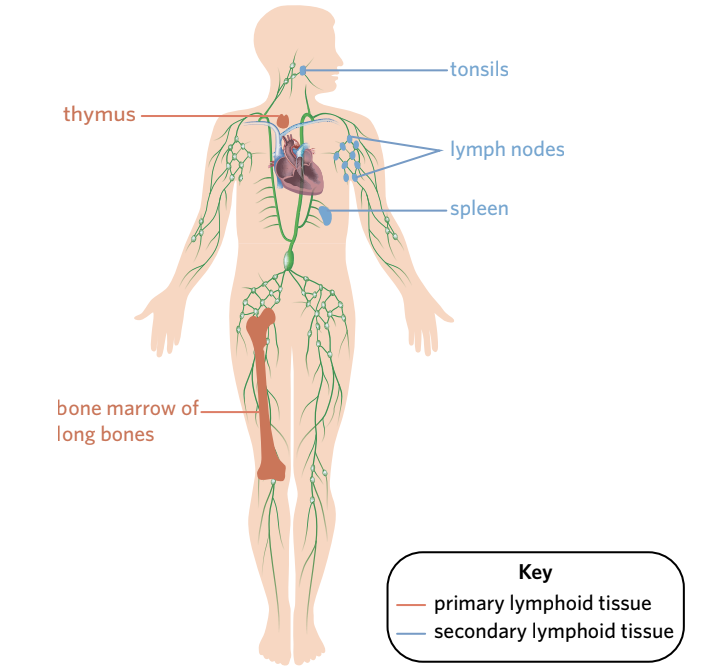
Primary lymphoid tissues
Primary lymphoid tissue refers to components of the lymphatic system responsible for the production and maturation of lymphocytes.
Bone marrow
Bone marrow is semi-solid tissue found within bones, particularly long bones such as the femur and humerus. It serves as the primary site where both B and T lymphocytes are produced. B lymphocytes remain in the bone marrow to complete their maturation, whilst T lymphocytes migrate to the thymus for further development.
Thymus
The thymus is a primary lymphoid organ located in the chest cavity. Its specialised function is to provide the environment where T lymphocytes mature. The location where a lymphocyte matures determines its type: B cells mature in bone marrow, whilst T cells mature in the thymus.
Note
Memory aid: Remember "B in Bone" - B cells mature in bone marrow, whilst "T to Thymus" - T cells travel to the thymus to mature.
| Structure | Functions |
|---|---|
| Bone marrow | - Production of immature B and T cells - Maturation of B cells |
| Thymus | - Maturation of T cells |
Secondary lymphoid tissues
Secondary lymphoid tissue comprises components of the lymphatic system responsible for maintaining mature lymphocytes and activating the adaptive immune response.
Lymph nodes
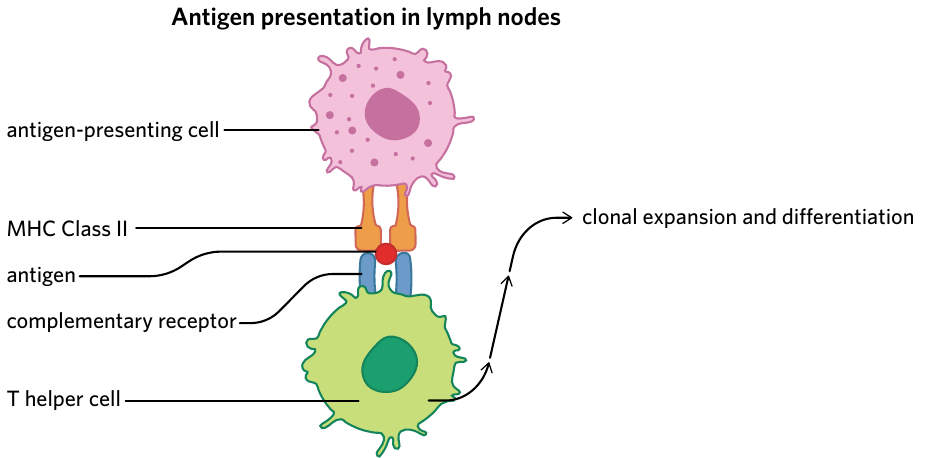
Lymph nodes are small secondary lymphoid tissues distributed throughout the body. These structures serve as sites where antigen-presenting cells activate the adaptive immune system. Within lymph nodes, mature lymphocytes cluster together and continuously scan passing lymph for the presence of pathogens or APCs.
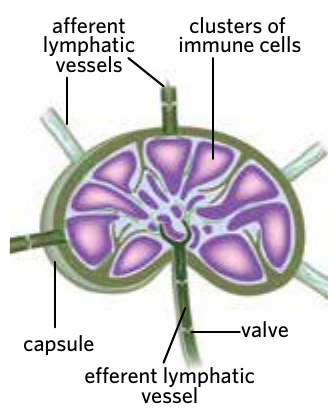
When a foreign antigen matches the specific receptors on certain lymphocytes, those cells undergo clonal selection - the process where B and T cells encountering an antigen matching their antigen-binding site then generate many copies of themselves. This multiplication produces large numbers of B and T cells within the lymph node, causing the characteristic swelling observed during illness.

Note
Tonsils represent specialised lymph nodes located at the back of the throat. They often become swollen during throat infections as they respond to pathogens in that region.
Spleen
The spleen is an organ positioned in the upper abdomen. It performs various functions within the immune system and also regulates red blood cell populations. Like other secondary lymphoid tissues, the spleen houses mature lymphocytes that monitor for pathogens.
| Structure | Functions |
|---|---|
| Lymph nodes | - Site where APCs meet lymphocytes |
| Spleen | - Location of clonal selection and expansion of T and B cells, and initiation of the adaptive immune response |
The lymphatic system as a transport network
One of the most important roles of the lymphatic system in immunity is serving as a transport network. This function can be understood through three sequential stages: lymphatic drainage, lymphatic flow, and lymphatic surveillance.
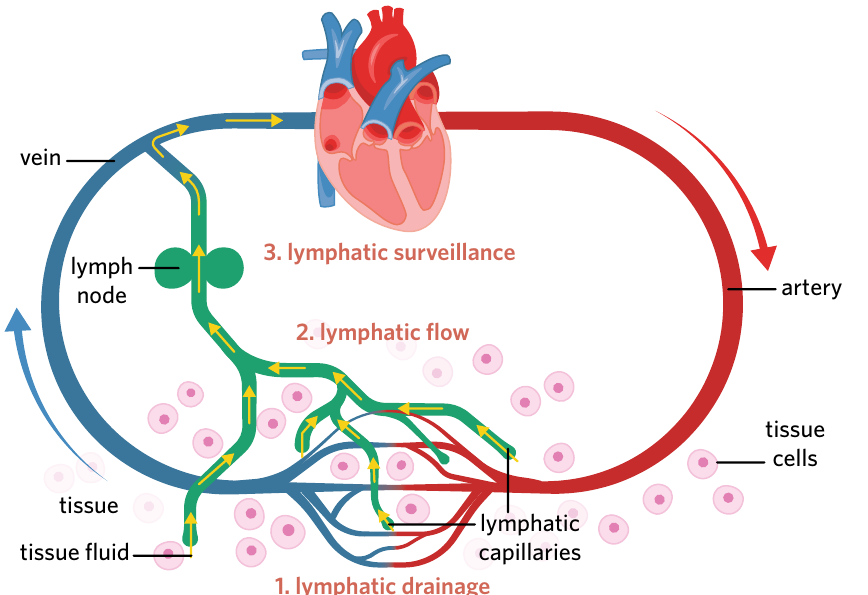
Lymphatic drainage
Blood plasma constantly leaks from blood vessels into the surrounding tissues. During inflammatory responses, this leakage increases to allow leukocytes to enter infected tissues. The lymphatic system prevents tissue swelling by collecting this excess fluid.
Lymphatic capillaries represent the smallest form of lymphatic vessel. These extremely thin-walled structures exist throughout body tissues, positioned in the spaces between cells. They collect tissue fluid along with any pathogens present in the area. Once this fluid enters the lymphatic capillaries, it becomes known as lymph and begins its journey through the lymphatic system towards lymph nodes.
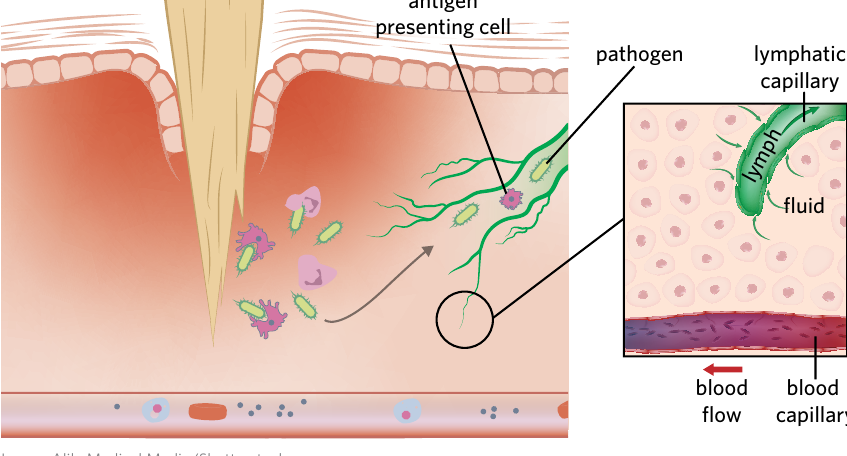
Note
At sites of infection or injury, lymphatic capillaries drain away both the excess tissue fluid and any pathogens or antigen-presenting cells present. This drainage removes threats from the local area whilst simultaneously transporting them to lymph nodes for immune surveillance.
Lymphatic flow
After entering lymphatic capillaries, lymph flows through progressively larger vessels. Small lymphatic capillaries merge to form larger vessels carrying increasing volumes of lymph. Unlike blood vessels, lymphatic vessels have thin walls and do not receive pumping assistance from the heart. Instead, lymph movement relies entirely on surrounding muscle contractions that squeeze the vessels.
To ensure lymph flows in the correct direction, lymphatic vessels contain numerous one-way valves. These valves prevent backflow, ensuring that muscle movements push lymph away from tissues and towards lymph nodes. This design means lymph always travels in one direction through the system.
Lymphatic surveillance
Eventually, lymph reaches lymph nodes through afferent lymphatic vessels - thin-walled structures that collect lymph from body tissues and deliver it to lymph nodes. Inside the lymph node, the fluid passes through dense clusters of B and T lymphocytes.
As lymph drains through these lymphocyte clusters, any antigen-presenting cells or pathogens present have the opportunity to encounter a lymphocyte with a matching antigen-binding site. When this recognition occurs, clonal selection begins, initiating the adaptive immune response.
After passing through the lymph node, lymph exits via efferent lymphatic vessels - thin-walled structures that collect lymph that has passed through lymph nodes. If an adaptive immune response has been triggered, this outgoing lymph contains antibodies and activated cytotoxic T cells. The lymph then returns to the cardiovascular circulation near the heart, where lymphatic vessels join large veins. From there, immune cells and antibodies can be pumped throughout the body via the bloodstream.
Note
Memory aid: Remember "Afferent = Arrives" (lymph arrives at the lymph node via afferent vessels) and "Efferent = Exits" (lymph exits the lymph node via efferent vessels).
Why the adaptive immune response is slow
This multi-stage process explains the delayed activation of adaptive immunity. Transportation within the lymphatic system, followed by antigen presentation and clonal selection and expansion, requires considerable time. Whilst the innate immune system provides immediate protection, the adaptive immune system typically takes several days to mount an effective response. During this delay, pathogens can multiply and cause symptoms. However, once activated, the adaptive response provides highly specific, powerful, and long-lasting immunity.
Important
Rather than relying on chance encounters between antigen-presenting cells and matching lymphocytes throughout the body, the lymphatic system efficiently transports APCs to lymph nodes where large numbers of diverse B and T cells await. This centralised surveillance system, though not instantaneous, ensures reliable activation of adaptive immunity.
Remember!
Summary
Key Points to Remember:
- The lymphatic system is a network of vessels and tissues forming a crucial part of both the circulatory and immune systems
- Primary lymphoid tissues (bone marrow and thymus) produce and mature lymphocytes: B cells mature in bone marrow, T cells mature in the thymus
- Secondary lymphoid tissues (lymph nodes and spleen) house mature lymphocytes and serve as sites where clonal selection initiates the adaptive immune response
- Lymphatic capillaries collect tissue fluid and pathogens, converting this to lymph that flows through one-way valved vessels propelled by muscle movement
- Lymph enters lymph nodes via afferent vessels, passes through lymphocyte clusters for antigen surveillance, and exits via efferent vessels
- The lymphatic system's transport function explains why adaptive immunity takes several days to activate, as antigen-presenting cells must travel to lymph nodes and undergo clonal selection before an effective response develops