Active Transport (VCE SSCE Biology): Revision Notes
📚Revision Notes
Active Transport
Active transport is a crucial process that allows cells to move substances across their plasma membrane even when this movement goes against the natural flow. Unlike passive transport, active transport requires energy to function.
What is active transport?
Important
Active transport is the movement of molecules across a semipermeable membrane that requires energy.
All cells need to control what enters and exits through their plasma membrane. Sometimes, molecules need to move from an area of low concentration to an area of high concentration. This is the opposite direction to passive transport. When this happens, cells must use active transport.
There are two main types of active transport:
- Protein-mediated active transport - uses membrane proteins to move individual molecules against their concentration gradient
- Bulk transport (also called cytosis) - uses vesicles to move large molecules or groups of molecules into or out of the cell
Protein-mediated active transport
When is it needed?
Cells sometimes need to maintain concentrations of certain substances that are very different from the surrounding environment. Consider potassium ions (K⁺) as an example. A cell might already have a high concentration of K⁺ inside compared to outside, but it may still need to bring in more K⁺ to function properly.
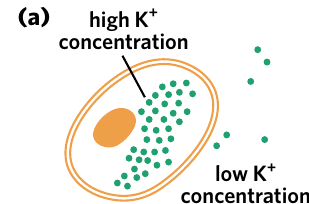
The challenge is that K⁺ cannot simply diffuse across the membrane because:
- It is a charged molecule (ions cannot pass through the lipid bilayer)
- It needs to move against its concentration gradient (from low to high concentration)
- Facilitated diffusion only works down the concentration gradient
Note
In this situation, the cell must use protein-mediated active transport. This process requires two key components:
Requirements for protein-mediated active transport:
- Energy - usually in the form of adenosine triphosphate (ATP)
- Membrane proteins - specifically protein pumps and carrier proteins
Key definitions
Protein pump - a polypeptide that transports molecules across a membrane against its concentration gradient with the aid of ATP.
Adenosine triphosphate (ATP) - a high energy molecule that, when broken down, provides energy for cellular processes.
Carrier protein - a membrane-based protein that undergoes conformational change to transport molecules across a membrane.
Conformational change - a change in the three-dimensional shape of macromolecules such as proteins.
The three-step process
Important
Active transport occurs through three distinct steps:
1. Binding - The target molecule attaches to a specific binding site on the protein pump. Each protein pump is specific to certain molecules.
2. Conformational change - Energy is released when ATP breaks down into ADP (adenosine diphosphate) and an inorganic phosphate (Pi). This energy causes the protein pump to change its three-dimensional shape.
3. Release - The conformational change pushes the target molecule through the protein pump. The molecule is then released on the other side of the membrane.
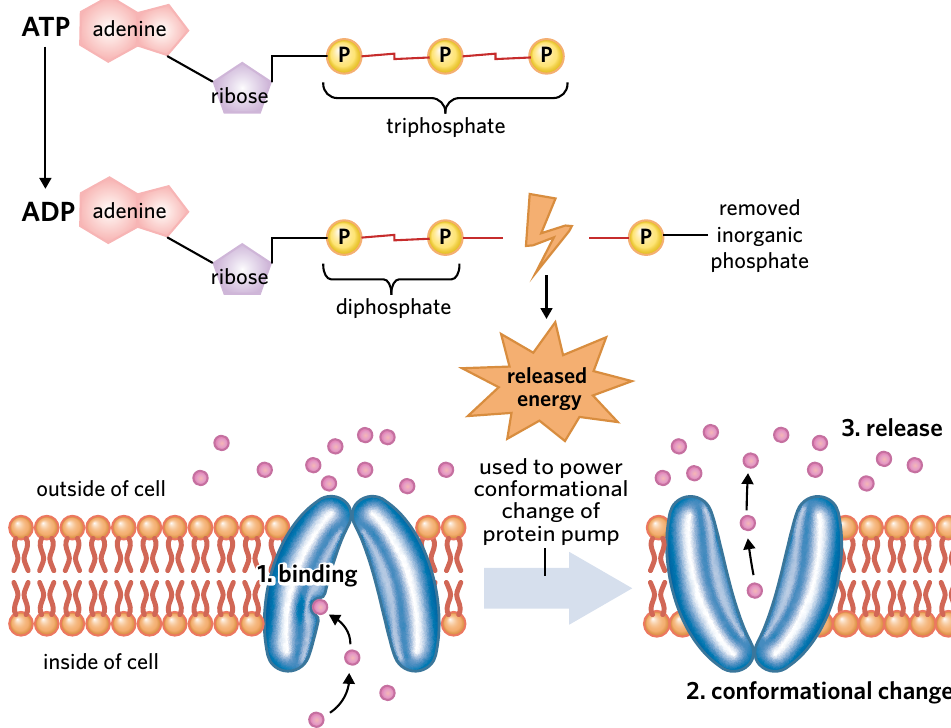
The energy for this process comes from breaking the chemical bond between the second and third phosphate groups in the ATP molecule:
This released energy powers the conformational change in the protein pump, allowing it to transport molecules against their concentration gradient.
Controlling water movement
Active transport can also be used to indirectly control water movement. Remember that water moves by osmosis from areas of low solute concentration to areas of high solute concentration.
Note
Cells can manipulate water movement by:
- Pumping solutes into the cell → water follows by osmosis into the cell
- Pumping solutes out of the cell → water follows by osmosis out of the cell
This is an important mechanism for maintaining proper cell hydration and preventing swelling or shrinking.
The sodium-potassium pump
The sodium-potassium (Na⁺/K⁺) pump is one of the most important examples of protein-mediated active transport in animal cells. This pump maintains the correct concentrations of sodium and potassium ions, which are essential for many cellular functions, particularly generating nerve impulses in neurons.
Concentration differences:
- Sodium (Na⁺) has a very high concentration outside the cell
- Potassium (K⁺) has a very high concentration inside the cell
Important
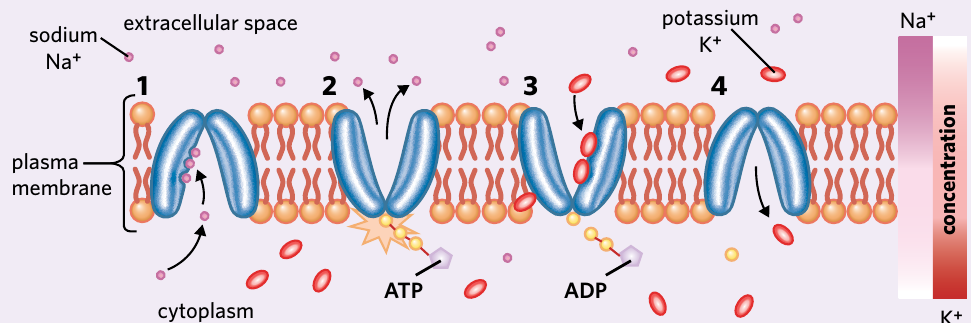
The Na⁺/K⁺ pump actively moves:
- 3 sodium ions (Na⁺) OUT of the cell
- 2 potassium ions (K⁺) INTO the cell
How the sodium-potassium pump works
The pump operates in a four-step cycle:
Step 1: The pump starts open to the cytoplasm. Three Na⁺ ions bind to the pump.
Step 2: ATP breaks down into ADP + Pi, releasing energy. This causes the pump to change shape and open to the extracellular space. In this new shape, the pump doesn't hold Na⁺ strongly, so the three Na⁺ ions are released outside the cell.
Step 3: Two K⁺ ions bind to the pump from outside the cell. This binding triggers the release of the phosphate (Pi) that was left over from step 2.
Step 4: The pump changes shape again, opening back to the cytoplasm. The two K⁺ ions are released inside the cell. The cycle can now start again.
Note
This pump is crucial for maintaining cell function, particularly in nerve and muscle cells where these ion gradients are essential for electrical signalling.
Bulk transport
Important
Bulk transport is a type of active transport that uses vesicles to move large molecules or groups of molecules into or out of the cell. It is also known as cytosis.
Vesicle - a small membrane-bound sac that transports or stores substances within a cell.
Bulk transport is necessary when:
- Molecules are too large to pass through protein channels
- Large quantities of molecules need to be moved at once
- Groups of different molecules need to be transported together
There are two types of bulk transport:
- Exocytosis - moving substances out of the cell
- Endocytosis - moving substances into the cell
Exocytosis
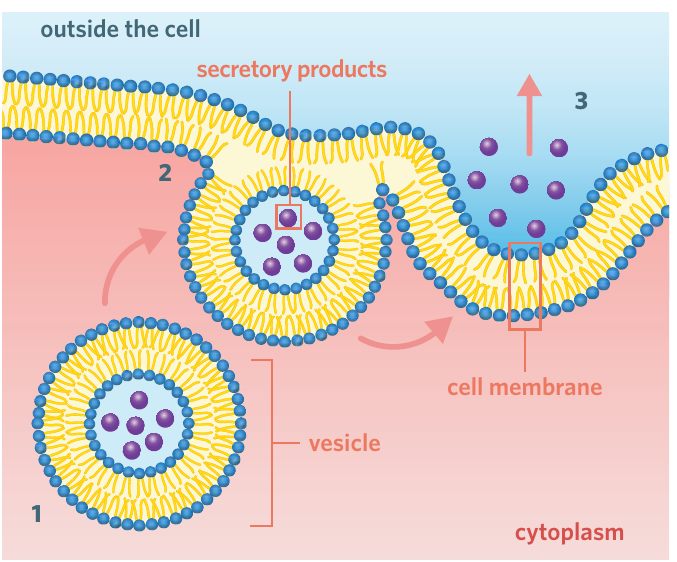
Exocytosis is a type of bulk transport that moves large substances out of the cell.
Cells use exocytosis to:
- Release large quantities of products (hormones, neurotransmitters, antibodies)
- Remove molecules that are too large to exit through protein channels
- Export proteins made by the cell
Many proteins are made at ribosomes on the rough endoplasmic reticulum, then sorted and packaged at the Golgi apparatus into vesicles. These vesicles transport the proteins to the plasma membrane for release through exocytosis.
The three steps of exocytosis
1. Vesicular transport - A vesicle containing secretory products (the substances being released) moves towards the plasma membrane.
2. Fusion - The membrane of the vesicle fuses with the plasma membrane. This is possible because both are made of phospholipid bilayers, which can merge together.
3. Release - The contents of the vesicle are released outside the cell.
Note
Memory aid: "Exo" comes from a Greek word meaning "outside", so exocytosis involves moving substances OUT of the cell.
Important
When vesicles fuse with the plasma membrane during exocytosis, they add phospholipids to the membrane, slightly increasing its surface area.
Endocytosis
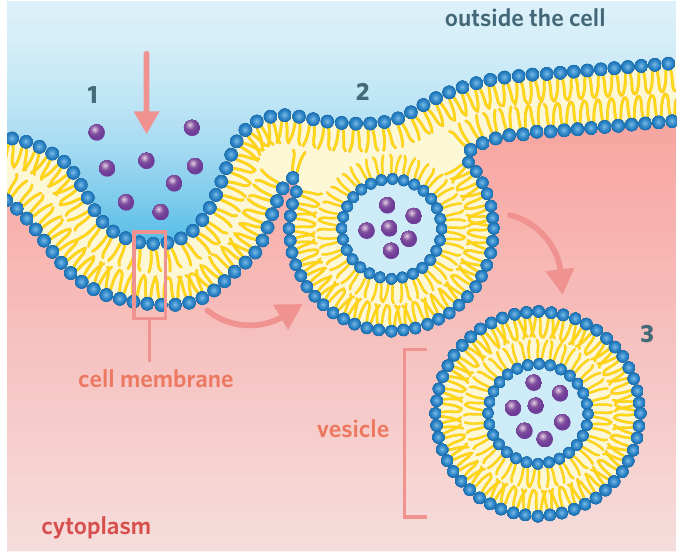
Endocytosis is a type of bulk transport that moves large substances into the cell.
Endocytosis is essential because:
- Many molecules cells need are too large to enter through protein channels
- Cells can engulf multiple different molecules at once
- It serves as a defence mechanism against invaders and toxins
Once inside the cell, substances brought in by endocytosis can be:
- Broken down by lysosomes (membrane-bound vesicles containing digestive enzymes)
- Used for metabolic processes
- Incorporated into cell structures
The three steps of endocytosis
1. Fold - The plasma membrane folds inwards, forming a pocket. This pocket fills with extracellular fluid containing the target molecules.
2. Trap - The membrane continues folding until the two edges meet and fuse together. This traps the target molecules inside a newly formed vesicle (also called an endosome).
3. Bud - The vesicle pinches off from the membrane and moves into the cell. It can then be transported to where it's needed or fused with a lysosome for digestion.
Note
Memory aid: "Endo" comes from a Greek word meaning "within", so endocytosis involves moving substances INTO the cell.
Important
Endocytosis removes phospholipids from the plasma membrane. If large amounts of endocytosis occur, the cell could shrink.
Types of endocytosis
There are two main types of endocytosis you should know:
Phagocytosis (cell eating) - the endocytosis of solid material or food particles. This occurs when immune cells like macrophages engulf invading microorganisms or when cells take in food particles.
Pinocytosis (cell drinking) - the endocytosis of liquid or dissolved substances from the extracellular fluid.
Real-world application: Oral rehydration therapy
When you are sick with vomiting or diarrhoea, your body loses much more water than normal, putting you at risk of dehydration. Oral rehydration therapy (ORT) uses active transport to help prevent dehydration.

Example
Worked Example: How ORT Uses Active Transport
The goal is to quickly absorb both water and sodium back into the body. Dehydrated people lose large amounts of sodium along with water, and sodium is important for normal body function.
However, you cannot simply drink water mixed with sodium. This is because protein pumps in your gut can only transport sodium when it is paired with glucose. This process is called secondary active transport.
The ORT mechanism:
ORT drinks contain both sodium and glucose. After drinking:
- Sodium and glucose are actively transported into gut cells
- This creates a high solute concentration inside the gut cells
- Water follows by osmosis (moving to the region of higher solute concentration)
This combination of active transport and osmosis allows rapid rehydration. Oral rehydration salts are estimated to have saved more than 70 million lives worldwide.
Remember!
Summary
Key Points to Remember:
-
Active transport requires energy (ATP) to move molecules against their concentration gradient, from low to high concentration.
-
Protein-mediated active transport uses protein pumps that undergo conformational changes when ATP breaks down into ADP + Pi, allowing molecules to be transported across the membrane.
-
The sodium-potassium pump is a crucial example that maintains ion concentrations by moving 3 Na⁺ out and 2 K⁺ into cells, essential for nerve function.
-
Bulk transport uses vesicles to move large molecules or groups of molecules: exocytosis moves substances out of the cell, while endocytosis moves substances into the cell.
-
Phagocytosis is "cell eating" (solid materials) while pinocytosis is "cell drinking" (liquids and dissolved substances).