Passive Transport (VCE SSCE Biology): Revision Notes
📚Revision Notes
Passive Transport
Introduction to passive transport
The plasma membrane is a selectively permeable barrier that controls which substances can enter and leave the cell. This selective permeability is crucial for maintaining the cell's specialised internal environment, separate from the surrounding extracellular fluid. The membrane's structure determines what can pass through based on molecular size, polarity, and concentration differences.
Passive transport refers to the movement of molecules across the plasma membrane without requiring the cell to expend energy. This contrasts with active transport, which does require energy input. In passive transport, molecules move naturally down their concentration gradient, from areas of high concentration to areas of low concentration.
Note
Key Distinction:
The fundamental difference between passive and active transport is the energy requirement. Passive transport works like water flowing downhill - it happens naturally without effort. Active transport is like pumping water uphill - it requires energy to move molecules against their natural direction of flow.
There are three main types of passive transport: diffusion, facilitated diffusion, and osmosis. Each mechanism allows different types of molecules to cross the membrane in different ways.
Diffusion
What is diffusion?
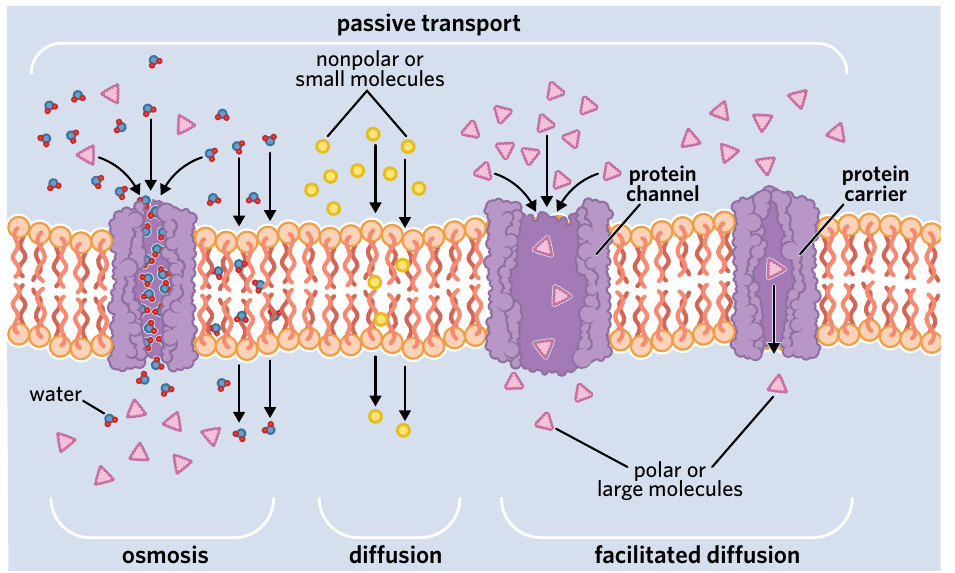
Diffusion is the passive movement of molecules from areas of high concentration to areas of low concentration, moving down the concentration gradient. This process occurs because molecules possess kinetic energy, which causes them to move randomly and collide with one another. Over time, this random molecular motion results in an even distribution of particles throughout an area.
A concentration gradient refers to the difference in solute concentration between two adjacent areas. When a concentration gradient exists, molecules will naturally move from the region of higher concentration to the region of lower concentration until equilibrium is reached.
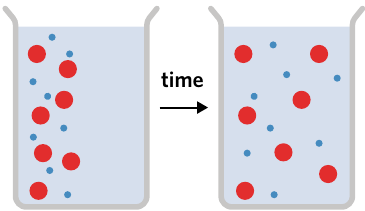
Understanding simple diffusion
Simple diffusion can occur through liquids, gases, or across membranes. When particles are dissolved in water (the solvent), they are called solutes. These solute molecules will diffuse through the water until they are evenly distributed throughout the available space.
Example
Everyday Example: Perfume Diffusion
Diffusion is not limited to cells - it occurs in everyday life. When someone sprays perfume in a room, the perfume molecules are initially concentrated in one location. Over time, the molecules diffuse throughout the entire room as they move from areas of high concentration to areas of low concentration. This is why you can eventually smell the perfume even if you're far from where it was originally sprayed.
Diffusion across the plasma membrane
Unlike a completely impermeable barrier, the plasma membrane is selectively permeable, allowing certain molecules to diffuse through while blocking others. The membrane's selective permeability depends on the characteristics of the molecules attempting to cross.
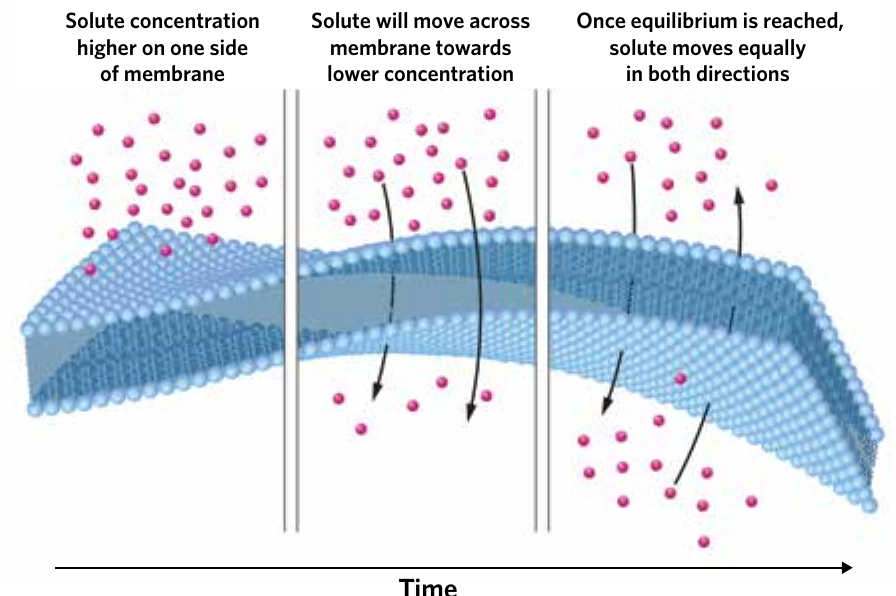
What types of molecules can diffuse freely?
Only certain molecules can cross the plasma membrane by simple diffusion. Two key molecular characteristics determine whether a molecule can freely diffuse across:
Polarity and charge:
- Nonpolar molecules lack distinct positive or negative ends and tend to be hydrophobic (water-repelling)
- Polar molecules have both positive and negative ends and tend to be hydrophilic (water-attracting)
- The plasma membrane is mostly nonpolar in its interior (the fatty acid tails of the phospholipid bilayer)
- Nonpolar, uncharged, or hydrophobic molecules (such as O₂, H₂, CO₂, and lipids) can easily cross because they have an affinity for the nonpolar interior of the membrane
Size:
- Small molecules can slip through the spaces between the lipids in the phospholipid bilayer
- Even some small hydrophilic molecules like water can pass through, though they move more slowly than nonpolar molecules
- Small but highly charged molecules (ions such as H⁺, K⁺, Cl⁻) cannot cross by simple diffusion despite their small size
Important
Critical Rule for Simple Diffusion:
Molecules that can freely diffuse across the plasma membrane must be both small AND nonpolar. Large molecules and hydrophilic molecules (including ions, amino acids, proteins, glucose, and nucleic acids) cannot pass through by simple diffusion. These molecules will bounce off the membrane, creating a concentration gradient.
Direction of diffusion
Whether molecules diffuse into or out of the cell depends on their relative concentration on either side of the plasma membrane.
For example, consider oxygen (O₂):
- If O₂ concentration is higher in the extracellular fluid than in the cytosol, O₂ will diffuse into the cell
- If O₂ concentration is higher inside the cell than outside, O₂ will diffuse out of the cell
Molecules always move down their concentration gradient, from high to low concentration, until equilibrium is reached. At equilibrium, molecules continue to move in both directions, but there is no net movement because the rate of movement in each direction is equal.
Factors affecting diffusion rate
Diffusion occurs faster under certain conditions:
Note
Factors That Speed Up Diffusion:
- Steeper concentration gradient: A greater difference in concentration between two areas increases the rate of diffusion
- Higher temperature: Increased temperature gives molecules more kinetic energy, causing faster movement
Facilitated diffusion
What is facilitated diffusion?
Facilitated diffusion is a type of passive transport where molecules move through a phospholipid bilayer with the aid of a membrane protein. This mechanism allows large or polar molecules to cross the membrane even though they cannot pass through by simple diffusion.
Like simple diffusion, facilitated diffusion moves molecules down their concentration gradient and does not require energy input. The key difference is that facilitated diffusion requires the assistance of specialised membrane proteins.
How facilitated diffusion works
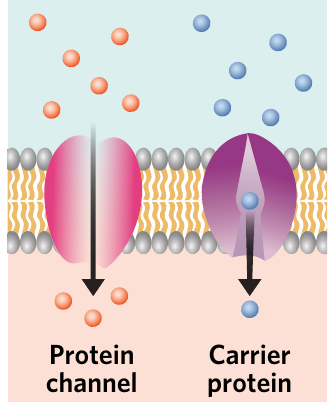
Facilitated diffusion allows large and/or polar molecules such as glucose, ions, and amino acids to move between the intracellular and extracellular environments. Two types of membrane proteins facilitate this transport:
Protein channels: A protein channel is a transmembrane protein that forms a pore or hole through the membrane. These channels are highly specific, allowing only certain substances to pass through. The channel provides a hydrophilic pathway through the hydrophobic interior of the membrane, enabling polar molecules to cross.
Carrier proteins: A carrier protein is a membrane protein that undergoes a conformational change (a change in its three-dimensional shape) to transport molecules across the membrane. The carrier protein binds to the specific molecule being transported, changes shape to move the molecule through the membrane, then returns to its original shape after releasing the molecule on the other side.
Note
Specificity of Transport Proteins:
Both protein channels and carrier proteins are highly specific to the molecules they transport, which contributes to the selective permeability of the plasma membrane. Some small molecules that can undergo simple diffusion (like water) also have dedicated protein channels called aquaporins, which can increase the rate of transport.
Osmosis
What is osmosis?
Osmosis is the passive transport of a solvent (typically water) through a semipermeable membrane from a region of low solute concentration (high solvent concentration) to a region of high solute concentration (low solvent concentration).
Osmosis is essentially the diffusion of water across a selectively permeable membrane. Water molecules can move through the phospholipid bilayer despite being hydrophilic because they are extremely small. Water movement can be further enhanced by specialised protein channels called aquaporins.
Why osmosis is important
Osmosis plays a crucial role in cells because the selectively permeable nature of the plasma membrane means that many solutes cannot easily cross, but water can. When there is a concentration difference of solutes across the membrane, water moves to equalise the concentration.
Example
How Osmosis Works in Practice:
If there is a high concentration of sugar molecules in the cytosol compared to the extracellular fluid, water will move into the cell. This water movement dilutes the sugar molecules until their concentration is equal on both sides of the membrane. While the sugar molecules could potentially move out of the cell through facilitated diffusion, it is usually easier and faster for water to cross the membrane.
Understanding tonicity
Tonicity is a measure of the relative concentration of solutes on either side of a semipermeable membrane. Tonicity describes the concentration difference between two solutions and determines the direction of water movement. There are three types of tonicity:
Hypertonic solution: A hypertonic solution has a higher solute concentration when compared to another solution. Water will move INTO a hypertonic solution from adjacent areas with lower solute concentrations.
Note
Memory Aid for Hypertonic:
Think of hyperactive children after drinking concentrated cordial - hypertonic means HIGH concentration.
Hypotonic solution: A hypotonic solution has a lower solute concentration when compared to another solution. Water will move OUT OF a hypotonic solution into adjacent areas with higher solute concentrations.
Isotonic solution: An isotonic solution has the same solute concentration as another solution. There is no net movement of water between isotonic solutions. It's important to note that water molecules still move in both directions, but the rate of movement is equal in each direction, resulting in no net change.
Important
Direction of Water Movement:
Remember this critical rule: water moves TO the hypertonic solution (the solution with higher solute concentration). Water always moves from areas of low solute concentration to areas of high solute concentration.
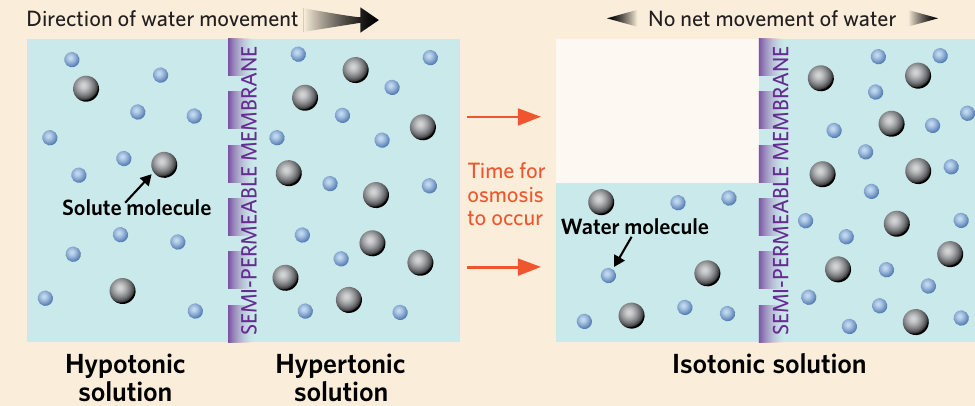
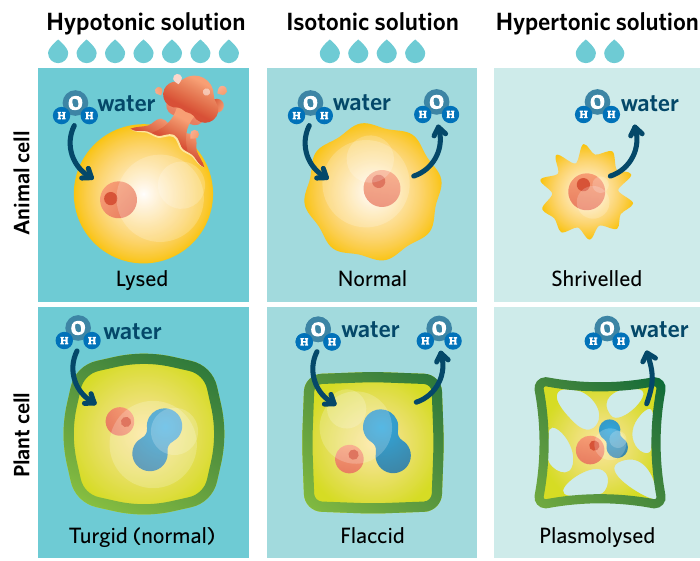
The effect of tonicity on cells
The tonicity of the surrounding solution has significant effects on cell size and structure. These effects differ between plant cells (which have cell walls) and animal cells (which lack cell walls).
Effects on plant cells:
When a plant cell is placed in different solutions, the following occurs:
- Hypotonic solution: Water moves into the cell, causing it to swell and become turgid (swollen and firm). The cell wall prevents the cell from bursting. Turgid cells are normal and healthy for plants.
- Isotonic solution: Water movement is balanced, and the cell remains flaccid (limp, normal state with no net water movement).
- Hypertonic solution: Water moves out of the cell, causing it to shrink. The cell becomes plasmolysed - the plasma membrane pulls away from the cell wall as the cell loses water and shrinks.
Effects on animal cells:
Animal cells lack cell walls, making them more vulnerable to changes in tonicity:
- Hypotonic solution: Water moves into the cell, causing it to swell. Without a cell wall to provide structural support, the cell may continue swelling until it bursts or lyses.
- Isotonic solution: Water movement is balanced, and the cell maintains its normal size and shape.
- Hypertonic solution: Water moves out of the cell, causing it to shrink and become shrivelled (crenated).
Real-world applications of tonicity
Understanding tonicity and osmosis has important practical applications:
Example
Practical Applications:
Plant turgor pressure: High turgor pressure in plant stems keeps plants upright and prevents wilting. When plants don't receive enough water, their cells become plasmolysed and the plant wilts.
Medical saline solutions: When patients receive intravenous fluids in hospital, they are given saline solution (salt water) rather than pure water. This saline solution is isotonic to blood cells, ensuring that the cells don't shrivel or burst. Pure water would be hypotonic to blood cells and could cause them to lyse.
Sports drinks: Isotonic sports drinks are designed to match the body's natural fluid concentration, allowing for optimal rehydration without affecting cell function.
Summary of passive transport
All three types of passive transport share common features while serving different purposes:
Comparison of passive transport mechanisms
| Passive transport type | Molecules transported | Direction of travel | Protein required? | Energy requirement |
|---|---|---|---|---|
| Diffusion | Nonpolar/hydrophobic, small molecules (e.g. oxygen, carbon dioxide) | Down concentration gradient | No | None |
| Facilitated diffusion | Polar/hydrophilic, large molecules (e.g. ions, glucose, amino acids) | Down concentration gradient | Yes | None |
| Osmosis | Water | From hypotonic to hypertonic solution | Sometimes (aquaporins) | None |
Summary
Key Features of Passive Transport:
- No energy required: All passive transport processes occur spontaneously without the cell expending energy
- Down concentration gradient: Molecules move from areas of high concentration to areas of low concentration
- Selective permeability: The plasma membrane controls which molecules can pass through based on size, polarity, and the availability of transport proteins
- Equilibrium: Transport continues until equilibrium is reached, at which point there is no net movement
Remember!
Summary
Essential Points to Remember:
-
Passive transport requires no energy and moves molecules down their concentration gradient, from high to low concentration.
-
Diffusion allows small, nonpolar molecules (like O₂ and CO₂) to pass directly through the lipid bilayer.
-
Facilitated diffusion uses protein channels or carrier proteins to transport large or polar molecules (like glucose and ions) across the membrane.
-
Osmosis is the diffusion of water from areas of low solute concentration to areas of high solute concentration. Remember: water moves TO the hypertonic solution.
-
Tonicity describes solute concentration differences: hypertonic (high solute), hypotonic (low solute), and isotonic (equal solute). Tonicity determines the direction of water movement and affects cell size and shape.