Acid-Base Reactions in the Environment (VCE SSCE Chemistry): Revision Notes
📚Revision Notes
Acid-Base Reactions in the Environment
Introduction
Since the Industrial Revolution began in the 1760s, the burning of fossil fuels has increased dramatically worldwide. This has led to significantly higher concentrations of acidic gases in Earth's atmosphere, including carbon dioxide (), sulfur dioxide (), and nitrogen dioxide (). These gases contribute not only to global warming but also to changes in ocean chemistry that threaten marine life.
Note
Understanding the acid-base chemistry behind environmental changes is crucial for recognising the impact of human activities on our planet. These chemical processes have far-reaching consequences for marine ecosystems and, ultimately, for human societies that depend on ocean resources.
In this topic, we explore how increasing levels of carbon dioxide affect ocean acidity and examine the consequences for marine ecosystems. These issues have significant environmental, social, and economic implications that result from human industrial activity.
Carbon dioxide in nature and ocean acidity
The carbon cycle
Carbon dioxide is essential for life on Earth. Through a natural process called the carbon cycle, carbon moves continuously between the land, atmosphere, and oceans within the biosphere (the global sum of all ecosystems on Earth). This cycle involves several key processes that maintain the balance of carbon in different parts of our environment.
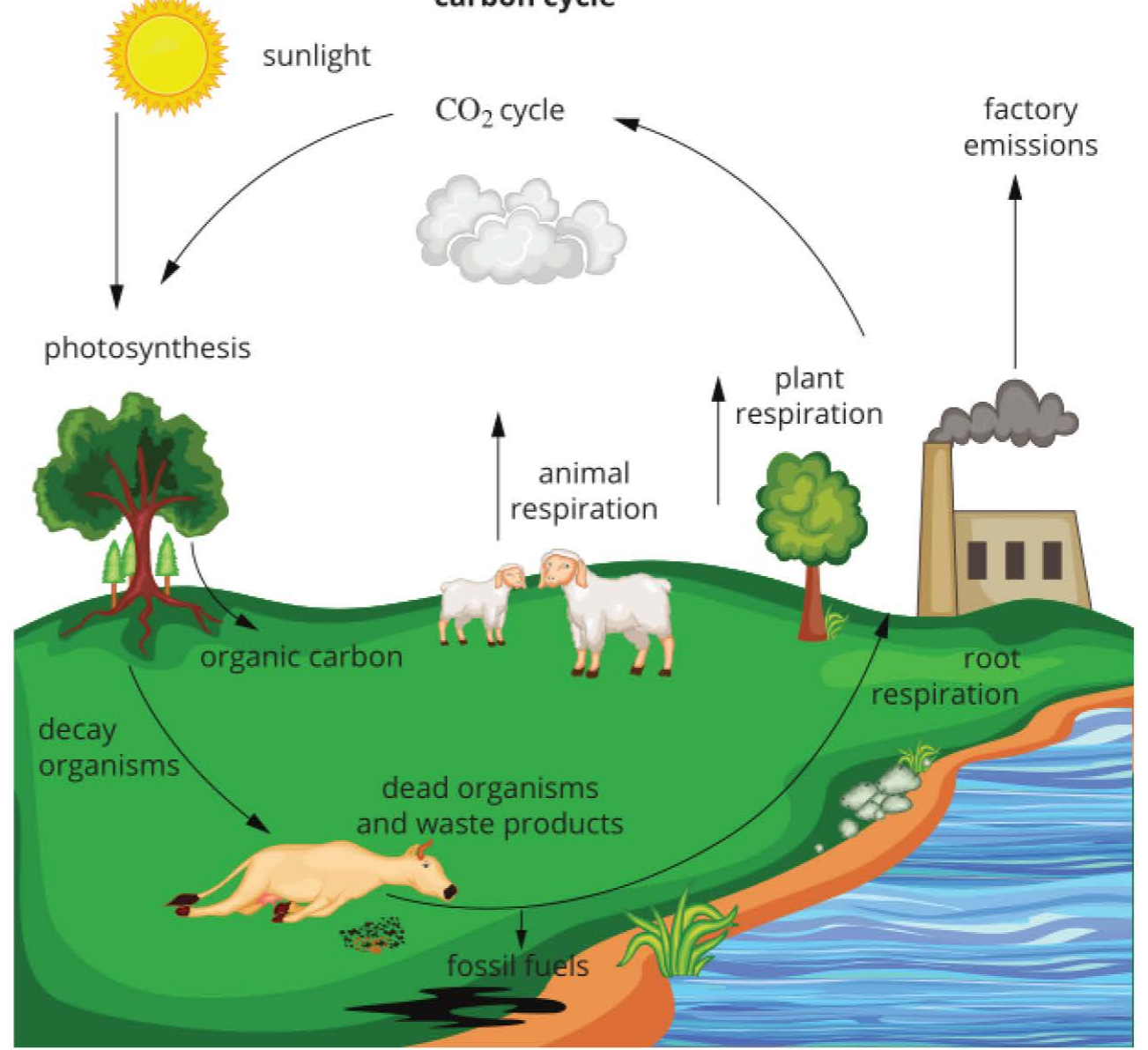
Plants remove carbon dioxide from the atmosphere and use it to produce glucose () through photosynthesis. This glucose serves as an energy source for the plant and can be converted into larger molecules that either store energy or form structural components within the plant. Photosynthesis requires sunlight and the pigment chlorophyll, which is found in the green parts of plants.
The process of photosynthesis can be summarised by the equation:
Note
This equation shows that six molecules of carbon dioxide and six molecules of water are converted into one molecule of glucose and six molecules of oxygen gas when exposed to sunlight in the presence of chlorophyll.
Animals consume plants and other organisms, releasing carbon dioxide back into the atmosphere through respiration. When organisms die, decomposers break down their remains, returning more carbon to the soil and atmosphere. Over millions of years, some dead organisms become fossil fuels, which humans now burn, releasing ancient carbon back into the atmosphere.
Carbon dioxide in the atmosphere
Scientific studies using ice core samples from Antarctica have revealed that atmospheric levels have varied naturally over the past 800,000 years. Atmospheric carbon dioxide and other greenhouse gases play a critical role in maintaining Earth's average surface temperature by trapping energy and re-radiating it in all directions. About half of this energy returns to Earth, whilst the other half escapes to outer space.
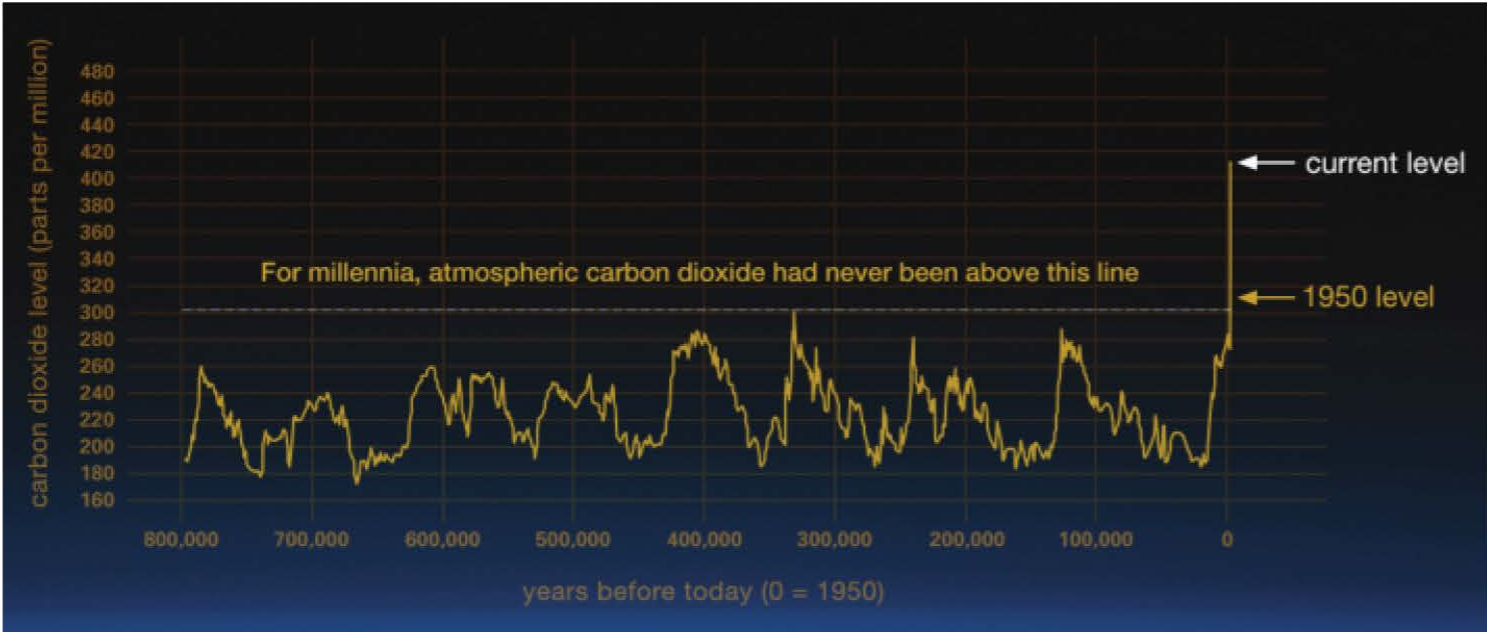
Scientists can distinguish between natural and human-caused contributions to levels by analysing ratios of carbon isotopes. In recent times, human contributions to atmospheric have exceeded natural fluctuations.
Important
The graph shows that for millennia, atmospheric carbon dioxide remained below 300 parts per million (ppm), but current levels exceed 400 ppm. This dramatic increase began with industrialisation and continues to accelerate.
These elevated levels influence several environmental factors, including the acidity of rain, surface land temperatures, and global warming. As a consequence, global weather patterns are changing, and chemical processes in the oceans are being altered.
Carbon dioxide in the oceans
As atmospheric carbon dioxide concentrations increase, more dissolves into ocean water. This dissolution increases the concentration of carbonic acid, a weak acid, which subsequently increases the concentration of hydronium ions () in seawater. Because pH is inversely related to hydronium ion concentration, this results in a decrease in ocean pH. The overall result is an increase in ocean acidity.
Note
Ocean acidity refers to a decrease in pH that occurs due to the absorption of carbon dioxide from the atmosphere. It's important to understand that "ocean acidity" doesn't mean the ocean becomes acidic (pH below 7). Seawater is slightly alkaline, with an average pH of 8.14.
However, over the past 200 years, the pH has dropped by 0.11 units. Since pH is a logarithmic scale, this represents approximately a 30% increase in the concentration of ions. If this trend continues, scientists estimate that by 2100, seawater will become 100% more acidic than pre-industrial levels, with a pH of about 7.85. Notice that even at this lower pH, seawater will still be alkaline, but it will be more acidic than it has been for thousands of years.
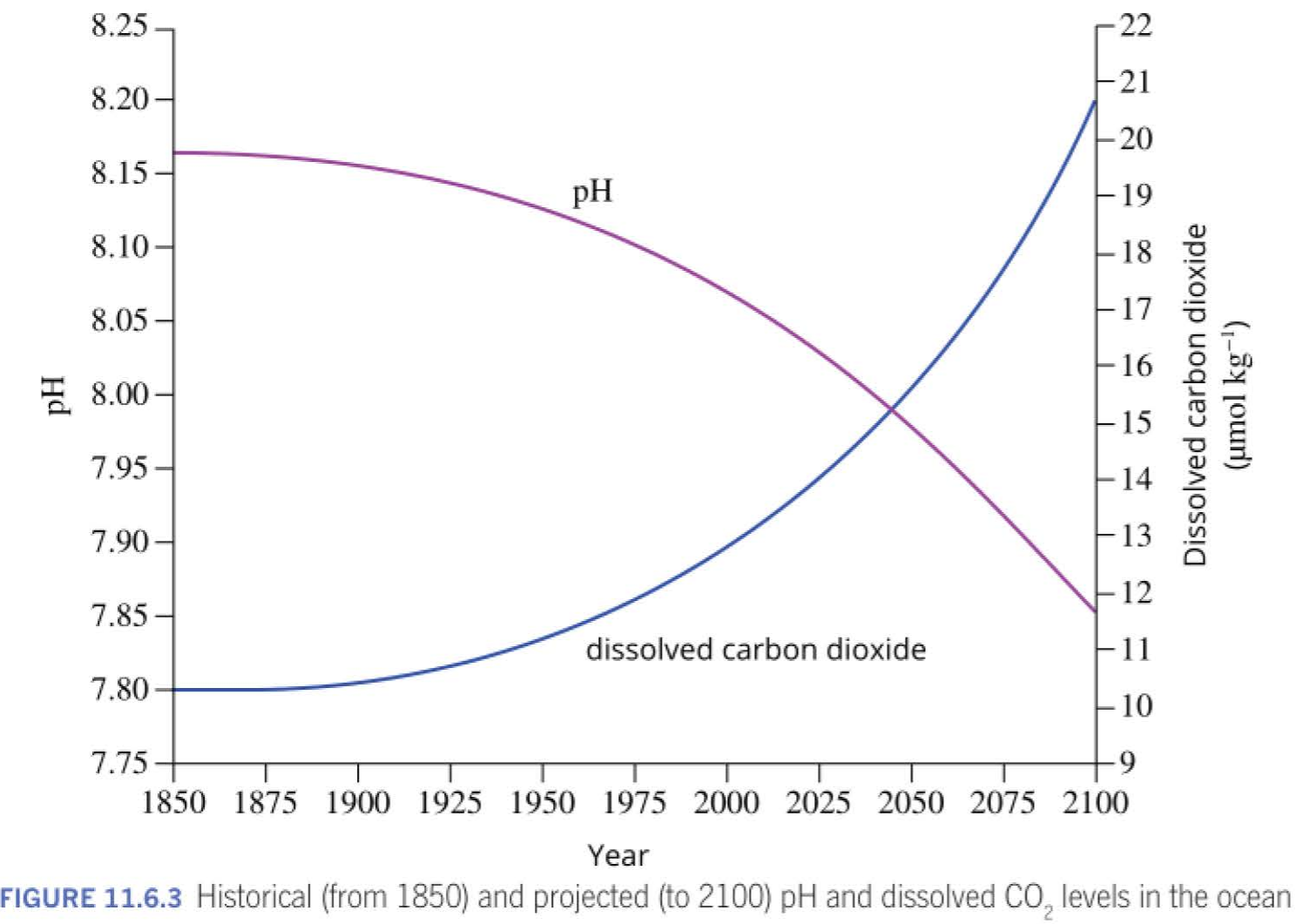
The graph above illustrates both historical data (from 1850) and projected trends (to 2100) for ocean pH and dissolved levels. As dissolved carbon dioxide increases, pH decreases. Combined with rising surface temperatures, these changes impact the complex chemical systems in the oceans. These systems involve enormous quantities of soluble metal salts (such as calcium and sodium salts), carbonate ions, organic matter, and dissolved gases.
Important
Scientists estimate that between one-third and one-half of all carbon dioxide emissions from human activity are absorbed by the oceans. Whilst this absorption reduces the greenhouse effect (which is primarily caused by atmospheric carbon dioxide), it has led to a 0.11 unit decrease in ocean pH since the Industrial Revolution. This seemingly small change represents a 30% increase in hydronium ion concentration in seawater, with significant consequences for marine life.
The chemistry of dissolved carbon dioxide
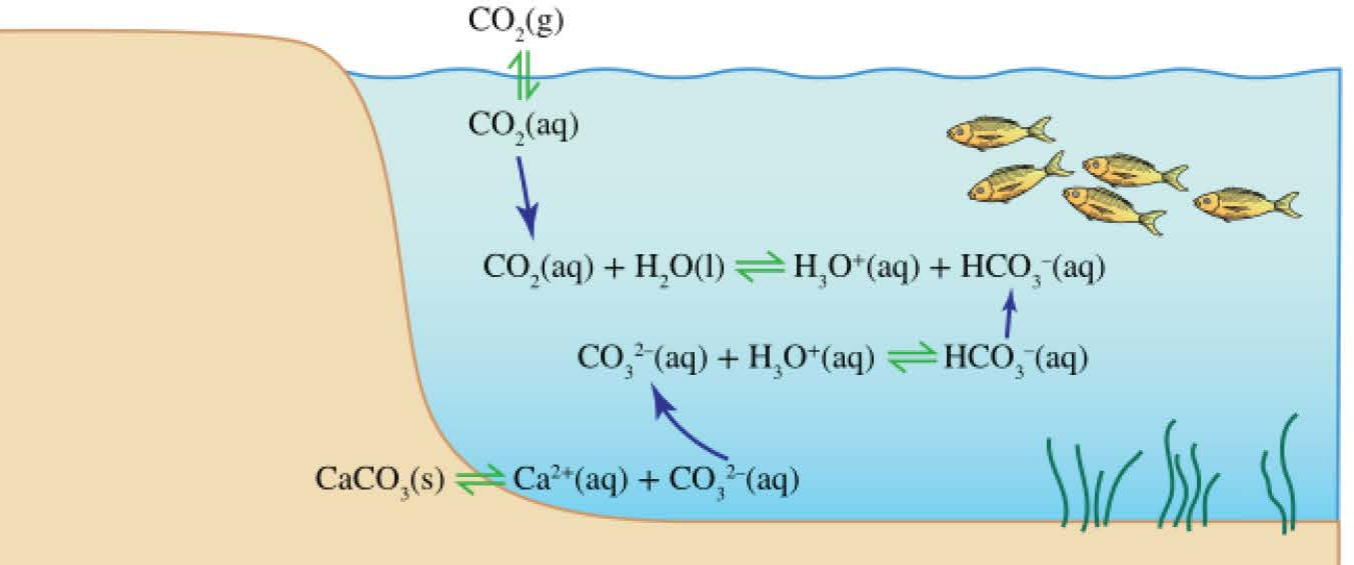
Understanding ocean acidity requires knowledge of the chemical reactions that occur when carbon dioxide dissolves in water. There are several interrelated equilibrium reactions in seawater involving dissolved carbon dioxide gas, hydrogen carbonate ions (), and carbonate ions ().
Carbon enters the ocean mainly through the dissolution of gaseous carbon dioxide, which is slightly soluble in water. The equation for this process is:
Most carbon dissolved in seawater exists as , but some reacts further with water molecules to form carbonic acid:
Carbonic acid is a weak diprotic acid, meaning it can donate two protons (hydrogen ions). It ionises in two distinct steps to form hydrogen carbonate ions and then carbonate ions:
First ionisation step:
Second ionisation step:
Note
The double arrows () in these equations indicate that the reactions are reversible and can proceed in either direction, depending on which chemical species are in excess. This is an important concept you will study in more detail in Year 12 Chemistry. For example, if the concentration of increases (which occurs as the ocean becomes more acidic), the lower reaction above shifts backwards, causing to react with ions.
Example
Worked Example: Understanding Ocean Acidification Process
The processes occurring in the ocean can be summarised as follows:
Step 1: As carbon dioxide in the atmosphere increases, more dissolves in the ocean
Step 2: The dissolved forms carbonic acid, which ionises to produce hydronium ions ()
Step 3: The ocean becomes more acidic due to the increased
Step 4: The increased hydronium ions react with dissolved carbonate ions ()
Step 5: As carbonate ion concentration decreases, some solid calcium carbonate () in shells, exoskeletons, and coral dissolves to produce more carbonate ions
Step 6: The decrease in available carbonate ions has serious consequences for the growth and maintenance of shells and coral structures
Consequences of increased ocean acidity
As ocean pH decreases, the concentration of available carbonate ions also decreases. This has a significant impact on two important biological processes: calcification and decalcification.
Calcification
Many aquatic organisms require calcium carbonate to survive. Marine invertebrates such as shellfish, starfish, coral, sea snails, crabs, and lobsters all have protective coverings made of calcium carbonate (). These organisms absorb calcium ions and carbonate ions from seawater to build and maintain these essential structures.
Calcification is the process by which marine organisms precipitate dissolved calcium ions and carbonate ions to form solid calcium carbonate in their shells and exoskeletons. This process can be represented by the equation:
Note
Calcium carbonate is virtually insoluble in water, and the oceans can be regarded as saturated solutions of calcium and carbonate ions. Once formed, solid calcium carbonate is usually quite stable under normal ocean conditions. The health and growth of these animals depends critically on the concentration of carbonate ions, which in turn depends on carbon dioxide levels in the oceans.
Decalcification
The increased acidity of the oceans disrupts the calcification process. As more carbon dioxide dissolves in seawater and forms hydronium ions, these ions react with carbonate ions according to the equation:
This reaction reduces the concentration of free ions in seawater, making it increasingly difficult for marine creatures to build or maintain their protective calcium carbonate structures. This process is called decalcification.
Important
Scientists estimate that the pH of the ocean will decrease from 8.14 to 7.90 over the next 50 years. This change will decrease the rate of calcification and increase the rate of decalcification, putting coral reefs and numerous marine organisms at serious risk.
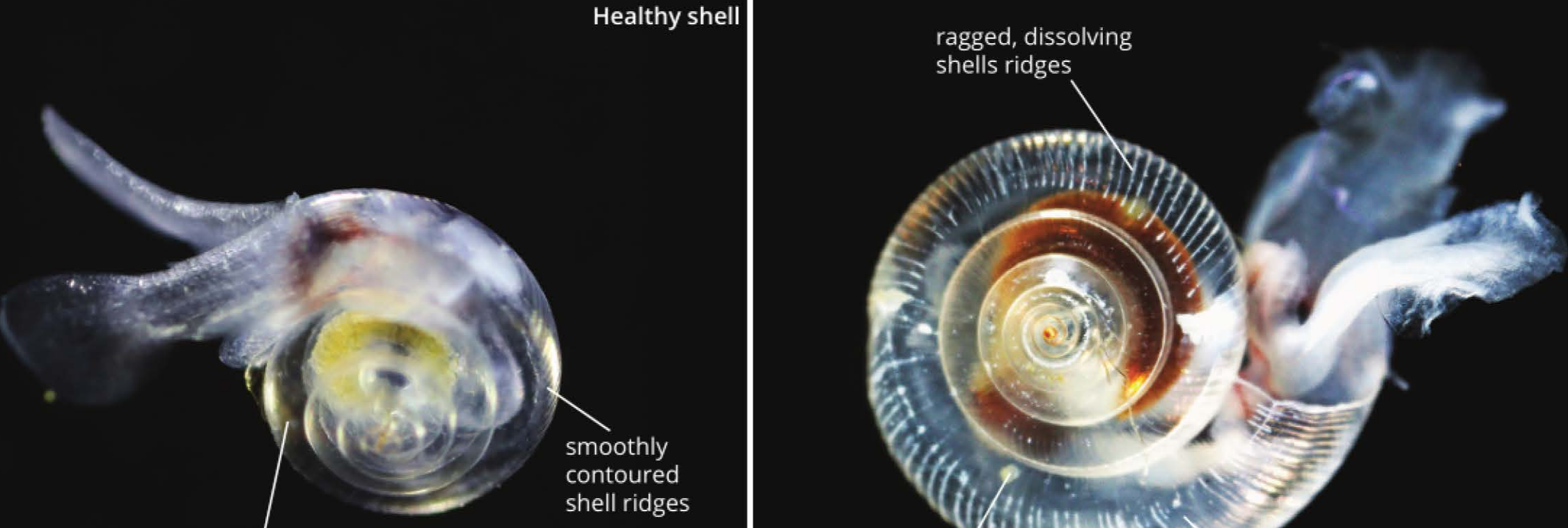
The image above shows the dramatic effects of decalcification on sea snails (pteropods). These small, free-floating snails are found at the base of the ocean food web and serve as food for many other marine species. The healthy specimen on the left has a clear, glass-like shell with smooth, evenly contoured ridges. In contrast, the specimen on the right has been affected by increased ocean acidity, and its shell is beginning to dissolve. Weak spots appear opaque and cloudy, and the shell ridges have become ragged and damaged. This deterioration makes these organisms more vulnerable to predators and environmental stresses.
Ecosystem impacts
The effects of ocean acidification extend far beyond individual organisms. Because many species with calcium carbonate shells and exoskeletons form the foundation of marine food webs, their decline threatens entire ocean ecosystems.
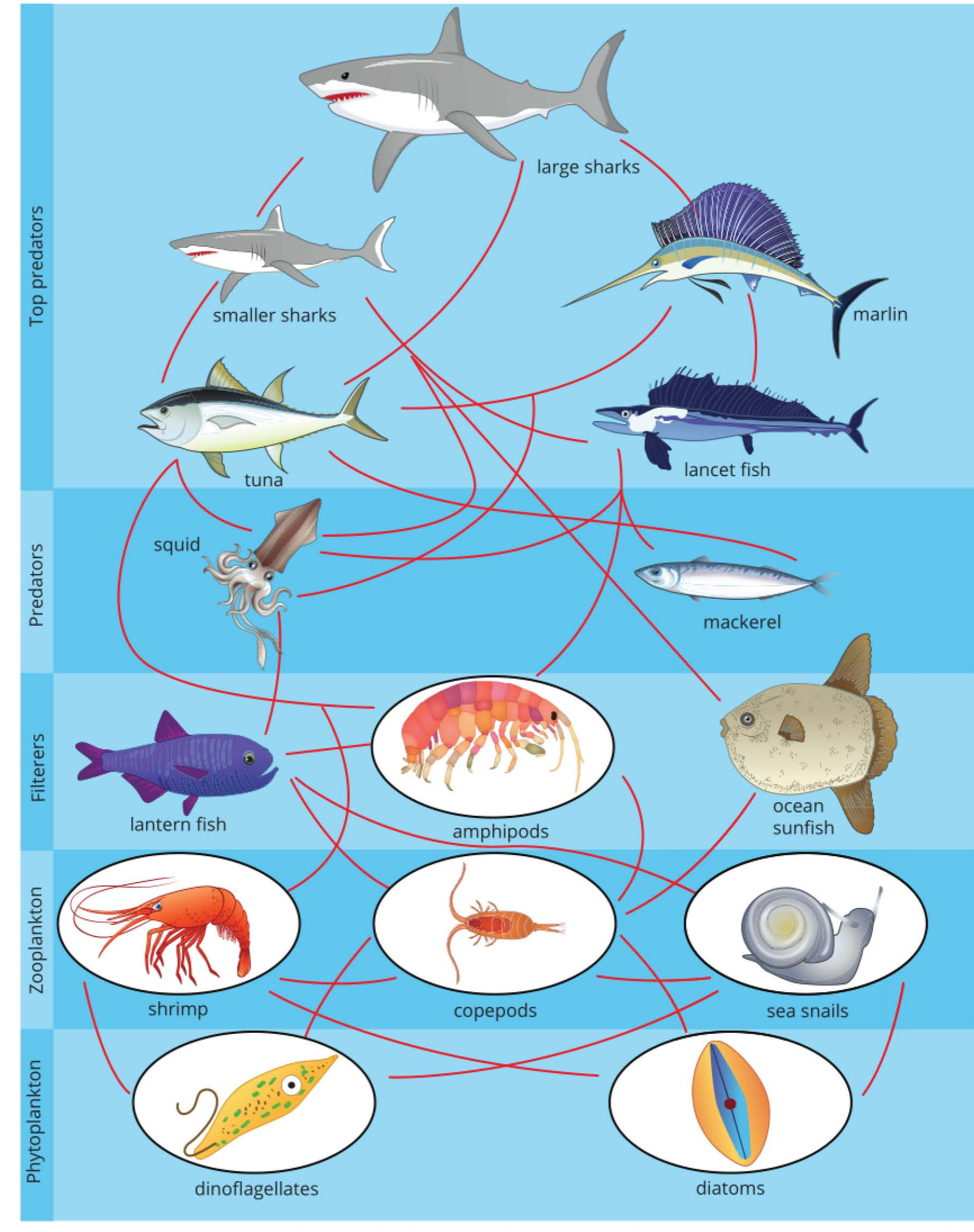
The food web diagram above illustrates the crucial role of small organisms such as sea snails (pteropods), shrimp, and copepods in marine ecosystems. These organisms occupy the zooplankton level and feed on phytoplankton (microscopic plants like dinoflagellates and diatoms). In turn, zooplankton serve as food for filter feeders and small predators, which are then consumed by larger predators, culminating in top predators like sharks and marlin.
Important
If ocean acidification reduces populations of zooplankton with calcium carbonate shells, the effects cascade throughout the food web. Fewer zooplankton means less food for filter feeders and small fish. This reduction affects mid-level predators, which ultimately impacts top predators. Because many commercial fish species depend on this food web, ocean acidification poses a threat to global food security and fishing industries.
Additional impacts on marine life
Ocean acidity affects all marine species, not just those that use calcium carbonate for protective structures. Cold ocean organisms, such as plankton and krill, are particularly vulnerable. Diatoms are single-celled algae that form an important component of plankton and serve as the foundation of marine and freshwater food chains.
Krill are small crustaceans that feed on plankton and can be found in massive swarms extending for kilometres. They represent a major food source for many marine organisms, ranging from small fish like sardines to enormous mammals like whales.
Note
Research has shown that krill eggs fail to hatch successfully at lower pH levels. Therefore, increased ocean acidity is predicted to significantly impact plankton and krill populations, which would affect all species that depend on them for survival.
A collapse of krill populations, combined with ocean warming, would have catastrophic effects on ocean ecosystems. Because oceans provide diverse food sources for human consumption, increased ocean acidity ultimately affects us all.
Coral reefs
The reduction in free ions in seawater represents a critical threat to coral reef ecosystems, making it harder for corals to build their calcium carbonate skeletons. Coral reefs provide essential services to human communities:
- They protect coastal areas from storms and erosion
- They support biodiversity and commercial fisheries
- They attract tourism due to their colour and diversity
Important
The deterioration and destruction of coral reefs would severely affect the economies of coastal communities and could ultimately destroy them. The loss of coral reefs would also eliminate crucial habitat for countless marine species, further disrupting ocean ecosystems.
Remember!
Summary
Key Points to Remember:
-
Ocean acidity is occurring due to increased atmospheric dissolving in seawater. The ocean pH has dropped from 8.14 to 8.03 since the Industrial Revolution (a 30% increase in ), and is projected to reach 7.85 by 2100.
-
When dissolves in water, it forms carbonic acid (), which ionises to produce hydronium ions (), hydrogen carbonate ions (), and carbonate ions ().
-
Calcification is the process by which marine organisms combine dissolved and ions to form solid in their shells and exoskeletons:
-
Decalcification occurs when increased hydronium ions react with carbonate ions, reducing their availability: This makes it harder for organisms to build shells and can cause existing shells to dissolve.
-
Ocean acidification threatens entire marine food webs because organisms with calcium carbonate structures (like pteropods, krill, and coral) form the foundation of ocean ecosystems. Their decline affects all species up the food chain, including commercially important fish species and ultimately human food security.