Acids and Bases (VCE SSCE Chemistry): Revision Notes
📚Revision Notes
Acids and Bases
Introduction
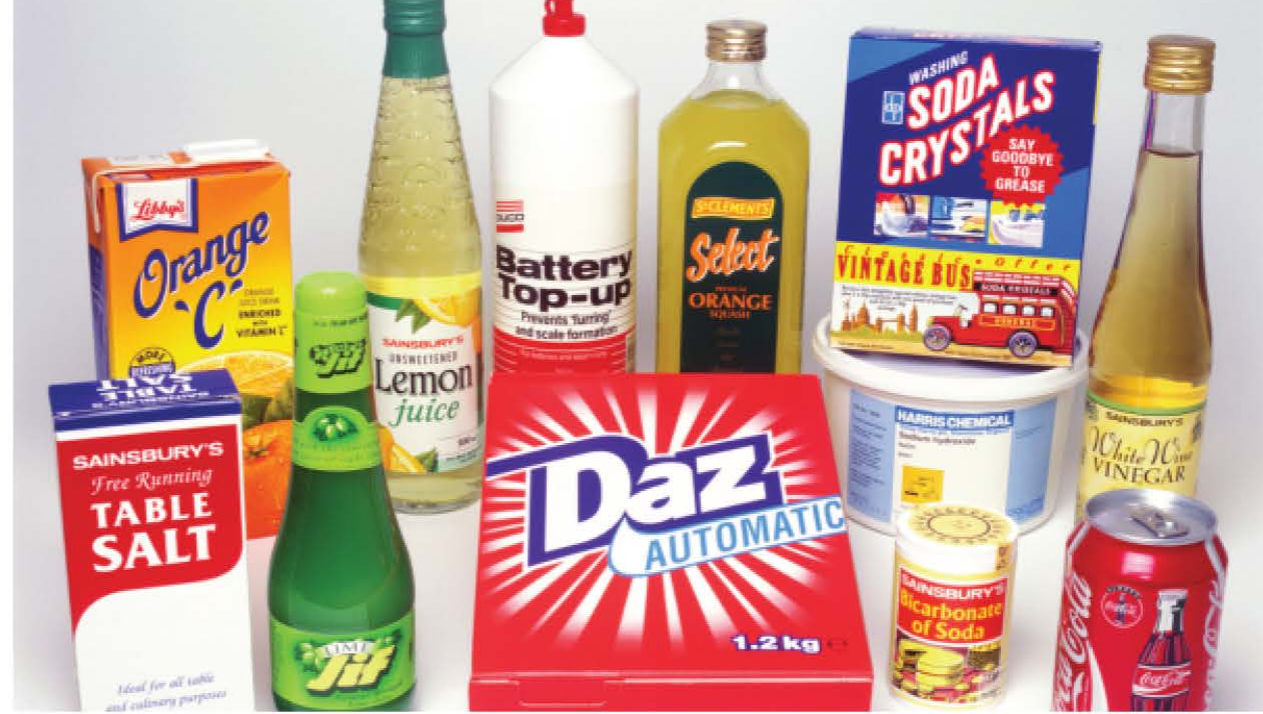
Acids and bases are all around us in everyday life. You'll find them in many household products, from cleaning agents to food items. Understanding their properties and behaviour is essential for chemistry.
Note
Acids and bases aren't just confined to chemistry laboratories - they're present in everyday items like citrus fruits, vinegar, soap, and even the acid in your stomach that helps digest food. Recognizing these substances in daily life helps make chemistry concepts more relatable and practical.
In this topic, you'll learn about the Brønsted-Lowry theory, which explains how acids and bases behave. You'll discover how to write balanced equations for acid-base reactions and understand that some substances can act as either an acid or a base, depending on the reaction.
Properties of acids and bases
Common acids
Acids play important roles in our homes, in industry, and even in our bodies. For example, hydrochloric acid is present in your stomach to help digest proteins. The table below shows some common acids you might encounter.
| Name | Formula | Uses |
|---|---|---|
| Hydrochloric acid | Present in stomach acid to help break down proteins; used as a cleaning agent for brickwork | |
| Sulfuric acid | One of the most common chemicals manufactured; used in car batteries and in the manufacture of fertilisers and detergents | |
| Nitric acid | Used in the manufacture of fertilisers, dyes and explosives | |
| Ethanoic acid (acetic acid) | Found in vinegar; used as a preservative | |
| Carbonic acid | Found in carbonated soft drinks and beer | |
| Phosphoric acid | Used in some soft drinks and in the manufacture of fertilisers | |
| Citric acid | Found in citrus fruits | |
| Ascorbic acid | Found in citrus fruits (vitamin C) |
Common bases
Many cleaning products contain bases. For instance, washing powders, oven cleaners, and floor cleaners often have bases as their active ingredients. Bases work well as cleaners because they react with fats and oils to create water-soluble soaps.
Bases that dissolve in water are called alkalis. Examples include ammonia () and sodium hydroxide (). Some bases, like calcium carbonate, don't dissolve in water, so they're not classified as alkalis even though they can still react with acids.
| Name | Formula | Uses |
|---|---|---|
| Sodium hydroxide (caustic soda) | Used in drain and oven cleaners, and soap making | |
| Ammonia | Used in household cleaners, fertilisers and explosives | |
| Calcium hydroxide | Found in cement and mortar; used in garden lime to adjust soil pH | |
| Magnesium hydroxide | Key ingredient in some antacids, such as milk of magnesia, to overcome indigestion | |
| Sodium carbonate | Used in the manufacture of washing powder and glass |
Comparing properties
All acids share certain characteristics, as do all bases. Understanding these common properties helps you identify and work with these substances safely.
| Properties of acids | Properties of bases |
|---|---|
| Turn litmus indicator red | Turn litmus indicator blue |
| Tend to be corrosive* | Are corrosive, caustic** and slippery |
| Taste sour | Taste bitter |
| React with bases | React with acids |
| Solutions have a relatively low pH | Solutions have a relatively high pH |
| Solutions conduct an electric current | Solutions conduct an electric current |
*Corrosive means able to dissolve or destroy the structure of an object.
**Caustic means able to burn or corrode organic tissue through chemical action.
Important
Safety Warning: Strong bases feel slippery because they react with fats in your skin to produce soap. Always handle strong bases with care. For example, oven cleaners contain about 4% sodium hydroxide (also called caustic soda) and can cause burns. Never touch strong acids or bases directly, and always wear appropriate safety equipment when handling them.
Development of acid-base theories
Scientists have developed different ways to understand acids and bases over the centuries. Each new theory built upon previous observations and helped explain more about how these substances behave.
Early observations
In the seventeenth century, British scientist Robert Boyle described acids based on their taste, their ability to dissolve other substances, and how they changed the colour of certain plant extracts. He also noticed that alkalis (soluble bases) could reverse the colour changes that acids produced.
Lavoisier's oxygen theory
In the late eighteenth century, French chemist Antoine Lavoisier proposed that acidic properties came from the presence of oxygen. This explained why sulfuric acid (), nitric acid (), and phosphoric acid () were acidic, but it couldn't explain why hydrochloric acid () was acidic despite containing no oxygen.
Davy's hydrogen theory
Around 1810, Humphrey Davy suggested that acidic properties were actually associated with hydrogen, not oxygen. He reached this conclusion after producing hydrogen gas by reacting acids with metals. Davy also proposed that acids react with bases to form compounds called salts, plus water.
Arrhenius theory
In 1887, Swedish scientist Svante Arrhenius developed a more detailed theory:
- Acids are substances that break apart (dissociate) and form ions (ionise) in water to produce hydrogen ions ()
- Bases dissociate in water to produce hydroxide ions ()
Brønsted-Lowry theory
In 1923, Danish chemist Johannes Nicolaus Brønsted and English chemist Thomas Martin Lowry independently developed the theory that now bears both their names. The Brønsted-Lowry theory is more comprehensive than earlier theories and can explain acid-base behaviours that Arrhenius's theory couldn't account for.
Note
The progression of acid-base theories shows how scientific understanding evolves. Each theory wasn't necessarily "wrong" - instead, each new theory built upon previous knowledge and extended our understanding to explain more situations. The Brønsted-Lowry theory is particularly useful because it applies to reactions beyond just aqueous solutions.
The Brønsted-Lowry theory
The Brønsted-Lowry theory provides our modern understanding of acids and bases. It's based on a simple but powerful concept: the transfer of protons.
Core definitions
Important
The Brønsted-Lowry Theory - Key Definitions:
According to this theory:
- Acids are proton donors - they give away a proton () to another substance
- Bases are proton acceptors - they receive a proton from an acid
- An acid-base reaction involves the transfer of protons from an acid to a base
Remember: "Acids Donate, Bases Accept" (protons)
The hydronium ion
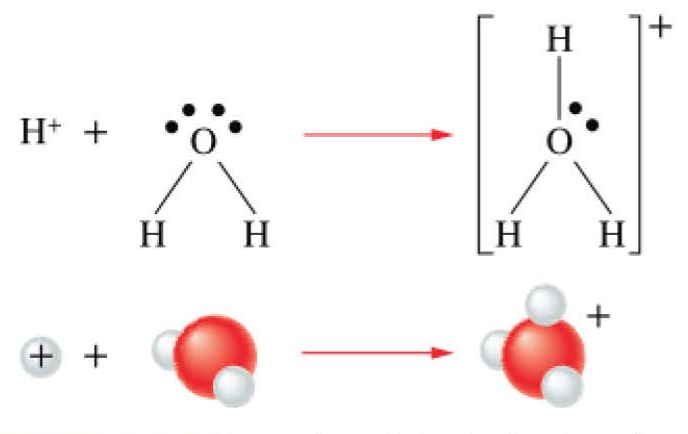
When acids dissolve in water, they donate protons to water molecules. This creates a special ion called the hydronium ion, written as .
Note
You might also see the hydronium ion written simply as . Both notations represent the same thing, but writing makes it clearer that a proton transfer has occurred. In reality, a free proton () cannot exist independently in solution - it immediately bonds to a water molecule to form the hydronium ion.
Example
Example: Hydrochloric Acid in Water
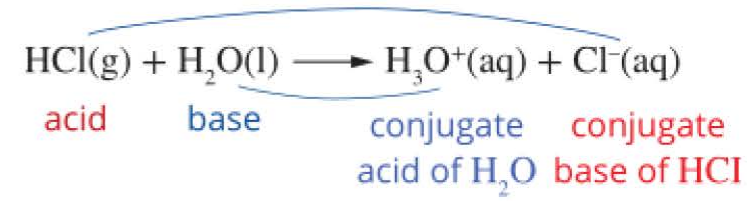
When hydrogen chloride gas dissolves in water, nearly all the molecules break apart and form ions. This creates hydrochloric acid:
In this reaction:
- Each molecule donates a proton to a water molecule, so acts as an acid
- Each water molecule accepts a proton from , so water acts as a base
Advantages of the Brønsted-Lowry model
The Brønsted-Lowry theory is more useful than earlier models because it's not limited to reactions in water. For example, it can describe reactions between gases:
In solution:
As gases:
Both reactions involve the same proton transfer from acid to base, so the Brønsted-Lowry theory classifies both as acid-base reactions.
Conjugate acid-base pairs
When an acid donates a proton, it becomes a new species that could potentially accept a proton back. These related species form what we call a conjugate acid-base pair.
Understanding conjugate pairs
Important
Definition: A conjugate acid-base pair consists of two species whose formulas differ by exactly one proton ().
Example
Example: Identifying Conjugate Pairs in the HCl Reaction
Looking at the reaction of hydrochloric acid with water:
- can be formed from by losing one proton, so is the conjugate base of HCl
- is the conjugate acid of Cl
- Together, and form a conjugate acid-base pair
- Similarly, and also form a conjugate pair
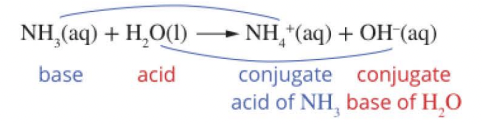
By convention, we usually write the acid form of the conjugate pair first.
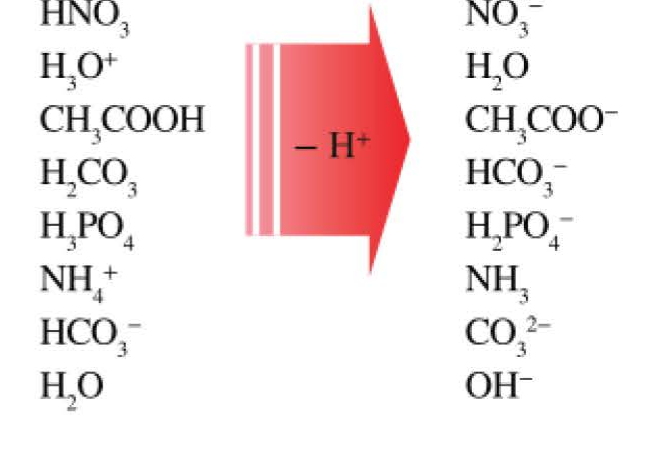
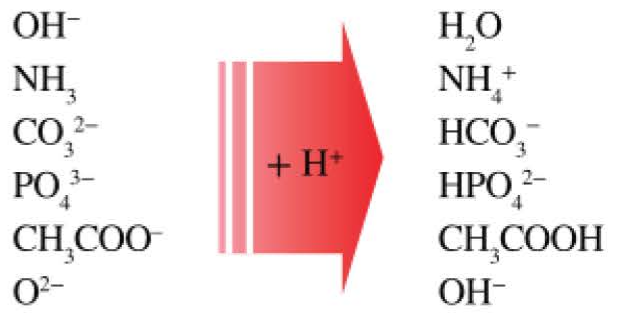
Common conjugate pairs
When an acid loses a proton, it forms its conjugate base:
When a base gains a proton, it forms its conjugate acid:
Ionisation reactions
When acids react with water, they produce hydronium ions (). When bases react with water, they produce hydroxide ions (). We call these ionisation reactions because ions are formed.
Writing equations for acid-base reactions
Chemical equations help us represent acid-base reactions clearly. When we show which species exist as ions, we call these ionic equations. For reactions in water, ions are in an aqueous state, shown by the symbol .
Understanding arrow symbols
Note
Arrow Notation in Chemical Equations:
Different arrow symbols tell us different things about how complete a reaction is:
Complete reactions use a forward arrow ():
This indicates that virtually all the molecules react when sufficient water is present.
Incomplete reactions use a reversible arrow ():
This indicates that only a small proportion of reactant molecules are consumed, so the reaction mixture contains both reactants and products.
Amphiprotic substances
Important
Definition: Amphiprotic substances can behave as either an acid or a base, depending on what they're reacting with. These substances can either donate or accept protons, depending on the reaction conditions.
Water as an amphiprotic substance
Water is the most important example of an amphiprotic substance. It can either donate or accept protons.
Example
Example: Water as an Amphiprotic Substance
Water acting as a base (accepting a proton from ):
Water acting as an acid (donating a proton to ):
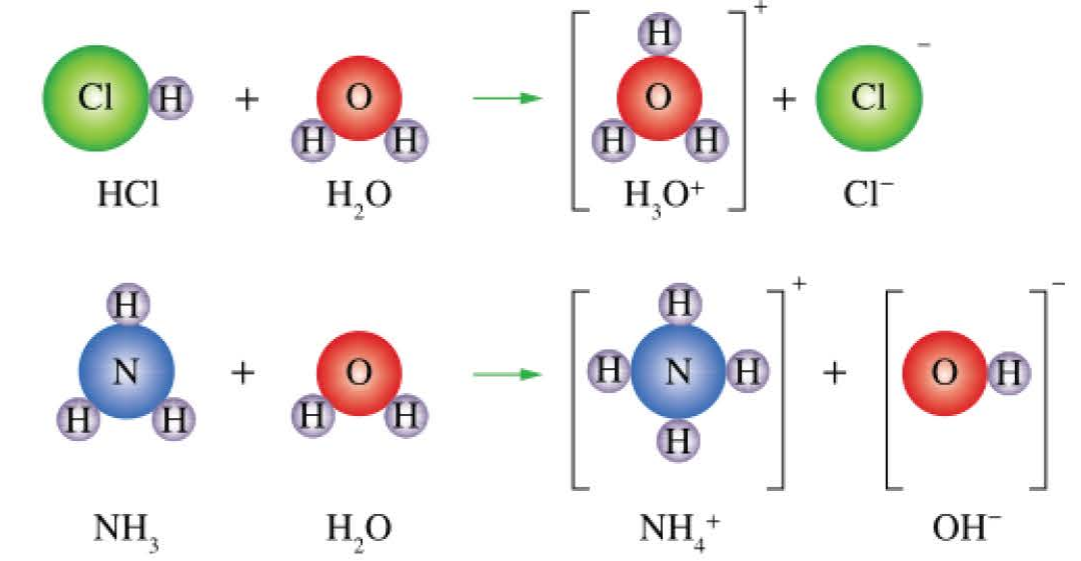
Whether water acts as an acid or base depends on the other reactant. If the other substance is a stronger acid than water, water will act as a base. If the other substance is a stronger base than water, water will act as an acid.
Other amphiprotic substances
Many other substances are amphiprotic. They can donate a proton under some conditions or accept a proton under other conditions.
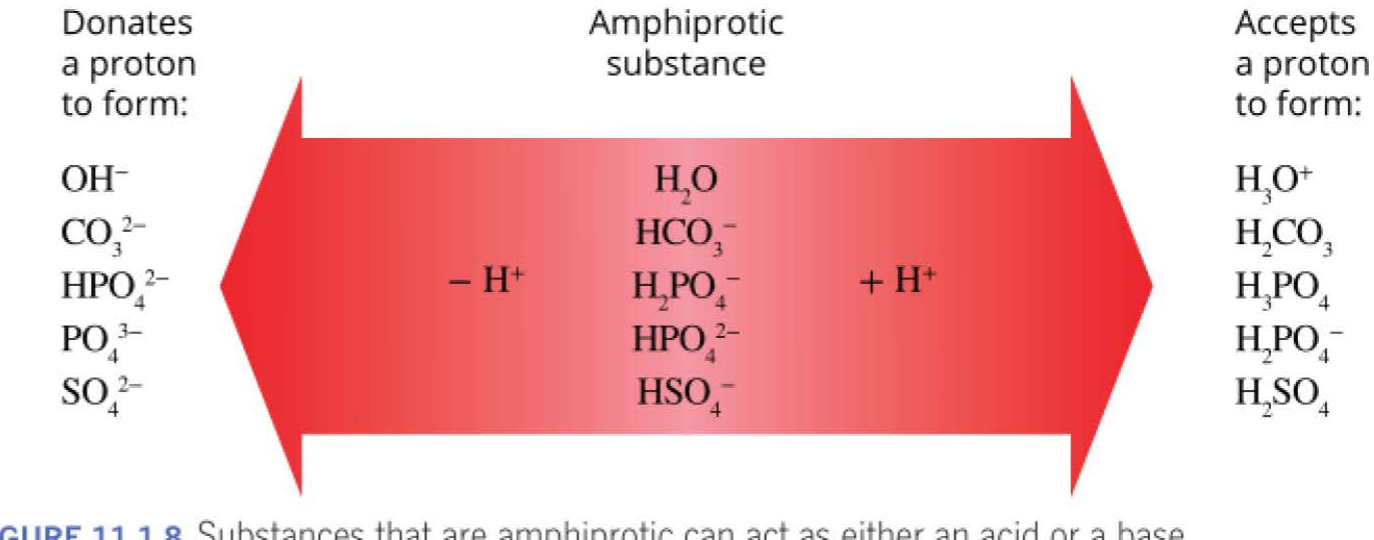
Example
Example: Hydrogen Carbonate Ion as Amphiprotic
The hydrogen carbonate ion () is amphiprotic. In water, it can react in two ways:
As an acid (donating a proton):
As a base (accepting a proton):
The reversible arrows () indicate that doesn't react completely as either an acid or a base.
Note
For most amphiprotic substances in water, one reaction usually dominates over the other. We can identify which reaction is dominant by measuring the pH of the solution.
Monoprotic acids
Monoprotic acids can donate only one proton per molecule. Common examples include:
- Hydrochloric acid ()
- Hydrofluoric acid ()
- Nitric acid ()
- Ethanoic acid ()
The acidic proton
Note
Even though ethanoic acid contains four hydrogen atoms, each molecule can donate only one proton. This makes it monoprotic. Only the hydrogen atom bonded to the electronegative oxygen atom can be donated. We call this the acidic proton.
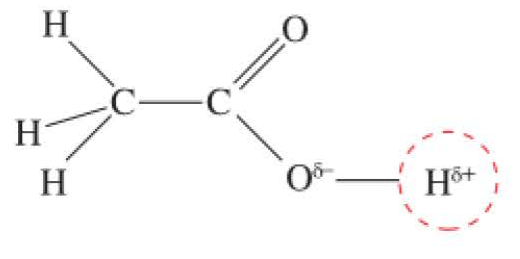
The acidic proton is part of a highly polar O-H bond. The other three hydrogen atoms are bonded to carbon and cannot be donated as protons.
Polyprotic acids
Polyprotic acids can donate more than one proton per molecule. The number of protons an acid can donate depends on its structure. Importantly, polyprotic acids don't donate all their protons at once. Instead, they donate them in stages when reacting with a base.
Diprotic acids
Diprotic acids can donate two protons. Examples include sulfuric acid () and carbonic acid ().
Example
Example: Stepwise Ionisation of Sulfuric Acid (Diprotic)
A diprotic acid ionises in two stages. Let's look at sulfuric acid:
Stage 1:
Sulfuric acid is a strong acid, so this first stage occurs almost completely. Virtually no molecules remain in aqueous solution, which is why we use the forward arrow ().
Stage 2:
The hydrogen sulfate ion () formed in stage 1 can also act as an acid. However, it's a weak acid, so only a small proportion reacts further in a 1.0 M solution. The reversible arrow () indicates this incomplete reaction.
Therefore, a solution of sulfuric acid contains hydrogen ions, hydrogen sulfate ions, sulfate ions, and water molecules.
Triprotic acids
Triprotic acids can donate three protons. Examples include phosphoric acid () and arsenic acid ().
Example
Example: Stepwise Ionisation of Phosphoric Acid (Triprotic)
A triprotic acid ionises in three stages:
Stage 1:
Stage 2:
Stage 3:
Phosphoric acid is a moderately weak acid. In a 1.0 M solution, only a small proportion of protons is donated at each stage. The extent of ionisation decreases progressively from stage 1 to stage 3. This happens because removing a positive proton from an already negatively charged species becomes more difficult at each step.
Summary
Key Points to Remember:
- Acids are proton donors and bases are proton acceptors according to the Brønsted-Lowry theory
- A conjugate acid-base pair consists of two species that differ by exactly one proton ()
- Amphiprotic substances can act as either acids or bases depending on what they react with; water is the most common example
- Monoprotic acids donate one proton, while polyprotic acids can donate two or more protons in successive stages
- When acids react with water, they produce hydronium ions (); when bases react with water, they produce hydroxide ions ()
- The Brønsted-Lowry theory is more versatile than the Arrhenius theory because it applies to reactions beyond aqueous solutions
- In polyprotic acids, each successive proton is harder to remove than the previous one