Calculations Involving Equilibrium (VCE SSCE Chemistry): Revision Notes
📚Revision Notes
Calculations Involving Equilibrium
Introduction
The equilibrium constant (K) is a numerical value that tells us about a chemical reaction at equilibrium. It is calculated using the equilibrium law, which is a mathematical expression showing the ratio of product concentrations to reactant concentrations. Understanding how to work with K values is essential for predicting how far a reaction will proceed and what concentrations of substances will be present when equilibrium is reached.
Note
In this note, you will learn how to:
- Interpret K values to understand reaction extent
- Calculate equilibrium constants from concentration data
- Determine unknown equilibrium concentrations using K
- Use ICE tables - a systematic method for solving equilibrium problems involving stoichiometry
How equilibrium constant depends on the equation
The value of K depends on exactly how you write the balanced chemical equation for a reaction. The same equilibrium system can be represented by different equations, and each version will have a different K value. Let's look at how K changes when equations are modified.
Reversed equations
When you reverse a chemical equation (swap reactants and products), the equilibrium constant becomes the reciprocal (inverse) of the original value.
For example:
- Forward: where
- Reverse: where
The K values are reciprocals:
Note
Mnemonic: "Reverse the equation, flip the K"
This reciprocal relationship means if you know one K value, you can instantly calculate the other by taking 1 divided by the known value.
Doubled coefficients
When you multiply all coefficients in an equation by 2, the new K value is the square of the original K value.
For example:
- Original: where
- Doubled: where
The relationship is:
Halved coefficients
When you divide all coefficients by 2, the new K value is the square root of the original K value.
For example:
- Original: where
- Halved: where
The relationship is:
Important
Exam tip: Always quote the balanced equation when stating a K value, as the same equilibrium can have different K values depending on how the equation is written.
Interpreting equilibrium constant values
The magnitude of K tells us about the extent of reaction - in other words, how far the forward reaction proceeds before equilibrium is established. By looking at the size of K, we can predict the relative amounts of reactants and products present at equilibrium.
Large K values (K > 10⁴)
When K is very large (greater than ), the reaction goes almost to completion. At equilibrium, the concentration of products is much higher than the concentration of reactants. This happens because the numerator (products) in the equilibrium expression must be much larger than the denominator (reactants) to give a large K value.
Note
Mnemonic: "Big K, Big Products"
A large K value means the products dominate at equilibrium.
Example: For the dissociation of hydrochloric acid in water:
At 25°C, M. This very large K value tells us that HCl is a strong acid that dissociates almost completely in water.
Intermediate K values (10⁻⁴ < K < 10⁴)
When K is between and , the reaction proceeds to a significant extent, but doesn't go to completion. At equilibrium, there are appreciable (measurable) concentrations of both reactants and products present.
Example: For the Haber process (ammonia synthesis):
At 400°C, M. This means that at equilibrium, both nitrogen/hydrogen gases and ammonia are present in significant amounts.
Small K values (K < 10⁻⁴)
When K is very small (less than ), very little reaction occurs. At equilibrium, the concentration of reactants is considerably higher than the concentration of products. The numerator (products) must be much smaller than the denominator (reactants) to give a small K value.
Note
Mnemonic: "Small K, Small Products"
A small K value means the reactants dominate at equilibrium.
Example: For the dissociation of acetic acid (ethanoic acid) in water:
At 25°C, M. This small K value indicates that acetic acid is a weak acid that only partially dissociates in water, with most molecules remaining as .
Case study: Equilibrium in blood
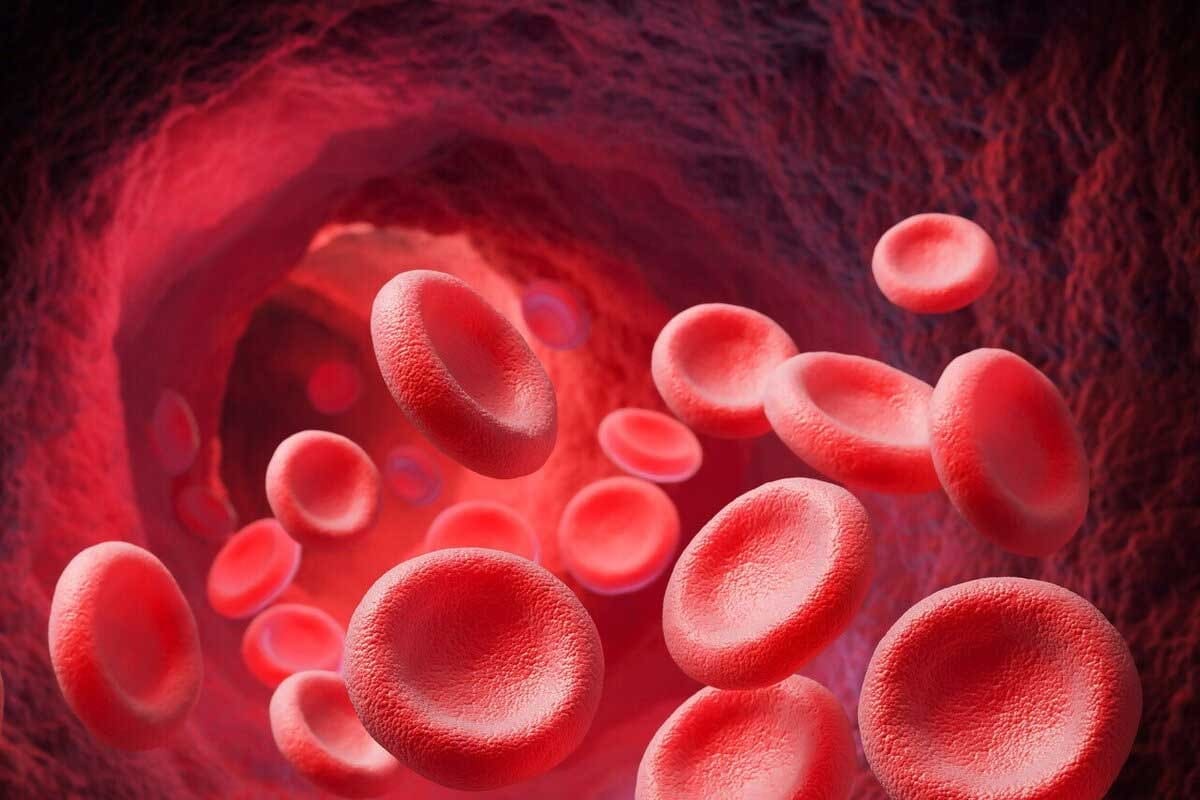
Haemoglobin is a large protein molecule found in red blood cells that transports oxygen from your lungs to cells throughout your body. The haemoglobin molecule combines reversibly with oxygen to establish an equilibrium:
Carbon monoxide (CO) is a colourless, odourless, and tasteless gas produced during incomplete combustion of fuels. It is present in cigarette smoke and vehicle exhaust fumes.
Important
Carbon monoxide is highly toxic because it also reacts with haemoglobin:
The equilibrium constant for the carbon monoxide reaction is approximately 20,000 times larger than for the oxygen reaction. This much larger K value means that carbon monoxide binds to haemoglobin far more readily than oxygen does.
Even small concentrations of carbon monoxide in the air can shift the equilibrium strongly toward carboxyhaemoglobin formation. When carboxyhaemoglobin forms, it reduces the concentration of free haemoglobin available. This causes the oxyhaemoglobin equilibrium to shift backward (Le Chatelier's principle), releasing oxygen.
Note
In severe cases of carbon monoxide poisoning, almost no oxyhaemoglobin remains in the blood, preventing oxygen transport to body tissues. This demonstrates the critical importance of equilibrium constant values in biological systems.
Calculating equilibrium constants from concentrations
When you know the equilibrium concentrations of all reactants and products, you can calculate the equilibrium constant K. The key steps are:
- Convert any amounts given in moles to concentrations using
- Write the equilibrium expression for K
- Substitute the equilibrium concentrations into the expression
- Calculate K and determine its units
Important
The concentrations used to calculate K must be the equilibrium concentrations, not initial concentrations or amounts.
Example
Worked Example: Calculating K
Problem: A 2.00 L vessel contains a mixture of 0.0860 mol of , 0.124 mol of , and 0.716 mol of HI in equilibrium at 460°C according to:
Calculate the value of K at 460°C.
Solution:
Step 1: Convert moles to molar concentrations using
The volume of the vessel = 2.00 L
Step 2: Write the expression for K
Step 3: Substitute equilibrium concentrations into the expression
Step 4: Determine the units
The units cancel, so K has no units in this case.
Calculating equilibrium concentrations using K
Sometimes you need to "work backwards" - using the known value of K to find an unknown equilibrium concentration. This involves rearranging the equilibrium expression to make the unknown concentration the subject.
Example
Worked Example: Finding an Equilibrium Concentration
Problem: Consider the equilibrium with M at 250°C:
An equilibrium mixture contains 0.0020 M and 0.0010 M at 250°C. Calculate the equilibrium concentration of .
Solution:
Step 1: Write the expression for K
Step 2: Substitute known values into the expression
Step 3: Rearrange to make the subject and solve
The equilibrium concentration of chlorine gas is 0.80 mol L⁻¹.
Using ICE tables for equilibrium calculations
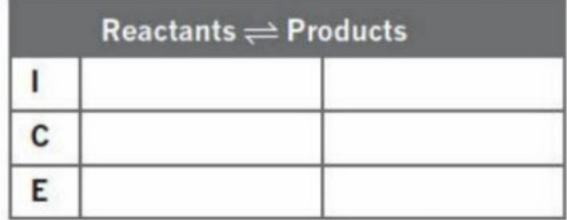
When you need to use stoichiometry to find equilibrium amounts before calculating K, an ICE table (reaction table) is very helpful. ICE stands for Initial, Change, and Equilibrium - the three rows of the table.
Note
ICE Table Method:
The ICE table method involves these steps:
- Setting up a table with columns for each species in the equation
- Filling in the Initial amounts (usually in moles)
- Expressing the Change in terms of a variable (usually x)
- Calculating the Equilibrium amounts
- Converting to concentrations and calculating K
Understanding the change row
In the Change row, you use the stoichiometric coefficients from the balanced equation to relate changes in different species:
- When a species is consumed (reactant), the change is negative (−x)
- When a species is produced (product), the change is positive (+x)
- The coefficients determine the ratio of changes
Example
Worked Example: Using an ICE Table
Problem: An equilibrium is established at a specified temperature:
0.540 mol of A was placed in a 2.00 L vessel. When equilibrium was reached, 0.280 mol of B was present. Calculate K.
Solution:
Step 1: Set up the ICE table
| A(g) | 2B(g) | |
|---|---|---|
| I | 0.540 mol | 0.00 mol |
| C | −x | +2x |
| E | 0.540 − x | 2x = 0.280 mol |
Step 2: Calculate x using the equilibrium amount of B
Since at equilibrium there is 0.280 mol of B:
Step 3: Calculate equilibrium moles of A
Step 4: Convert to concentrations using where V = 2.00 L
Step 5: Write the K expression and substitute values
Important
When to use ICE tables:
ICE tables are most useful when you know initial amounts and one equilibrium amount, but need to find other equilibrium amounts. The stoichiometric relationships ensure all changes are correctly related.
Summary
Key Points to Remember:
-
The value of K depends on how the equation is written. When reversing an equation, K becomes its reciprocal. When doubling coefficients, K is squared.
-
Large K values (> ) indicate reactions that go almost to completion with products dominating at equilibrium. Small K values (< ) indicate negligible reaction with reactants dominating.
-
To calculate K, you must use equilibrium concentrations (not initial amounts). Convert moles to concentration using .
-
You can rearrange the equilibrium expression to calculate an unknown equilibrium concentration when you know K and the other concentrations.
-
ICE tables provide a systematic method for solving equilibrium problems involving stoichiometry. The rows represent Initial amounts, Changes (in terms of x), and Equilibrium amounts. Use stoichiometric coefficients to relate changes in different species.