Dynamic Equilibrium (VCE SSCE Chemistry): Revision Notes
📚Revision Notes
Dynamic Equilibrium
Introduction to reversible reactions
Some chemical reactions can occur in both the forward and reverse directions. These are called reversible reactions. Reversible reactions are found in many everyday situations, including:
- Chemical manufacturing processes (e.g., ammonia production)
- Reactions of ions within cells in your body
- Environmental reactions involving carbon dioxide
In reversible reactions, products can react with each other to reform the original reactants. At a certain point, these reactions appear to stop, even though reactants remain. The concentrations of all substances become constant. However, at the atomic level, reactions continue to occur—reactants form products at exactly the same rate that products reform reactants.
Note
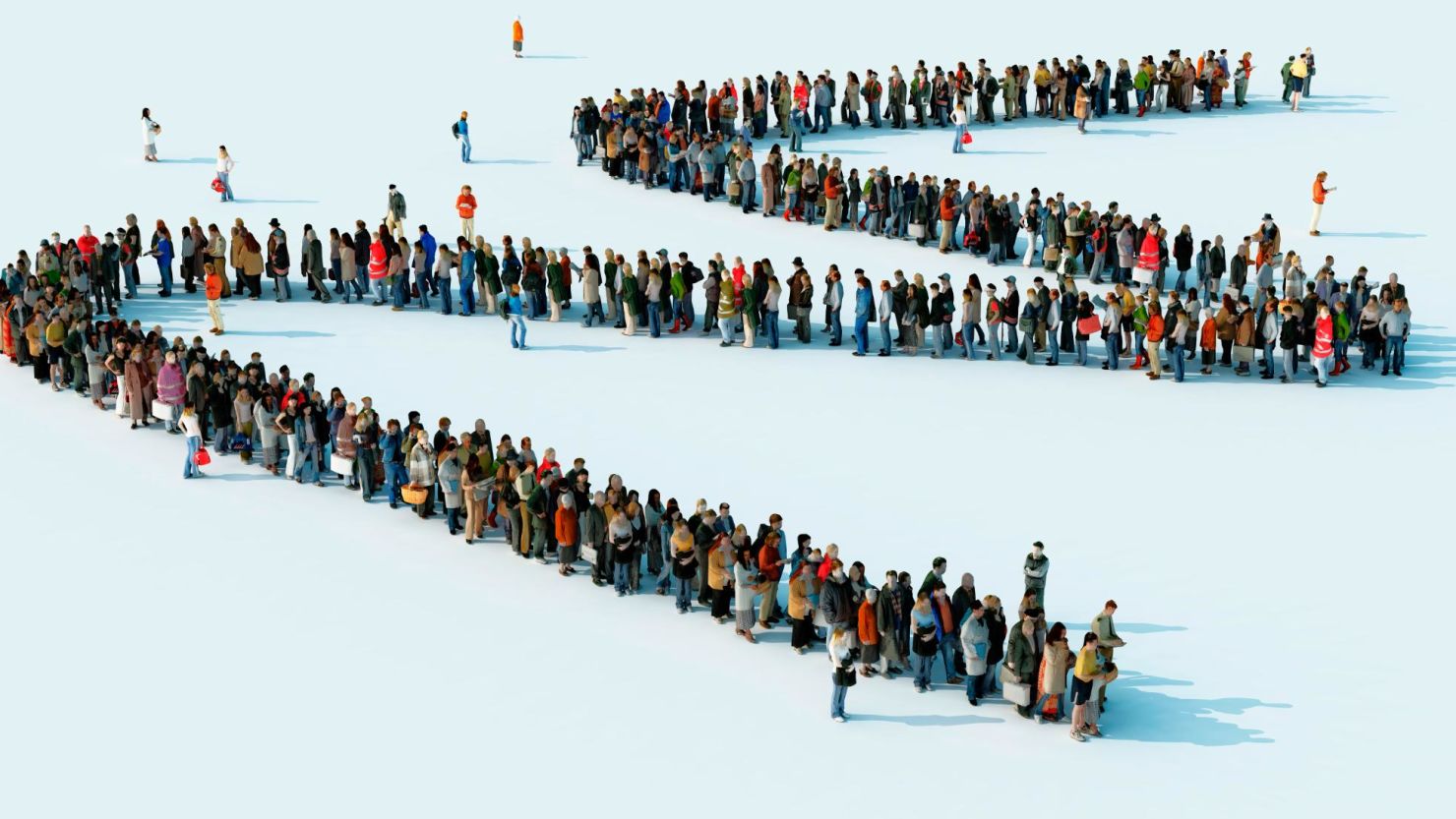
The Queue Analogy
This situation is similar to a queue of constant length. Although the queue appears unchanged, people are continuously leaving at one end whilst others join at the other end at the same rate. This demonstrates how equilibrium appears static on a large scale but is dynamic at the molecular level.
Open and closed systems
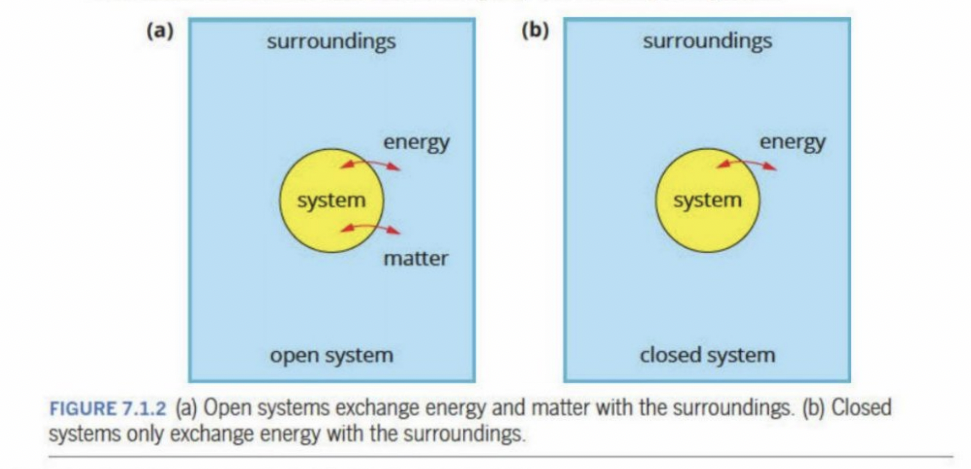
A chemical reaction can be viewed as a system, with everything else around it (the rest of the universe) called the surroundings.
In an endothermic reaction, the system absorbs energy from the surroundings. In an exothermic reaction, the system releases energy to the surroundings.
There are two types of systems:
Open systems
Open systems exchange both matter and energy with the surroundings. Most everyday situations involve open systems.
Note
Example: Bushfire
A bushfire burning through a forest is an open system. Carbon dioxide and water vapour produced by burning trees are released into the atmosphere—both matter and energy escape to the surroundings.
Closed systems
Closed systems exchange only energy with the surroundings. Matter cannot enter or leave the system.
Note
Example: Submarine
A submarine operating underwater can be regarded as a closed system, with a carefully monitored internal environment. Energy can be exchanged, but matter (gases, water, etc.) is contained within the vessel.
Irreversible reactions
Many reactions proceed in only one direction. These are called non-reversible or irreversible reactions. In these reactions, products cannot be converted back to reactants under normal conditions.
Examples of irreversible reactions
Baking a cake involves several irreversible chemical reactions:
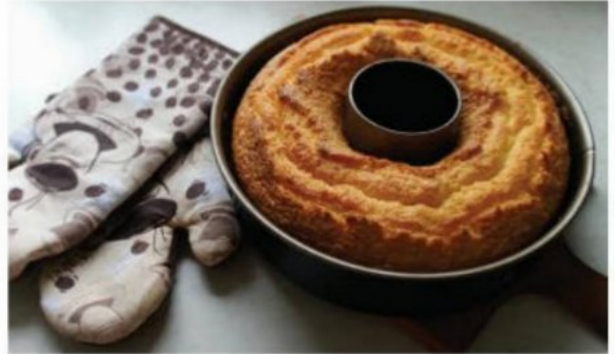
Once the cake is baked, the chemical changes cannot be reversed—you cannot "un-bake" a cake to recover the original flour, eggs, and sugar.
Combustion reactions such as burning methane are also irreversible:
Once the fuel has burnt, the products (carbon dioxide and water) will not react with each other under normal conditions to reform methane and oxygen.
Important
Key Difference: Reversible vs Irreversible
The fundamental distinction is that irreversible reactions use a single arrow (→), showing the reaction proceeds in one direction only, whilst reversible reactions use double arrows (⇌), indicating the reaction can proceed in both directions.
Reversible reactions
In reversible reactions, products can react together to reform the original reactants. Once some products form, collisions between product particles can result in the reactants being re-formed.
Representing reversible reactions
A double arrow () is used when writing chemical equations to show a reversible process.
For example, the phase change of water:
The Haber process
The production of ammonia from hydrogen and nitrogen gases is known as the Haber process. This is an important example of a reversible reaction:
If you mix of nitrogen gas with of hydrogen gas in a sealed container, you might expect of ammonia to eventually form (based on the equation stoichiometry). However, the reaction appears to 'stop' when much less than of ammonia is present.
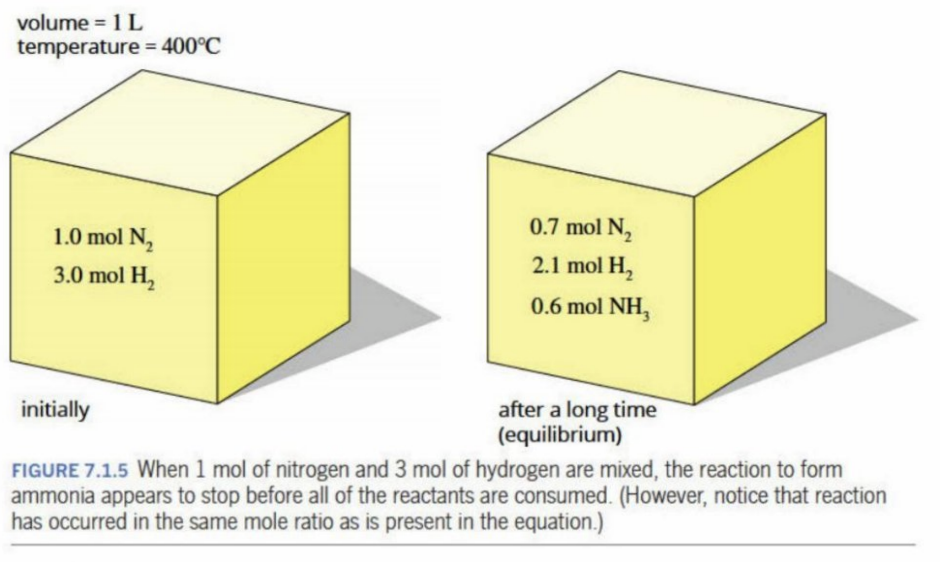
The reaction vessel is a closed system from which reactants and products cannot escape. Reversible reactions in closed systems eventually reach a situation where the rate of the forward reaction equals the rate of the reverse reaction. At this point, there appears to be no further change—the system has reached equilibrium. Significant amounts of reactants may still be present at equilibrium.
Explaining reversibility
Energy profile diagrams help us understand why reversible reactions can occur. When particles collide, the energy from collisions can break bonds in the reacting particles, allowing them to rearrange to form products. The energy required to break the bonds of the reactants is called the activation energy.
An energy profile diagram shows that once products form, it is possible for the reverse process to occur. If newly formed product particles collide with enough energy to break their bonds, they can reform the original reactants.
Important
Important Points About Reversibility:
- Both forward and reverse reactions require activation energy
- If the forward reaction is endothermic, the reverse reaction is exothermic (and vice versa)
- The activation energy for the reverse reaction is different from that of the forward reaction
Explaining equilibrium
The Haber process is a reversible reaction, so it should be written with an equilibrium arrow:
Important
Using Equilibrium Arrows Correctly
Equilibrium arrows indicate that the reaction can occur in both forward and reverse directions. These arrows should only be used where the reaction can proceed in both directions.
How equilibrium is established
When nitrogen and hydrogen gases are mixed in a sealed container at constant temperature, the following sequence of events occurs:
Example
Worked Example: Establishing Equilibrium in the Haber Process
Step 1 - Initially: Nitrogen and hydrogen molecules collide and form ammonia (forward reaction). As the forward reaction proceeds, concentrations of nitrogen and hydrogen decrease, so collision frequency decreases and the rate of ammonia production decreases.
Step 2 - As ammonia forms: Some ammonia molecules collide and decompose to reform nitrogen and hydrogen (reverse reaction). The rate of the reverse reaction increases as ammonia concentration increases.
Step 3 - At equilibrium: Eventually, the forward and reverse reactions proceed at the same rate. Ammonia is formed at exactly the same rate as it breaks down. The concentrations of ammonia, nitrogen and hydrogen remain constant. To an observer, the reaction appears to have stopped.
Graphs showing equilibrium
Rate versus time graph:
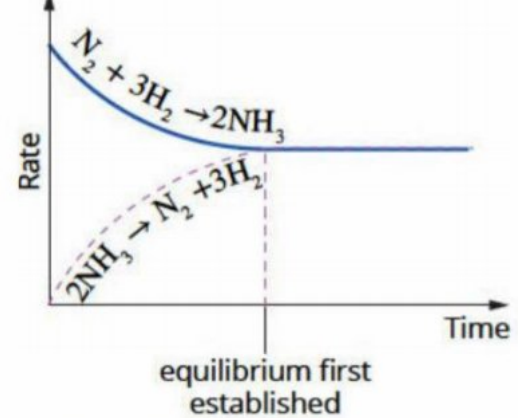
This graph shows:
- The forward reaction rate (blue line) starts high and decreases as reactants are consumed
- The reverse reaction rate (dashed line) starts at zero and increases as products form
- Equilibrium is established when the two rates become equal
Concentration versus time graph:
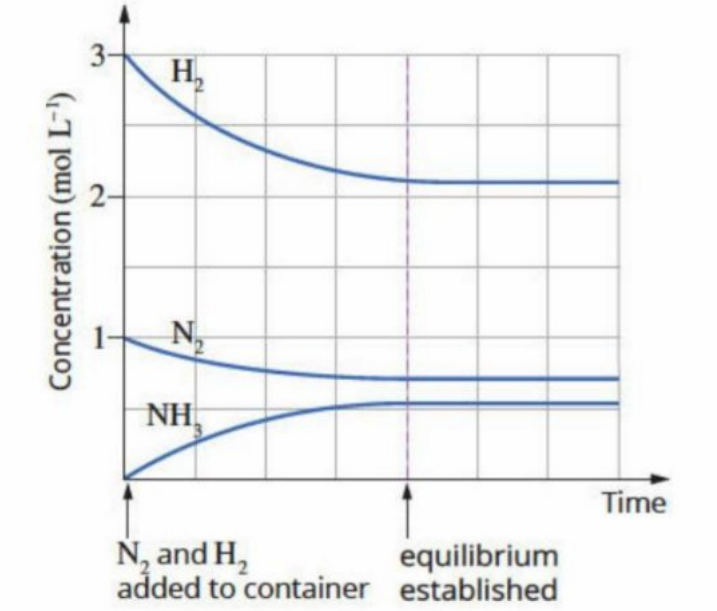
This graph shows:
- Hydrogen concentration starts at and decreases
- Nitrogen concentration starts at and decreases
- Ammonia concentration starts near zero and increases
- All concentrations become constant once equilibrium is established (horizontal lines)
- The graphs show that reactants are consumed in the mole ratio shown in the equation
Important
Exam Tip: Interpreting Equilibrium Graphs
When interpreting graphs involving equilibrium systems, always check whether the data shows concentration versus time or reaction rate versus time. These tell you different things about the system:
- Concentration graphs show how much of each substance is present over time
- Rate graphs show how quickly reactions are proceeding over time
Dynamic state of equilibrium
Chemical equilibrium exists in a dynamic state. This means that forward and reverse reactions have not stopped—they continue to occur simultaneously at the same rate. This is called dynamic equilibrium.
Characteristics of dynamic equilibrium
Note
What Makes Equilibrium "Dynamic"?
- The reaction is 'incomplete'—all substances (reactants and products) are present in the equilibrium mixture
- At the molecular level, bonds are constantly being broken and new bonds are being formed as reactants and products continue to be converted from one to another
- To an observer, nothing appears to be happening because concentrations remain constant
- The rates of the forward and reverse reactions are equal
Example: Decomposition of dinitrogen tetroxide
The decomposition of dinitrogen tetroxide gas () to nitrogen dioxide gas () demonstrates dynamic equilibrium visually:
is colourless, whilst is dark brown. When pure is placed in a sealed container, the following observations are made:
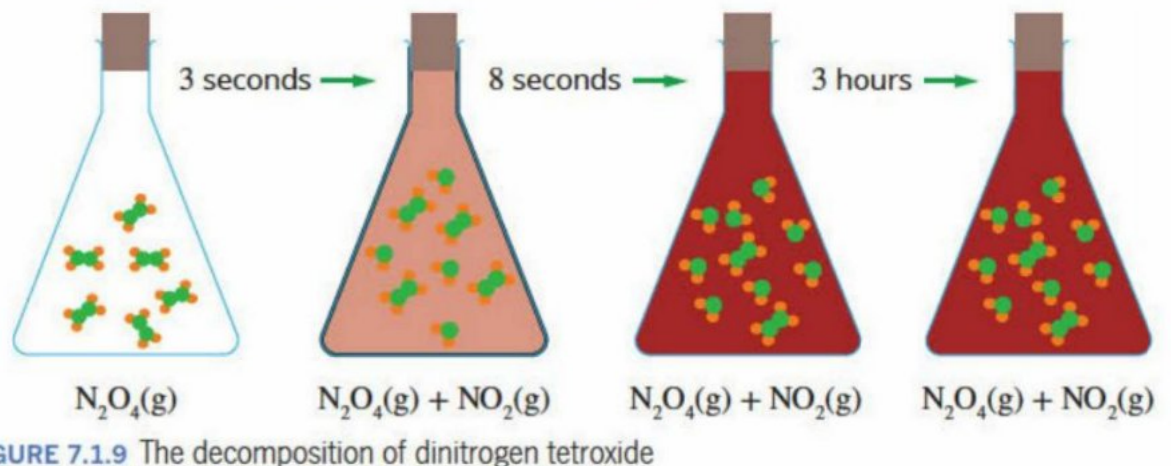
Example
Observing Dynamic Equilibrium Through Colour Change
- 3 seconds: Slight brown colour appears as begins to form
- 8 seconds: Deeper brown colour as more forms
- 3 hours: No further change in colour—equilibrium has been reached
After 8 seconds, equilibrium is established. The colour remains constant after this point, regardless of how long you wait. This demonstrates that the reaction appears to have stopped, even though both forward and reverse reactions continue at equal rates.
Extent of reaction
Not all reversible reactions proceed to the same extent before reaching equilibrium. The extent of reaction describes how much product is formed when the system reaches equilibrium.
Strong acids versus weak acids
Both hydrogen chloride () and ethanoic acid () react with water to form ions:
Solutions of both chemicals conduct electricity because they contain mobile ions. The electrical conductivity is proportional to the number of free ions in solution. By comparing the conductivity of solutions with the same concentration, we can determine how much each compound ionises.
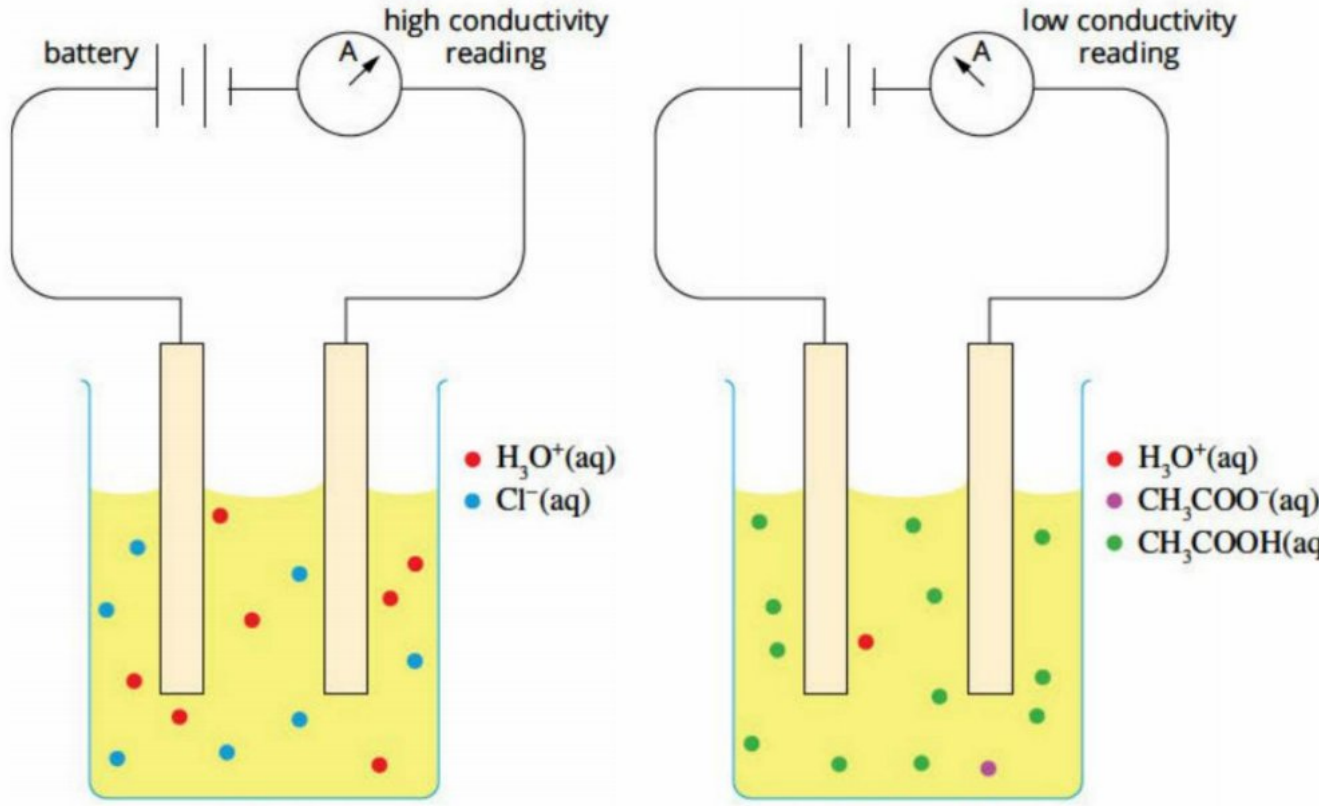
Example
Comparing Strong and Weak Acids
Observations:
- The hydrochloric acid solution conducts electricity much better than the ethanoic acid solution
- Both solutions were made by adding the same number of moles of acid to identical volumes of water
Results at equilibrium in a solution at :
- Almost all molecules are ionised (strong acid)
- Only approximately 1% of molecules are ionised (weak acid)
Conclusion: Different reactions proceed to different extents. The ratios of reactants to products are different for different equilibrium systems.
Important distinction: Extent versus rate
Important
Don't Confuse Extent with Rate!
The extent of reaction describes how much product is formed when equilibrium is reached. It does not tell us how fast the reaction proceeds.
The rate of reaction measures how quickly concentrations change with time. It is not directly related to the extent of reaction. Reversible reactions can have rates ranging from very slow to very fast—the rate determines how long it takes to reach equilibrium, not how much product forms.
Note
Since is almost completely ionised in water, the equation is often written with a single arrow rather than equilibrium arrows:
Investigating dynamic equilibrium
Chemists can use radioactive isotopes to investigate systems in dynamic equilibrium. Radioactive isotopes behave chemically the same way as non-radioactive atoms of the same element, but their presence can be detected using a radiation detector.
Saturated sodium iodide solution experiment
When solid sodium iodide () is added to water:
- It dissolves readily at first
- As concentration increases, a saturated solution forms
- No further solid appears to dissolve
- Concentrations of and ions remain constant
- Some solid remains present
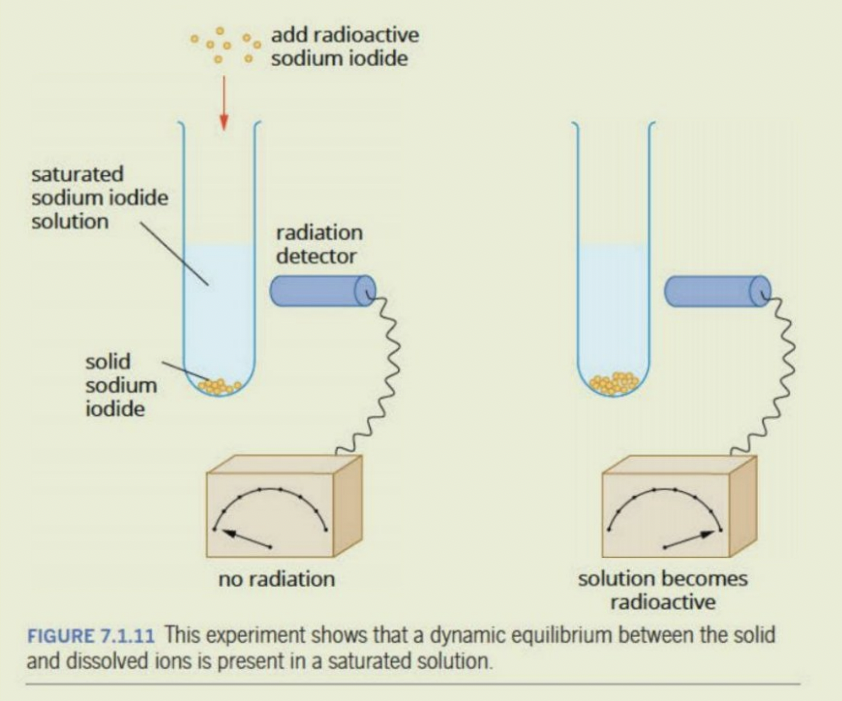
When solid sodium iodide containing radioactive iodide ions is added to a saturated solution, the movement of these 'labelled' ions can be traced:
Example
Demonstrating Dynamic Equilibrium with Radioactive Tracers
Observations:
- Although solid sodium iodide is still observed at the bottom of the container, the solution quickly becomes radioactive
- The radioactivity shows that some radioactive sodium iodide has dissolved
- The concentration of sodium iodide remains constant
- Therefore, non-radioactive particles must have crystallised from solution at the same rate as radioactive solid dissolved
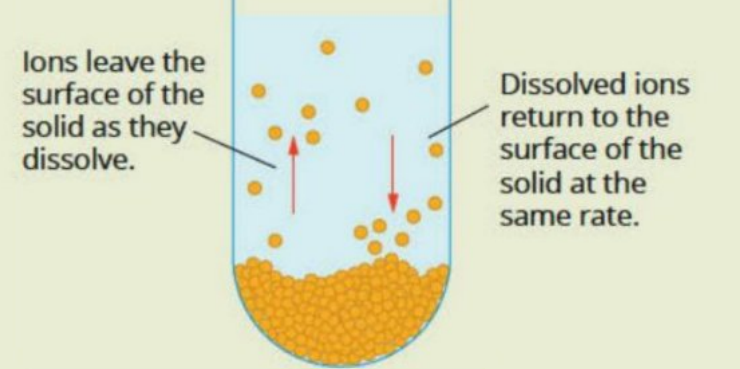
Conclusion: Even though we see nothing happening, there is continual activity at the surface of the solid. Ions leave the solid surface as they dissolve, whilst dissolved ions return to the solid surface at the same rate. The process is a dynamic equilibrium.
Limestone caves
A natural example of reversibility is the formation of stalactites and stalagmites in limestone caves.
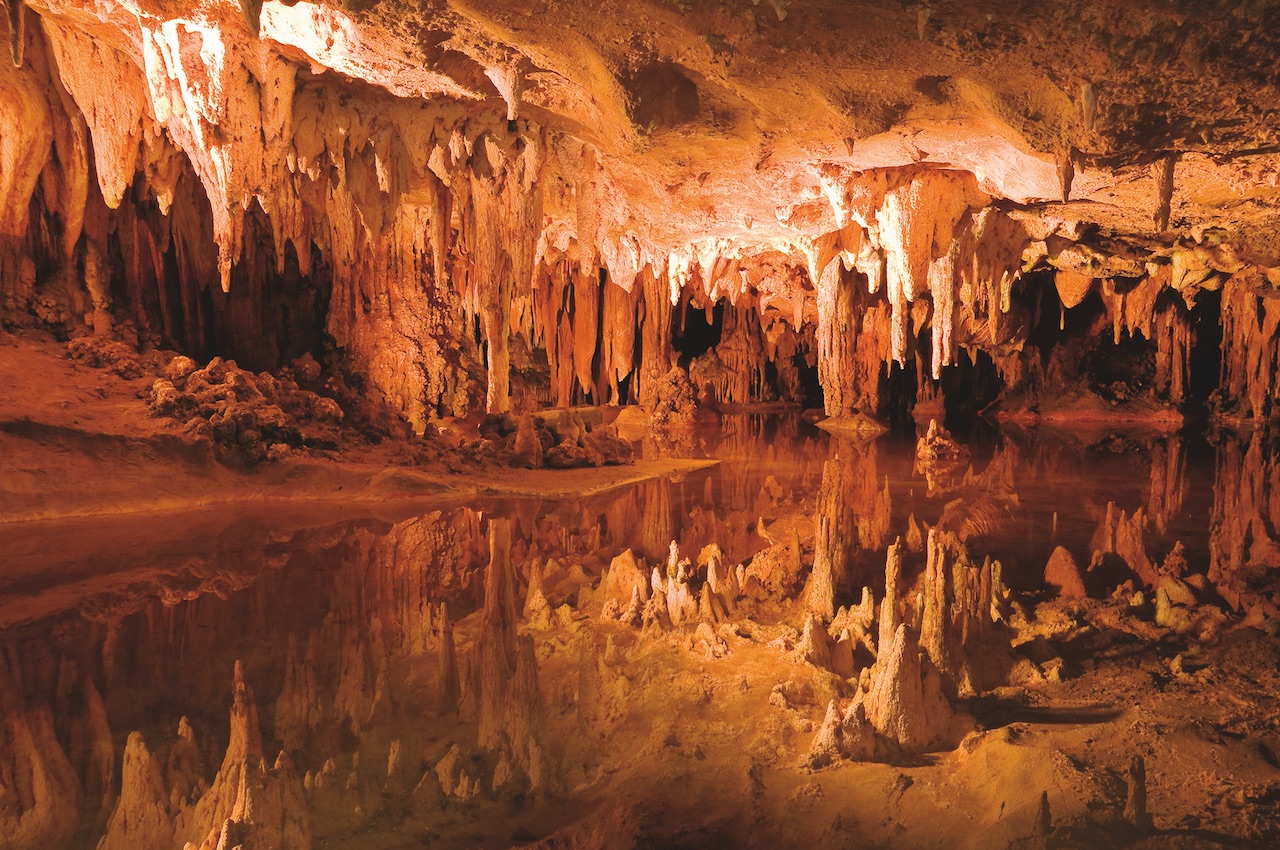
The main mineral in limestone is calcite (). Water saturated with carbon dioxide drips through the cave roof:
As water seeps through rocks, it becomes saturated with and ions. When the water evaporates, the reverse reaction produces stalactites from the ceiling:
Some solution drips onto the cave floor, where more deposits of form stalagmites. Stalactites and stalagmites grow in pairs and can produce beautiful columns.
Remember!
Summary
Key Points to Remember:
- Reversible reactions can occur in both forward and reverse directions, shown using equilibrium arrows ()
- Dynamic equilibrium occurs when forward and reverse reaction rates are equal—concentrations remain constant but reactions continue at the molecular level
- Closed systems are required for equilibrium—only energy (not matter) can be exchanged with surroundings
- At equilibrium: forward rate = reverse rate, all species present, concentrations constant, reactions continue
- Extent of reaction (how much product forms) is different from rate of reaction (how fast equilibrium is reached)