Le Châtelier’s Principle (VCE SSCE Chemistry): Revision Notes
📚Revision Notes
Le Châtelier's Principle
Introduction to Le Chatelier's principle
When a chemical system reaches equilibrium, the rates of the forward and reverse reactions are equal. However, equilibrium systems can respond to changes in their conditions. Understanding how equilibria respond to changes is essential for optimising chemical reactions in industry and nature.
Note
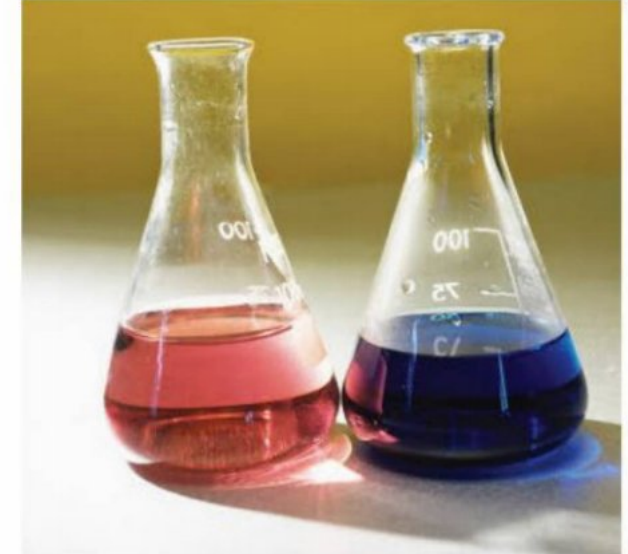
Le Chatelier's principle states that when an equilibrium system experiences a change, the system adjusts itself to partially oppose the effect of that change. A net reaction occurs that partially counteracts the change, and the system establishes a new equilibrium.
As a result, the position of equilibrium changes. This means the relative amounts of reactants and products at equilibrium shift. There may be an increase in either products or reactants, depending on the type of change applied.
Important
Important distinction: The position of equilibrium should not be confused with the equilibrium constant K. The value of only changes when temperature changes. Other changes (concentration, pressure, addition of catalyst) shift the equilibrium position but do not change .
Changes that affect equilibrium systems
The position of equilibrium can be changed by:
- Adding or removing a reactant or product
- Changing the pressure by changing the volume (for gas equilibria)
- Dilution (for equilibria in solution)
- Changing the temperature
Chemists use careful control of reaction conditions to maximise the yield of desired products by shifting the equilibrium position "to the right" (increasing the amount of products formed).
Adding or removing reactants and products
Effect of adding a reactant
Consider the equilibrium between nitrogen, hydrogen and ammonia:
When extra nitrogen gas is added to the container (without changing volume or temperature), the mixture temporarily moves out of equilibrium. The following events occur:
- Initially, the system is at equilibrium with equal rates of forward and reverse reactions
- Adding nitrogen increases its concentration, causing more frequent collisions between N₂ and H₂ molecules
- The rate of the forward reaction instantly increases, producing more NH₃
- As ammonia concentration increases, the rate of the reverse reaction also increases
- Eventually, the forward and reverse rates become equal again at a new equilibrium position
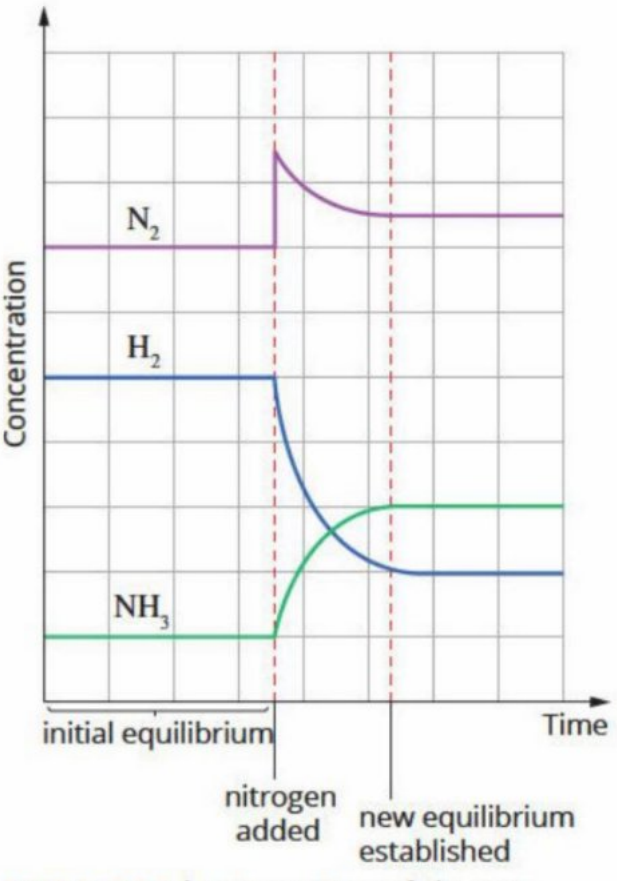
The equilibrium position shifts "to the right" (toward products). There is a net forward reaction with an increase in ammonia concentration at the new equilibrium.
Note
Although the nitrogen concentration decreases as the new equilibrium forms, its final concentration is still higher than in the original equilibrium. Le Chatelier's principle states that the change is only partially opposed, not completely reversed.
The value of remains unchanged because temperature has not changed.
Effect of adding a product
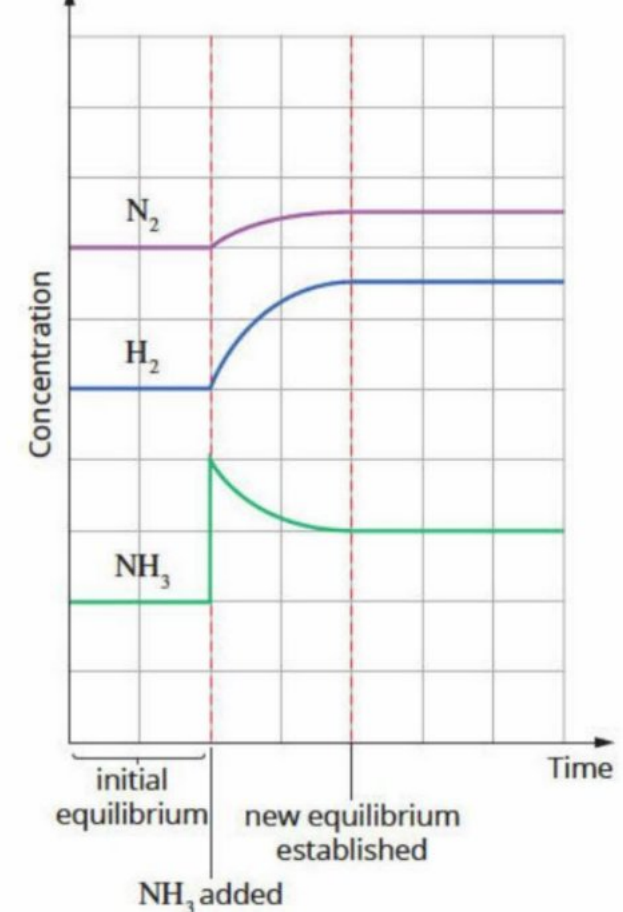
Adding more ammonia (product) to the system causes the opposite effect. The equilibrium position shifts "to the left" (toward reactants), resulting in a net reverse reaction. The overall ammonia concentration decreases compared to immediately after addition.
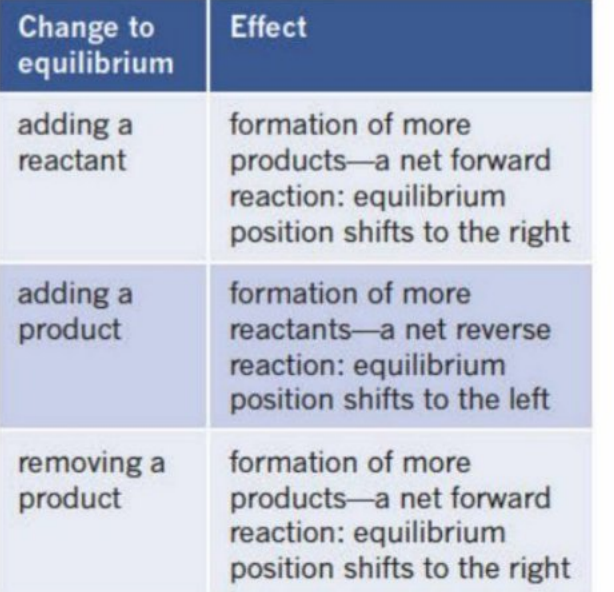
General effects of changes
Using the equilibrium law to predict changes
The effect of adding reactants or products can also be predicted using the equilibrium law and the reaction quotient Q.
Example
Worked Example: Predicting Equilibrium Shifts Using Q and K
For the nitrogen-hydrogen-ammonia equilibrium:
When extra nitrogen is added:
- The N₂ concentration increases
- The reaction quotient temporarily becomes less than
- When Q < K, a net forward reaction occurs
- Products increase and reactants decrease until Q = K again
This mathematical approach gives the same result as applying Le Chatelier's principle qualitatively.
Changing pressure by changing volume
The pressure of a gas is inversely proportional to its volume. This means pressure can be changed by increasing or decreasing the container volume at constant temperature.
Example: sulfur dioxide oxidation
Consider this equilibrium:
On the left side: 3 gas particles (2 SO₂ + 1 O₂) On the right side: 2 gas particles (2 SO₃)
The forward reaction reduces the number of gas particles from 3 to 2, which would decrease the overall pressure. The reverse reaction increases particles from 2 to 3, which would increase the overall pressure.
Applying Le Chatelier's principle to pressure changes
Le Chatelier's principle tells us that an equilibrium system responds to an increase in pressure by adjusting to reduce the pressure. The position of equilibrium moves toward the side with fewer gas particles.
In the sulfur dioxide example:
- Increasing pressure causes a net forward reaction
- Three gaseous reactant particles become two gaseous product particles
- The amount of SO₃ increases at equilibrium
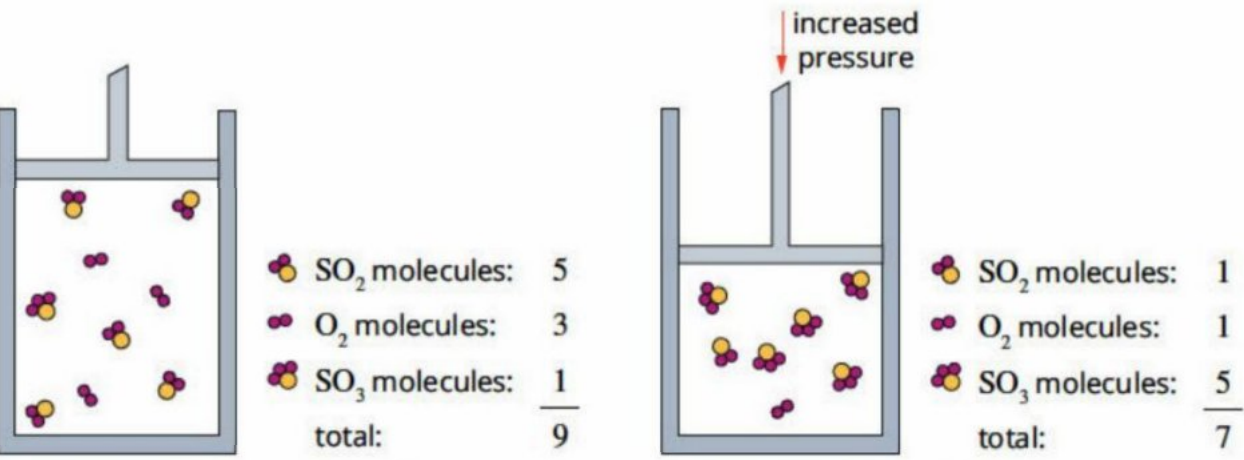
The effect can also be shown graphically:
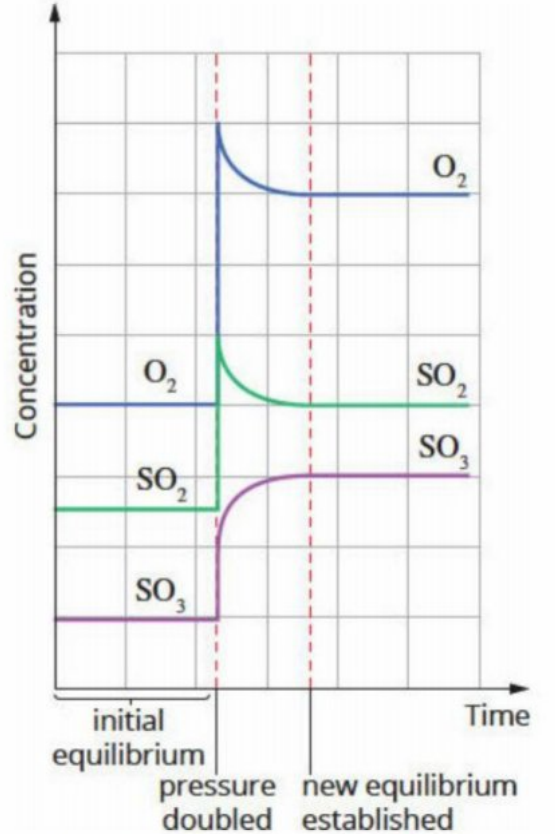
When pressure is initially increased (by decreasing volume), all concentrations increase simultaneously. As the system adjusts, concentrations gradually change until a new equilibrium is established. The equilibrium constant remains unchanged.
Important
Key rule: An increase in pressure favours the side of the reaction with fewer gas particles.
Using the equilibrium law to explain pressure changes
For the equilibrium:
The equilibrium constant is:
Example
Worked Example: Pressure Change Effect on Q
When the volume is halved, all partial pressures and concentrations double. The reaction quotient becomes:
Since Q < K, a net forward reaction occurs to increase until it equals again.
Special case: equal numbers of particles
When there are equal numbers of reactant and product gas particles, pressure changes do not shift the equilibrium position.
Example:
Left side: 2 gas particles Right side: 2 gas particles
Note
Regardless of which direction the system shifts, the total number of particles remains constant. The system cannot oppose the volume change by changing the number of particles.
Pressure changes in liquids and solids
Pressure changes do not affect equilibrium positions of systems in liquid or solid phases. Particles in these phases are too tightly packed for pressure changes to noticeably affect volume or concentration.
Changing pressure by adding an inert gas
Adding a non-reacting (inert) gas such as helium, neon or argon to an equilibrium mixture increases the total pressure but does not change the concentrations of reactants or products.
Note
Since the inert gas does not appear in the reaction equation or equilibrium constant expression, and concentrations remain unchanged, there is no effect on the equilibrium position or the value of .
Dilution of equilibria in solution
For equilibria occurring in solution, adding water (dilution) reduces the number of particles per unit volume. The equilibrium position shifts toward the side that produces the greater number of dissolved particles.
Example: iron(III) thiocyanate equilibrium
Left side: 2 particles in solution Right side: 1 particle in solution
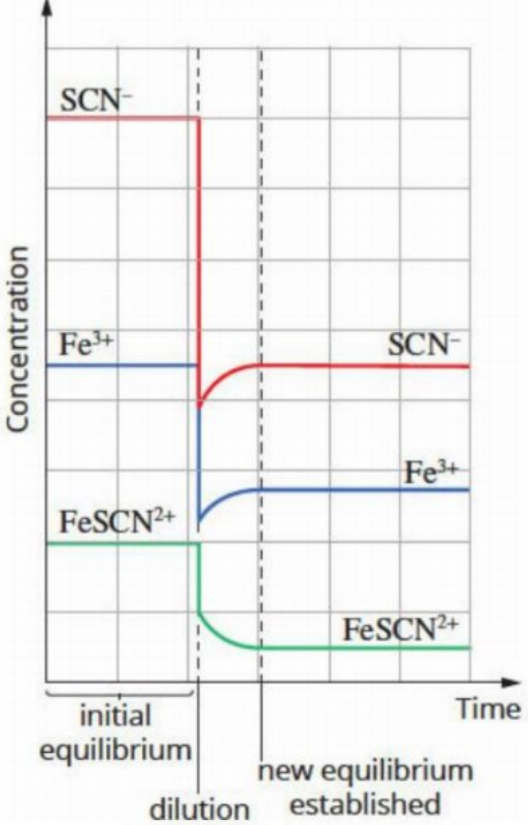
When water is added to double the volume, all concentrations are momentarily halved. According to Le Chatelier's principle, a net reverse reaction occurs to increase the total concentration of particles in solution.
Note
At the new equilibrium, the concentrations of Fe³⁺ and SCN⁻ are still lower than before dilution. The equilibrium shift only partially opposes the change.
Dilution of an aqueous equilibrium system has no effect on the value of .
Temperature changes and effects on the equilibrium constant
The equilibrium constant for a reaction depends only on temperature. It is not affected by:
- Addition of reactants or products
- Changes in pressure
- Use of catalysts
How temperature affects K
The effect of temperature on depends on whether the reaction is exothermic or endothermic.

Important
Critical concept: Only a change in temperature changes the value of K for a given reaction.
Example: nitrogen dioxide and dinitrogen tetroxide
The conversion of brown nitrogen dioxide gas to colourless dinitrogen tetroxide is exothermic:
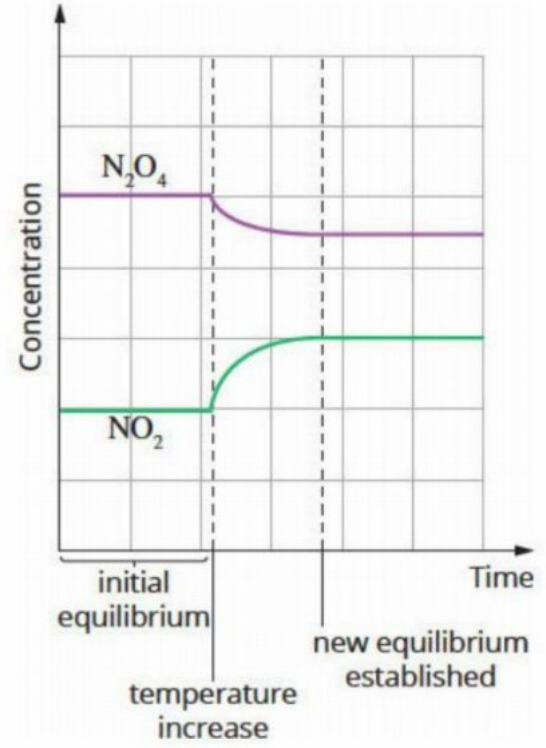
When the temperature increases:
- The system opposes the increase in energy by absorbing energy
- The reverse reaction is endothermic (absorbs energy)
- A net reverse reaction occurs
- Less N₂O₄ and more NO₂ are present at the new equilibrium
- The mixture appears darker brown
Note
Concentration-time graphs for temperature changes show gradual changes, not instantaneous jumps, because temperature changes occur over time.
Applying Le Chatelier's principle to temperature
For exothermic reactions (release energy):
- Increasing temperature: equilibrium shifts left (toward reactants), decreases, less product formed
- Decreasing temperature: equilibrium shifts right (toward products), increases, more product formed
For endothermic reactions (absorb energy):
- Increasing temperature: equilibrium shifts right (toward products), increases, more product formed
- Decreasing temperature: equilibrium shifts left (toward reactants), decreases, less product formed
Note
Memory aid: "Heat helps endothermic" - heating favours the endothermic direction.
Effect of a catalyst on equilibrium
A catalyst lowers the activation energy of both forward and reverse reactions by providing an alternative pathway.
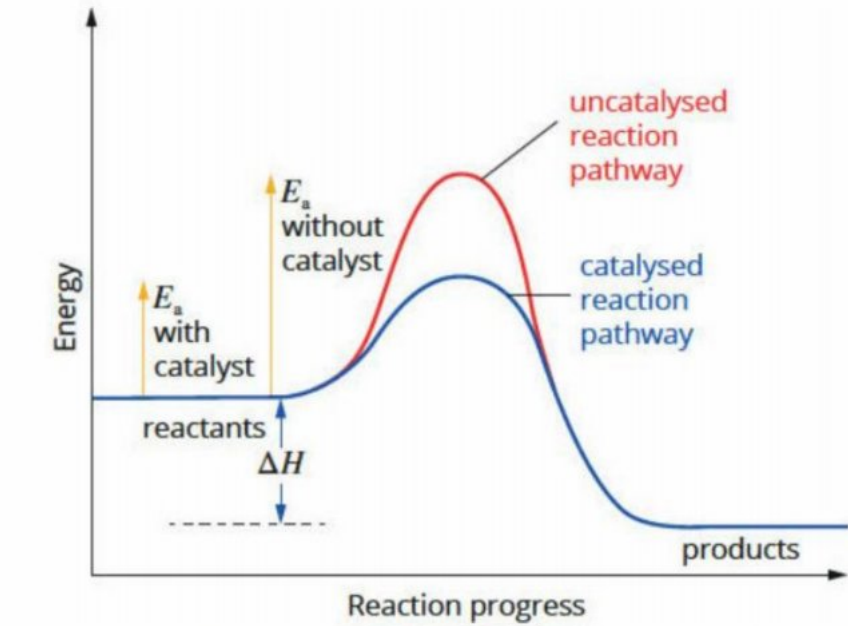
Lower activation energy increases the number of effective collisions, which increases the rate of both forward and reverse reactions equally.
Important
Key points about catalysts:
- Increase the rate of forward and reverse reactions equally
- Do not change the relative concentrations of reactants and products
- Do not change the position of equilibrium
- Do not change the value of
- Increase the rate at which equilibrium is attained
Catalysts are widely used in industry and biological systems to speed up reactions without affecting the equilibrium yield.
Case study: ocean acidification
Carbon dioxide dissolves in seawater through a series of equilibria:
Using Le Chatelier's principle, increasing atmospheric CO₂ causes:
- More CO₂ to dissolve in oceans
- Increased H₃O⁺ concentration
- Decreased pH (increased acidity)
- This process is called ocean acidification
Note
Ocean pH has decreased from 8.2 (300 years ago) to 8.14 (current) and is predicted to fall to 7.85 by 2100.
Marine organisms use carbonate ions to build shells:
Higher H₃O⁺ concentrations react with CO₃²⁻ ions, causing this equilibrium to shift left. This can dissolve calcium carbonate shells, threatening marine ecosystems.
Case study: swimming pool chemistry
Swimming pools are chlorinated to prevent bacterial and algal growth. Pool chlorine (calcium hypochlorite) dissolves to form hypochlorous acid (HOCl), an effective antibacterial agent:
The pool pH must be maintained between 7.2 and 7.8:
- If pH rises above 7.8: H₃O⁺ concentration decreases, equilibrium shifts left, HOCl concentration becomes too low to control bacteria and algae
- If pH falls below 7.2: H₃O⁺ concentration increases, equilibrium shifts right, too much HOCl forms, water becomes irritating to eyes and skin
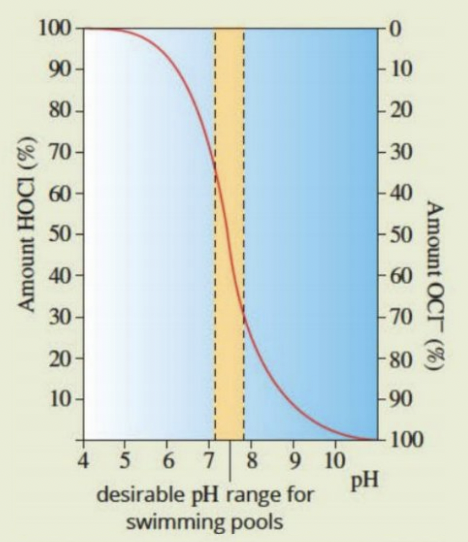
Maintaining proper pH ensures adequate HOCl for hygiene while keeping water comfortable for swimmers.
Summary of Le Chatelier's principle effects
| Change | Effect on equilibrium position | Effect on K |
|---|---|---|
| Add reactant | Shifts right (more products) | No change |
| Add product | Shifts left (more reactants) | No change |
| Remove product | Shifts right (more products) | No change |
| Increase pressure (decrease volume) | Shifts toward fewer gas particles | No change |
| Decrease pressure (increase volume) | Shifts toward more gas particles | No change |
| Add inert gas (constant volume) | No shift | No change |
| Dilution (solution equilibria) | Shifts toward more dissolved particles | No change |
| Increase temperature (exothermic) | Shifts left (more reactants) | Decreases |
| Increase temperature (endothermic) | Shifts right (more products) | Increases |
| Add catalyst | No shift (faster to reach equilibrium) | No change |
Summary
Key Points to Remember:
- Le Chatelier's principle: when an equilibrium experiences a change, it adjusts to partially oppose that change
- Adding reactant or removing product shifts equilibrium right (more products); adding product or removing reactant shifts equilibrium left (more reactants)
- Increasing pressure (decreasing volume) favours the side with fewer gas particles
- Dilution favours the side with more dissolved particles
- Temperature is the only factor that changes the value of K: heating favours the endothermic direction, cooling favours the exothermic direction
- Catalysts speed up both forward and reverse reactions equally, helping equilibrium to be reached faster without changing or the equilibrium position