Optical Isomers and Inhibition of Enzymes (VCE SSCE Chemistry): Revision Notes
📚Revision Notes
Optical Isomers and Inhibition of Enzymes
Introduction
Understanding how enzymes work is valuable for chemists, doctors, and pharmaceutical scientists in several important areas. These include developing vaccines, preventing disease, managing medical conditions, and providing enzyme supplementation to people who lack specific enzymes. This note explores two key areas of enzyme research: optical isomers and enzyme inhibition.
Note
Enzyme research has wide-ranging applications across medicine and healthcare. The concepts in this note form the foundation for understanding drug design, disease treatment, and how our bodies interact with medications at the molecular level.
Optical isomers
Optical isomers, also called enantiomers, are molecules that have identical molecular formulas and the same sequence of functional groups, yet they differ in how their atoms are arranged in three-dimensional space. These molecules are a type of stereoisomer.
The importance of optical isomers becomes clear when we consider ascorbic acid (vitamin ). This compound exists in two forms: L-ascorbic acid and D-ascorbic acid. L-ascorbic acid effectively prevents and treats scurvy, a disease affecting skin and gums that was once common among sailors with limited access to fresh fruit and vegetables. However, D-ascorbic acid, despite having the exact same molecular formula, provides no protection against scurvy. The different spatial arrangements of atoms in these two forms create this dramatic difference in biological activity.
Note
The naming conventions for enantiomers use either L- and D- or R- and S- prefixes. These letters indicate the direction in which the enantiomers rotate plane-polarised light, which is how optical isomers were first discovered and identified.
Chirality
What is chirality?
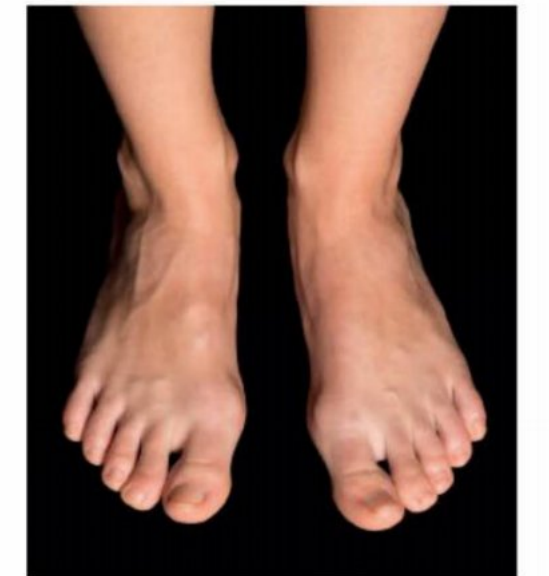
Substances that exist as optical isomers are described as chiral. Two objects are chiral when they are mirror images of each other, but these mirror images cannot be superimposed on top of each other. The term 'chiral' comes from the Greek word for hand, which makes sense because hands are perfect examples of chiral objects.
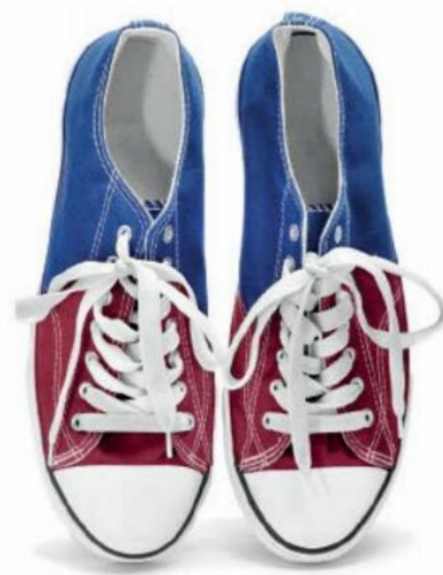
Your hands demonstrate chirality beautifully. One hand is a mirror image of the other, but a left hand and right hand cannot be superimposed in three dimensions. The same applies to feet. Your left and right feet are mirror images, but they cannot be superimposed, which is why a left shoe does not fit on a right foot.
Achiral objects
Objects that are not chiral are called achiral. Achiral objects have mirror images that can be superimposed on the original. These objects possess at least one plane of symmetry. A plane of symmetry exists when a three-dimensional figure can be divided into two halves that are mirror images of each other.

Important
Chiral objects, in contrast, do not have any planes of symmetry. This absence of symmetry is what allows them to exist as non-superimposable mirror images. When analyzing whether a molecule is chiral, always check for planes of symmetry first.
Chirality in organic molecules
Understanding chiral centres
Organic molecules become chiral when they contain a carbon atom bonded to four different groups arranged in a tetrahedral shape. A pair of chiral molecules are called enantiomers.
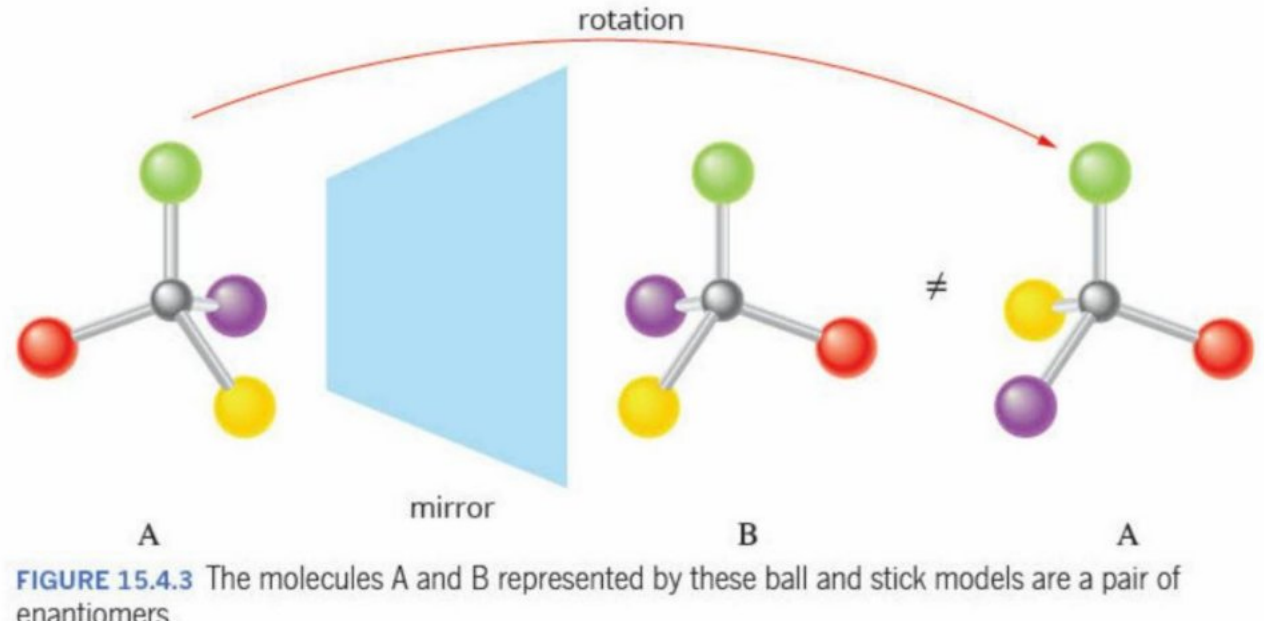
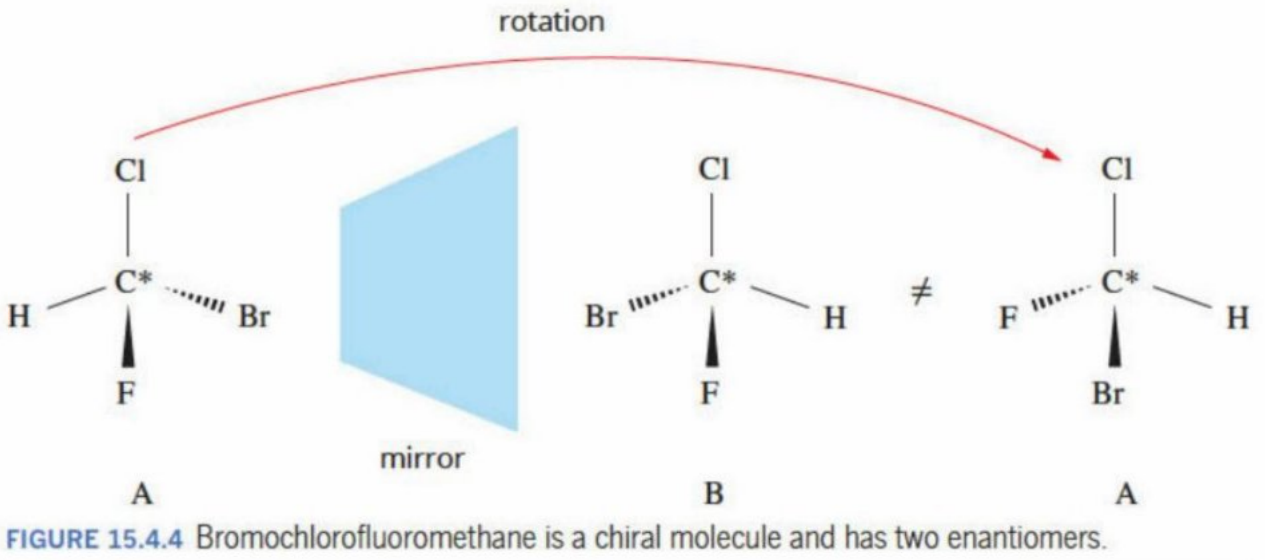
A carbon atom attached to four different groups is called a chiral centre. For a molecule to be chiral, it must contain at least one chiral centre and must have no planes of symmetry overall. The chiral centre is often marked with an asterisk () in structural diagrams.
Note
When drawing these molecules, chemists use special notation to show the three-dimensional arrangement:
- Simple lines represent bonds lying flat on the page
- Wedged lines show bonds coming out of the page toward you
- Dashed wedges indicate bonds going into the page away from you
Identifying achiral molecules
Not all molecules with a central carbon are chiral. If a carbon atom is bonded to two or more identical groups, it is not a chiral centre, and the molecule is achiral. The mirror image of such a molecule can be rotated to produce a structure that perfectly overlays the original.
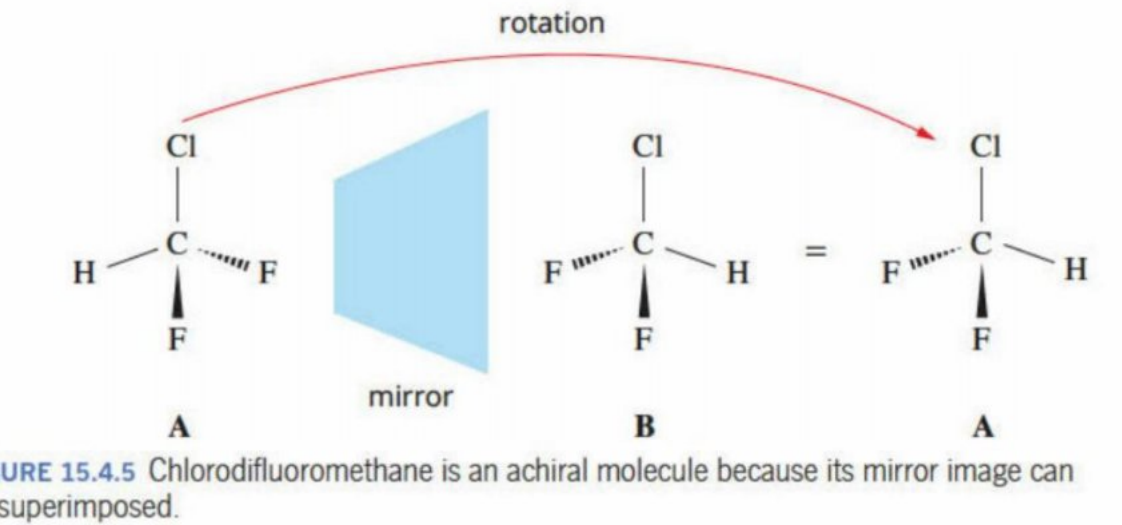
Identifying chiral centres in molecules
To identify chiral centres in organic molecules, you need to examine each carbon atom systematically to determine if it has four different groups attached. Sometimes you need to look beyond the immediately adjacent atoms to establish whether groups are truly different.
Example
Worked Example: Identifying Chiral Centres
The process involves two steps:
Step 1: Eliminate carbon atoms that cannot be chiral centres. This includes all groups, groups, and any carbon atom that is part of a double or triple bond. These cannot have four different groups attached.
Step 2: For each remaining carbon atom, carefully examine the four groups attached to it. If all four groups are different, that carbon is a chiral centre.
Important
Exam tip: When identifying chiral centres, be systematic. Start by eliminating obvious non-chiral carbons (those in , groups, or double bonds), then carefully analyse what remains. Remember to look at the entire group attached, not just the first atom.
Chiral drugs
Why enantiomers matter in medicine
Approximately 56% of drugs currently in use contain chiral molecules, and we cannot assume that different enantiomers will work equally well. Although enantiomers have the same sequence of functional groups, living systems treat them as virtually different substances. The functional groups of one enantiomer might align perfectly with receptor sites or enzymes in the body, while the other enantiomer's groups might not align at all.
This occurs because enzymes and receptors in the body are themselves chiral molecules with specific three-dimensional shapes. The spatial arrangement of atoms in a drug molecule determines how well it fits into these biological active sites. Even a small change in orientation around a single chiral carbon can completely prevent a molecule from binding effectively.
Important
One of the most challenging and important steps in drug manufacture involves separating the two enantiomers to ensure the product is both safe and effective. This separation process is often slow and expensive but essential for patient safety.
Three possible outcomes for pharmaceutical enantiomers
When researchers compare the pharmaceutical activity of enantiomers, three different outcomes are possible:
1. One enantiomer is more effective than the other
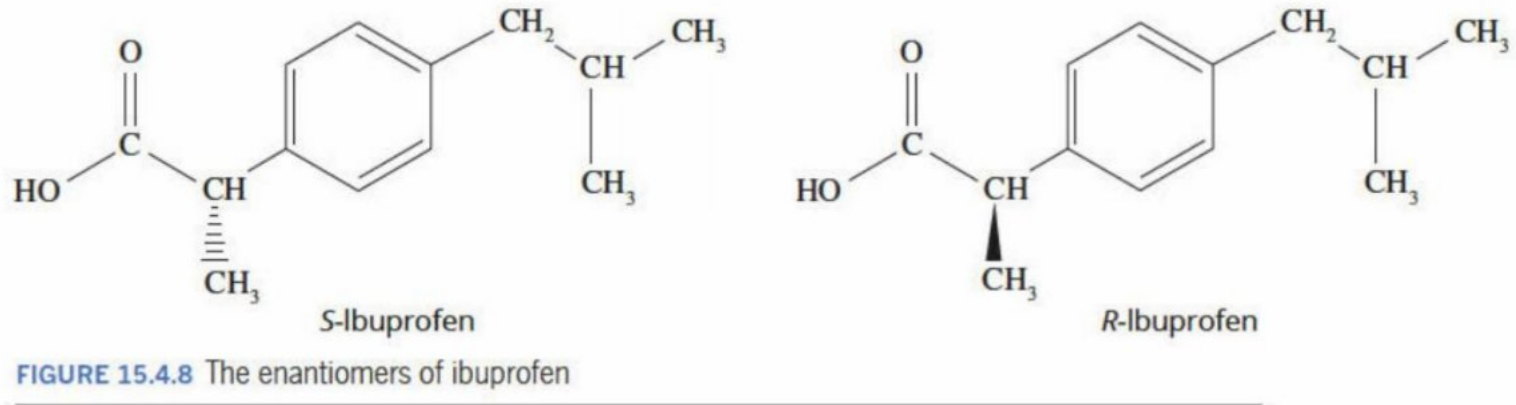
Ibuprofen provides an excellent example. The two enantiomers of ibuprofen are S-ibuprofen and R-ibuprofen. S-ibuprofen is far more effective at reducing pain and inflammation than R-ibuprofen. Although separating the two forms is a slow and expensive process, it leads to a much more effective pharmaceutical product.
2. Each enantiomer has a different effect on the body
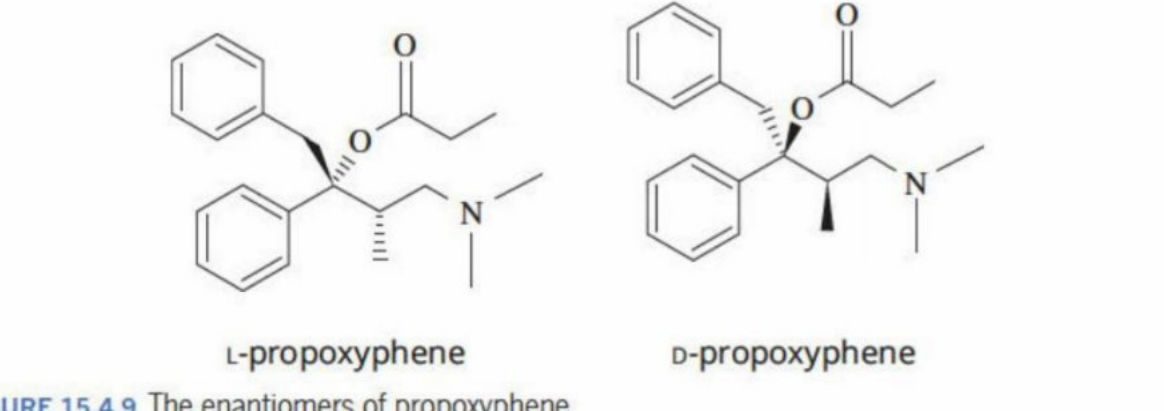
With propoxyphene, both enantiomers are pharmacologically active but serve completely different purposes. D-propoxyphene functions as a pain reliever (analgesic), while L-propoxyphene helps relieve coughs (acts as an antitussive). This demonstrates how dramatically the biological activity of a molecule can change based solely on its three-dimensional shape.
3. One enantiomer is effective while the other is harmful
Important
The Thalidomide Tragedy
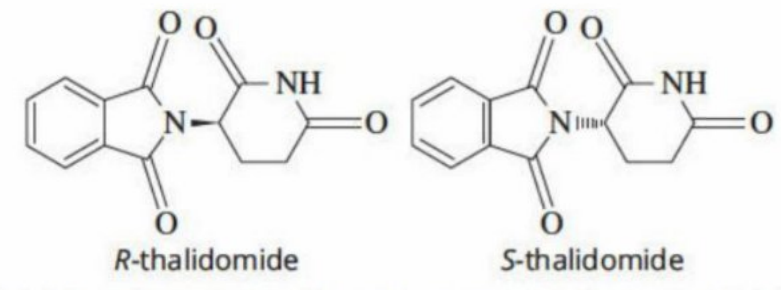
Thalidomide represents one of the most tragic examples in pharmaceutical history. This drug was released in 1957 as a treatment for morning sickness during pregnancy. It later became clear that thalidomide was associated with severe birth defects, including missing or severely malformed limbs.
Scientists now understand that the R-enantiomer effectively treats morning sickness, but the S-enantiomer causes serious birth defects. This case highlighted the critical importance of testing and separating enantiomers in drug development, fundamentally changing pharmaceutical regulations worldwide.
Note
Exam tip: Remember that enantiomers can have completely different biological effects despite having identical molecular formulas. Always consider the three-dimensional shape when thinking about drug effectiveness.
Enzyme inhibitors
Understanding enzyme function allows medical researchers to work in reverse, using this knowledge to inhibit unwanted reactions in the body. Enzyme inhibitors are molecules that prevent specific enzymatic reactions, and they can be classified as either competitive or non-competitive based on their mechanism of action.
Competitive enzyme inhibitors
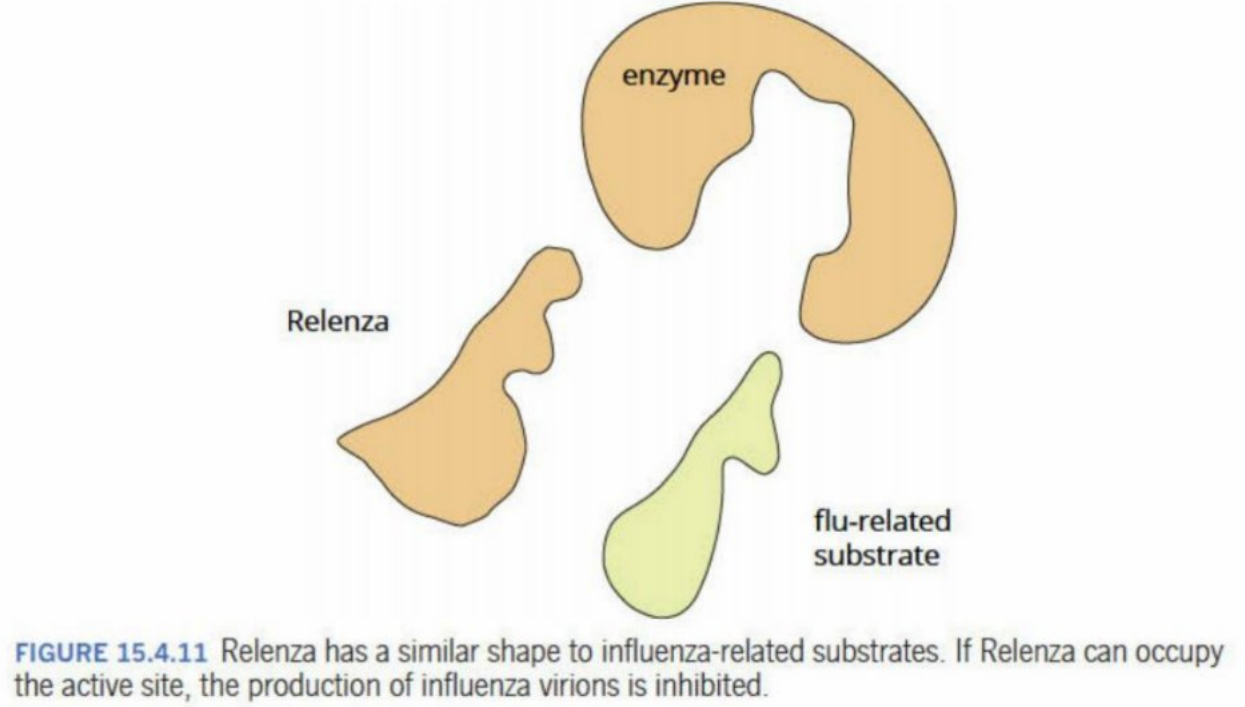
A competitive enzyme inhibitor works by occupying the active site of an enzyme, preventing the enzyme from catalysing a reaction that would be harmful to the body. These inhibitors must have a similar shape and chemical structure to the natural substrate of the enzyme.
How competitive inhibitors work
Competitive inhibitors function through a straightforward mechanism. They compete with the natural substrate molecules for access to the enzyme's active site. If an inhibitor molecule occupies the active site, the natural substrate cannot bind, and the unwanted reaction cannot proceed. The effectiveness of a competitive inhibitor depends on the relative concentrations of the inhibitor and the natural substrate.
Examples of competitive inhibitors
Note
Relenza (zanamivir)
Australian scientists developed Relenza to treat influenza. When someone has the flu virus, infected cells release viral particles called virions that spread the infection to neighbouring cells. Relenza binds to enzyme sites in infected cells that would normally produce these virions. With the active sites occupied by Relenza, virion production stops, and the spread of flu throughout the body is contained. Relenza works because it is chemically and structurally similar to the natural substrate it replaces.
Note
Penicillin
Penicillin is an antibiotic that kills certain bacteria by acting as a competitive enzyme inhibitor. It interferes with the synthesis of bacterial cell walls by inhibiting an enzyme called transpeptidase, which normally catalyses cell wall formation in reproducing bacteria. Without properly formed cell walls, the bacterial cells burst, eliminating the infection without harming human cells.
Important
Exam tip: For competitive inhibition, remember the key phrase: "competes for the same site." The inhibitor and substrate are rival molecules trying to bind to the same active site.
Non-competitive enzyme inhibitors
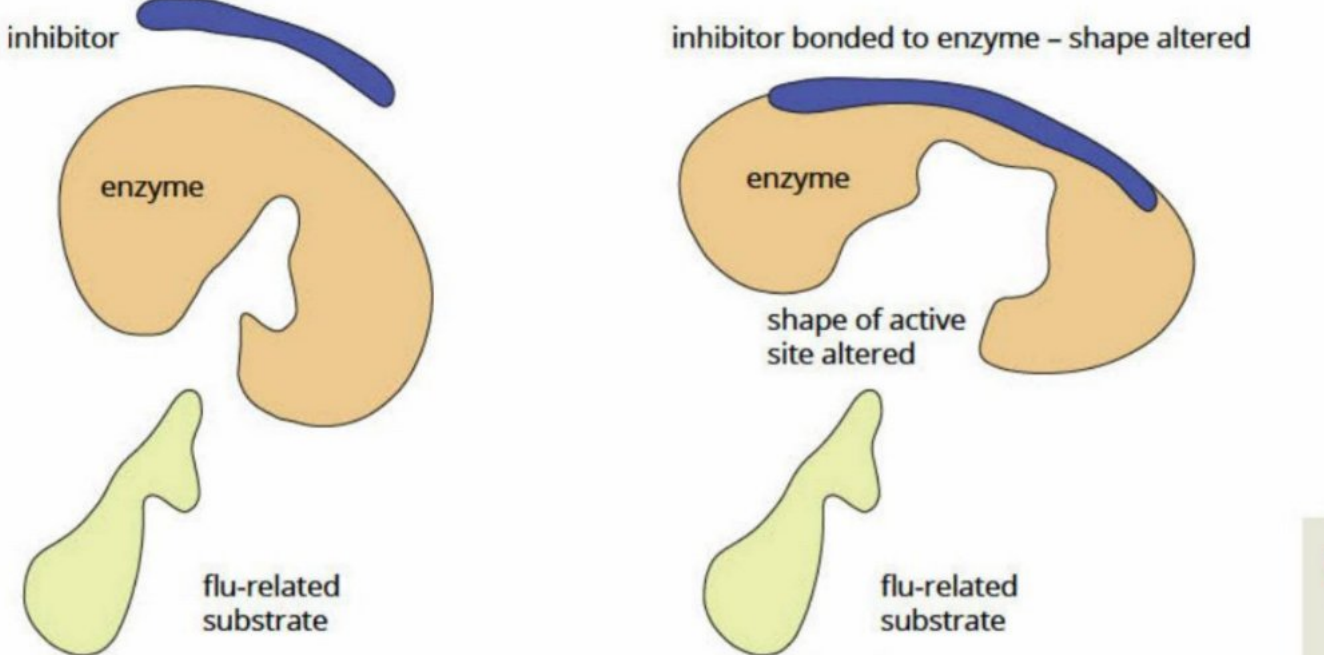
Non-competitive enzyme inhibition works through a different mechanism. Rather than occupying the active site directly, a non-competitive inhibitor binds to a different location on the enzyme. This binding causes a change in the enzyme's overall shape, which alters the shape of the active site. The altered active site no longer matches the shape of the substrate, so the enzyme cannot catalyse the reaction.
An important distinction is that non-competitive inhibitors are not in direct competition with the substrate for binding. This means the concentration of the substrate does not affect the inhibitor's effectiveness, unlike competitive inhibition.
Examples of non-competitive inhibitors
Note
Cyanide
Cyanide acts as a poison through non-competitive inhibition. In a healthy body, the enzyme cytochrome oxidase plays a crucial role in cellular respiration. When a person ingests cyanide, cyanide ions bind to this enzyme at a site other than the active site. This binding changes the enzyme's shape so it can no longer catalyse respiration processes. Without treatment, this disruption of cellular respiration can be fatal.
Note
Methotrexate
Methotrexate is used therapeutically to treat arthritis and severe cases of psoriasis. It functions as a non-competitive inhibitor of enzymes responsible for inflammation. By changing the shape of these enzymes, methotrexate prevents them from catalysing inflammatory reactions, reducing symptoms for patients with these conditions.
Important
Exam tip: For non-competitive inhibition, remember: "new shape, no catalysis." The inhibitor binds elsewhere on the enzyme, changes its shape, and the active site no longer works properly.
Remember!
Summary
Key Points to Remember:
-
Optical isomers (enantiomers) are molecules with identical molecular formulas but different three-dimensional arrangements of atoms. They are non-superimposable mirror images of each other.
-
Chiral molecules contain at least one chiral centre (a carbon bonded to four different groups) and have no plane of symmetry. Hands and feet are everyday examples of chiral objects.
-
Enantiomers in medicine can have dramatically different effects despite identical molecular formulas. They may be equally effective, serve different purposes, or one may be therapeutic while the other is harmful (as with thalidomide).
-
Competitive inhibitors block unwanted enzymatic reactions by occupying the enzyme's active site, preventing the natural substrate from binding. Examples include Relenza (flu treatment) and penicillin (antibiotic).
-
Non-competitive inhibitors prevent enzymatic reactions by binding elsewhere on the enzyme and changing its shape, making the active site unable to bind substrate. Examples include cyanide (poison) and methotrexate (anti-inflammatory).