Metallic Properties and Bonding (VCE SSCE Chemistry): Revision Notes
📚Revision Notes
Metallic Properties and Bonding
Introduction to metals
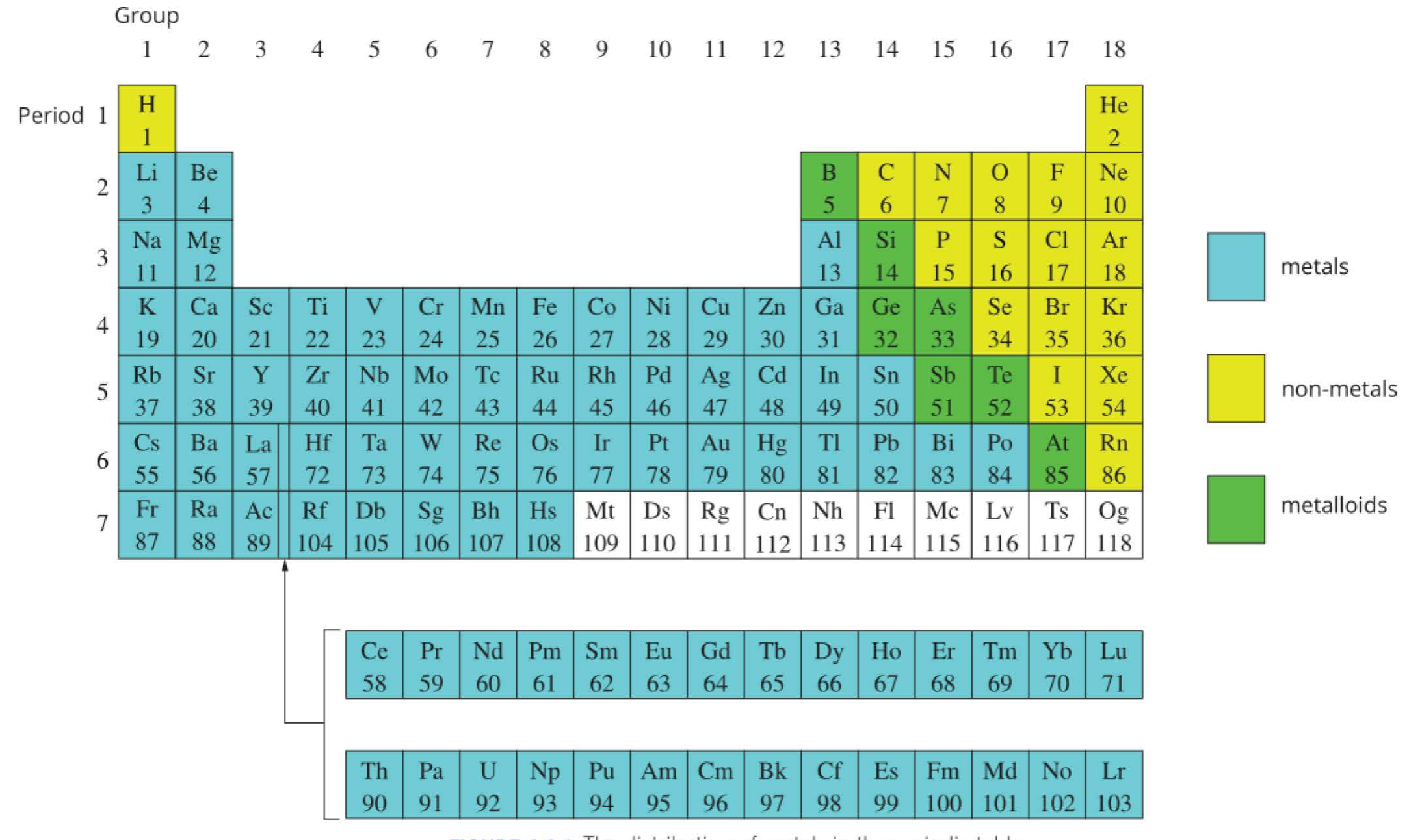
Metals make up over four-fifths of all elements in the periodic table. Understanding their properties and bonding helps explain why metals have been so important throughout human history and continue to be essential in modern technology.
Note
The development of civilisations has often been measured by how metals were used. Many parts of the world progressed through the Copper Age (- BCE), followed by the Bronze Age (- BCE) and the Iron Age (from BCE to CE). Gold, silver and copper were found on Earth in almost pure form and were used by prehistoric humans to make ornaments, tools and weapons.
As knowledge of metallurgy (the science of modifying metals) developed, metals became central to diverse fields including construction, agriculture, art, medicine and transport. The varying properties of different metals make them suitable for specific purposes.
Properties and uses of metals
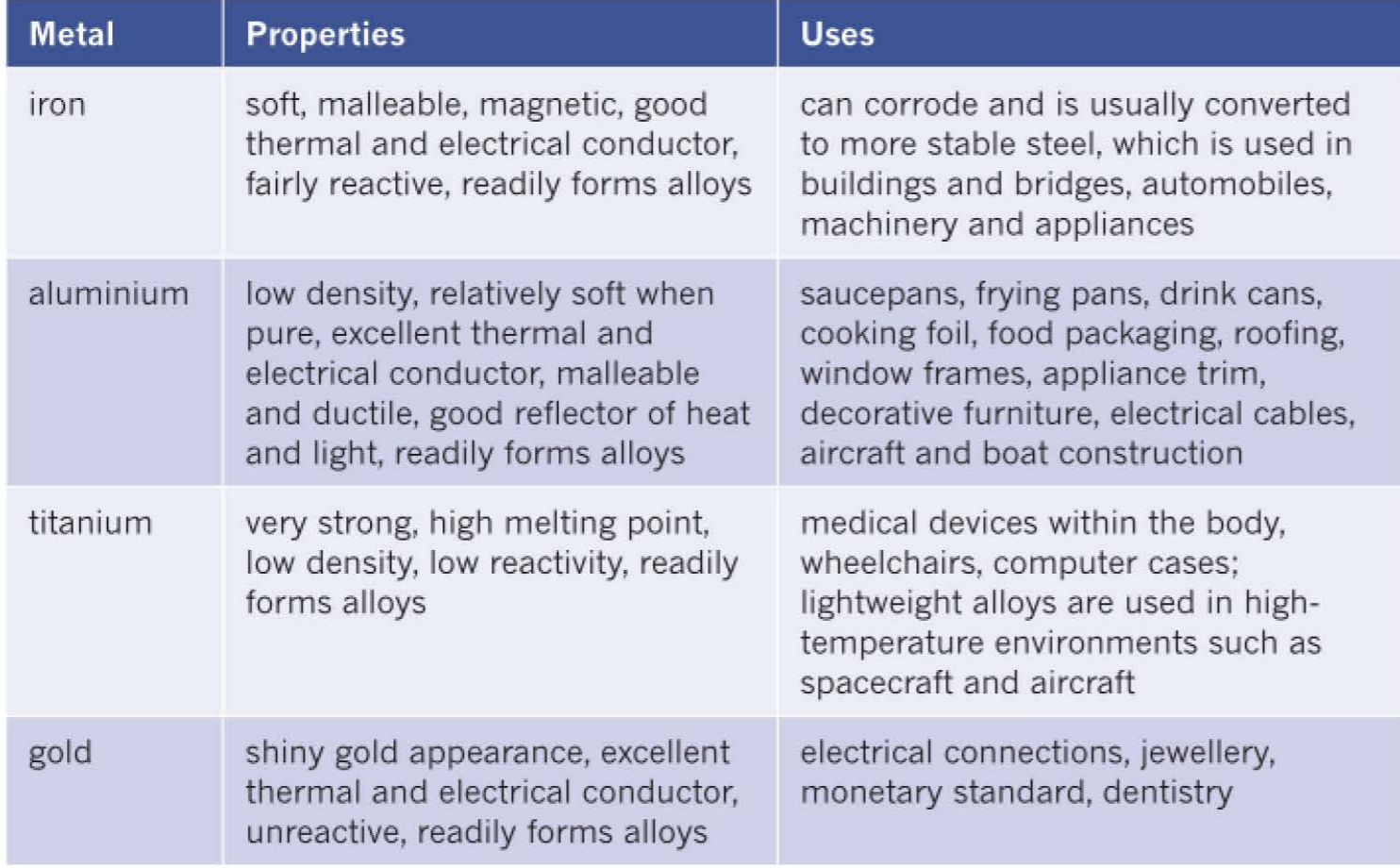
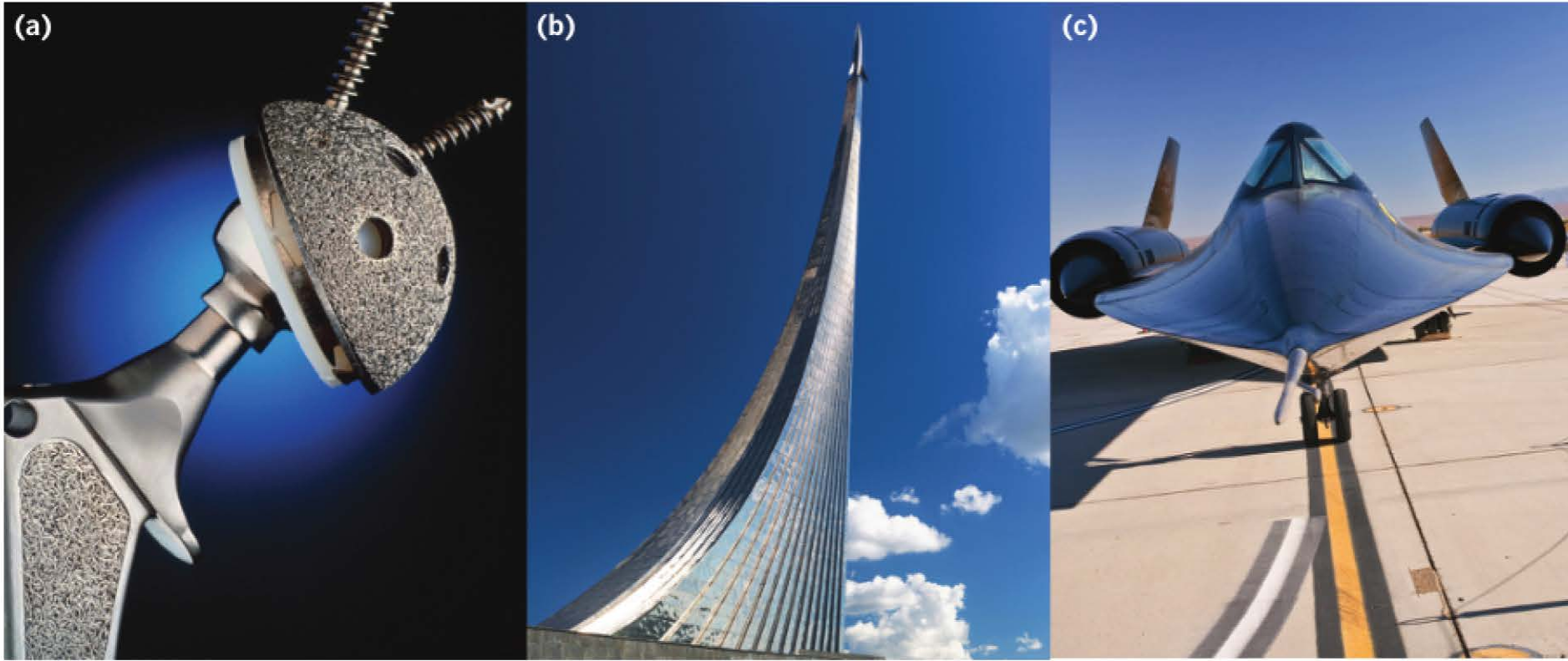
Different metals possess unique combinations of properties that make them ideal for particular applications. For example, titanium is very strong, relatively unreactive, and has a low density close to that of bone. These properties make it excellent for surgical implants that can last up to years with minimal effect on the body. Titanium is also used in the aerospace industry, in art and architecture, and in sporting products.
General physical properties of metals
Most metals share several characteristic physical properties:
- High melting and boiling points - indicating strong forces between particles
- Good electrical conductivity - both as solids and in molten state
- Good thermal conductivity - efficiently transfer heat energy
- High density - particles are closely packed (mass per unit volume)
- Malleable - can be shaped by beating or rolling
- Ductile - can be drawn into wires
- Lustrous - reflective when freshly cut or polished
- High tensile strength - resistant to breaking under tension
Important
Not all metals exhibit all these properties. Mercury is liquid at room temperature with an unusually low melting point. Group elements (alkali metals) are soft enough to cut with a knife and react vigorously with water to produce hydrogen gas. However, they still exhibit most other metallic properties.
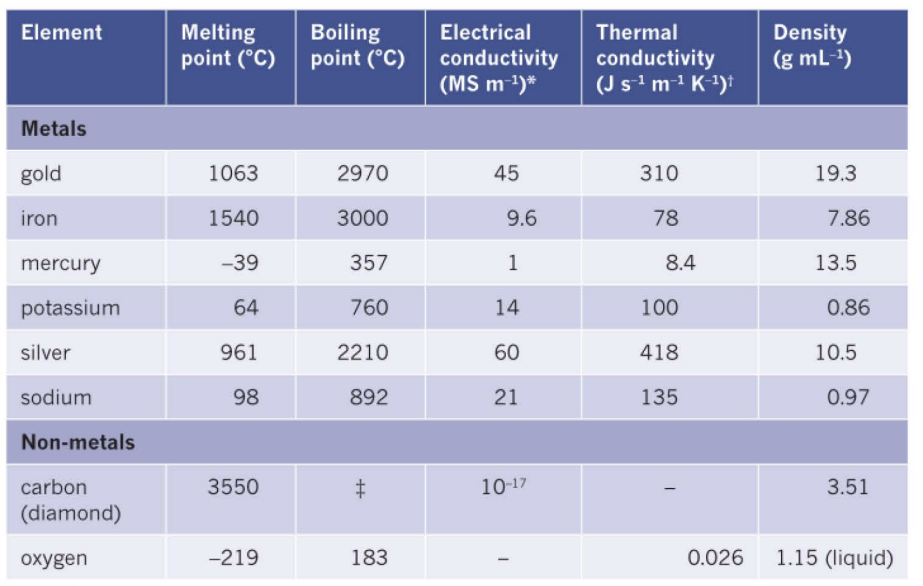
This table compares properties of various metallic and non-metallic elements, showing clear differences in melting points, boiling points, electrical conductivity, thermal conductivity, and density.
Transition metals
Between group and group in the periodic table lies a block of particularly useful elements called the transition metals. These include iron and nickel (used to build cities, bridges, cars and railway lines) and precious metals such as silver and gold (with ornamental and economic uses).

Most transition metals are silver-coloured and similar in appearance. Compared to main group metals, transition metals tend to be:
- Harder
- Have higher densities
- Have higher melting points
- Some possess strong magnetic properties
Note
Many metals can be shaped at room temperature by hammering, exploiting their malleability. Gold, copper and aluminium are very malleable at room temperature, whilst other metals like iron must be heated before shaping.
Most metals appear lustrous and silvery-grey in colour. Notable exceptions include gold (yellow) and copper (reddish).
Alloys
Metals are often mixed with small amounts of other substances, usually another metal or carbon. These substances are melted together, mixed and allowed to cool. The resulting solid is called an alloy. By varying the composition of alloys, materials with specific properties can be obtained. Generally, an alloy is harder and melts at a lower temperature than a pure metal.
Important
Steel Production
Transition metals and carbon are combined with iron to produce steel, which is stronger and has more desirable characteristics than pure iron. Copper is one of the few metals mainly used in pure form due to its high electrical conductivity, making it ideal for electrical wiring.
Chemical properties of metals
Metals also share important chemical characteristics:
- Low ionisation energies - easier to remove outer electrons
- Low electronegativities - readily lose electrons
- Form positive ions (cations) when reacting
Metallic elements are found on the left-hand side of the periodic table. Metal atoms are generally larger than non-metal atoms within a period, and the effective nuclear charge of their atoms is lower. This means less energy is required to remove electrons from their outer shell, resulting in lower ionisation energy compared to non-metals in the same period.
Forming metal ions
Metal atoms tend to lose their outer-shell electrons to form positive ions called cations. Atoms of metals typically have one, two or three electrons in their outer shell. When these valence electrons are lost, the resulting cations have a stable noble gas electronic configuration with eight electrons in their outer shell.
Note
Determining Ion Charge from Group Number
The charge on many metal cations can be quickly determined from their group number:
- Group metals (e.g. Na) form cations (e.g. Na)
- Group metals (e.g. Mg) form cations (e.g. Mg)
- Group metals (e.g. Al) form cations (e.g. Al)
Example
Worked Example: Determining Ion Charge for Calcium
For calcium (Ca):
- Atomic number
- Number of protons , number of electrons
- Electronic configuration:
- Outer shell contains two electrons
- When these are lost: electrons remain
- Cation charge
Therefore, calcium forms Ca ions. Since calcium is in group , this confirms the pattern that group metals form cations.

The metallic bonding model
To explain the properties of metals, chemists developed a model for metallic structure and bonding. Examining the properties of metals reveals that the metallic bonding model must include:
- Charged particles that are free to move and conduct electricity
- Strong forces of attraction between particles throughout the metal structure
- Electrons that are relatively easily removed
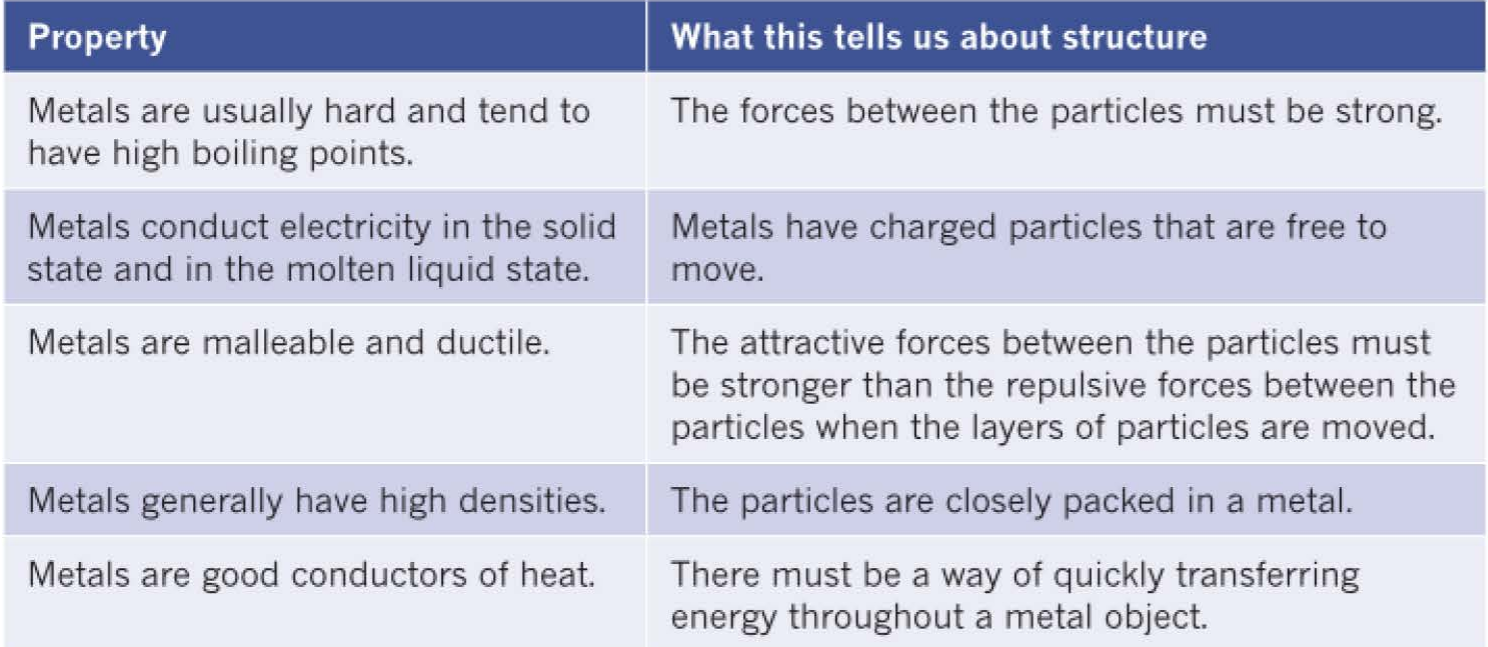
This table shows how various metal properties provide clues about the underlying structure. For example, high boiling points indicate strong interparticle forces, whilst electrical conductivity reveals the presence of free-moving charged particles.
Structure of metallic bonding
The metallic bonding model describes metals as having:
1. Positive ions in a lattice
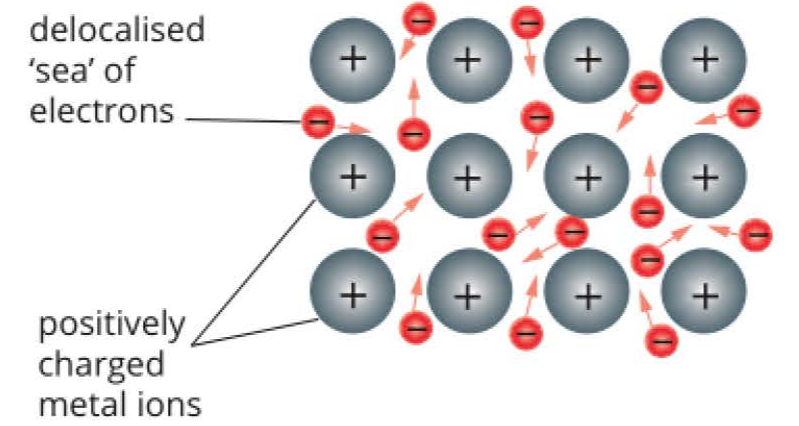
Positive metal cations are arranged in a closely packed structure within crystals, forming a regular three-dimensional lattice. The cations occupy fixed positions in this lattice.
2. Delocalised electrons
Negatively charged electrons move freely throughout the crystal lattice. These are called delocalised electrons because they belong to the lattice as a whole, rather than remaining in the shell of a particular atom.
3. Source of delocalised electrons
The delocalised electrons come from the outer shells of metal atoms. Inner-shell electrons remain firmly bonded to individual cations and are not free to move.
4. Metallic bonding
The positive cations are held in the lattice by the strong electrostatic force of attraction between the cations and the delocalised electrons. This attraction extends throughout the lattice and is called metallic bonding.
Note
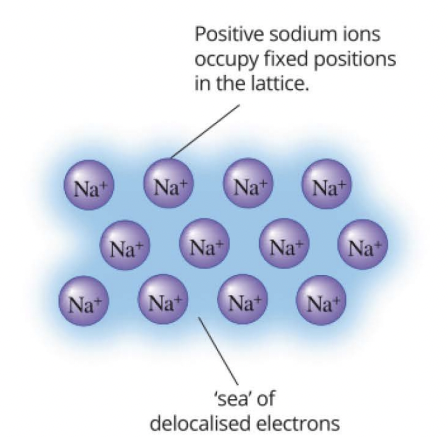
This diagram shows sodium metal as an example. Each sodium atom loses its one valence electron, which is shared with all atoms in the lattice to form a sea of delocalised electrons surrounding the fixed Na ions.
Explaining metal properties using the metallic bonding model
The metallic bonding model successfully explains many characteristic properties of metals:
Hardness and high boiling points
Strong electrostatic forces of attraction exist between the positive metal ions and the sea of delocalised electrons. These forces hold the metallic lattice together firmly, requiring significant energy to overcome them. This explains why metals are generally hard solids with high boiling points.
Electrical conductivity
Metals conduct electricity in both solid and molten states because the delocalised electrons are free to move. When a metal is part of an electric circuit, these free-moving electrons move towards the positive electrode and away from the negative electrode, creating an electric current.
Malleability and ductility
When a force causes metal ions to move past each other, the layers of ions remain held together by the delocalised electrons between them. The metallic bonding is maintained even as the structure deforms, allowing metals to be hammered into shapes (malleability) or drawn into wires (ductility). The attractive forces between particles are stronger than repulsive forces when layers slide past each other.
High density
The cations in a metal lattice are closely packed together. The density of a metal depends on the mass of the metal ions, their radius, and how they are packed in the lattice.
Thermal conductivity
When delocalised electrons collide with each other and with metal ions, they transfer energy to their neighbours. Heating a metal gives ions and electrons more energy, causing them to vibrate more rapidly. The electrons, being free to move, transmit this energy rapidly throughout the lattice, making metals good conductors of heat.
Lustre (shininess)
Free electrons in the lattice allow metals to reflect light of all wavelengths. This gives metals their characteristic shiny or lustrous appearance when freshly cut or polished.
Tendency to lose electrons in reactions
Delocalised electrons in metals can participate in reactions anywhere on the metal's surface. The reactivity of a metal depends on how easily electrons can be removed from its atoms, which relates to ionisation energy.
Example
Worked Example: Explaining Electrical Conductivity in Aluminium
For aluminium (Al):
- Atomic number
- Electronic configuration:
- Aluminium has electrons in its outer shell
- Al atoms lose these valence electrons to form Al cations
- The outer-shell electrons become delocalised and form the sea of delocalised electrons within the metal lattice
- When aluminium is part of an electric circuit, the delocalised electrons move through the lattice towards a positively charged electrode
- This movement of charged particles constitutes an electric current
Therefore, solid aluminium can conduct electricity because it contains free-moving delocalised electrons that can carry charge through the material.
Colourful transition metal compounds
Transition metal compounds display a wide range of colours and are extensively used as pigments in paints, glass, ceramics and enamel. Some widely used pigments include:
- Cobalt blue: CoAlO
- Cadmium yellow: CdS
- Prussian blue: Fe(CN)
- Chrome green: CrO
- Chrome yellow: CdPbO
- Cerulean blue: CoSnO

Note
Natural Pigments in Indigenous Art
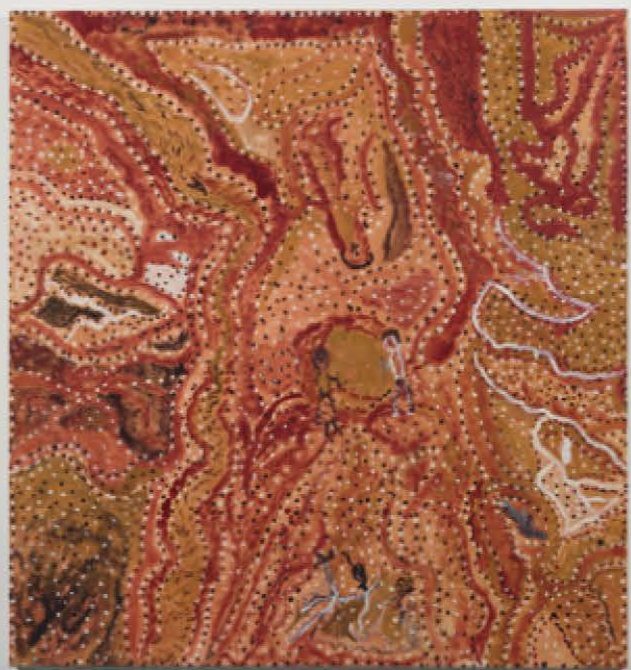
Ochre, containing iron oxides and hydroxides such as FeO and FeO(OH), occurs naturally in many colours including red, pink, white and yellow. When ground into powder and mixed with liquids, ochre has been used for millennia by Aboriginal and Torres Strait Islander peoples for body decoration, cave painting, bark painting and other artwork.
The colours of many gemstones also arise from transition metals. For example, sapphires contain traces of titanium and iron in a crystal lattice of aluminium oxide (AlO).

These colours arise when electrons within metal ions absorb light of particular wavelengths and move to higher energy levels. By contrast, compounds of other metals do not usually absorb wavelengths of visible light and are therefore colourless. Diamonds, composed purely of carbon (not a metal), are usually colourless for this reason.
Limitations of the metallic bonding model
Important
What the Model Cannot Explain
Although the metallic bonding model explains many properties of metals, some properties cannot be explained so simply:
- Range of melting points, hardness and densities of different metals
- Differences in electrical conductivities between metals
- Magnetic nature of metals such as cobalt, iron and nickel
Scientists have developed more advanced models to explain these properties, but these are beyond the scope of this content. The basic metallic bonding model remains highly useful for understanding most metallic properties.
Summary
Key Points to Remember:
- Over 80% of elements are metals, found primarily on the left side of the periodic table
- Metals have characteristic properties: high melting/boiling points, electrical and thermal conductivity, malleability, ductility, lustre, and high density
- Metal atoms form positive cations by losing outer-shell electrons, with charge determined by group number (Group 1 = 1+, Group 2 = 2+, Group 13 = 3+)
- Metallic bonding model: positive metal cations in a regular lattice surrounded by a sea of delocalised electrons, held together by strong electrostatic attraction
- The model explains key properties: hardness and high boiling points (strong forces), electrical conductivity (free electrons), malleability and ductility (layers can slide), thermal conductivity (electron energy transfer), and lustre (electron light reflection)
- Transition metal compounds produce diverse colours due to electron transitions, making them valuable as pigments in art and industry