Determination of Limiting Reactants or Reagents (VCE SSCE Chemistry): Revision Notes
📚Revision Notes
Determination of Limiting Reactants or Reagents
Introduction to limiting reactants
In previous work, you learned how to calculate the amount of product formed or energy released when a fuel burns. Those calculations assumed there was always enough oxygen for complete combustion. However, in real chemical reactions, this isn't always the case.
This section teaches you how to solve problems when it's not immediately clear whether a reactant is completely consumed. You'll learn to identify which reactant runs out first and use this information to calculate how much product forms.
Note
Understanding limiting reactants is essential for accurate stoichiometric calculations. In real-world scenarios, reactants are rarely present in perfect proportions, making this concept crucial for both laboratory work and industrial applications.
Understanding reactants vs reagents
Before we begin, it's important to understand two key terms:
- A reactant is a starting material that undergoes change during a chemical reaction
- A reagent is a substance added to a system to cause a chemical reaction
Both reactants and reagents can act as limiting substances in a reaction. For simplicity, this note will primarily use the term "reactant" to refer to both.
Understanding limiting and excess reactants
The basic concept
When two reactants combine in a chemical reaction, they might be mixed in exactly the right proportions shown in the balanced equation, allowing both to be completely consumed. However, this is unusual. More commonly, the reactants are not in the exact ratio required by the equation. This means one reactant will be completely used up before the other, causing the reaction to stop. The reactant that remains is said to be in excess.
The skateboard analogy
To understand this concept, imagine you want to build skateboards. Each complete skateboard needs one deck and four wheels.
Note
The Skateboard Assembly Example
If you have 2 decks and 10 wheels, how many complete skateboards can you make?
You can only make 2 complete skateboards because you only have 2 decks. After making two skateboards, you'll have used:
- All 2 decks
- 8 wheels (4 wheels per skateboard × 2 skateboards)
This leaves you with 2 wheels remaining. The decks were the limiting factor because they ran out first. The wheels were in excess.
Limiting reactants in chemical reactions
The same principle applies to chemical reactions. Consider the reaction between hydrogen gas and oxygen gas to form water:
This diagram shows three different scenarios:
- Neither reactant in excess: When 4 molecules of react with 2 molecules of , both are completely consumed, forming 4 molecules of
- Oxygen in excess: When 4 molecules of react with 4 molecules of , the hydrogen runs out first. This produces 4 molecules of and leaves 2 molecules of unreacted. The limiting reactant is
- Hydrogen in excess: When 5 molecules of react with 2 molecules of , the oxygen runs out first. This produces 4 molecules of and leaves 1 molecule of unreacted. The limiting reactant is
Key definitions
- The limiting reactant is the reactant that is completely consumed in the reaction
- The excess reactant is the reactant that is not completely consumed and remains after the reaction stops
Important
Critical Concept
The amount of product formed is always determined by the amount of the limiting reactant present. The amount of product cannot be determined from the amount of excess reactant. This is why identifying the limiting reactant is essential for all stoichiometry calculations.
Industrial applications
In the chemical industry, understanding limiting reactants has important practical applications. Chemical manufacturers must consider cost, product yield, and waste minimisation when designing production processes.
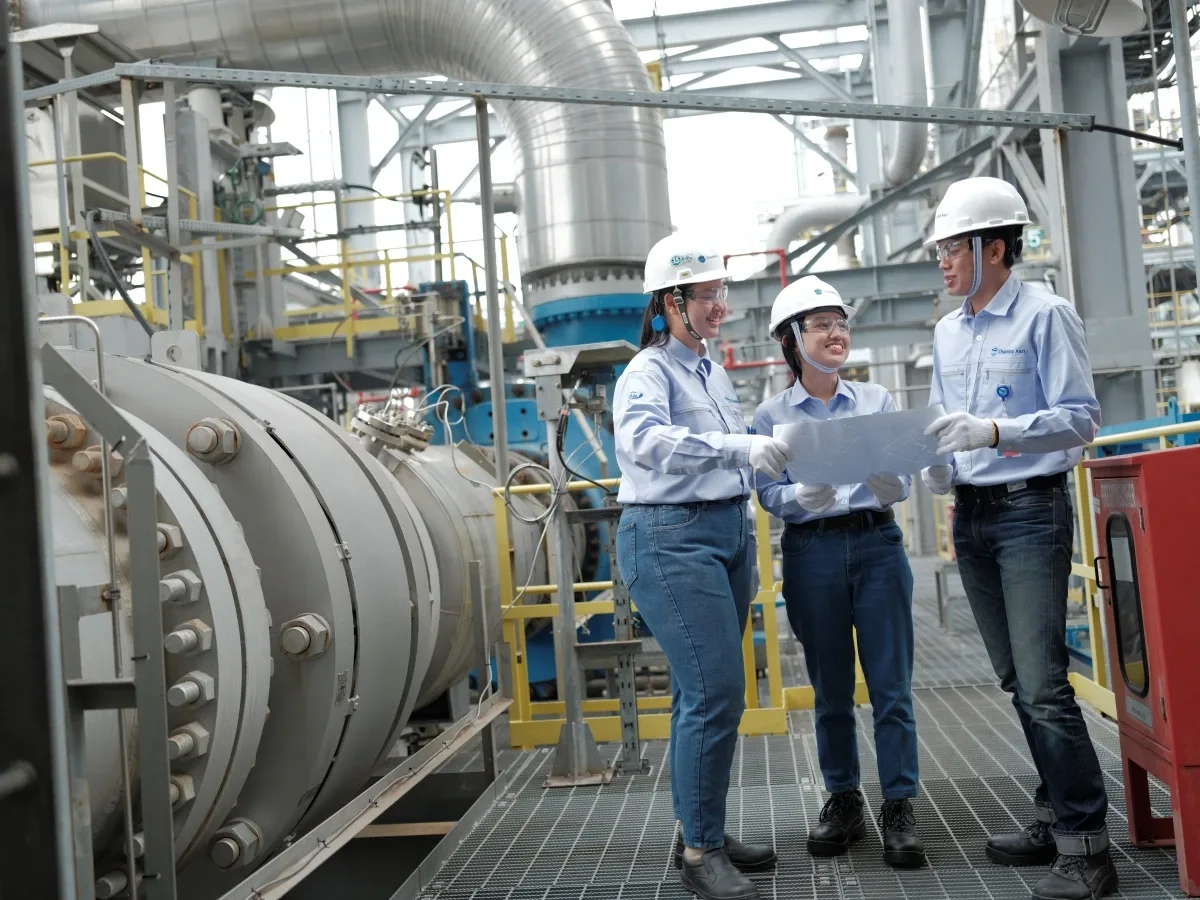
If one reactant in a process is significantly more expensive than another, manufacturers will want to ensure the expensive reactant is completely used. One strategy to achieve this is to deliberately have the cheaper reactant in excess. This ensures the expensive reactant reacts completely, maximising the return on investment.
Note
The Trade-off with Excess Reactants
However, using excess reactants creates a trade-off. The excess reactant may need to be recovered and recycled, which adds to processing costs and complexity. Industrial chemists use stoichiometric calculations to determine precisely how much excess reactant is needed to ensure complete reaction of the valuable reactant whilst minimising waste and recovery costs.
Problem-solving approach
Three-step method
When solving stoichiometry problems involving limiting reactants, follow these three steps:
- Calculate the number of moles of each reactant using the appropriate formula based on the information given:
- From mass:
- From volume at SLC: (where L mol)
- From volume at other conditions:
- Identify which reactant is the limiting reactant by:
- Choosing one reactant
- Using the balanced equation coefficients to calculate how much of the other reactant is needed
- Comparing the required amount with the actual amount present
- The reactant that would run out first is the limiting reactant
- Use the amount of limiting reactant to determine the amount of product formed using mole ratios from the balanced equation
Example
Worked Example 3.2.1: Identifying limiting and excess reactants
This example demonstrates how to identify the limiting reactant and calculate the amount of excess reactant remaining.
Question: A gaseous mixture of 25.0 g of hydrogen gas () and 150 L of oxygen gas at SLC are mixed and ignited according to the equation:
a) Identify which reactant is the limiting reactant
b) Calculate the amount, in mol, of the excess reactant that remains unreacted
Solution:
Step 1: Calculate moles of each reactant
For hydrogen (given mass):
For oxygen (given volume at SLC):
Step 2: Identify the limiting reactant
From the equation, the mole ratio is 2 mol : 1 mol
Calculate needed to react with all the :
Compare: 12.1 mol of is needed, but 12.5 mol is present
Therefore: H₂ is in excess and O₂ is the limiting reactant
Step 3: Calculate excess reactant remaining
Amount of that reacts mol
Example
Worked Example 3.2.2: Calculating product amount
This example shows the complete process including calculating the amount of product formed.
Question: 100.0 g of ethanol () burns in 250.0 g of oxygen gas according to the equation:
Calculate the volume, in L, of carbon dioxide formed at 100 kPa and 15°C.
Solution:
Step 1: Calculate moles of each reactant
For ethanol:
For oxygen:
Step 2: Identify the limiting reactant
From the equation, mole ratio is 1 mol : 3 mol
Amount of needed to react with all the ethanol:
Since 7.81 mol of is present (more than 6.52 mol needed), O₂ is in excess.
Therefore: Ethanol is the limiting reactant
Step 3: Calculate product formed
From the equation, mole ratio is:
Amount of formed:
Step 4: Convert to volume at given conditions
Using the ideal gas equation at non-standard conditions:
Temperature must be in Kelvin: K
Summary
Key Points to Remember
-
The limiting reactant is the substance that is completely consumed first in a chemical reaction. It determines how much product can form.
-
The excess reactant is the substance that remains after the limiting reactant is used up. Some of it is left over unreacted.
-
Always use the amount of limiting reactant to calculate how much product forms. Never use the excess reactant amount for this calculation.
-
The three-step approach is:
- Calculate moles of each reactant
- Identify the limiting reactant by comparing mole ratios
- Use limiting reactant amount to find product
-
In industry, having one reactant in excess can ensure complete reaction of an expensive reactant, but creates the need for recovery and recycling of the excess.