Polymer Formation (VCE SSCE Chemistry): Revision Notes
📚Revision Notes
Polymer Formation
Introduction to polymers
Polymers are extremely large molecules made up of thousands of smaller units called monomers. The word 'polymer' comes from Greek: 'poly' meaning 'many' and 'mer' meaning 'part'. These molecules are formed when monomers join together through a process called polymerisation.
You'll find polymers everywhere in daily life - from plastic bottles and food containers to clothing and sporting equipment. Polymers are widely used in manufacturing because they are cheap to produce, versatile, and easy to work with.
Note
Common Polymer Applications: Polymers have revolutionized modern manufacturing. Look around you - your phone case, water bottle, synthetic clothing, and even some parts of vehicles are all made from polymers. Their versatility comes from the ability to design polymers with specific properties for different applications.
Understanding the term 'plastic'
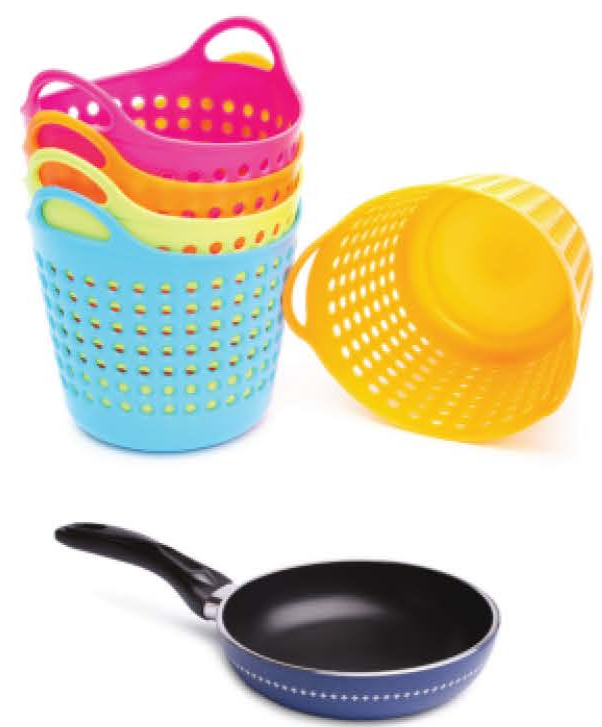
It's important to understand the difference between 'polymer' and 'plastic'. In chemistry, 'plastic' describes a property of a material, not the material itself. A material is described as plastic if it can be moulded into different shapes readily when heated.
Important
Plastic as a Property vs Material: Don't confuse these terms! A polymer is a type of molecule, while plastic describes the ability to be moulded. Not all polymers have plastic properties - for example, a polymer saucepan handle is hard and brittle and cannot be reshaped when heated, even though it's made from a polymer.
For example, a plastic basket has plastic properties because the polymer material can be heated and reshaped. However, a polymer saucepan handle is hard and brittle - it will not melt and cannot be reshaped when heated, so it doesn't have plastic properties even though it's made from a polymer.
Polymer structure
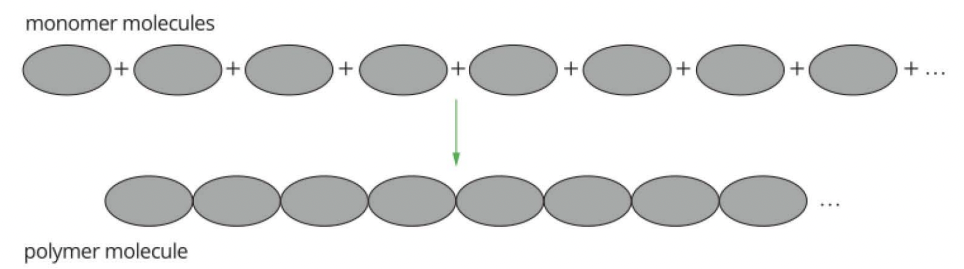
Polymers are covalent molecular substances formed by joining many small molecules together. These small molecules are called monomers (where 'mono' means 'one'). Through polymerisation, thousands of monomer molecules bond together to create one very long polymer chain.
Note
Memory Aid - The Paper Clip Analogy: Think of polymerisation like linking paper clips together - each individual paper clip is a monomer, and when you connect many of them in a chain, you've created a polymer. This simple analogy helps you remember that polymers are just many small units joined together.
Addition polymerisation
What is addition polymerisation?
Addition polymerisation occurs when unsaturated molecules (containing carbon-carbon double bonds) react with themselves to form long chains. During this reaction:
- The double bond in each monomer breaks
- New single bonds form between neighbouring monomers
- All atoms from the monomers are present in the final polymer
- No other products are formed
Important
Key Characteristics of Addition Polymerisation: The defining feature is that no atoms are lost - everything from the monomers ends up in the polymer. This is why it's called "addition" polymerisation - monomers simply add together without producing any byproducts.
Ethene to polyethene
The most common example of addition polymerisation is the conversion of ethene () into polyethene. Several thousand ethene monomers typically react together to form one polyethene molecule.
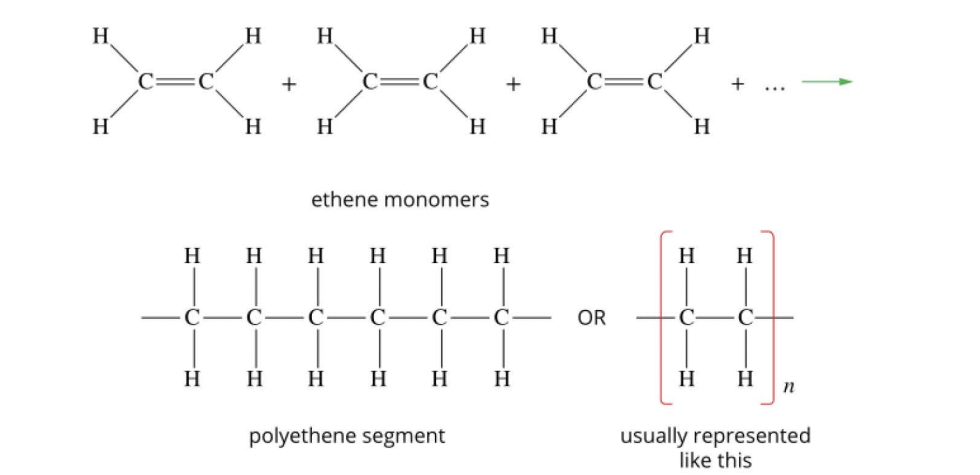
In the polymerisation reaction:
- The double bonds in ethene break open
- Carbon atoms from neighbouring ethene molecules form new single bonds
- A long chain of carbon atoms with hydrogen atoms attached is created
Representing polymer structures
Because polymer chains are so long, chemists use a simplified notation. Large square brackets with a subscript represent the repeating unit of the polymer. The value of indicates how many times the unit repeats - typically around for a polyethene chain.
Note
Understanding Polymer Notation: Both representations show the same molecule, but the notation on the right is much simpler to draw and understand. The subscript is a variable representing the number of repeating units - in real polymers, this number is typically in the thousands or tens of thousands.
Both representations show the same molecule, but the notation on the right is much simpler to draw and understand.
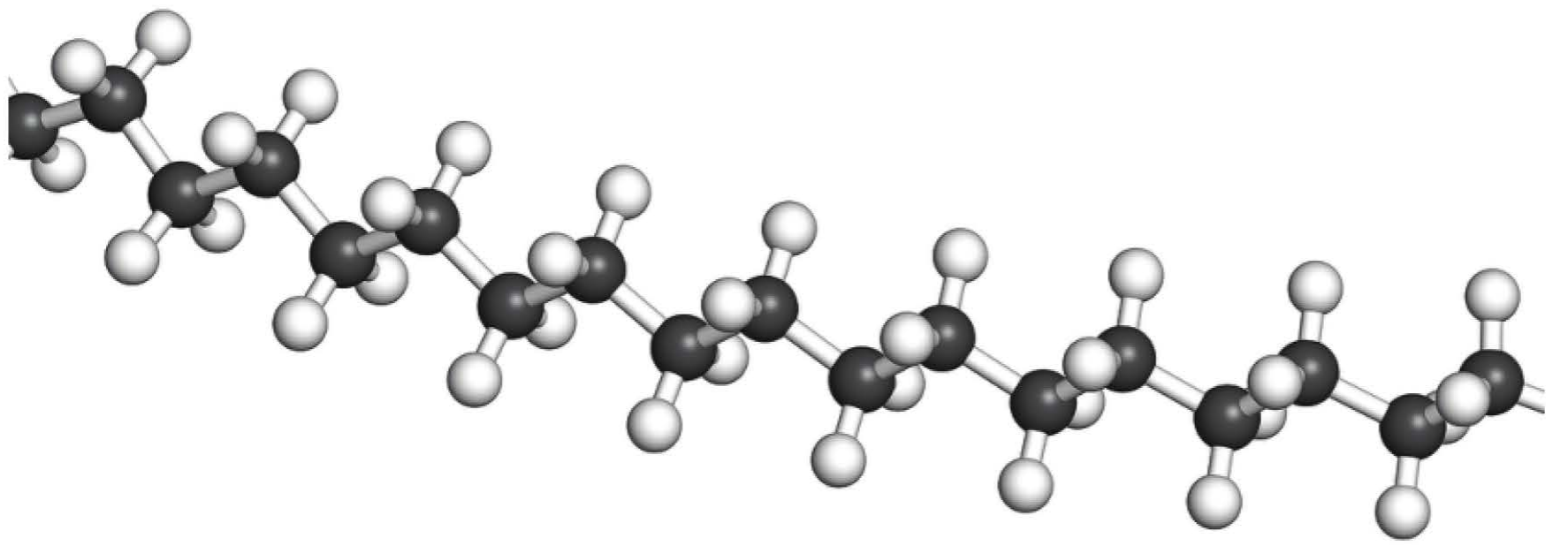
This 3D model shows how the carbon atoms form a zigzag chain with hydrogen atoms bonded to each carbon.
Important characteristics of addition polymers
When ethene polymerises:
- The original unsaturated molecule (containing ) becomes a saturated polymer chain (containing only single bonds)
- The empirical formula of the monomer is the same as the polymer
- The name of the polymer often includes the monomer name (ethene → polyethene)
Common examples of monomer-polymer pairs:
| Monomer | Polymer |
|---|---|
| Ethene | Polyethene |
| Propene | Polypropene |
| Tetrafluoroethene | Polytetrafluoroethene |
Why are polymers solid at room temperature?
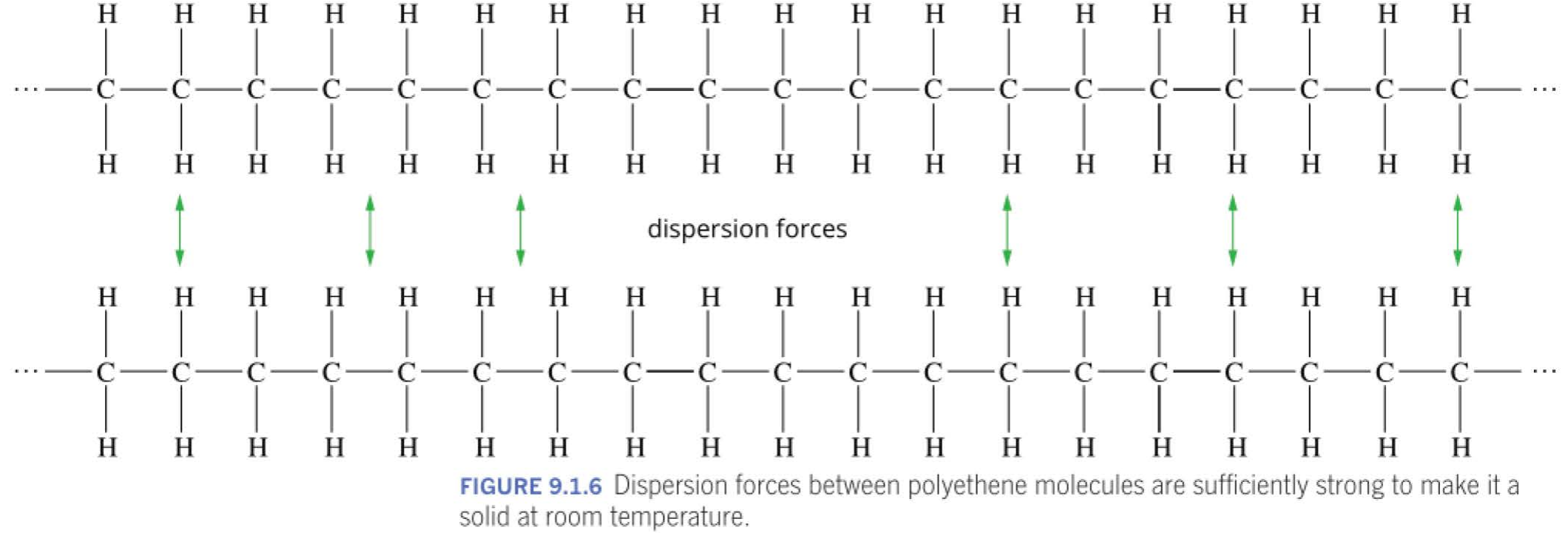
Polyethene is essentially an extremely long alkane molecule. Even though individual alkane molecules are gases or liquids at room temperature, polymers are solids. This is because of dispersion forces (also called London forces) between the long polymer chains.
Important
Why Polymer Length Matters: The dispersion forces between these very long molecules are strong enough to hold them together as a solid at room temperature. The longer the chain, the stronger these intermolecular forces become. This is why polymers behave so differently from small alkane molecules - their enormous length creates cumulative intermolecular forces that are much stronger than those in small molecules.
The dispersion forces between these very long molecules are strong enough to hold them together as a solid at room temperature. The longer the chain, the stronger these intermolecular forces become.
General properties of polymers
Most polymers share these common properties:
- Lightweight compared to metals
- Non-conductors of electricity
- Durable and long-lasting
- Versatile - can be made with different properties
- Resistant to acids
- Flammable
Note
Exam Tip: Remember that these are general properties - specific polymers may have different characteristics depending on their structure and how they're processed. For example, some specially designed polymers can conduct electricity, breaking the general rule.
Low-density polyethene (LDPE)
Formation and structure
LDPE was the earliest form of polyethene to be discovered (accidentally in 1933). It's produced using:
- High temperatures (around )
- Extremely high pressures
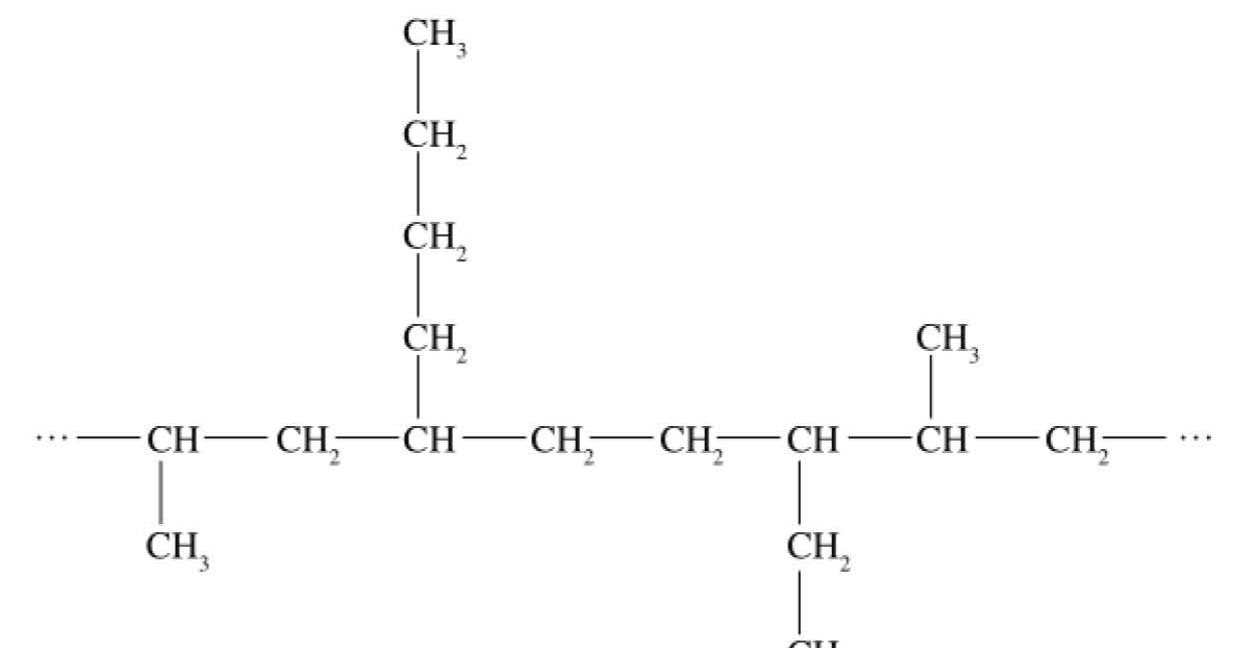
Under these harsh conditions, the polymer forms very rapidly. This doesn't give the molecules time to arrange neatly, resulting in a structure with many branches - short side chains extending off the main polymer backbone.
Why branching matters
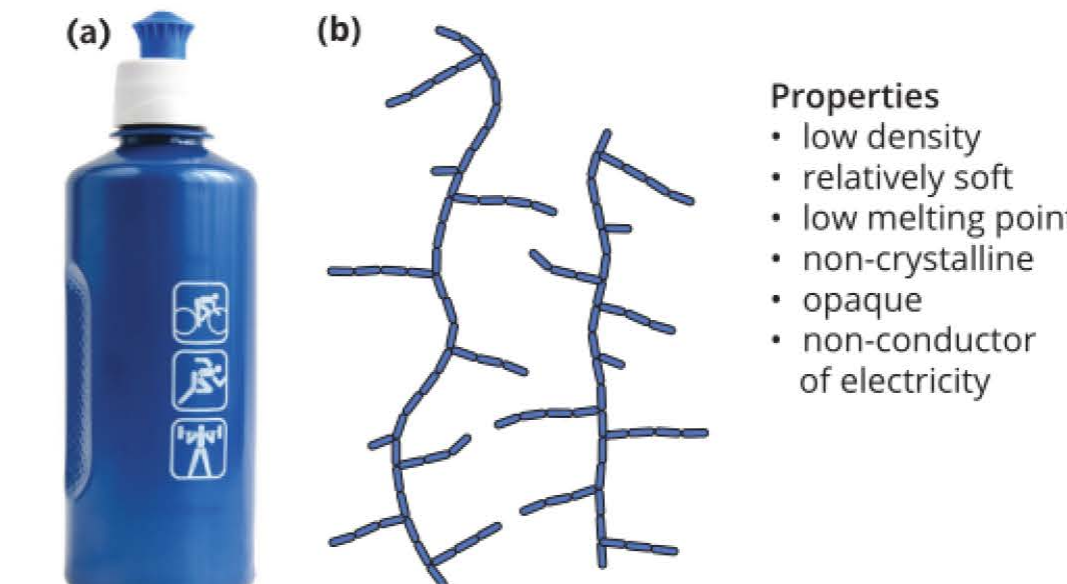
The presence of branches significantly affects the polymer's properties. Branched chains cannot pack closely together, leaving more space between molecules. This means:
- Dispersion forces between molecules are weaker (molecules are further apart)
- The arrangement is described as amorphous or non-crystalline (disordered)
- The material has relatively low density
Important
The Impact of Branching: Think of branches like arms sticking out - they prevent the polymer chains from getting close together, similar to how people wearing bulky coats can't stand as close as those in thin clothing. This increased spacing weakens the dispersion forces and makes the material less dense and more flexible.
Properties of LDPE
The branched structure gives LDPE these characteristics:
- Low density
- Relatively soft and flexible
- Low melting point
- Non-crystalline structure
- Opaque appearance
- Non-conductor of electricity
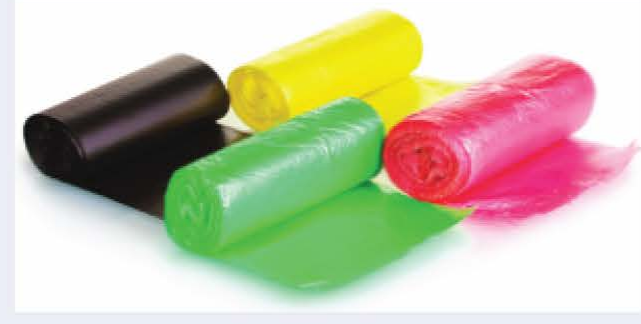
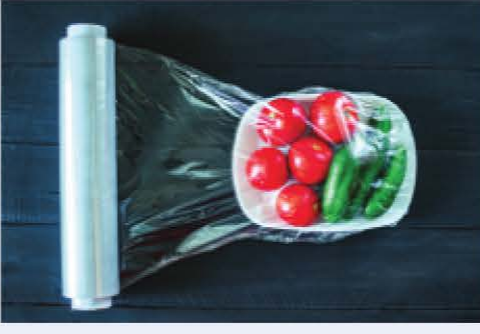
Common uses: Plastic bags, cling film, squeeze bottles, flexible containers
High-density polyethene (HDPE)
Formation and structure
HDPE was developed later (late 1960s) using a different production method:
- Low pressure
- Lower temperature
- Specialised Ziegler-Natta catalysts (transition metal catalysts)
These milder conditions allow the polymer to form more slowly and systematically, resulting in very few branches.
Why unbranched structure matters
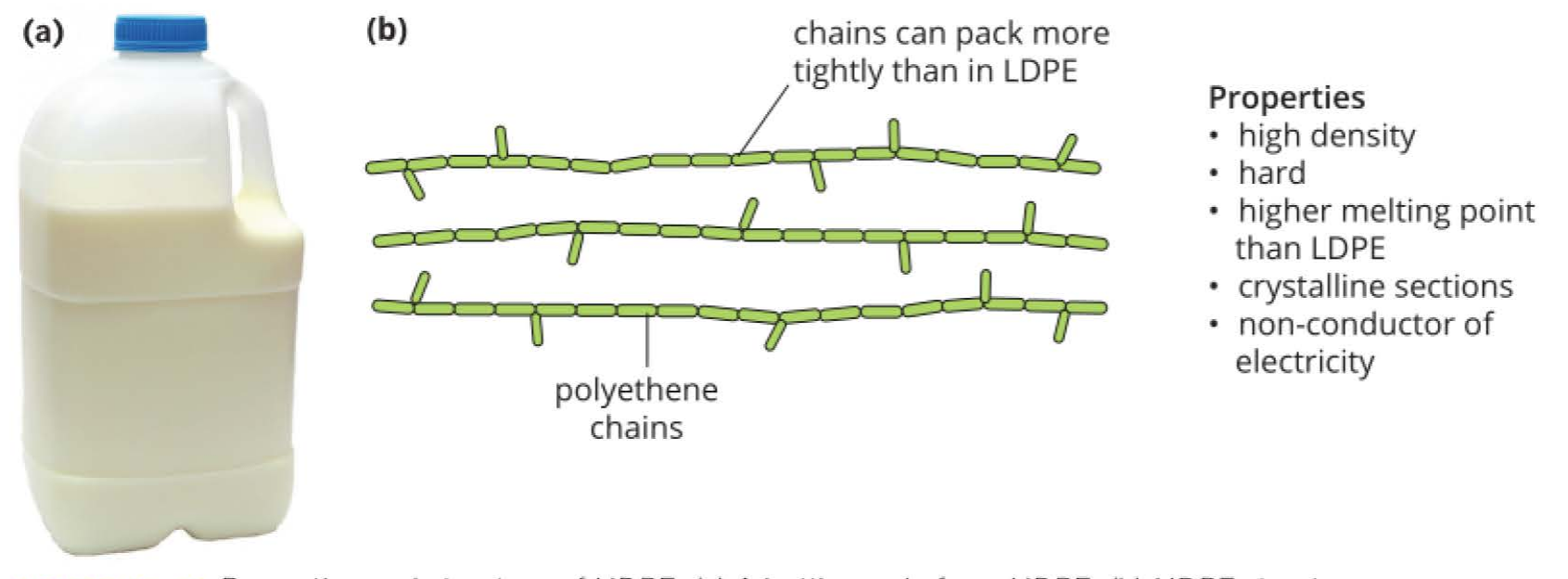
Without branches, HDPE molecules can pack together much more tightly. This leads to:
- Stronger dispersion forces (molecules are closer together)
- Higher density
- More ordered arrangement with crystalline sections
- Harder, more rigid material
Note
The Power of Catalysts: The development of Ziegler-Natta catalysts revolutionized polymer production. These catalysts allow polymerisation to occur under much gentler conditions, giving the polymer chains time to arrange themselves in an orderly fashion without branches forming.
Properties of HDPE
The unbranched structure gives HDPE these characteristics:
- High density
- Hard and rigid
- Higher melting point than LDPE
- Crystalline sections in structure
- Opaque appearance
- Non-conductor of electricity
Common uses: Milk bottles, detergent containers, pipes, harder plastic products
Comparing LDPE and HDPE
| Feature | HDPE | LDPE |
|---|---|---|
| Production | Catalysts control polymerisation at low pressure | High temperature and pressure, uncontrolled |
| Structure | Long molecules, few branches | Many branches |
| Packing | Molecules pack tightly | Molecules cannot pack tightly |
| Forces | Stronger dispersion forces | Weaker dispersion forces |
| Strength | Higher tensile strength | Lower tensile strength |
| Flexibility | Can be rigid or flexible | Flexible |
| Appearance | Opaque | Transparent |
| Density | High | Low |
Important
Exam Tip - The Key Difference: The key difference is branching - LDPE has many branches which prevent tight packing, while HDPE has few branches allowing tight packing and stronger intermolecular forces. If you remember this single structural difference, you can deduce all the other property differences.
Crystalline vs amorphous polymers
In some polymers, the entire solid is amorphous (disordered). Amorphous polymers are generally:
- Less rigid and weaker
- Often transparent (see-through)
- More flexible
Note
Structure Determines Properties: HDPE contains crystalline sections (ordered regions) while LDPE is relatively amorphous. This structural difference explains their different properties. Crystalline regions are like neatly stacked blocks, while amorphous regions are like randomly scattered blocks - the neat stacking makes the material stronger and more rigid.
HDPE contains crystalline sections (ordered regions) while LDPE is relatively amorphous. This structural difference explains their different properties.
Other addition polymers
Addition polymerisation can occur with any unsaturated monomer (containing double bonds). Here are two more important examples:
Bromoethene to polybromoethene
Bromoethene polymerises to form polybromoethene, a speciality polymer used when flame-resistant properties are needed.
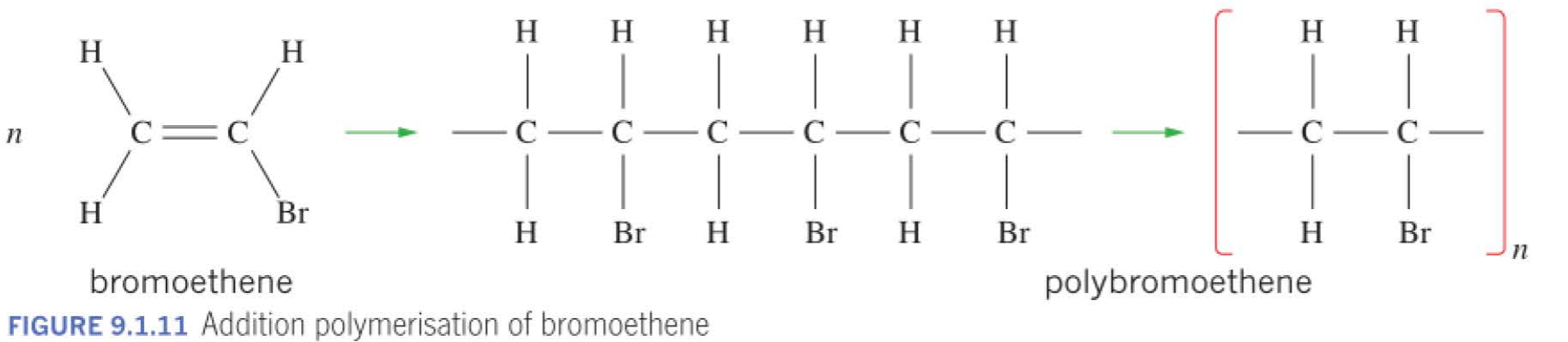
Notice that:
- The double bond breaks
- Bromine atoms alternate with hydrogen atoms along the chain
- All atoms are retained in the polymer (no byproducts)
Propene to polypropylene
Polypropylene (PP) is one of the few polymers manufactured in Australia. It has many uses including synthetic sports fields, microwave containers, and rope.
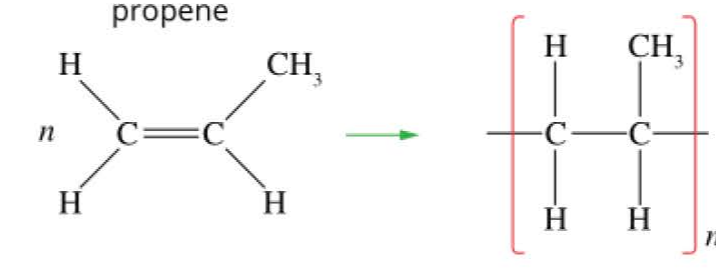
The methyl group () attached to alternate carbon atoms affects the properties of the polymer compared to polyethene.
Condensation polymerisation
What is condensation polymerisation?
Condensation polymerisation is a different method of forming polymers. Instead of using monomers with double bonds, it uses monomers with functional groups at each end of the molecule. Key features include:
- Functional groups at each end of monomers react with each other
- An ester link typically forms between monomers
- A small molecule (usually water) is released as a byproduct
- This explains the name 'condensation' - water condenses out
Important
Why It's Called Condensation: The name comes from the fact that water is released during the polymerisation process. When functional groups react, they join together and "squeeze out" a water molecule. This is similar to how water vapor condenses into liquid water - molecules come together and release water.
The mechanism
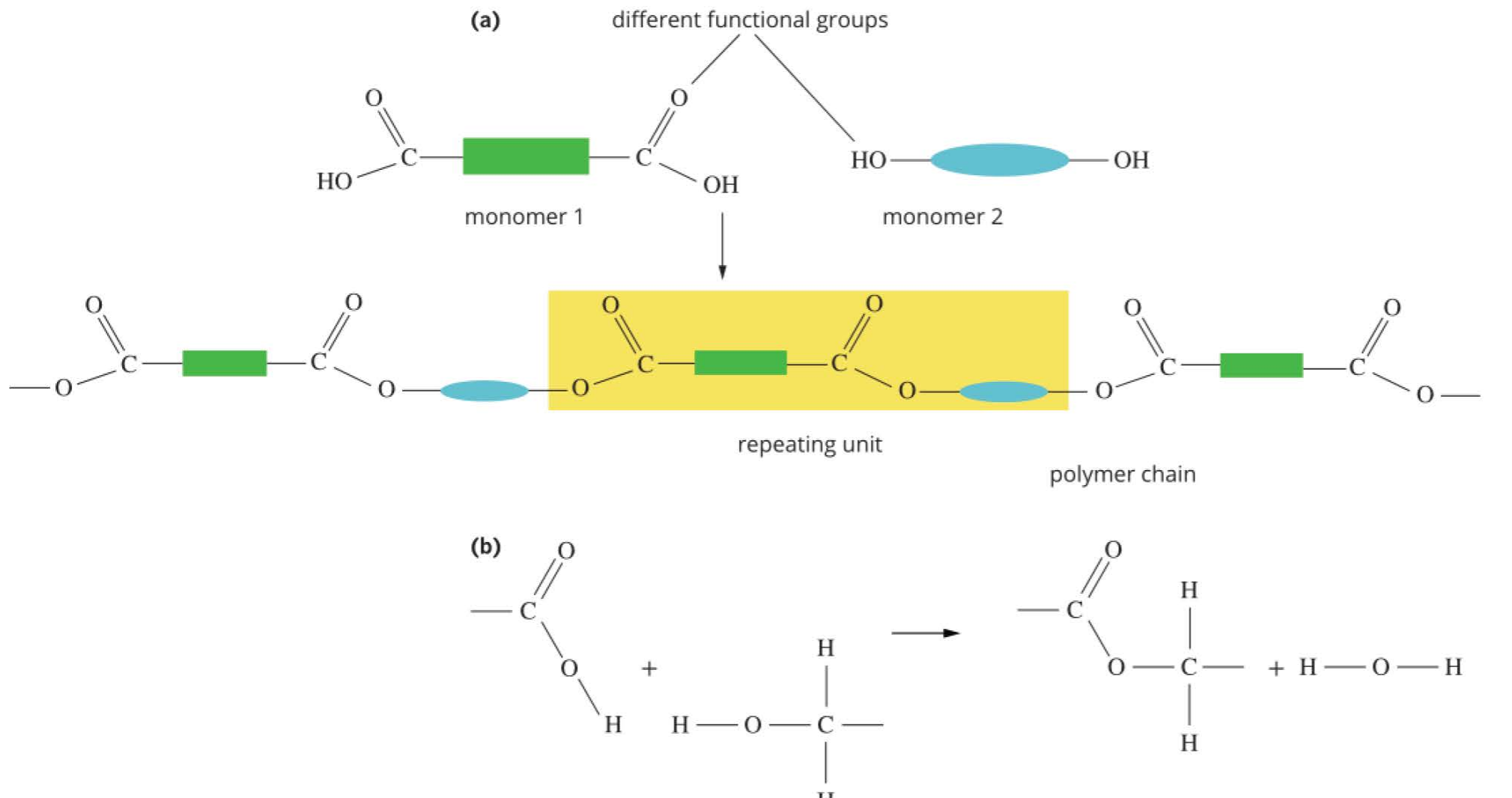
The diagram shows:
- Monomer 1 has carboxyl groups () at each end
- Monomer 2 has hydroxyl groups () at each end
- When these functional groups meet, they react to form an ester linkage
- Water () is released
- The process repeats, building a long polymer chain
The key reaction is:
Carboxyl group + Hydroxyl group → Ester group + Water
Note
Functional Groups in Action: Unlike addition polymerisation which requires double bonds, condensation polymerisation requires reactive functional groups at both ends of each monomer. These functional groups are like chemical "hooks" that can grab onto each other, releasing water as they connect.
Polyethylene terephthalate (PET)
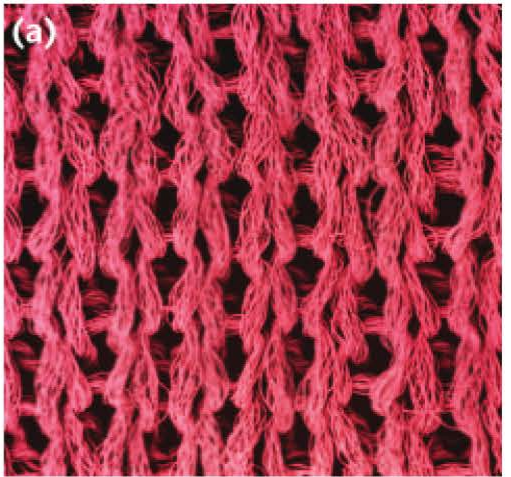
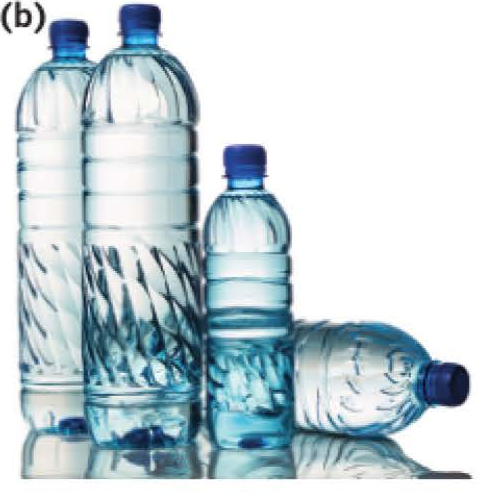
PET is one of the world's most-used condensation polymers. You'll recognise it as polyester fabric or plastic water bottles (recycling code 1).
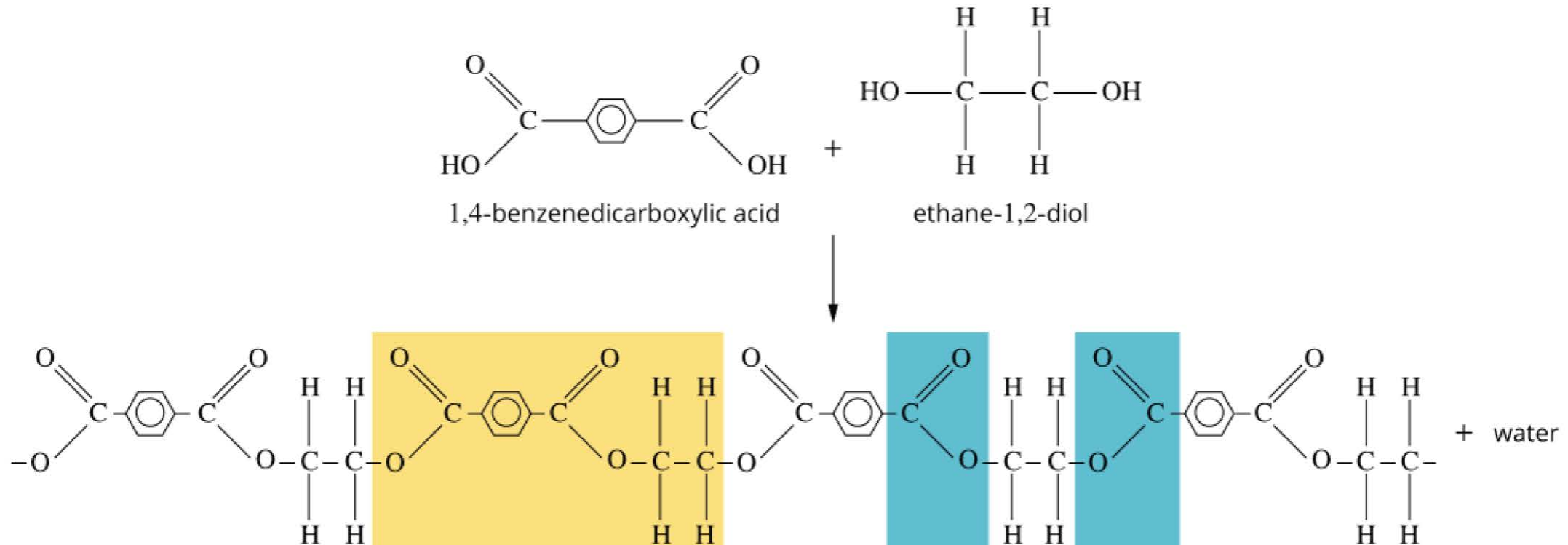
The formation involves:
- 1,4-benzenedicarboxylic acid (also called terephthalic acid) - has two carboxyl groups
- Ethane-1,2-diol (also called ethylene glycol) - has two hydroxyl groups
- These react repeatedly to form long chains linked by ester groups
- Water molecules are released at each linkage
Note
Common uses:
- Polyester clothing and fabrics
- Plastic water bottles
- Food containers
- Carpet fibres
Exam tip: Any plastic item marked with recycling code 1 is made from PET. PET is part of the polyester family because it contains ester linkages.
Polylactic acid (PLA)
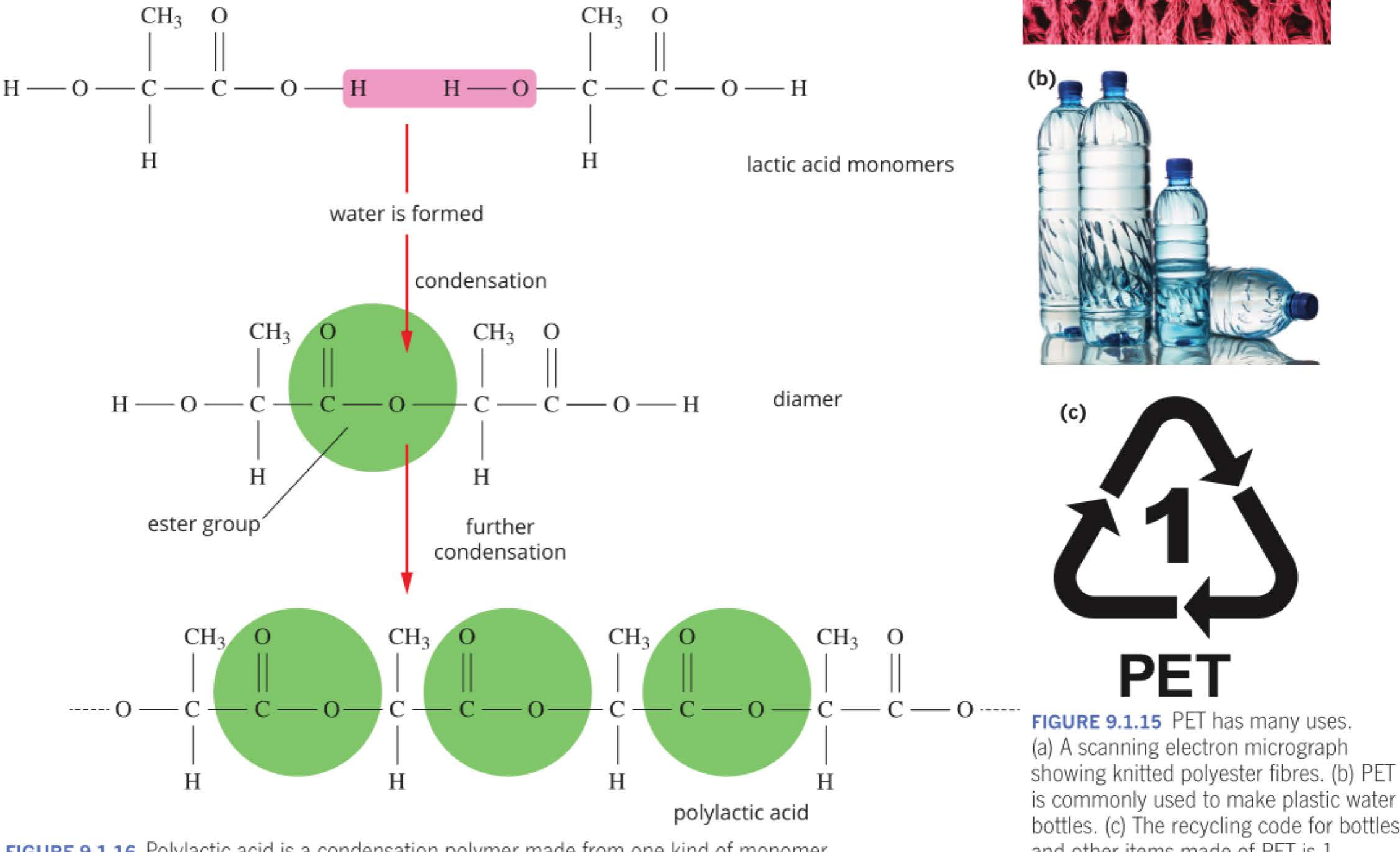
Polylactic acid demonstrates that condensation polymers don't always need two different monomers. PLA forms from just one monomer - lactic acid - which has different functional groups at each end.
The polymerisation proceeds as follows:
- One end of lactic acid has a carboxyl group ()
- The other end has a hydroxyl group ()
- These groups react between neighbouring molecules
- Ester linkages form, releasing water
- The process continues, building the polymer chain
Important
Environmental Significance: PLA is becoming increasingly popular because it's biodegradable - it breaks down naturally in the environment much faster than traditional plastics. This makes it an environmentally friendly alternative for applications like food packaging and disposable items.
PLA is becoming increasingly popular because it's biodegradable - it breaks down naturally in the environment much faster than traditional plastics.
Comparing addition and condensation polymerisation
| Feature | Addition polymerisation | Condensation polymerisation |
|---|---|---|
| Monomer requirement | Contains double bond | Functional groups at each end |
| Bond change | Double bond breaks | Functional groups react |
| Polymer structure | Only contains single bonds | Contains atoms other than carbon (e.g., oxygen in ester links) |
| Byproducts | No byproducts formed | Small molecules released (usually water) |
| Example structure | Complex structure with ester/amide links |
Important
Exam Tip - Quick Identification: To identify the type of polymerisation:
- If you see in the monomer → Addition polymerisation
- If you see functional groups at monomer ends → Condensation polymerisation
This simple rule will help you quickly classify any polymerisation reaction you encounter.
Natural polymers
While humans build factories to manufacture synthetic polymers, living organisms have been creating natural polymers for millions of years. Many biological molecules are polymers formed through condensation polymerisation within the organism itself.
Examples of natural polymers
Important natural polymers include:
- Proteins - made from amino acid monomers
- Cellulose - found in plant cell walls
- Starch - energy storage in plants
- Silk - protein fibres produced by insects
- Chitin - found in fungal cell walls and exoskeletons
Note
Nature's Polymer Factory: All these natural polymers are formed through condensation reactions, demonstrating that this type of polymerisation is fundamental to life itself. Organisms use condensation polymerisation to build essential structures like cell walls, store energy, and create protective coverings.
Chitin
Chitin is a particularly interesting natural polymer. It's found in:
- Cell walls of fungi
- Exoskeletons of crustaceans (like crabs and lobsters)
- Exoskeletons of insects
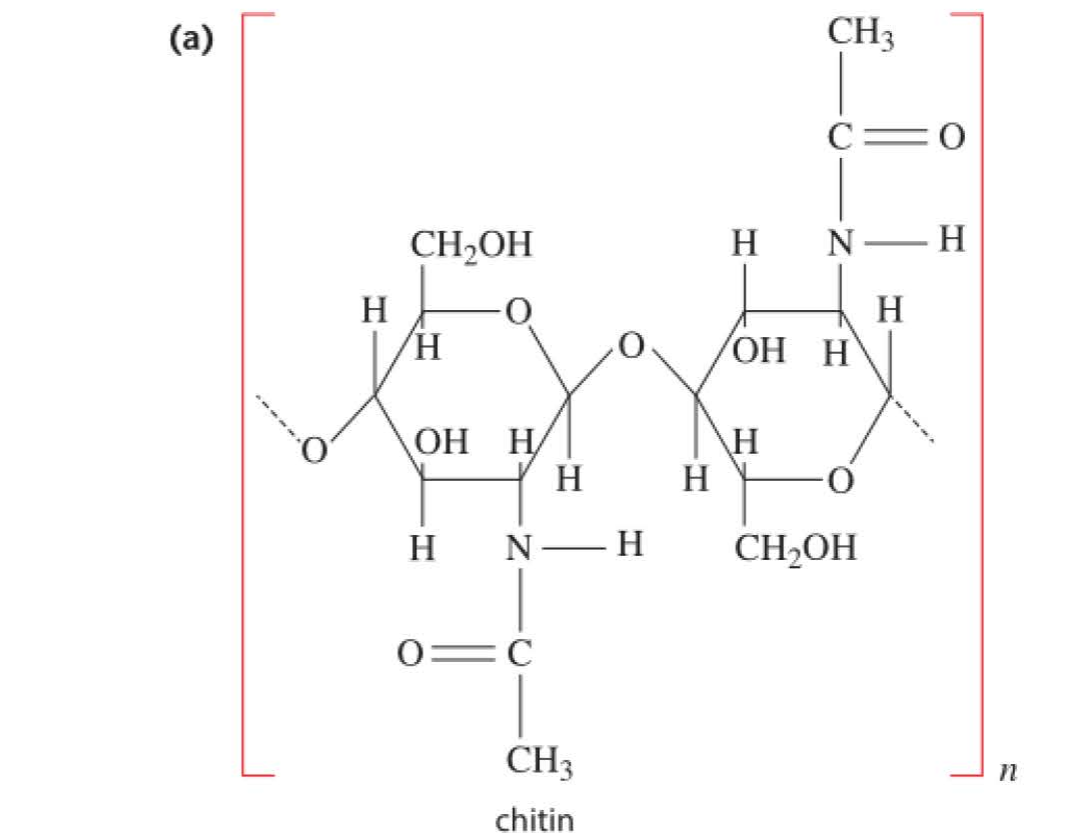
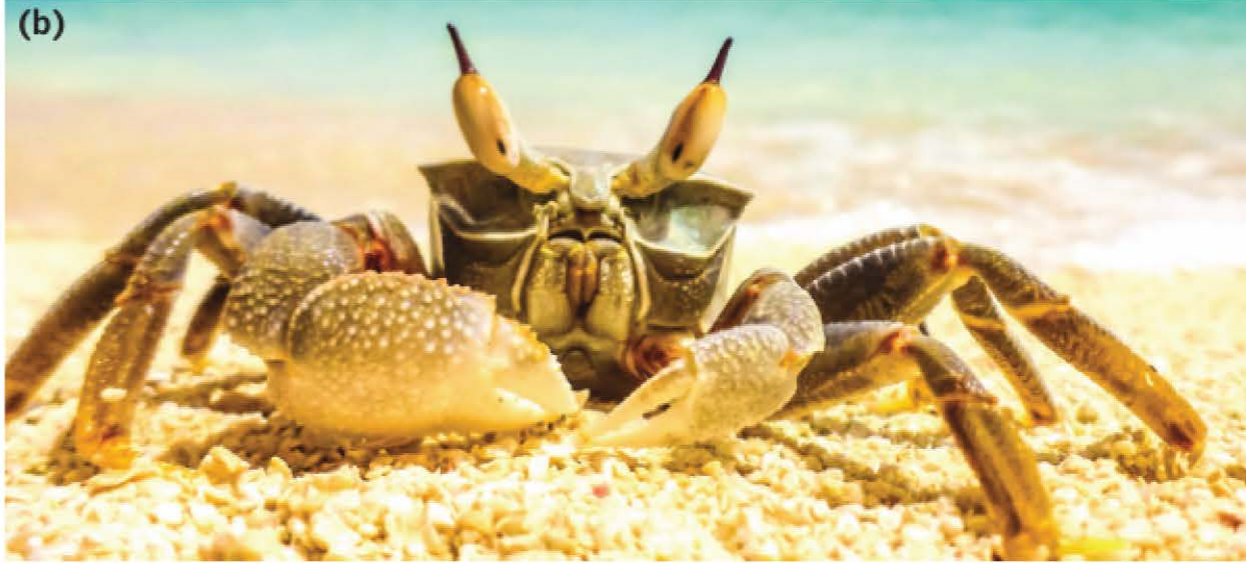
The chemical structure shows that chitin is built from repeating monomer units. The condensation polymerisation reaction occurs naturally within the organism, allowing it to build its protective structures.
All these natural polymers are formed through condensation reactions, demonstrating that this type of polymerisation is fundamental to life itself.
History of polymers
Natural polymers like wool, cellulose, and proteins have existed for millions of years. However, synthetic polymers have only been widely used for about 100 years.
Early developments
The story of synthetic polymers began with rubber. Native Americans were already playing with crude rubber balls when European settlers arrived in North America - these balls were made from rubber tree sap.
Note
Vulcanisation Revolution: Charles Goodyear revolutionised rubber production in 1839 by inventing vulcanisation. This process involves heating rubber with a small amount of sulfur, which significantly improves its properties. The Goodyear name remains famous for tyres today.
The first completely synthetic polymer was Bakelite, created by Belgian-American chemist Leo Baekeland in 1909. He reacted phenol with formaldehyde to form a hard material. Bakelite is still used today for bowling balls and saucepan handles.
Timeline of significant polymer developments
| Year | Polymer | Significance |
|---|---|---|
| 1869 | Celluloid (cellulose nitrate) | First commercial plastic; used for billiard balls, photographic film, and table-tennis balls |
| 1907 | Bakelite (phenol formaldehyde) | Used for light switches and saucepan handles |
| 1927 | Nylon | Created a shopping frenzy when used to make stockings in 1939 |
| 1927 | PVC (polyvinyl chloride) | Low flammability and low electrical conductivity |
| 1933 | Perspex (polymethyl methacrylate) | Transparency enabled it to replace glass during World War II |
| 1937 | Polyurethane | Invented in Germany by Professor Otto Bayer; first used to replace rubber |
| 1938 | Teflon (polytetrafluoroethene) | Extremely difficult to handle due to its lack of 'stickiness' |
| 1951 | Polypropene (PP) | Second-most used polymer in the world |
| 1972 | Kevlar | Very strong and lightweight polymer; flameproof |
| 1980 | Polyacetylene | Conductive polymer |
| 1990 | Polylactic acid | Biodegradable polymer |
Polymers in modern life
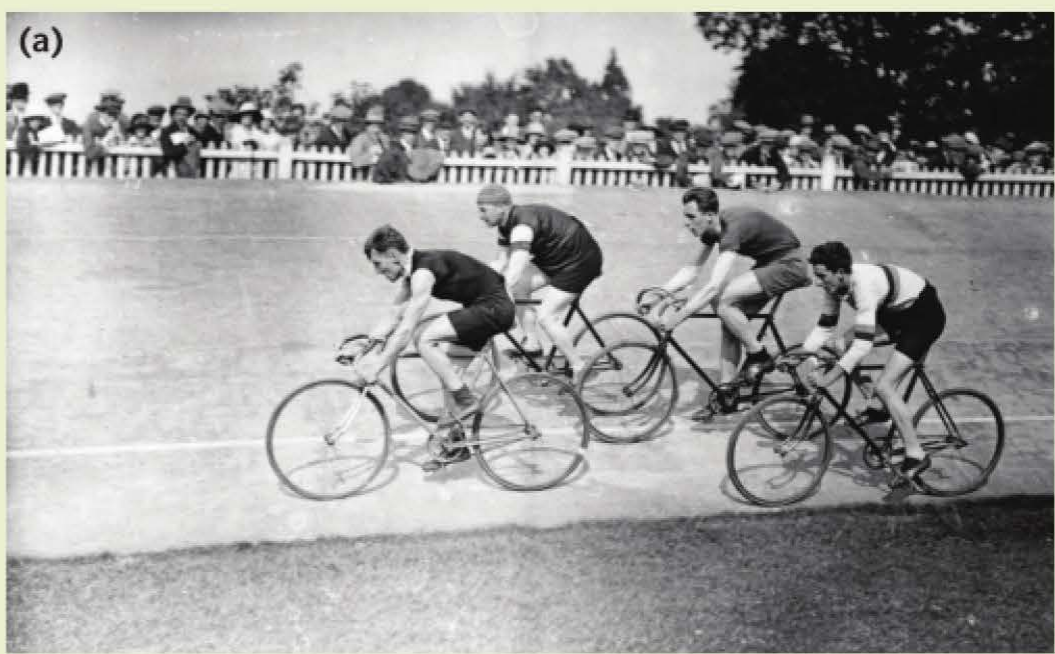
The rapid development of polymer technology is visible in many areas. Compare these two images of cyclists:
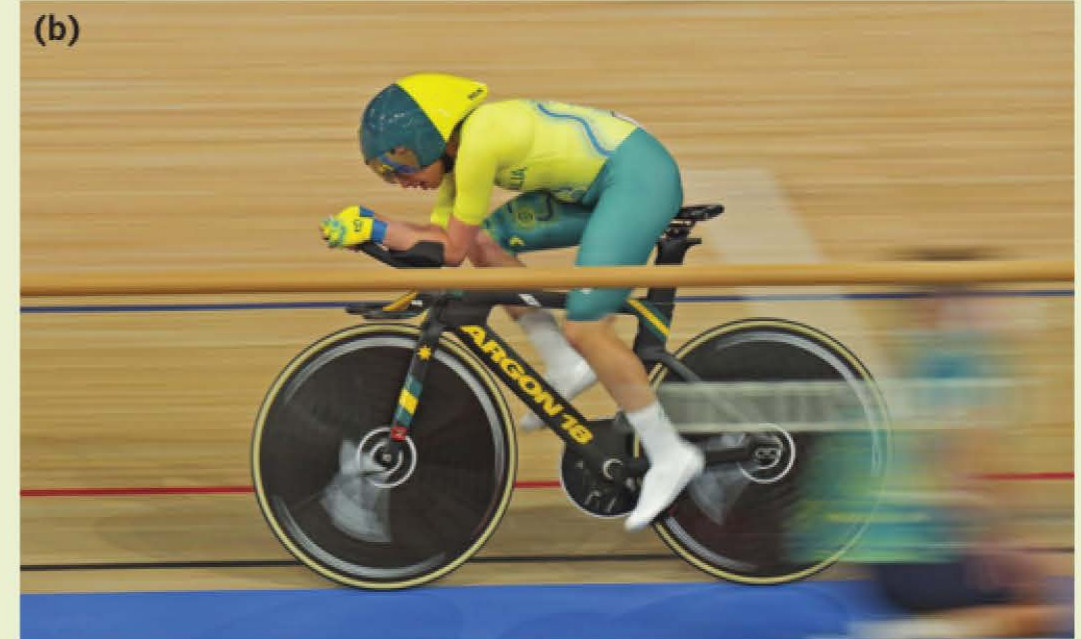
Note
Transformation Through Polymers: The contrast between 1920s cyclists with metal bicycles and modern Paralympic athletes highlights how polymers have transformed not only the materials used for bicycles but also athletic clothing, helmets, and safety equipment. This dramatic change occurred in less than a century.
Commercial use of polyethene flourished during World War II, when it replaced much heavier components in planes and ships, demonstrating the strategic importance of polymer development.
Summary
Key Points to Remember:
-
Polymers are very large molecules formed by joining thousands of small monomers together through polymerisation. The word comes from Greek: 'poly' (many) + 'mer' (part).
-
Addition polymerisation occurs when unsaturated monomers (containing ) react with themselves. The double bonds break and all atoms end up in the polymer - no byproducts form. Examples: ethene → polyethene, propene → polypropene.
-
LDPE vs HDPE: LDPE has many branches (made at high pressure/temperature), giving it lower density and more flexibility. HDPE has few branches (made with catalysts at low pressure), allowing tight packing for higher density and rigidity.
-
Condensation polymerisation uses monomers with functional groups at each end. When functional groups react, they form links (like ester groups) and release small molecules like water. Examples: PET, polylactic acid.
-
Natural polymers like proteins, cellulose, starch, and chitin are formed through condensation polymerisation within living organisms. Synthetic polymers have only been widely used for about 100 years, but they've transformed modern life.