Thermoplastic and Thermosetting Polymers (VCE SSCE Chemistry): Revision Notes
📚Revision Notes
Thermoplastic and Thermosetting Polymers
Classification of polymers by heating behavior
Polymers can be grouped into two main categories based on how they respond to heat:
- Thermoplastic polymers – these soften when heated
- Thermosetting polymers (also called thermoset polymers) – these do not soften when heated
Understanding the difference between these two types is essential for determining which polymers can be recycled and which applications they are best suited for.
Thermoplastic polymers
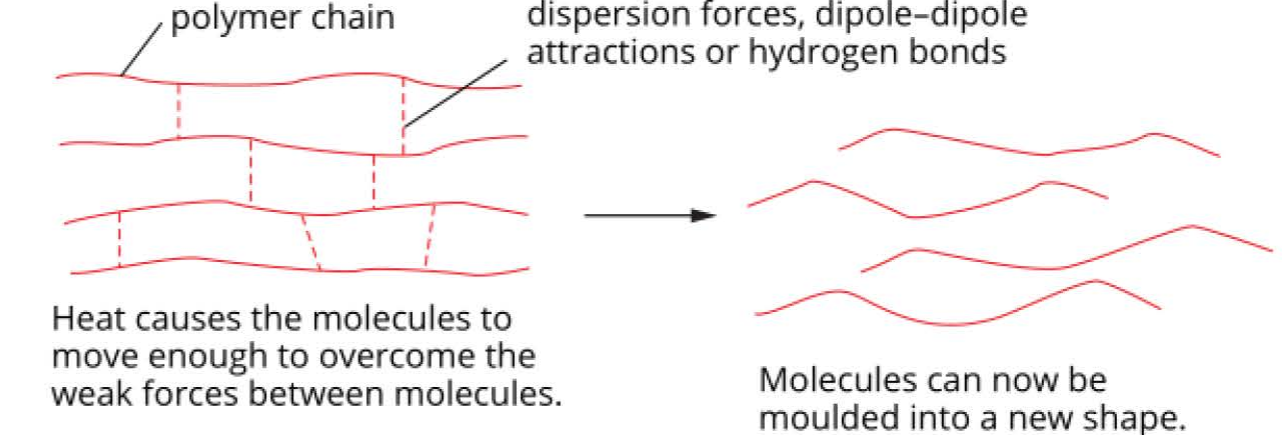
Thermoplastic polymers become soft and pliable when heated, which allows them to be reshaped or recycled into new products. This behavior only occurs when the bonds holding the long polymer chains together are relatively weak intermolecular forces, including:
- Hydrogen bonds
- Dipole-dipole attractions
- Dispersion forces (also called van der Waals forces)
How heating affects thermoplastic polymers
When a thermoplastic material is heated, the polymer molecules gain enough kinetic energy to overcome the weak intermolecular forces between chains. This allows the chains to move freely and slide past one another, making the material moldable. Once cooled, the intermolecular forces re-establish themselves, and the polymer solidifies in its new shape.
Note
The ability to be remolded makes thermoplastic polymers highly recyclable – a valuable property for reducing environmental waste. This is one of the main advantages of thermoplastics over thermosetting polymers.
Most addition polymers fall into the thermoplastic category.
Thermosetting polymers
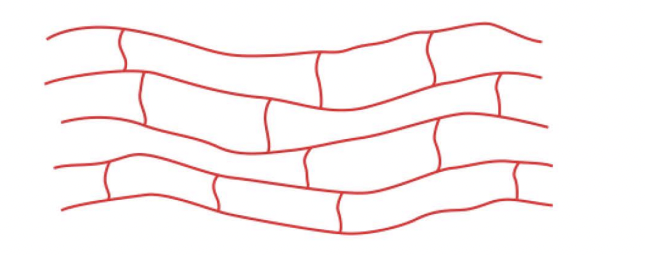
Thermosetting polymers have a fundamentally different structure to thermoplastics. They form when monomers containing more than two functional groups undergo polymerisation, creating a three-dimensional network rather than linear chains.
Structure and cross-links
The three-dimensional structure contains cross-links – strong covalent bonds that connect different polymer chains throughout the material. These cross-links severely restrict the movement of polymer chains, making thermosetting polymers rigid, hard, and highly resistant to heat.
Example
Example: Urea-formaldehyde Formation
A common example of a thermosetting polymer is urea-formaldehyde, formed through a condensation reaction between urea and formaldehyde monomers. The reaction creates a network of strong covalent bonds throughout the structure.
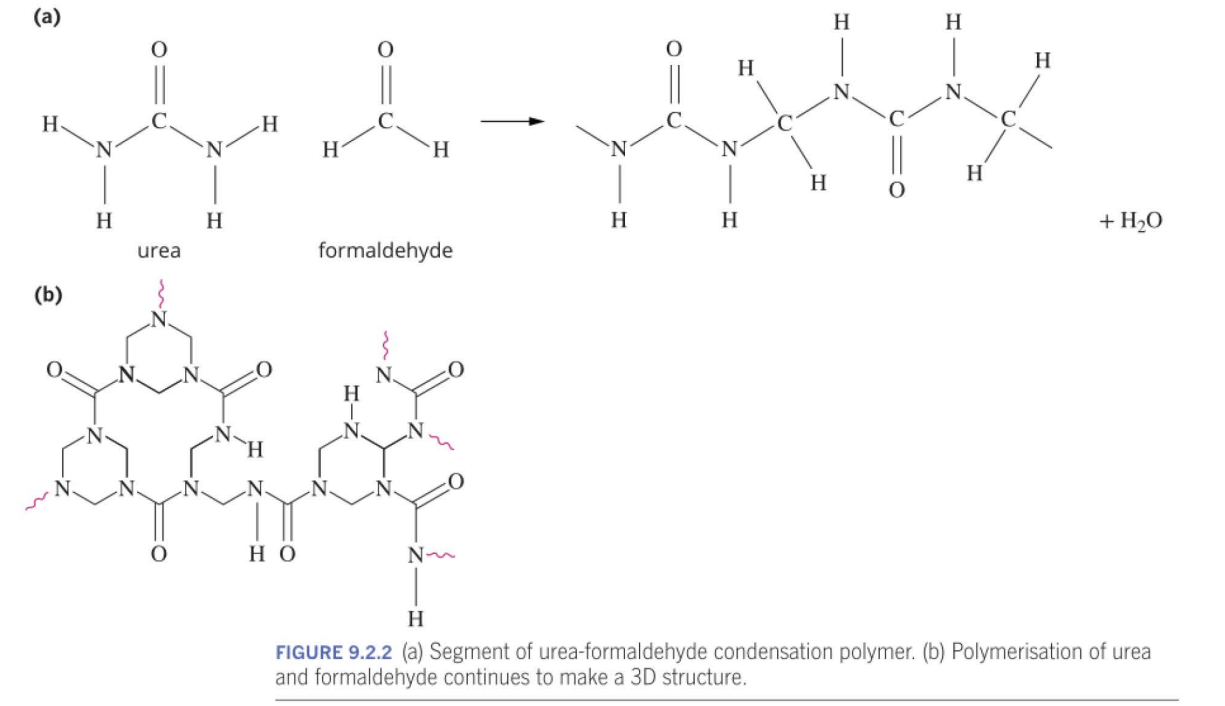
This three-dimensional network gives urea-formaldehyde its characteristic rigidity and heat resistance, making it ideal for applications like electrical fittings and adhesives.
Behaviour when heated
Important
Unlike thermoplastic polymers, thermosetting polymers do not soften when heated. Instead, if the temperature becomes high enough to break the covalent cross-links, the bonds can break at random points throughout the structure, causing the entire polymer to chemically decompose or burn. This decomposition is irreversible.
Recycling challenges
Because thermosetting polymers cannot be melted and remolded, they are extremely difficult to recycle. Once the three-dimensional network is formed, it cannot be reshaped into new products.
Applications
Despite their recycling limitations, thermosetting polymers are chosen for applications requiring exceptional strength or heat resistance, such as:
- Saucepan handles
- Bowling balls
- Shatterproof crockery
In general, most modern plastic products are manufactured from thermoplastic polymers to enable recycling. Thermosetting polymers are only selected when their superior strength or heat resistance is specifically required.
Elastomers
Elastomers represent an interesting intermediate class of polymers. They form when polymer chains contain only occasional cross-links rather than the extensive cross-linking found in thermosetting polymers.
Unique properties
The sparse cross-links in elastomers allow the polymer chains to move and stretch past one another when a force is applied. However, the cross-links act like anchor points that pull the chains back to their original positions once the stretching force is removed. This gives elastomers their characteristic elastic properties.
Note
Think of elastomers like a series of springs connected at certain points. When you pull on them, they stretch out, but the connection points ensure they snap back to their original shape when you let go.
Applications
Elastomers are used to make products that need to stretch and return to their original shape, including:
- Elastic bands
- Rubber items
- Car tyres
Example
Example: Sulfur Cross-linking in Rubber
In rubber products such as car tyres, sulfur atoms form cross-links between polymer chains. This process, called vulcanisation, creates the elastomer structure.
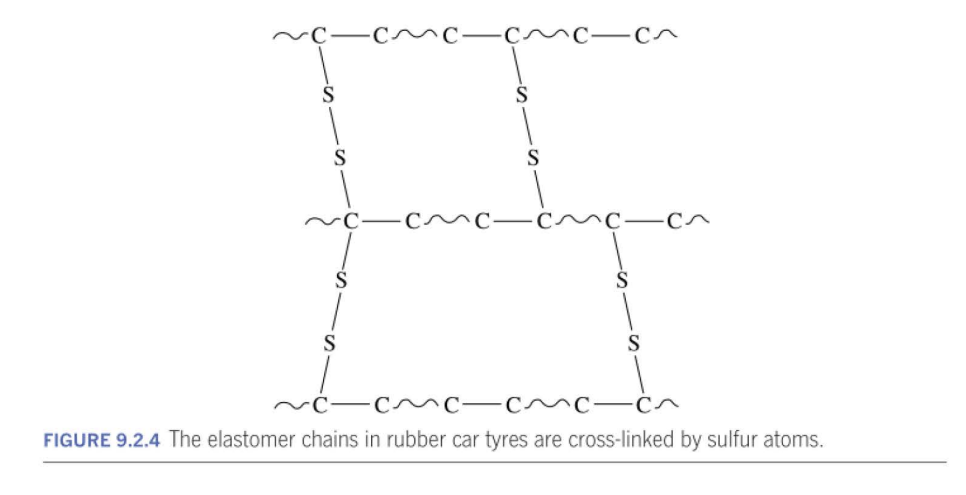
The sulfur cross-links are spaced far enough apart to allow stretching, but close enough to ensure the rubber returns to its original shape.
Recycling difficulties
Although elastomers are more flexible than thermosetting polymers, the cross-links prevent them from completely melting when heated. This makes elastomers difficult to recycle through conventional methods. For example, the sulfur cross-links in car tyres mean they cannot be melted down and remolded into new products.
Summary
Key Points to Remember:
-
Thermoplastic polymers soften when heated because they are held together by weak intermolecular forces. This allows them to be easily remolded and recycled.
-
Thermosetting polymers have strong covalent cross-links forming a rigid three-dimensional structure. They decompose or burn when heated rather than softening, making them difficult to recycle.
-
Elastomers contain occasional cross-links that allow them to stretch and return to their original shape, but prevent complete melting and make recycling challenging.
-
Most modern plastics are thermoplastic to enable recycling, while thermosetting polymers are reserved for applications requiring exceptional heat resistance or strength.
-
The type of bonding between polymer chains (weak intermolecular forces versus strong covalent cross-links) determines whether a polymer is thermoplastic or thermosetting.