Faraday’s Laws (VCE SSCE Chemistry): Revision Notes
📚Revision Notes
Faraday's Laws
Introduction
Industrial chemists working with electrolytic cells need to understand the relationships between the amount of product formed, the electric current used, and the operating time. In 1834, Michael Faraday discovered fundamental laws that explain these relationships in electrochemical processes. These laws apply to both electrolytic cells (which use electrical energy to drive chemical reactions) and galvanic cells (which produce electrical energy from chemical reactions).
Electroplating
Electroplating is a commercially important application of electrolysis where a thin coating of metal (only a fraction of a millimetre thick) is applied to the surface of another object. This process has many practical uses in industry.
Applications of electroplating
A common example is the tin coating applied to steel food cans. Although these are called 'tin' cans, they are primarily made of steel (an alloy of iron and carbon). Only a thin layer of tin is plated over the steel surface. This tin coating serves an important purpose: tin corrodes very slowly and prevents contact between the iron, moisture, and air. This effectively stops the steel from rusting and protects the food inside.

Note
The tin coating on steel cans is incredibly thin - typically only 0.0001 to 0.0005 mm thick - yet it provides excellent protection against corrosion. This demonstrates the efficiency and cost-effectiveness of electroplating in industrial applications.
Electroplating cells: how they work
Electroplating occurs in electrolytic cells. Understanding the setup and reactions in these cells is essential for applying Faraday's laws.
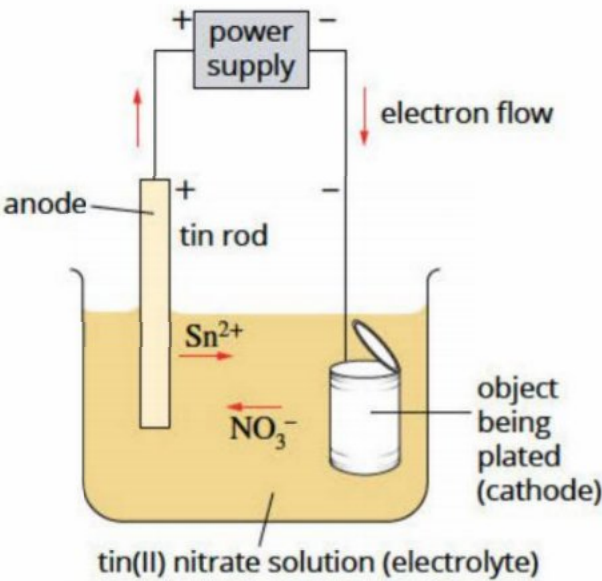
In an electroplating cell:
- The object to be plated is connected to the negative terminal of a power supply, making it the cathode (negative electrode)
- The object is immersed in an electrolyte solution containing ions of the metal to be plated (for example, ions in tin(II) nitrate solution for tin plating)
- A rod of the plating metal is connected to the positive terminal, making it the anode (positive electrode)
- When the cell operates, the power supply acts as an 'electron pump', pushing electrons onto the cathode and removing them from the anode
Reaction at the cathode (negative electrode)
At the cathode, metal ions from the solution are attracted to the negative electrode. Here they accept electrons and undergo reduction to form metal atoms:
This creates a coating of tin metal on the object being plated. Because reduction occurs here (gain of electrons), this electrode is called the cathode.
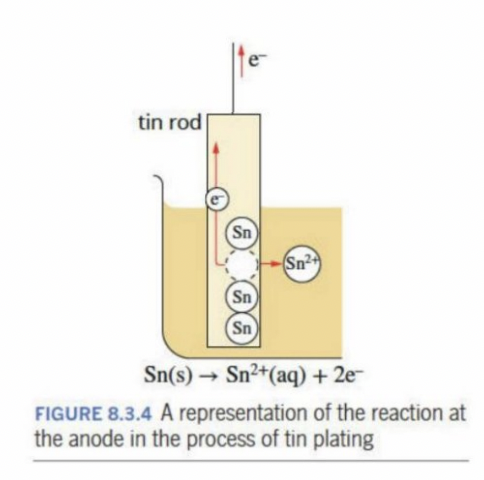
Reaction at the anode (positive electrode)
At the anode, the power supply withdraws electrons from the metal electrode, causing an oxidation reaction. The tin metal slowly dissolves as ions are formed:
This reaction replaces the ions that were consumed at the cathode, keeping the concentration of metal ions in the electrolyte constant. Because oxidation occurs here (loss of electrons), this electrode is called the anode.
Important
Remember the key principle:
- Reduction occurs at the cathode (gain of electrons)
- Oxidation occurs at the anode (loss of electrons)
A helpful memory aid: "RED CAT" (REDuction at CAThode) and "AN OX" (ANode OXidation)
Summary of electroplating cell setup
Summary
Key Points to Remember:
- The object being plated is the cathode (negative electrode)
- An electrode made of the plating metal is the anode (positive electrode)
- The electrolyte solution contains ions of the metal being plated
- Reduction occurs at the cathode (metal ions gain electrons)
- Oxidation occurs at the anode (metal atoms lose electrons)
Factors affecting product formation
Several key factors determine how much product forms in an electrolytic cell:
- The charge on the ion involved in the electrode reaction
- The current flowing through the cell
- The length of time the current flows
Faraday's laws describe the mathematical relationships between these factors.
Faraday's first law of electrolysis
Understanding electric charge
Before examining Faraday's first law, we need to understand how electric charge is measured and calculated.
Electric charge (symbol ) is measured in coulombs (C). The charge passing through a cell can be calculated from:
- The current () through the cell, measured in amperes (A)
- The time () the current flows, measured in seconds (s)
The relationship is:
where:
- = charge in coulombs (C)
- = current in amperes (A)
- = time in seconds (s)
Note
This fundamental relationship is one of the two key formulas you'll use in all Faraday's law calculations. Make sure you always convert time to seconds before using this equation!
Experimental investigation
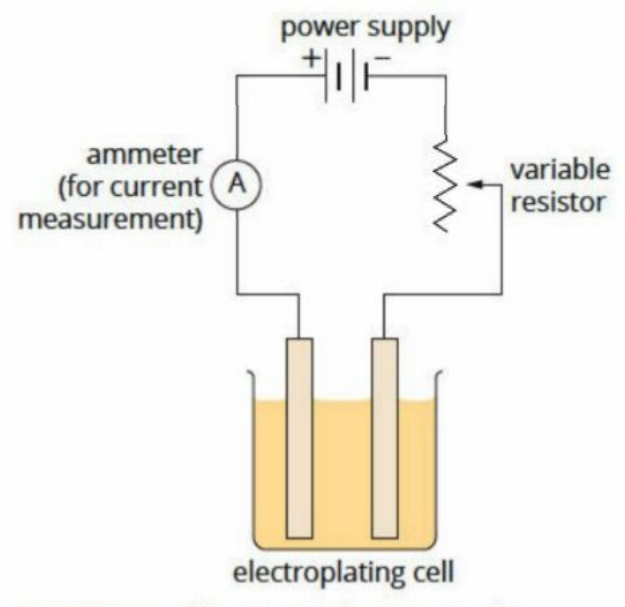
An experiment was conducted using a silver-plating cell to investigate the relationship between charge and mass of metal deposited. The apparatus included an ammeter to measure current and a variable resistor to keep the current constant.
The experimental data from the silver-plating cell is shown below:
| Current (A) | Time (s) | Charge (C) | Mass of silver formed (g) |
|---|---|---|---|
| 2.0 | 200 | 400 | 0.45 |
| 2.0 | 400 | 800 | 0.91 |
| 2.0 | 600 | 1200 | 1.34 |
| 2.0 | 800 | 1600 | 1.79 |
| 2.0 | 1000 | 2000 | 2.24 |
The relationship between charge and mass
When this data is plotted on a graph, it shows a straight line through the origin. This demonstrates that the mass of silver produced at the cathode is directly proportional to the electrical charge passed through the cell.
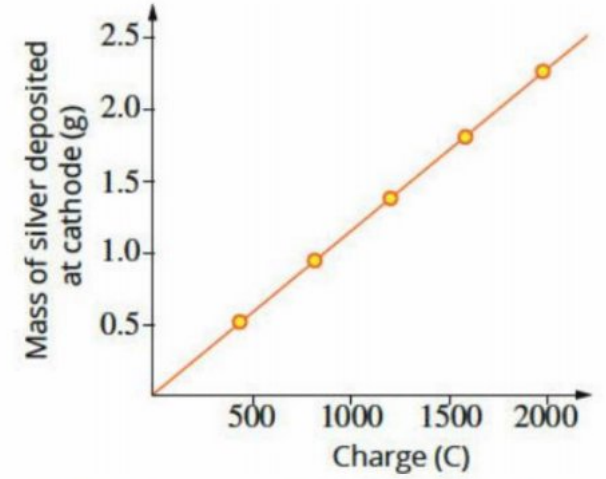
This observation led to Faraday's first law of electrolysis:
Important
Faraday's First Law of Electrolysis:
The mass of any substance deposited, evolved or dissolved at an electrode in an electrochemical process is directly proportional to the electrical charge passed through the cell.
Symbolically:
Faraday's second law of electrolysis
Comparing different metals
When the electroplating experiment is repeated using different metals (copper, tin, lead, chromium, and silver), each metal shows a different relationship between charge and mass deposited.
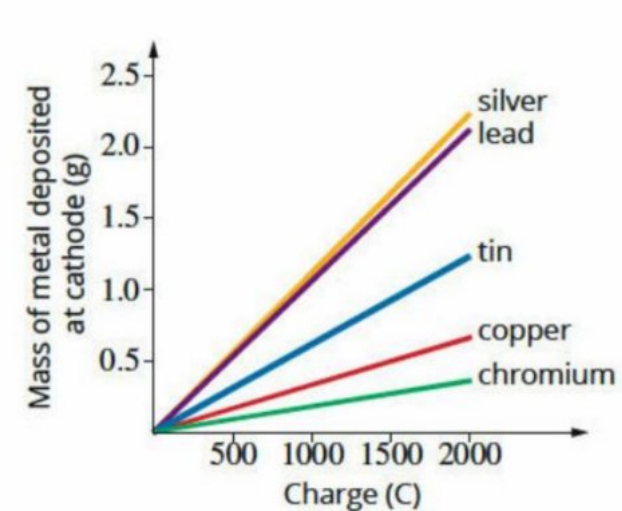
While each metal obeys Faraday's first law (showing a straight line), the slopes of the lines differ. However, when we plot the amount of metal in moles (rather than mass in grams) against charge, an interesting pattern emerges.
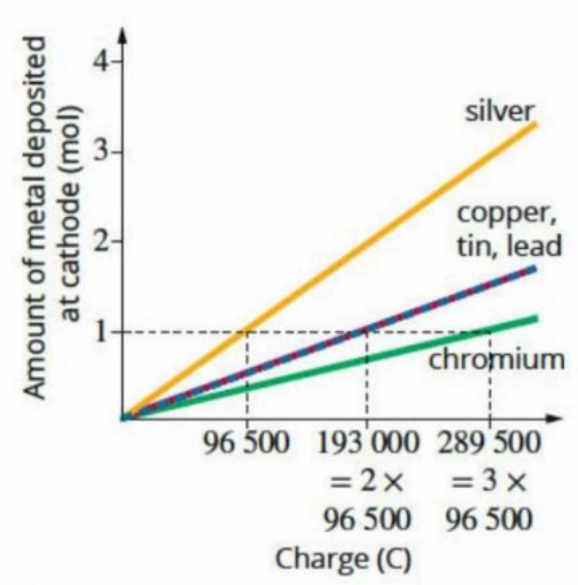
All the data now falls onto just three lines! This reveals the underlying principle:
- One mole of silver requires about 96,500 C of charge
- One mole of copper, tin, or lead requires about 193,000 C (which is C)
- One mole of chromium requires about 289,500 C (which is C)
The Faraday constant
The charge on one mole of electrons is 96,500 C. This quantity is called a faraday and has the symbol . Therefore:
This is known as the Faraday constant.
The charge on any number of moles of electrons can be calculated using:
or
where:
- = charge in coulombs (C)
- = number of moles of electrons
- = Faraday's constant (96,500 C mol⁻¹)
Note
The Faraday constant is one of the most important values in electrochemistry. You may be expected to recall this value in exams, so commit it to memory: F = 96,500 C mol⁻¹
Understanding the pattern
The different lines on the graph arise because different metal ions have different charges, requiring different numbers of electrons:
For silver: 1 mole of electrons produces 1 mole of silver
For copper, tin, and lead: 2 moles of electrons produce 1 mole of metal
For chromium: 3 moles of electrons produce 1 mole of chromium
This leads to Faraday's second law of electrolysis:
Important
Faraday's Second Law of Electrolysis:
To produce 1 mole of a substance at an electrode, 1, 2, 3, or another whole number of moles of electrons must be consumed.
The number of moles of electrons required depends on the charge of the ion being reduced or oxidised.
General statement of Faraday's laws
Faraday's laws can be stated more generally:
- The mass of any substance deposited, evolved or dissolved at an electrode is directly proportional to the electrical charge passed through the cell
- For 1 mole of a substance to be deposited, evolved or dissolved at an electrode, the passage of 1, 2, 3 or another whole number of moles of electrons is required
These laws apply to all electrochemical processes, including both electrolytic cells and galvanic cells (such as fuel cells).
Calculations using Faraday's laws
Faraday's laws enable us to perform quantitative calculations about electrochemical cells. These calculations are based on two key relationships:
Note
These two formulas are the foundation of all Faraday's law calculations. The strategy is to:
- Use to find charge from current and time
- Use to convert between charge and moles of electrons
- Use the electrode equation to relate moles of electrons to moles of substance
- Convert moles to mass using molar mass
Calculating the mass of product formed
Example
Worked Example: Chromium plating
A chromium-plating cell operates with a steady current of 30.0 A for 20.0 minutes. What mass of chromium is plated on the object at the cathode?
The cathode reaction is:
Step 1: Calculate the charge passing through the cell
Step 2: Calculate the moles of electrons
Step 3: Use the mole ratio to find moles of chromium
From the equation: 3 moles of produce 1 mole of Cr
Step 4: Calculate the mass of chromium
The molar mass of Cr is 52.0 g mol⁻¹
Answer: 6.47 g of chromium is plated on the cathode
Calculating the time required
Example
Worked Example: Copper plating
How long would it take, in hours, to deposit 50.0 g of copper at the cathode of a copper-plating cell operating at a current of 8.00 A?
The cathode reaction is:
Step 1: Calculate the moles of copper
Step 2: Calculate the moles of electrons needed
From the equation: 2 moles of deposit 1 mole of Cu
Step 3: Calculate the charge required
Step 4: Calculate the time required
Step 5: Convert to hours
Answer: It would take 5.28 hours to deposit 50.0 g of copper
Application to fuel cells
Faraday's laws also apply to galvanic cells such as fuel cells. Here, chemical reactions produce electrical energy, and we can calculate how long a given mass of fuel will last.
Example
Worked Example: Ethanol fuel cell
A fuel cell uses ethanol () as its fuel source. How long would it take, in seconds, for 200 g of ethanol to be used in the fuel cell operating at a current of 1.25 A?
The half-equation is:
Step 1: Calculate the moles of ethanol
The molar mass of ethanol is 46.0 g mol⁻¹
Step 2: Calculate the moles of electrons produced
From the equation: 1 mole of ethanol produces 12 moles of
Step 3: Calculate the charge generated
Step 4: Calculate the time taken
Answer: It would take 4.03 × 10⁶ seconds for 200 g of ethanol to be consumed
Note
In fuel cell calculations, notice that electrons are produced (not consumed) at the electrode. The half-equation shows electrons on the product side, and each mole of fuel produces multiple moles of electrons. Despite this difference, the same calculation method applies!
Exam tips
Summary
Exam Strategy for Faraday's Law Problems:
When solving problems involving Faraday's laws:
- Always convert time to seconds before using
- Pay careful attention to the mole ratio in the electrode equation - this tells you how many moles of electrons are needed per mole of substance
- Remember that Faraday's constant is 96,500 C mol⁻¹ (you may need to recall this value)
- Show all working clearly, using the formulas and
- Check that your final units are appropriate for the question (grams, hours, coulombs, etc.)
Historical context

Michael Faraday (1791-1867) was an English scientist who made significant contributions to electrochemistry and electromagnetism. His experiments on the decomposition of tin(II) chloride revealed that the amounts of tin and chlorine gas produced were always proportional to the amount of electric charge passed through the cell. Faraday also played a key role in popularising the terms 'anode', 'cathode', 'electrode' and 'electrolyte' that we still use today.
Note
Faraday's work was remarkable considering he had little formal education. He began his scientific career as an assistant to Sir Humphry Davy at the Royal Institution in London, and through his meticulous experimental work, became one of the most influential scientists of the 19th century.
Remember!
Summary
Key Takeaways:
- Electroplating deposits a thin layer of metal onto an object using electrolysis
- Faraday's first law: The mass of substance formed at an electrode is directly proportional to the charge passed through the cell ()
- Faraday's second law: To produce 1 mole of substance, a whole number of moles of electrons (1, 2, 3, etc.) must be transferred
- Key formulas: and , where C mol⁻¹
- The number of electrons required depends on the charge of the ion in the electrode equation
- Faraday's laws apply to both electrolytic cells and galvanic cells (such as fuel cells)