Avogadro’s Constant (VCE SSCE Chemistry): Revision Notes
📚Revision Notes
Avogadro's Constant
Introduction to the mole
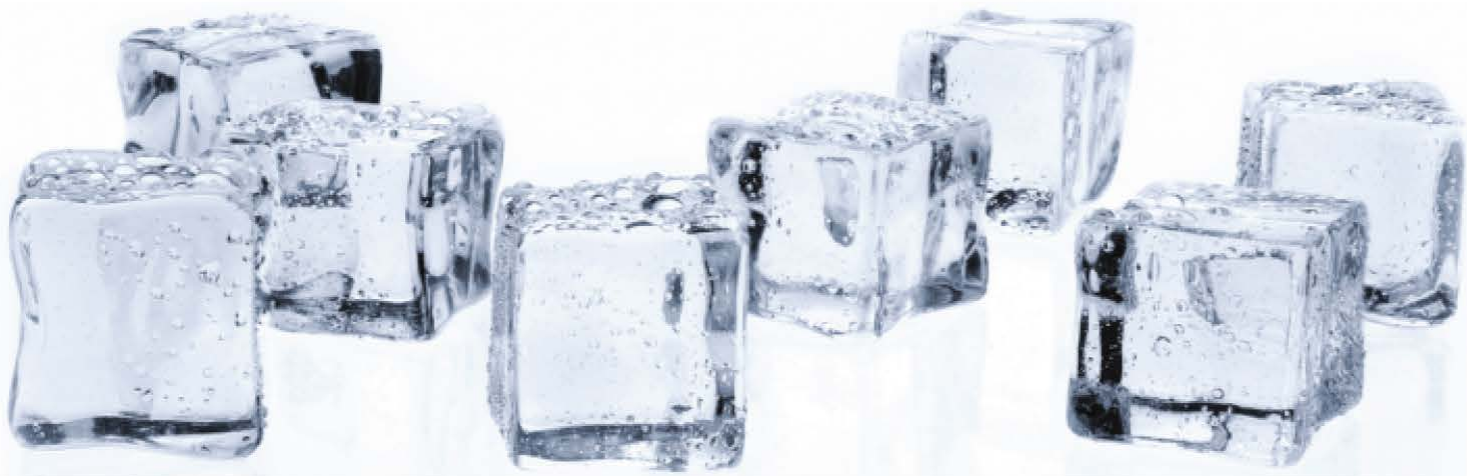
Atoms, ions, and molecules are incredibly tiny particles. Counting them individually would be practically impossible, even if we tried to count thousands or millions at a time. Even tiny samples contain enormous numbers of particles. For example, a single ice cube contains more than water molecules (). Since each water molecule contains two hydrogen atoms and one oxygen atom, the total number of individual atoms in one ice cube exceeds .
Note
To put this in perspective, if you could count one particle per second, it would take you more than 3 trillion years to count all the particles in a single ice cube - far longer than the age of the universe!
Because chemical particles are so small and numerous, chemists needed to develop a practical counting unit that would allow them to measure amounts of these extremely small particles accurately.
The chemist's counting unit
In everyday life, we use convenient quantity units to count specific numbers of items. You're probably familiar with terms like "pair" (which equals two) and "dozen" (which equals twelve). When you buy eggs or roses by the dozen, you know exactly how many items you're getting. If one dozen equals twelve, then two dozen equals 24, twenty dozen equals 240, and half a dozen equals 6.

While a dozen works well for counting eggs or roses, chemists require a unit that represents a much larger number for counting atoms, ions, and molecules. The accepted convenient quantity unit used by chemists is called the mole.
The mole is often called the 'amount of substance' and uses the symbol with the unit mol.
For example, means "the amount of glucose is 2 moles".
Note
Chemists use the mole as a counting unit in the same way we use dozen. They understand that one mole equals a specific number, and that 2 moles, 20 moles, or half a mole are all multiples of that number.
The number in a mole
One mole of any substance is defined as containing exactly particles. Written out in full, that's 602,214,076,000,000,000,000,000 particles!
This number is commonly rounded to and is called Avogadro's constant. It uses the symbol .
Avogadro's constant is written using scientific notation, which is a convenient way to express very large or very small numbers. The value can be written as:
Important
Remember: 1 mol of any substance contains particles. This is true for any substance - whether it's atoms, molecules, or ions.
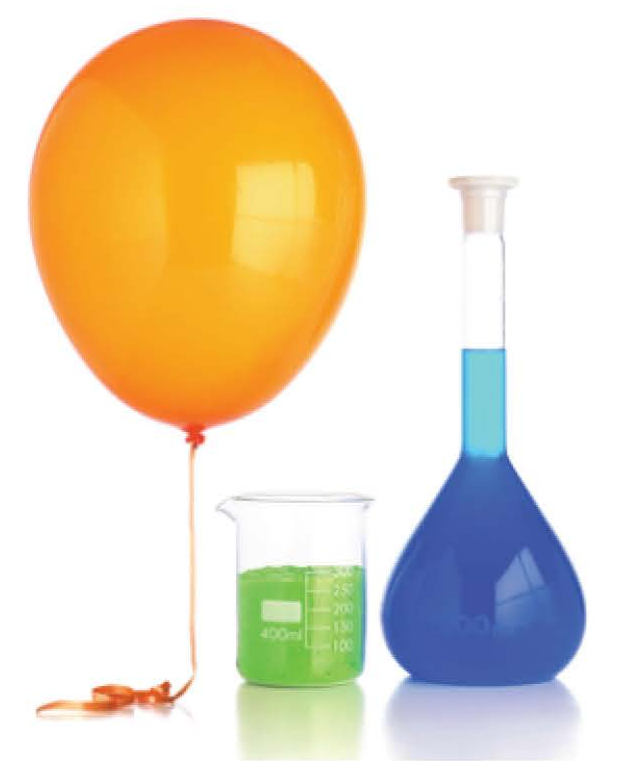
Although Avogadro's constant is an enormous number, the extremely small size of atoms, ions, and molecules means that one mole of most elements and compounds doesn't occupy much mass or volume. For instance, a balloon containing one mole of gas, a beaker containing one mole of nickel(II) chloride, and a flask containing one mole of copper(II) sulfate dissolved in one litre of water all contain particles of their respective substances.
Historical note on the mole definition
Note
A Change in Definition
The definition of the mole as containing an exact number of particles was adopted in November 2018. Before this date, one mole was defined as containing the same amount of substance as there were carbon atoms in exactly 12.000 g of carbon-12. The new definition emphasises that moles relate to counting particles rather than measuring mass. Practically speaking, this new definition doesn't change how the mole is used in calculations.
The relationship between particles and moles
If you know that 1 mol of a substance contains particles, you can calculate the number of particles in different amounts of moles:
- 2 mol of a substance contains particles
- 0.3 mol of a substance contains particles
- particles equals mol
- particles equals mol
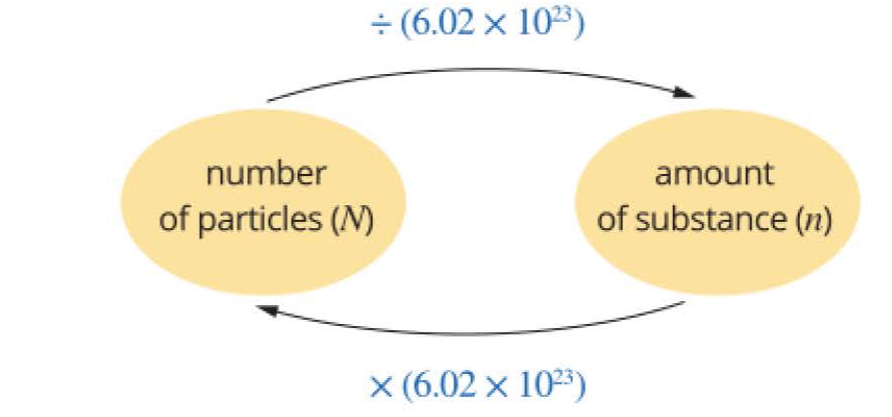
A mathematical relationship exists between the number of particles, , and the amount of substance in moles, :
The amount of substance versus the amount of atoms
When referring to a mole of a substance, it's crucial to specify which particle you're counting. This is because molecules and ionic compounds contain multiple atoms.
Important
Avoiding Ambiguity
The expression "one mole of oxygen" is ambiguous because it could mean:
- One mole of oxygen atoms (O), or
- One mole of oxygen molecules ()
Since each oxygen molecule contains two oxygen atoms, one mole of oxygen molecules will contain two moles of oxygen atoms. Always specify whether you're referring to atoms or molecules!
For example, an oxygen molecule contains two oxygen atoms joined by a double covalent bond. The oxygen molecule is most commonly represented by the molecular formula .
Similarly, the empirical formula of an ionic compound indicates the number of each type of ion in one formula unit. For example, in one mole of aluminium chloride (), there is one mole of aluminium ions and three moles of chloride ions.
Here are some examples of using the mole as a counting unit:
| Number of moles of substance | Information about numbers of particles |
|---|---|
| 1 mole of hydrogen atoms (H) | 1 mole of hydrogen atoms (H) |
| 1 mole of hydrogen molecules () | 1 mole of hydrogen molecules () 2 moles of hydrogen atoms (H) |
| 2 moles of aluminium atoms (Al) | 2 moles of aluminium atoms (Al) |
| 2 moles of calcium chloride () | 2 moles of ions 4 moles of ions |
| 10 moles of glucose () molecules | 10 moles of glucose () molecules 60 moles of carbon atoms 120 moles of hydrogen atoms 60 moles of oxygen atoms |
Calculations using the mole and Avogadro's constant
Three key quantities are used in mole calculations:
- The mole, symbol , unit mol
- Avogadro's constant, symbol , value
- The actual number of particles (atoms, ions, or molecules), symbol
The mathematical relationship linking these three quantities is:
where:
- is the number of moles (unit: mol)
- is the actual number of particles
- is Avogadro's constant, equal to
Example
Worked Example 1: Calculating the number of molecules given the amount of a substance
Question: Calculate the number of molecules in 3.5 moles of water ().
Solution:
List the given data:
- mol
Rearrange the formula to find :
Therefore:
Substitute the values:
Example
Worked Example 2: Calculating the number of moles of atoms given the number of moles of molecules
Question: Calculate the amount, in mol, of hydrogen atoms in 3.6 mol of sulfuric acid ().
Solution:
List the given data:
- mol
Calculate the amount of hydrogen atoms from the molecular formula (each molecule contains 2 hydrogen atoms):
Example
Worked Example 3: Calculating the number of atoms given the amount of a substance
Question: Calculate the number of oxygen atoms in 2.5 mol of oxygen gas ().
Solution:
List the given data:
- mol
First, calculate the amount of oxygen atoms (each molecule contains 2 oxygen atoms):
Then calculate the number of oxygen atoms:
Example
Worked Example 4: Calculating the number of atoms given the amount of an ionic compound
Question: Calculate the number of oxygen atoms in 1.5 mol of iron(III) sulfate, .
Solution:
List the given data:
- mol
Calculate the amount of oxygen atoms from the formula (each formula unit contains 12 oxygen atoms: 3 sulfate ions × 4 oxygen atoms each):
Calculate the number of oxygen atoms:
Example
Worked Example 5: Calculating the number of moles given the number of particles
Question: Calculate the amount, in mol, of ammonia molecules () represented by ammonia molecules.
Solution:
List the given data:
- molecules
Use the formula (no rearrangement needed):
Summary
Key Points to Remember:
- The mole is chemistry's counting unit, represented by the symbol with unit mol.
- Avogadro's constant () is the number of particles in one mole of any substance.
- The relationship between moles and particles is:
- Always specify which particle you're counting (atoms, molecules, or ions) when using moles.
- When dealing with molecules or ionic compounds, remember to account for the number of atoms per formula unit when calculating the amount of individual atoms.