Molar Mass (VCE SSCE Chemistry): Revision Notes
📚Revision Notes
Molar Mass
Introduction to molar mass
In chemistry, we often need to know how many particles of a substance we're working with, but counting individual atoms or molecules is impossible in a laboratory. Instead, chemists use balances to weigh substances. The concept of molar mass provides the crucial link between the mass of a substance we can measure and the number of moles (and therefore particles) it contains.

Different elements and compounds have particles with different masses. This means that one mole of different substances will have different masses, just as a dozen oranges weighs more than a dozen mandarins because each orange is heavier than each mandarin. Understanding molar mass allows you to convert easily between the mass of a substance and the amount in moles.
Note
The molar mass acts as a conversion factor between the macroscopic world (mass in grams that we can measure) and the microscopic world (number of particles that we cannot directly count).
Molar masses of elements
The molar mass of an element is the mass, in grams, of one mole of that element. It uses the symbol and has the unit .
Finding the molar mass of an element is straightforward: simply take the relative atomic mass () from the periodic table and add the unit . For example, oxygen has a relative atomic mass of , so its molar mass is .
This convenient relationship works because Avogadro's constant was specifically chosen so that of carbon-12 contains exactly atoms. The table below shows how relative atomic mass relates to molar mass for several elements:

Important
Key point: The numerical value of the relative atomic mass and the molar mass are the same - you just add the unit to convert to .
Molar masses of molecules and ionic compounds
Molecules and ionic compounds contain two or more atoms bonded together. To find the molar mass of a molecule or ionic compound, you need to add up the relative atomic masses of all the atoms in its chemical formula.
Let's look at how this works for some common substances:
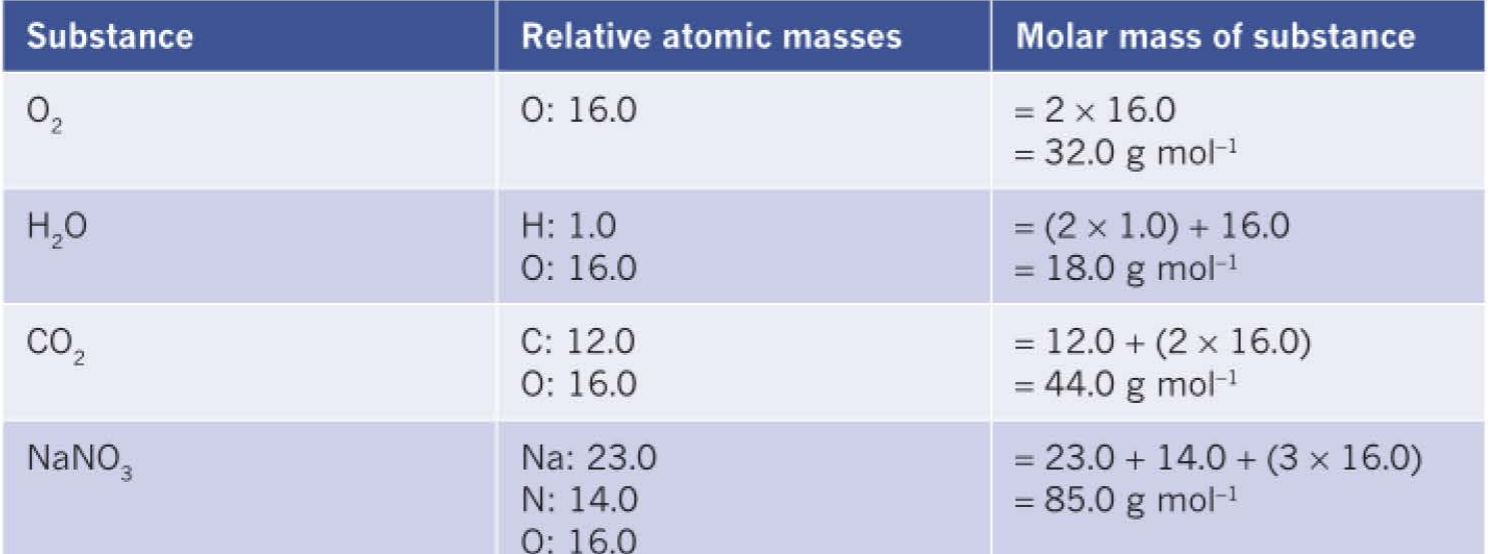
For example, water () contains 2 hydrogen atoms and 1 oxygen atom. Using the periodic table:
- Hydrogen:
- Oxygen:
Therefore:
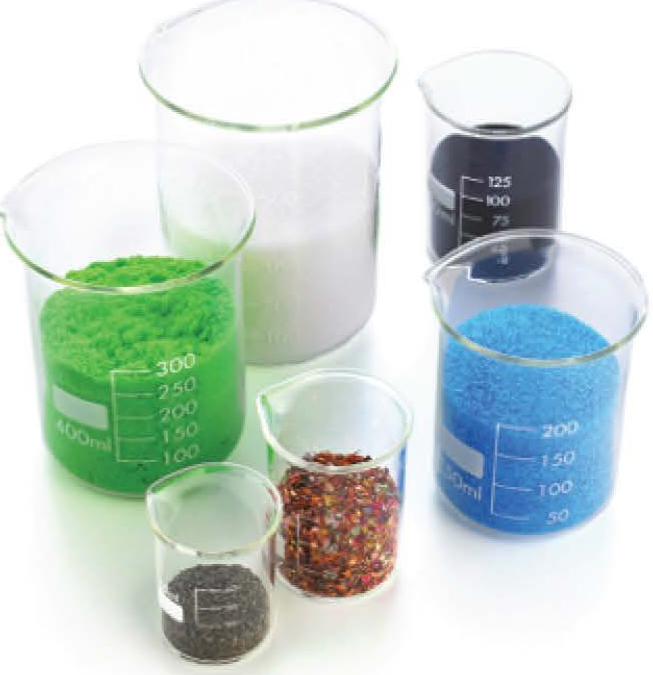
The image below shows one mole samples of different substances - notice how each has a different mass and volume:
Example
Worked Example: Calculating molar mass of carbon dioxide
Let's calculate the molar mass of step by step.
Step 1: Find the relative atomic masses from the periodic table
Step 2: Count the atoms in the formula
- 1 carbon atom
- 2 oxygen atoms
Step 3: Calculate the molar mass
Note
Exam tip: Always count atoms carefully, especially when there are brackets in the formula. For example, in , the subscript 2 outside the bracket multiplies everything inside, giving 2 nitrogen atoms and 6 oxygen atoms.
Calculations using moles and molar mass
A fundamental formula in chemistry links the amount of substance (in moles), its mass (in grams), and its molar mass:
where:
- = amount in mol
- = mass in g
- = molar mass in
This formula can be rearranged to find mass if you know the number of moles:
Note
The triangle diagram helps you remember these relationships - cover up the quantity you want to find, and what remains shows you the calculation.
Example
Worked Example: Finding moles from mass
Calculate the amount, in mol, of of sodium chloride ().
Step 1: Find the molar mass of
Step 2: Use the formula
Example
Worked Example: Finding mass from moles
Calculate the mass of of magnesium nitrate ().
Step 1: List the given information
Step 2: Calculate the molar mass
Step 3: Use the formula
Note
Exam tip: Always show your working clearly. Start by writing down what you know and what you need to find. This helps you choose the correct formula and reduces errors.
Calculations using moles, mass and Avogadro's constant
Sometimes you need to find the actual number of particles (atoms, molecules, or ions) in a sample. This requires combining the formula for molar mass with the formula involving Avogadro's constant:
where:
- = number of particles
- = Avogadro's constant =
Example
Worked Example: Finding number of molecules
Calculate the number of molecules present in of carbon dioxide.
Step 1: Calculate the molar mass
Step 2: Convert mass to moles using
Step 3: Convert moles to number of molecules using
Note
Study tip: For multi-step calculations, write out each step separately. This makes it easier to check your work and helps avoid calculation errors.
Case study: The sting of a bee
Pentyl ethanoate () is a compound that gives bananas their characteristic smell. Interestingly, it's also a pheromone that bees release when they sting.
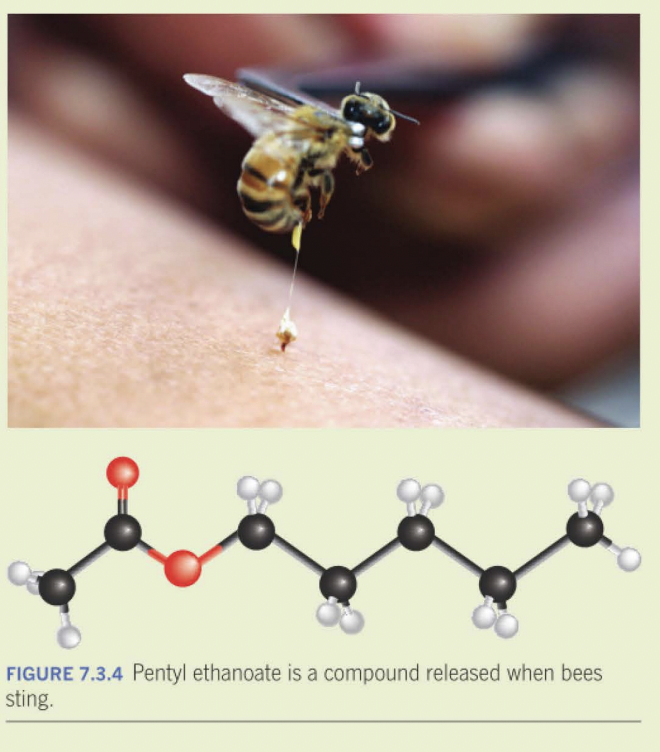
When a bee stings, it releases a tiny amount of pentyl ethanoate - only (one millionth of a gram). This chemical acts as an alarm signal, attracting other bees to the area and triggering defensive behaviour. Beekeepers use smoke to mask this pheromone, which calms the bees and allows safe handling of hives.
Using our knowledge of molar mass, we can calculate exactly how many molecules of pentyl ethanoate are released in a single sting:
Example
Worked Example: Bee sting pheromone calculation
Calculation 1: Find the molar mass of
Calculation 2: Find the amount in moles
Calculation 3: Find the number of molecules
Important
Even though the mass is incredibly small, it still contains over 4 million billion molecules - more than enough to send a chemical signal to nearby bees!
Remember!
Summary
Key Points to Remember:
-
Molar mass is the mass of one mole of a substance, measured in .
-
For elements, molar mass equals the relative atomic mass with the unit added.
-
For compounds, add up the relative atomic masses of all atoms in the formula to get the molar mass.
-
The key formula is , which can be rearranged to - use this to convert between mass and moles.
-
To find the number of particles, combine mass calculations with Avogadro's constant: first convert mass to moles, then multiply by .