Percentage Composition, Empirical and Molecular Formulas (VCE SSCE Chemistry): Revision Notes
📚Revision Notes
Percentage Composition, Empirical and Molecular Formulas
Introduction
Compounds are made up of two or more different elements chemically bonded together. We can describe the composition of compounds in two main ways:
- By mass: showing the percentage of each element's contribution to the total mass
- By formula: showing either the ratio of atoms (empirical formula) or the actual number of atoms (molecular formula)
Understanding these representations is essential for working with chemical formulas and equations.
Percentage composition by mass
What is percentage composition?
Percentage composition by mass tells us what proportion of a compound's total mass comes from each element present. This is expressed as a percentage.
Note
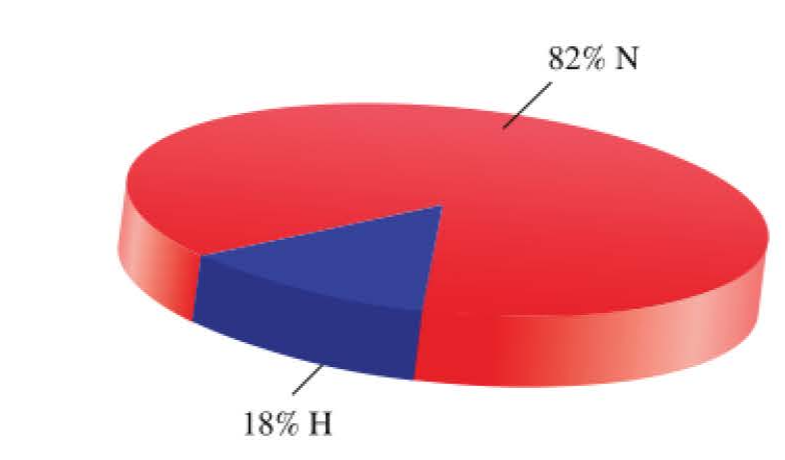
For example, in ammonia (), nitrogen accounts for 82% of the total mass, whilst hydrogen contributes 18%. This means that if you had 100 g of ammonia, 82 g would be nitrogen and 18 g would be hydrogen.
Calculating percentage composition
To calculate the percentage composition of an element in a compound, you need to know:
- The molar mass of the compound
- The mass of the element in one mole of the compound
Formula:
Example
Worked Example: Percentage composition of carbon dioxide
Let's calculate the percentage by mass of carbon in carbon dioxide ().
Step 1: Find the molar mass of
Step 2: Find the mass of carbon in one mole
Step 3: Calculate the percentage
This tells us that carbon makes up 27.3% of the mass of carbon dioxide.
Empirical formula
What is an empirical formula?
The empirical formula shows the simplest whole-number ratio of atoms of each element in a compound. It doesn't necessarily show the actual number of atoms in a molecule—just the simplest ratio.
Important
Key points:
- Ionic compounds always use empirical formulas because they exist as lattice structures, not discrete molecules
- For molecular compounds, the empirical formula may be the same as the molecular formula, or it may be simplified
Examples of empirical formulas
| Compound | Empirical formula | Simplest whole-number ratio |
|---|---|---|
| water () | H = 2:1 | |
| ethene () | C = 1:2 | |
| ethane () | C = 1:3 | |
| calcium carbonate | Ca:C = 1:1:3 |
Determining empirical formulas from percentage composition
To find the empirical formula when you know the percentage composition, follow these steps:
Step 1: Obtain the mass of each element in the compound
- If given percentages, assume you have 100 g of the compound
- The percentages then become masses in grams
Step 2: Calculate the amount in moles of each element
- Use the formula:
- Where is amount in moles, is mass, and is molar mass
Step 3: Convert to whole-number ratios
- Divide each mole value by the smallest number of moles calculated
- This gives you the simplest ratio
Step 4: Write the empirical formula
- Use the whole-number ratios as subscripts in the formula
Example
Worked Example: Finding empirical formula from percentage composition
An organic compound contains 52.2% carbon, 13.0% hydrogen, and the remainder is oxygen. Let's find its empirical formula.
Step 1: Find the mass of each element in 100 g of compound
Step 2: Calculate moles of each element
Step 3: Divide by the smallest value (2.18)
Step 4: Write the empirical formula
The ratio is C:H
= 2:6:1Therefore, the empirical formula is
Elemental microanalysis: A case study
Analysing warfarin composition
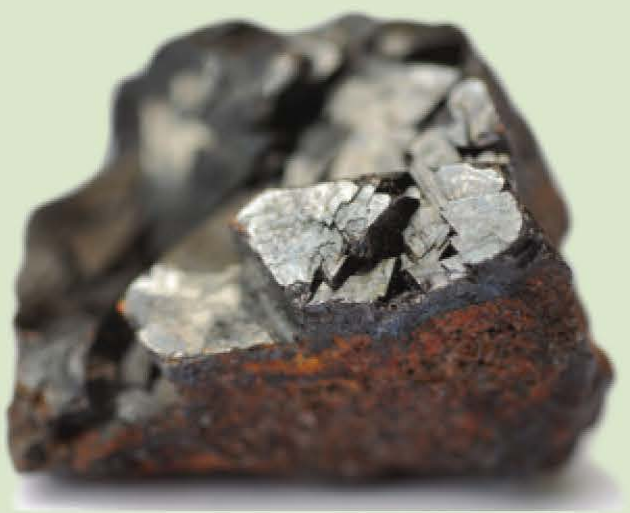
Warfarin is an anticoagulant drug that prevents blood clots. It's also used as rat poison. The empirical formula of warfarin can be determined through elemental microanalysis.
The combustion analysis method
Note
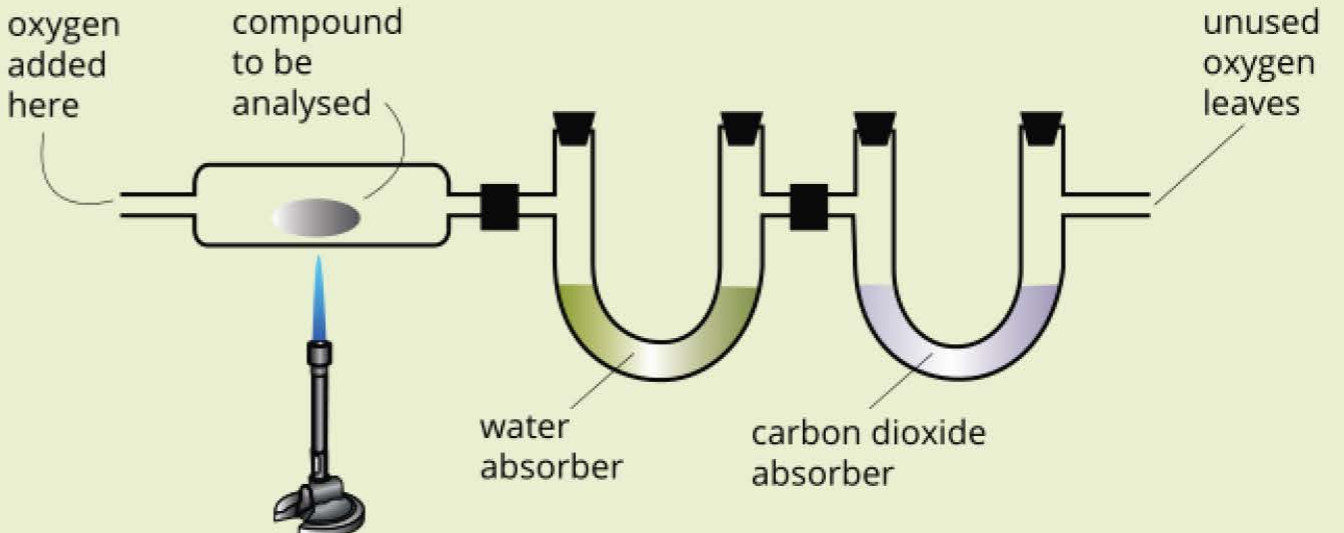
Elemental microanalysis involves burning an organic compound in oxygen. The combustion products are then absorbed and weighed:
- Carbon dioxide is absorbed by sodium hydroxide solution
- Water is absorbed by a drying agent such as magnesium perchlorate,
Calculating masses from combustion data
For carbon:
From the mass of produced:
Since all carbon in the original compound ends up in :
For hydrogen:
From the mass of produced:
Since each water molecule contains two hydrogen atoms:
For oxygen:
If the original mass of the compound is known, and we've calculated the masses of carbon and hydrogen:
Important
Exam tip: In combustion analysis questions, always remember that each water molecule contains two hydrogen atoms, so you must multiply the moles of water by 2 to get the moles of hydrogen.
Molecular formula
What is a molecular formula?
The molecular formula shows the actual number of atoms of each element present in a molecule. This is different from the empirical formula, which only shows the simplest ratio.
Important
Ionic compounds do not have molecular formulas because they don't exist as discrete molecules—they form crystal lattices instead.
Comparing empirical and molecular formulas
| Molecule | Molecular formula | Empirical formula |
|---|---|---|
| water | ||
| ethane | ||
| carbon dioxide | ||
| glucose |
Note
Notice that:
- Sometimes the molecular and empirical formulas are identical (water, carbon dioxide)
- Sometimes the molecular formula is a whole-number multiple of the empirical formula (ethane, glucose)
Determining molecular formulas
To find the molecular formula, you need:
- The empirical formula
- The molar mass of the compound
The molecular formula is always a whole-number multiple of the empirical formula.
Formula:
Example
Worked Example: Finding molecular formula
A compound has the empirical formula . Its molar mass is 78 g mol. What is the molecular formula?
Step 1: Calculate the molar mass of one empirical formula unit
Step 2: Determine how many empirical formula units are in the molecule
Step 3: Write the molecular formula
This compound is benzene.
Important
Exam tip: Always check that your molecular formula makes chemical sense. The molecular formula must always be a whole-number multiple of the empirical formula.
Remember!
Summary
Key Points to Remember:
-
Percentage composition shows what fraction of a compound's mass comes from each element, calculated using:
-
The empirical formula gives the simplest whole-number ratio of atoms in a compound. For ionic compounds, this is the only formula type used.
-
The molecular formula shows the actual number of atoms in a molecule and is always a whole-number multiple of the empirical formula.
-
To find empirical formulas: convert masses to moles (), divide by the smallest value to get ratios, then write the formula.
-
To find molecular formulas: divide the compound's molar mass by the empirical formula's molar mass, then multiply the empirical formula by this factor.