Synthesis of Proteins (VCE SSCE Chemistry): Revision Notes
📚Revision Notes
Synthesis of Proteins
Introduction to proteins
Proteins are organic biopolymers with many vital functions in living organisms. Like synthetic polymers, biopolymers are assembled from large numbers of small monomer units. However, proteins are specifically made within living organisms from monomers called amino acids.
Note
Just different amino acids combine to create thousands of different proteins essential for life. These proteins serve diverse roles, from structural support to chemical regulation in the body.
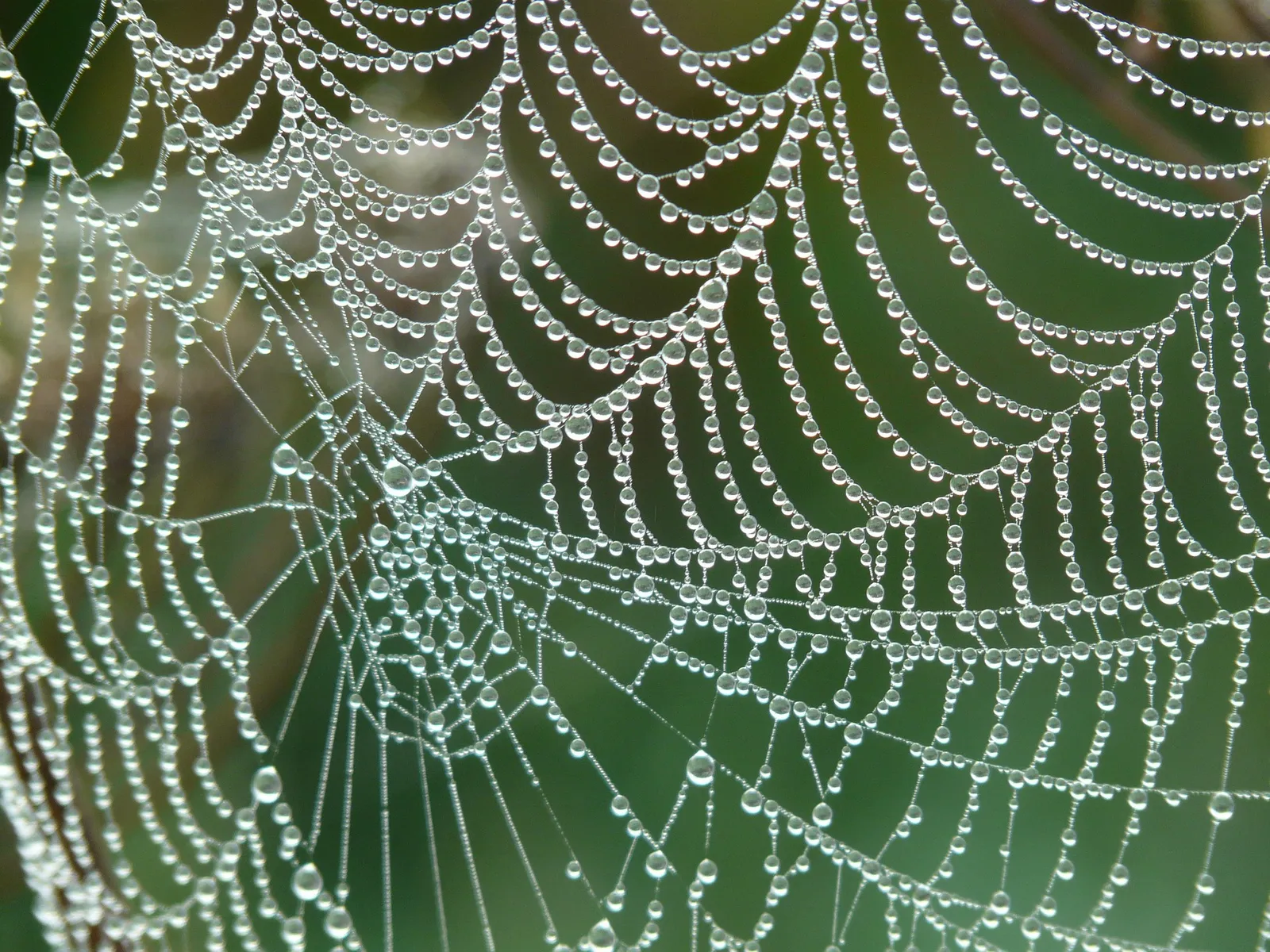
Examples of proteins include:
- Structural proteins: Spider silk is made from fibroin, a strong fibrous protein that forms the threads of spider webs
- Transport proteins: Haemoglobin in red blood cells binds reversibly to oxygen molecules, carrying oxygen from the lungs to body cells throughout the organism
Condensation reactions in protein synthesis
All large biological molecules, including proteins, form through condensation reactions. In these reactions, small molecules (usually water) are released as byproducts when monomers join together.
Requirements for condensation polymerisation
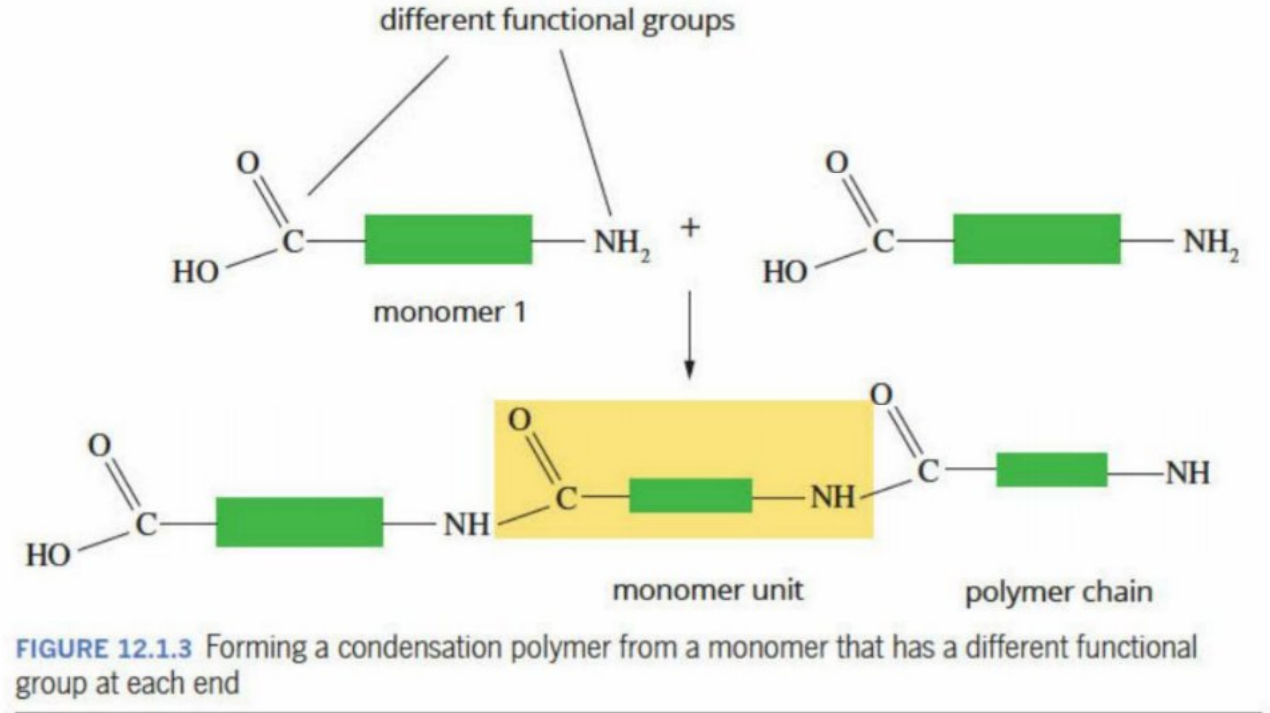
For condensation polymerisation to occur, monomers must contain two different reactive functional groups, one at each end of the molecule. This happens in two ways:
Homopolymers form when one type of monomer has two different functional groups. For example, amino acids have an amine group () at one end and a carboxyl group () at the other end. All biological polymers in this topic are homopolymers.
Heteropolymers (or copolymers) form when two different monomer types combine, each having two identical functional groups. For instance, a diol (molecule with two hydroxyl groups) can react with a dicarboxylic acid (molecule with two carboxylic acid groups).
Important
A key feature of condensation reactions is the release of small molecules as byproducts. Water is always the byproduct when proteins form. Other condensation reactions may produce ammonia, hydrogen chloride, or methanol.
Structure of amino acids
General features
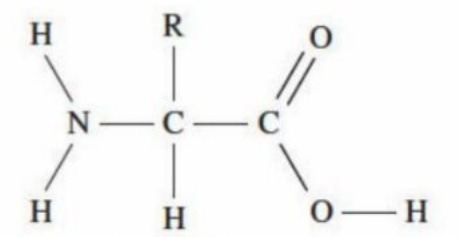
All amino acids share the same basic structural features:
- An amino functional group ()
- A carboxyl functional group ()
- A hydrogen atom
- All three groups attach to a central carbon atom
General formula
The amino acids used to produce human proteins have the general formula . These are called 2-amino acids or α-amino acids because the amino group bonds to the carbon atom adjacent to the carboxyl carbon (numbered as position in the chain).
The R group (side chain)
The main difference between amino acids is the R group (side chain). These side chains vary in their properties:
Note
Properties of R groups:
Non-polar side chains include:
- in alanine
- in valine
Polar side chains include:
- in aspartic acid
- in serine
Acidic side chains (proton donors) include:
- in aspartic acid contains an acidic carboxyl group
Basic side chains (proton acceptors) include:
- in lysine contains a basic amino group
Three-letter abbreviations
Biochemists commonly use three-letter codes for amino acids. For example:
- Alanine = Ala
- Glycine = Gly
- Cysteine = Cys
The 20 amino acids in humans
| Name | Symbol | Structure |
|---|---|---|
| alanine | Ala | |
| arginine | Arg | |
| asparagine | Asn | |
| aspartic acid | Asp | |
| cysteine | Cys | |
| glutamine | Gln | |
| glutamic acid | Glu | |
| glycine | Gly | |
| histidine | His | with imidazole ring |
| isoleucine | Ile | |
| leucine | Leu | |
| lysine | Lys | |
| methionine | Met | |
| phenylalanine | Phe | with benzene ring |
| proline | Pro | Cyclic structure with |
| serine | Ser | |
| threonine | Thr | |
| tryptophan | Trp | with indole ring |
| tyrosine | Tyr | with hydroxylated benzene ring |
| valine | Val | |
Note: All -amino acids have the general formula , where R is the side chain shown above the main structure.
Formation of proteins
Large protein molecules form through multiple condensation reactions between amino acids. Organisms carry out these reactions in a highly organised manner to ensure the correct amino acids appear in the correct sequence. Proteins grow stepwise, starting with two amino acids forming a dipeptide, then extending to longer polypeptides, and finally to complete proteins.
Peptide bond formation
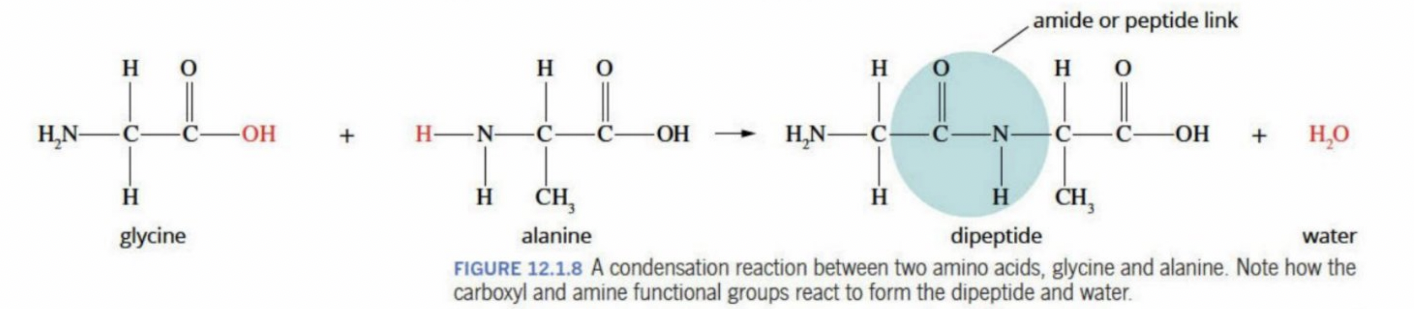
Condensation occurs between the carboxyl group () of one molecule and the amino group () of another molecule. This reaction creates an amide functional group (), also called a peptide link, amide link, peptide group, or peptide bond. Water is released in the process.
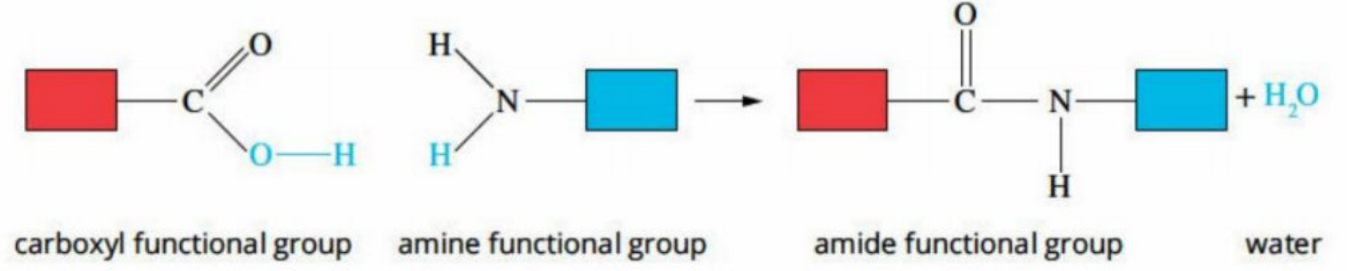
Since -amino acids contain both functional groups, they readily undergo condensation reactions with each other.
Dipeptides
When two amino acid molecules join together, the product is a dipeptide. The peptide link connects the molecules.
Example
Worked Example: Formation of a Dipeptide
When glycine reacts with alanine:
Step 1: The carboxyl group of glycine reacts with the amino group of alanine
Step 2: A peptide bond forms between them:
Step 3: Water is released as a byproduct
Result: A dipeptide containing glycine and alanine linked by a peptide bond
Important
When two different amino acids react, two possible dipeptide products can form, depending on which ends react together. If alanine's carboxyl group reacts with glycine's amino group instead, a different dipeptide results.
Polypeptides
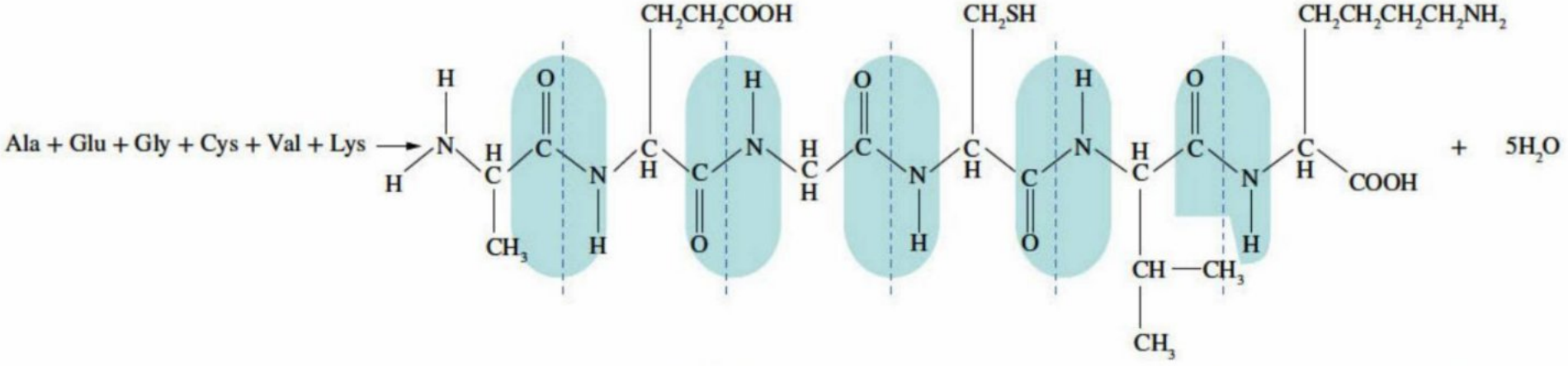
Polypeptides are polymers formed by further condensation reactions between amino acids, creating long chains. When three amino acids join, a tripeptide forms. A polymer made from many amino acids is called a polypeptide.
Biological synthesis
Organisms synthesise their proteins in complex structures called ribosomes. These biological machines, made from many molecules including enzymes, operate at body temperature and complete protein synthesis within minutes. This process is called translation in biological sciences.
Laboratory synthesis
Scientists can also synthesise proteins in laboratories using flow synthesis systems with solid-state catalysts at temperatures of . Modern developments allow synthesis of custom proteins within a few hours.
Note
Whether made by ribosomes or in laboratories, protein synthesis is a stepwise process where amino acids add one by one to the growing polymer chain.
Naming polypeptides
A shorthand notation uses three-letter abbreviations to describe the amino acid sequence in a polypeptide. By convention:
- The structure is drawn with the free amino group on the left
- The free carboxyl group is on the right
Example
Worked Example: Naming a Polypeptide
A polypeptide formed from alanine, glutamic acid, glycine, cysteine, valine, and lysine (in that order) would be named:
Ala-Glu-Gly-Cys-Val-Lys
The amino acids are listed from left to right using their three-letter codes, separated by hyphens.
From polypeptide to protein
A polypeptide containing more than 50 amino acids is usually called a protein.
When amino acids join in a polypeptide chain:
- The amino acid at the start with a free amino group is the N-terminal amino acid
- The amino acid at the end with a free carboxyl group is the C-terminal amino acid
Example: insulin structure
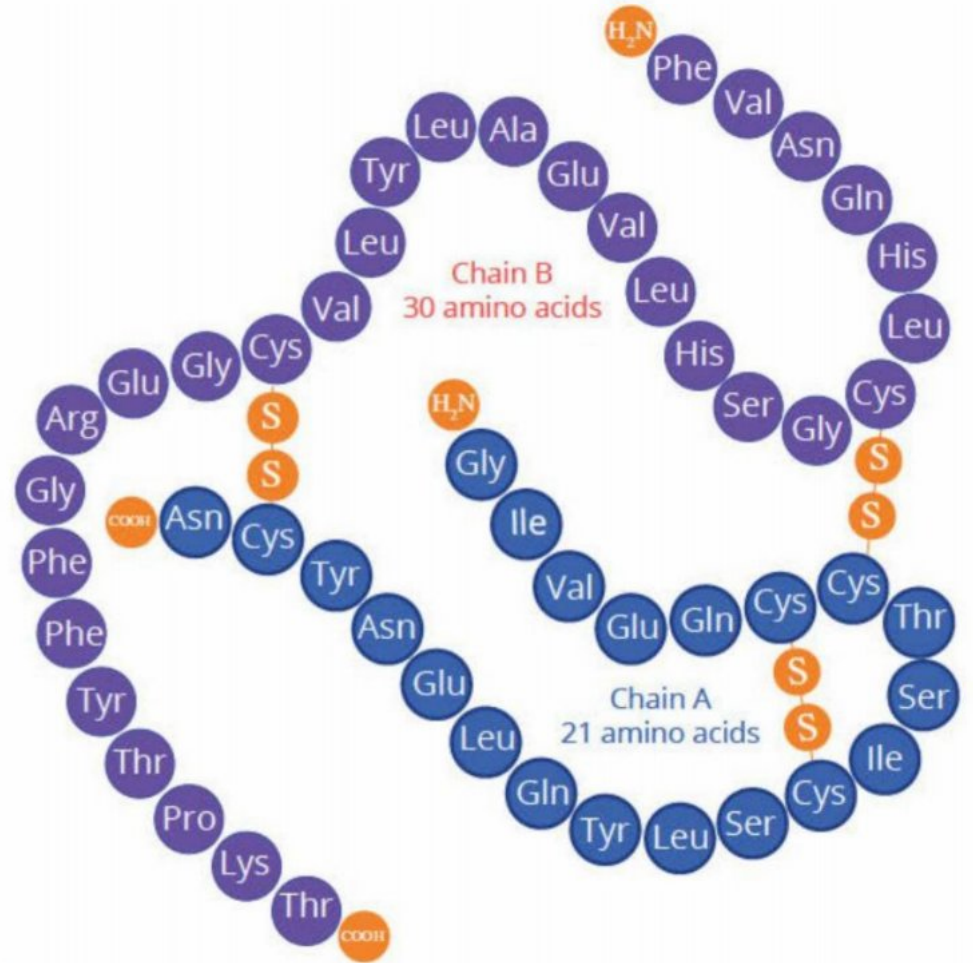
Insulin is a protein hormone that regulates chemical reactions breaking down carbohydrates, fats, and proteins in the body. It is one of the smallest proteins in the human body.
Note
Key features of insulin structure:
- Contains two linked chains with a total of 51 amino acid residues
- The chains connect through covalent bonds between sulfur atoms from cysteine R groups (called disulfide bonds)
- The longer chain (Chain B with amino acids) starts with phenylalanine (Phe) as the N-terminal amino acid
- The longer chain ends with threonine (Thr) as the C-terminal amino acid
- Chain A contains amino acids
This example demonstrates how a relatively small protein has a complex structure with multiple chains held together by specific chemical bonds.
Summary
Key Points to Remember:
- Proteins are biopolymers made from different amino acids that join through condensation reactions
- All amino acids share the same basic structure with an amino group, carboxyl group, and hydrogen atom attached to a central carbon, plus a variable R group (side chain)
- Peptide bonds (amide links) form when the carboxyl group of one amino acid reacts with the amino group of another, releasing water
- Proteins build up stepwise from dipeptides (two amino acids) to polypeptides (many amino acids) to proteins (usually more than amino acids)
- Polypeptide sequences are written using three-letter codes with the N-terminal (free amino group) on the left and C-terminal (free carboxyl group) on the right