Reaction Pathways and Atom Economy (VCE SSCE Chemistry): Revision Notes
📚Revision Notes
Reaction Pathways and Atom Economy
Introduction to reaction pathways
Organic chemists are skilled at creating compounds with specific properties for particular purposes, such as pharmaceuticals and polymers. Once a desired compound has been identified, chemists must develop an effective method for synthesizing it. The goal is to design an efficient route for converting easily accessible starting materials, often alkenes or alkanes, into more complex products.
A reaction pathway is a series of one or more steps that transforms a reactant containing certain functional groups into a desired product with different functional groups. Modern chemists aim to design environmentally friendly synthetic routes that minimize waste, use 'greener' solvents, require less energy, and help preserve natural resources.
Note
For example, the production of ibuprofen, a commonly used painkiller, can be achieved through different pathways. Some routes are more efficient than others, using fewer reactants and producing less waste. This highlights why choosing the right synthetic route matters in both laboratory and industrial settings.
Simple reaction pathways
Simple reaction pathways involve converting basic organic compounds into products through one or a few steps. Understanding these fundamental transformations allows chemists to build more complex synthesis routes.
Ethane and ethene-based conversions
Starting from ethane () or ethene () , we can create various organic compounds through different reaction types. The same principles and reaction conditions can be applied to other members of the alkane and alkene families.
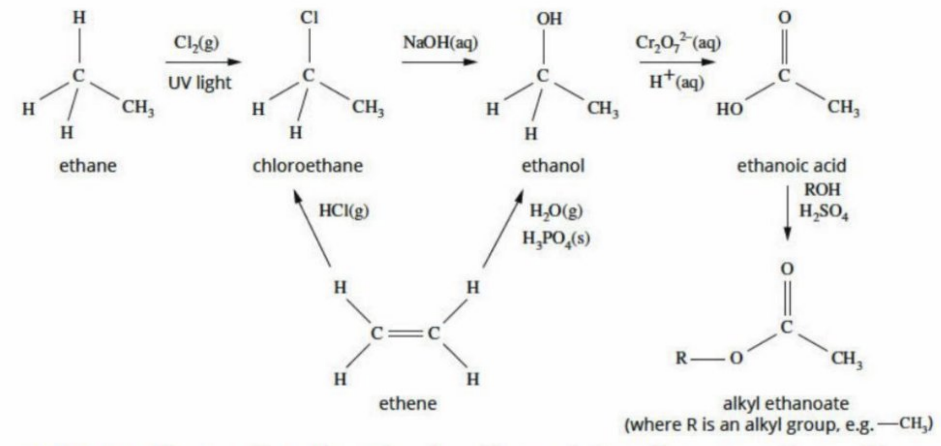
The diagram above shows several important transformations:
- Ethane to chloroethane: Free radical halogenation using chlorine gas () under UV light
- Chloroethane to ethanol: Nucleophilic substitution with aqueous sodium hydroxide ()
- Ethanol to ethanoic acid: Oxidation using dichromate ions () in acidic conditions
- Ethanoic acid to alkyl ethanoate: Esterification with an alcohol () using sulfuric acid catalyst
- Ethene to ethanol: Direct hydration or via chloroethane intermediate
- Ethanol to ethene: Elimination reaction using concentrated or and heat
Making ethanol from ethene
Ethanol () is an important two-carbon alcohol that can be synthesized from ethene in two different ways.

Pathway 1 (direct route): Ethene reacts directly with water in the presence of a phosphoric acid () catalyst to produce ethanol. This is the more efficient route as it requires only one step.
Pathway 2 (two-step route): Ethene first reacts with hydrogen chloride () to form chloroethane as an intermediate compound. The chloroethane then undergoes substitution with hydroxide ions () to produce ethanol.
Important
Exam tip: When planning a synthesis, always look for the most direct route with the fewest steps, as this typically gives better overall yields.
Complex reaction pathways
More complex syntheses often require multiple steps and careful planning. Let's examine the synthesis of ethyl propanoate, an ester used in fragrances and flavorings.
Making propanoic acid from propane
Propanoic acid () is a three-carbon carboxylic acid. Working backwards from the final product helps us plan the synthesis:
- Propanoic acid can be formed by oxidizing the primary alcohol propan-1-ol
- Propan-1-ol can be made by reacting 1-chloropropane with sodium hydroxide
- 1-chloropropane can be prepared by reacting propane with chlorine under UV light

Note
The halogenation step produces several isomers, which must be separated by fractional distillation to obtain the desired 1-chloropropane product. This separation step adds complexity and can reduce the overall yield of the synthesis.
Making ethyl propanoate
Ethyl propanoate is an ester with the structure . This compound requires two separate precursors: ethanol and propanoic acid.
The complete synthesis pathway combines the routes we've already discussed:
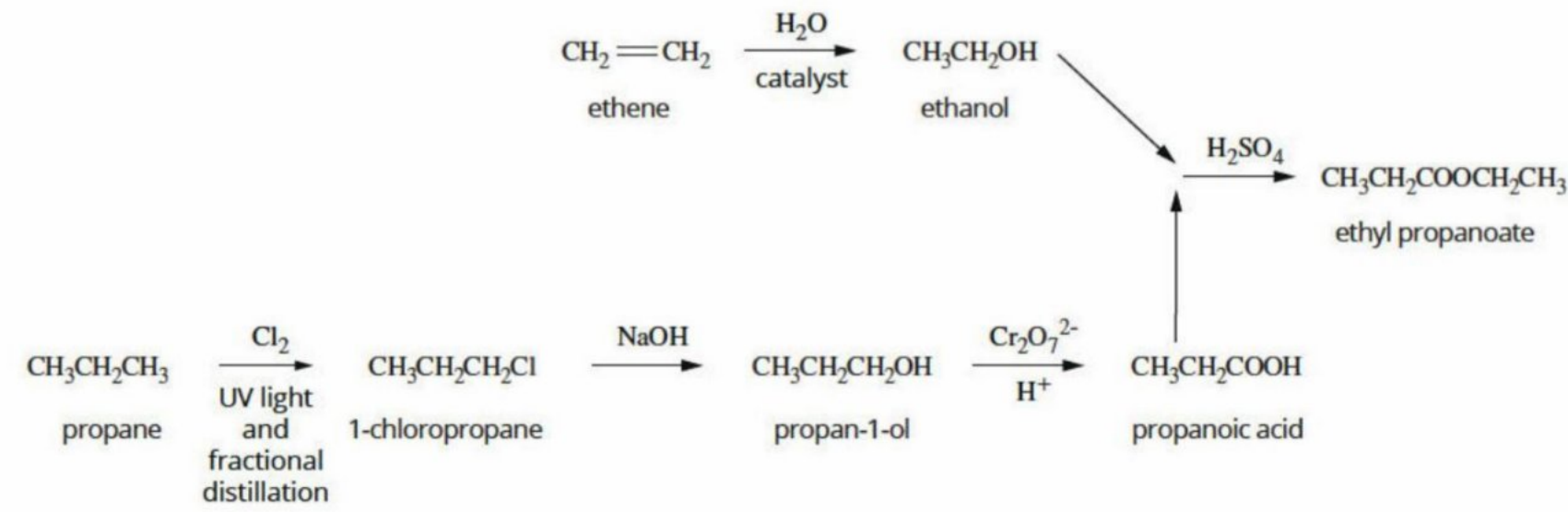
This multi-step synthesis demonstrates how chemists combine simpler reactions to build more complex molecules. The final esterification step involves condensing propanoic acid and ethanol using sulfuric acid as a catalyst, producing the ester and water.
Summary of reaction pathways
The following comprehensive diagram shows the interconnected pathways for producing various organic compounds from alkenes:
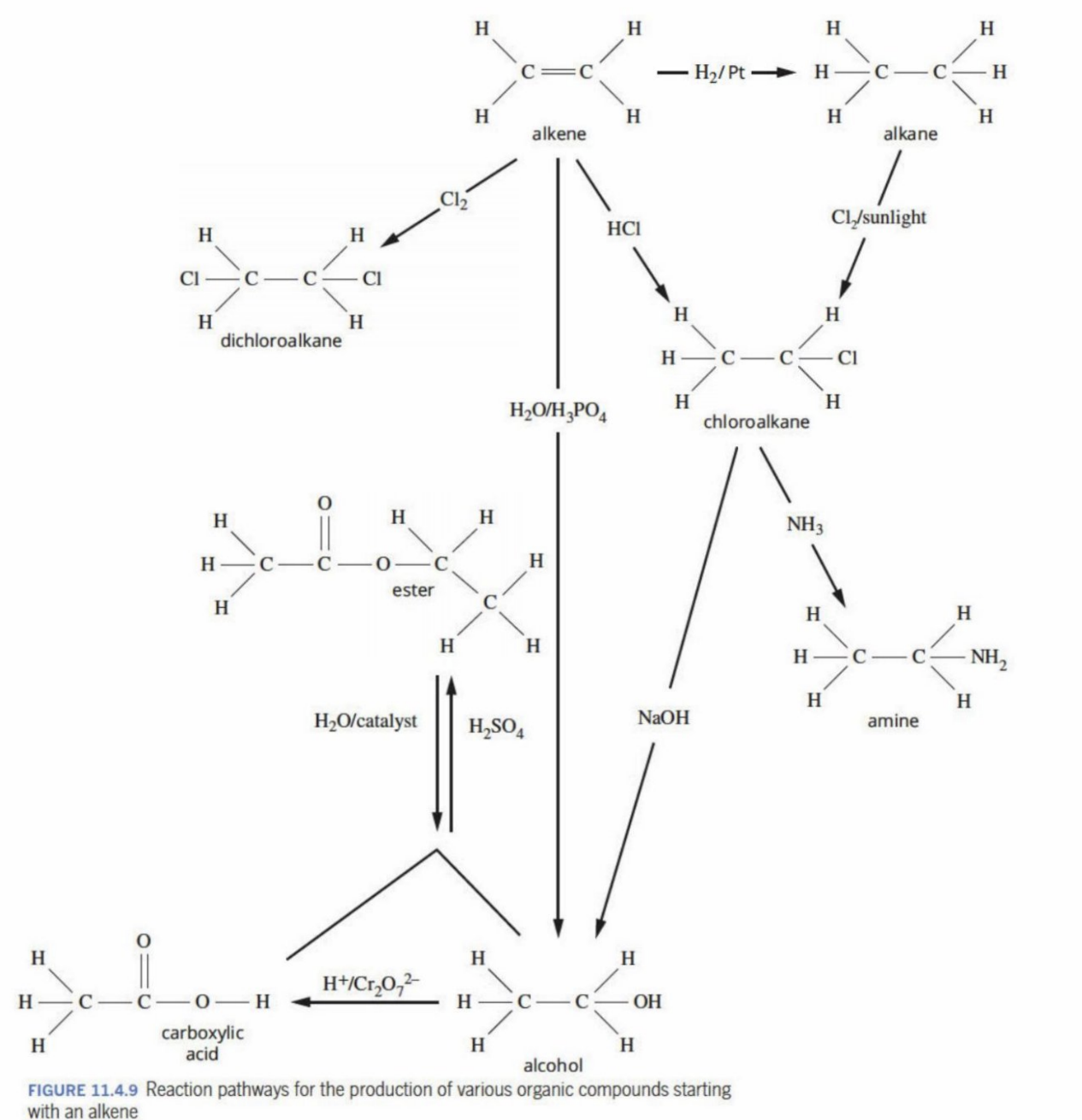
This diagram is useful when planning new syntheses because it shows:
- Multiple routes to the same product
- Which functional groups can be interconverted
- The reagents and conditions needed for each transformation
Planning a synthesis
When designing a reaction pathway, chemists must consider several factors beyond simply identifying a possible sequence of reactions:
Note
Key considerations in synthesis planning:
- Equilibrium position: Some reactions don't go to completion, which affects the overall yield
- Reaction rate: Slow reactions may not produce the desired amount of product in the available time
- Green chemistry principles: Consider the environmental impact of solvents and by-products
- Separation methods: How will intermediate products be isolated and purified?
- Isomer formation: Some reactions produce mixtures that must be separated
- Alternative routes: Multiple pathways may exist; the best one should be chosen
The planning process involves studying the structure of the target molecule, identifying functional groups, devising a synthetic pathway using known reactions, considering by-products and separation methods, evaluating purity, and calculating expected yields.
Yield calculations
Understanding and calculating yields is essential for evaluating the efficiency of chemical reactions and industrial processes.
Theoretical and actual yields
Theoretical yield is the maximum amount of product that could be formed if the limiting reactant reacts completely according to the stoichiometric ratios in the balanced equation. It assumes 100% conversion and is calculated using mole ratios.
Actual yield is the amount of desired product actually obtained at the end of the reaction. The actual yield is typically less than the theoretical yield due to several factors:
- Reactions reaching equilibrium before completion
- Slow reaction rates preventing full conversion
- Loss of material during transfers and purification
- Competing reactions producing unwanted by-products
Percentage yield
Percentage yield compares the actual yield to the theoretical yield, providing a measure of reaction efficiency:
A higher percentage yield indicates greater efficiency in converting reactants to products.
Example
Worked Example: Calculating percentage yield
Problem: 30.0 g of propan-1-ol was oxidized to propanoic acid using acidified . The propanoic acid obtained had a mass of 20.0 g. Calculate the percentage yield.
Solution:
| Step | Working |
|---|---|
| Write the equation | (simplified - products keep same number of carbon atoms, so mole ratio is 1:1) |
| Calculate moles of reactant | |
| Use mole ratio | Since the mole ratio is 1:1, |
| Calculate theoretical yield | |
| Calculate percentage yield |
Answer: This means only 54.1% of the reactant was successfully converted to the desired product under these conditions.
Multi-step synthesis yields
When a synthesis involves multiple steps, the overall percentage yield is the product of the individual yields at each step. Each intermediate reaction reduces the final amount of product obtained.
Example
Worked Example: Multi-step yield calculation
Problem: Calculate the overall percentage yield for preparing C from A through a two-step synthesis: A → B → C. The yield of A → B is 80% and the yield of B → C is 70%.
Solution:
| Step | Working |
|---|---|
| Multiply individual yields | Overall yield = |
Answer: Even though each individual step has a reasonable yield, the overall yield is significantly lower at 56%. This demonstrates why chemists prefer shorter synthetic routes when possible.
Important
Exam tip: For multi-step syntheses, convert percentages to decimals, multiply them together, then convert back to a percentage by multiplying by 100. Remember: fewer steps = better overall yield.
Atom economy
An important consideration in modern chemistry is atom economy, which measures how efficiently the atoms in reactants are incorporated into the desired product.
Understanding atom economy
Atom economy is the percentage of atoms from the reactants that end up in the desired product. A high atom economy means fewer waste products are generated, making the reaction more sustainable and environmentally friendly.
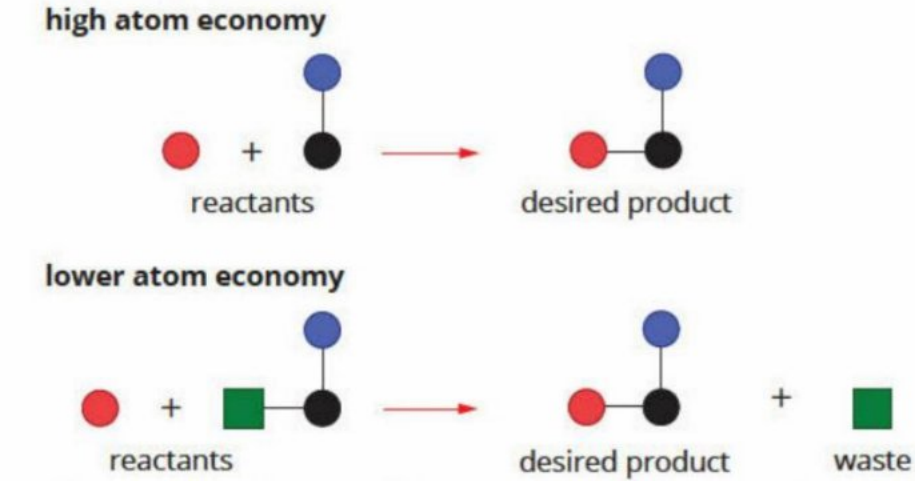
The diagram illustrates the difference between high and low atom economy reactions. In a high atom economy reaction, all reactant atoms become part of the desired product. In a low atom economy reaction, some reactant atoms become waste by-products.
Calculating atom economy
The atom economy can be calculated using either of these formulas:
or alternatively:
Note
These formulas are equivalent because the total mass of products equals the total mass of reactants in any chemical reaction (conservation of mass).
Example
Worked Example: Calculating atom economy
Problem: Calculate the atom economy for producing ethanol from chloroethane:
Solution:
| Step | Working |
|---|---|
| Calculate total molar mass of reactants | |
| Calculate molar mass of desired product | |
| Calculate atom economy |
Answer: This means only 44.0% of the starting materials are converted to the desired product. The remaining 56.0% becomes sodium chloride waste.
Advantages of high atom economy
The choice of synthetic route can dramatically affect atom economy and environmental impact. Consider these two pathways for oxidizing 1-phenylethanol to acetophenone:
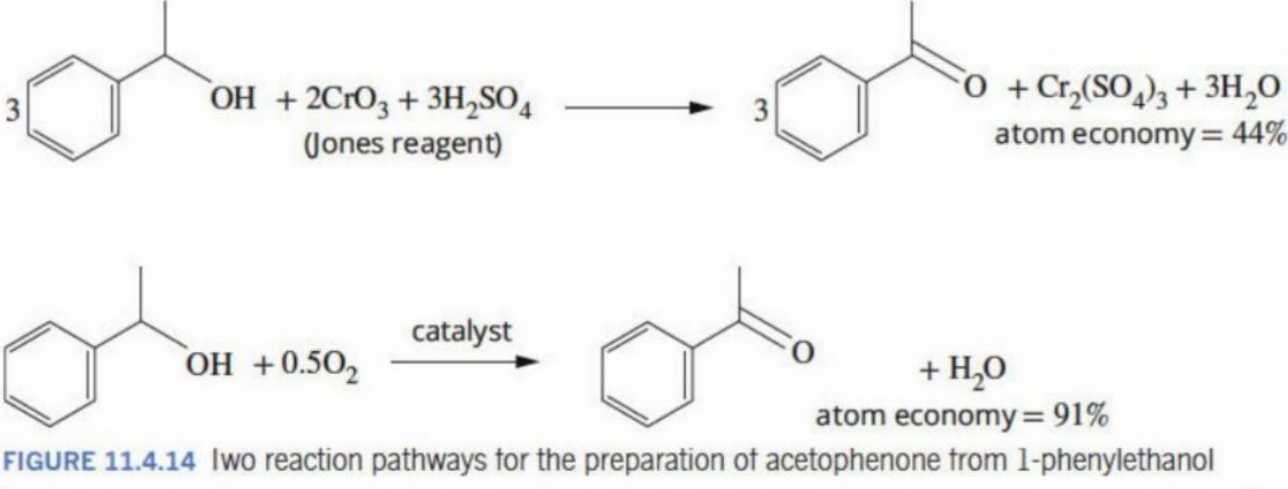
Pathway 1 (traditional method): Uses Jones reagent (chromium trioxide and sulfuric acid) with an atom economy of 44%. This produces significant amounts of chromium(III) sulfate waste, which must be disposed of safely. The process requires expensive reagents and consumes more of Earth's resources.
Pathway 2 (modern method): Uses catalytic oxidation with oxygen, achieving an atom economy of 91%. The only by-product is water, making it much more environmentally friendly. The catalyst also reduces the energy needed for the reaction.
Note
Benefits of high atom economy reactions:
- Reduced waste disposal costs
- Lower consumption of raw materials
- Decreased environmental impact
- Better alignment with green chemistry principles
- Often more cost-effective for industrial production
Important
Exam tip: When comparing synthetic routes, consider both percentage yield (efficiency) and atom economy (sustainability). The best route balances both factors.
Case study: Aspirin synthesis
Pharmaceutical products are often developed from substances found in plants used as traditional medicines. Aspirin provides an excellent example of this process.
Historical background
The origin of aspirin traces back to salicin, a compound found in willow tree leaves and bark. Ancient civilizations, including the Sumerians and Egyptians (3000-1500 BCE), used willow as a medicine. Around 400 BCE, the Greek physician Hippocrates recommended willow leaf infusions to relieve pain.
In 1829, salicin was identified and isolated as the active ingredient. Scientists discovered that the body converts salicin to salicylic acid, which reduces fever and acts as a painkiller. However, pure salicylic acid is harsh and causes stomach irritation.
Note
In 1897, Felix Hoffmann modified salicylic acid by replacing its hydroxyl functional group with an ester group, creating acetylsalicylic acid, later named aspirin. This modification made the compound much gentler on the mouth and stomach.
Aspirin synthesis reaction
Aspirin is produced through a condensation reaction between salicylic acid and ethanoic acid (acetic acid):
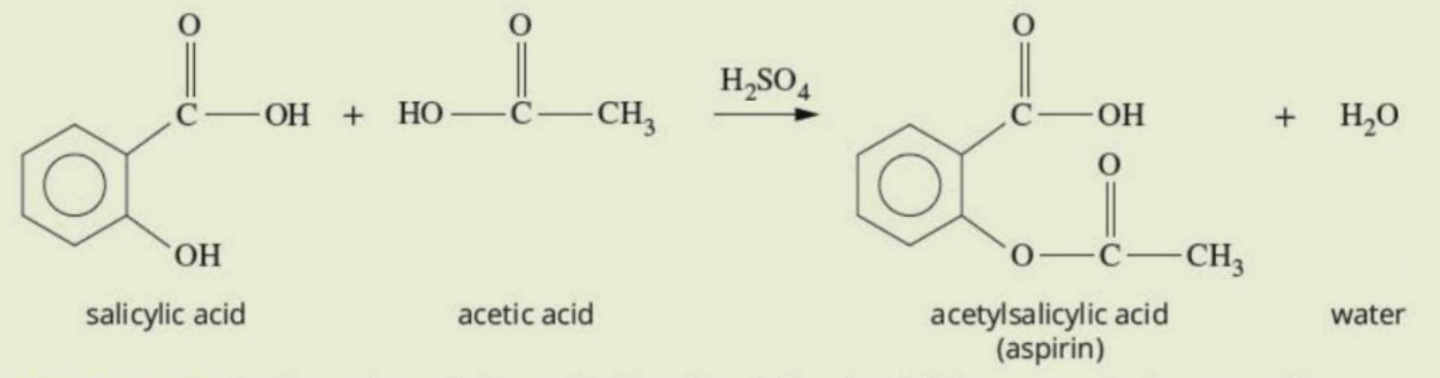
In this reaction:
- The hydroxyl group of salicylic acid reacts with the carboxyl group of ethanoic acid
- An ester link is formed, creating acetylsalicylic acid (aspirin)
- Water is eliminated as a by-product
- Sulfuric acid acts as a catalyst
Although this reaction can be performed in a school laboratory, the yield is quite low. Industrial production uses more complex methods to achieve better yields.
Important
Exam tip: Esterification reactions always produce water as a by-product. Remember that the ester link forms between the carboxyl group of the acid and the hydroxyl group of the alcohol.
Remember!
Summary
Key Points to Remember:
- A reaction pathway is a planned sequence of reactions to convert simple starting materials into desired products through functional group transformations
- Percentage yield = (actual yield / theoretical yield) × 100, measuring how efficiently reactants are converted to products
- In multi-step syntheses, overall yield decreases with each step; shorter routes generally give better total yields
- Atom economy = (molar mass of desired product / molar mass of all reactants) × 100, measuring how many reactant atoms end up in the product versus waste
- High atom economy reactions are more sustainable, produce less waste, and align with green chemistry principles
- When planning syntheses, consider both efficiency (yield) and sustainability (atom economy) to design environmentally friendly routes