Reactions of Alkenes (VCE SSCE Chemistry): Revision Notes
📚Revision Notes
Reactions of Alkenes
Introduction
The chemical behaviour of organic compounds is primarily determined by the functional groups they contain. Since all members of a homologous series share the same functional group, they typically undergo similar types of reactions.
Alkenes form a homologous series characterised by the presence of a carbon-carbon double bond (). This double bond is quite reactive and plays a crucial role in determining the chemical properties of alkenes. Understanding how alkenes react is essential for organic chemists who synthesise complex molecules from simpler starting materials.
Note
The presence of the carbon-carbon double bond is what distinguishes alkenes from alkanes and gives them their unique chemical properties. This structural feature is responsible for the wide variety of reactions that alkenes can undergo.
Reactivity of alkenes
Alkenes are generally more reactive than alkanes. The carbon-carbon double bond in alkene molecules significantly affects their chemical properties, making them more reactive than compounds containing only single bonds.
Note
For example, ethene () reacts more readily and with a wider variety of chemicals than ethane (), which contains only single bonds. This increased reactivity is due to the electrons in the double bond being more accessible to attacking reagents.
Combustion in air
Like alkanes, alkenes are flammable and burn in excess oxygen to produce carbon dioxide and water. The complete combustion of ethene can be represented by the following equation:
Addition reactions of alkenes
The most characteristic reactions of alkenes are addition reactions. In these reactions, a small molecule adds to the carbon-carbon double bond of the alkene.
Important
Addition reactions are the defining feature of alkene chemistry. Understanding these reactions is crucial for predicting how alkenes will behave in chemical processes and for planning organic synthesis routes.
Key features of addition reactions:
- Two reactant molecules combine to form one product molecule
- The carbon-carbon double bond () becomes a single bond ()
- An unsaturated compound is converted to a saturated compound
- The atoms of the small molecule are 'added across the double bond', with one atom bonding to each carbon atom of the original double bond
Unlike substitution reactions, addition reactions do not produce any inorganic by-products. All atoms from the reactants end up in the final product.
Reaction of alkenes with hydrogen
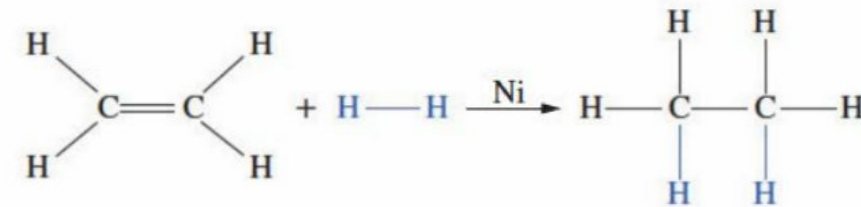
Alkenes react with hydrogen gas in the presence of a metal catalyst (such as nickel) to form alkanes. This process is called hydrogenation.
During hydrogenation, an unsaturated hydrocarbon is converted to a saturated one. For example, ethene reacts with hydrogen gas to produce ethane:
Important
Important conditions:
- A metal catalyst (typically nickel) is required
- The activation energy for this reaction is too high for it to proceed at room temperature without a catalyst
- The catalyst provides an alternative reaction pathway with lower activation energy
Reaction of alkenes with halogens
Alkenes undergo addition reactions with halogens such as bromine (), chlorine (), and iodine (). The halogen molecule adds across the double bond, placing one halogen atom on each carbon atom.
Example
Worked Example: Reaction of Ethene with Bromine
When ethene reacts with bromine, the bromine molecule adds across the double bond to form 1,2-dibromoethane:
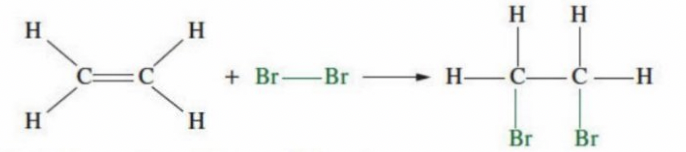
The product is a di-substituted haloalkane where both carbon atoms that were part of the double bond now each have a bromine atom attached.
Key points:
- This reaction proceeds at room temperature without a catalyst
- Other halogens ( and ) also react with alkenes to form di-substituted haloalkanes
The bromine test
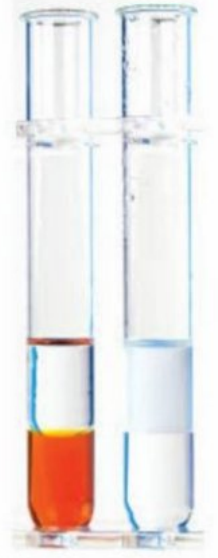
The reaction with bromine provides a useful test to distinguish between alkanes and alkenes. While alkanes will react with bromine in the presence of UV light (and the reaction is slow), alkenes react rapidly with bromine at room temperature.
Important
The Bromine Test for Unsaturation
The distinctive red-orange colour of bromine quickly disappears when it is mixed with an alkene. This colour change provides visual confirmation of the presence of a carbon-carbon double bond.
This is one of the most reliable and widely used tests for detecting the presence of double bonds in organic compounds.
Reaction of alkenes with hydrogen halides
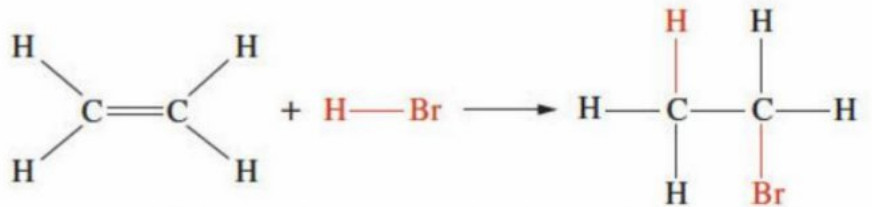
Alkenes react with hydrogen halides (such as and ) in addition reactions. During these reactions, a hydrogen atom adds to one carbon atom of the double bond, and the halogen atom adds to the other carbon atom.
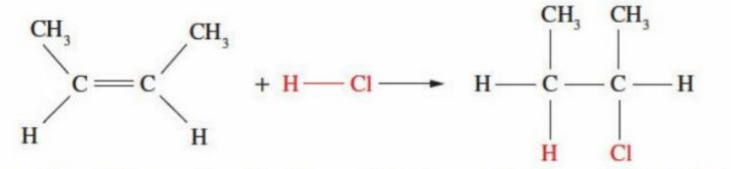
For symmetrical alkenes, only one product is formed. For example, but-2-ene reacts with hydrogen chloride to produce 2-chlorobutane:
Note
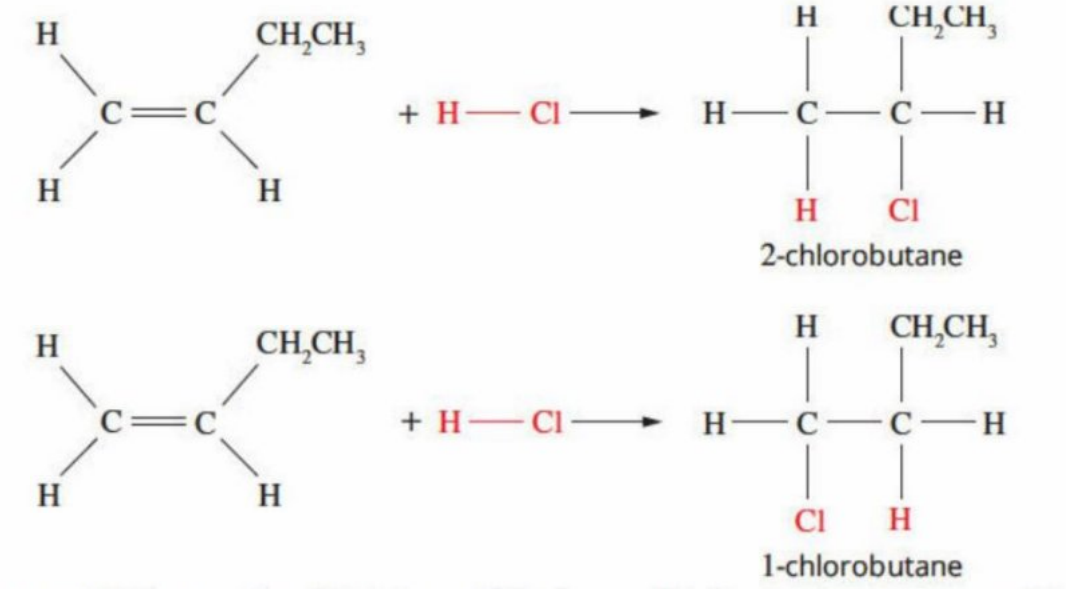
However, when asymmetrical alkenes react with hydrogen halides, two isomeric products can form. For instance, but-1-ene can react with hydrogen chloride to produce both 2-chlorobutane and 1-chlorobutane:
Reaction of alkenes with water
Alkenes can react with water under specific conditions to form alcohols. This process is called hydration.
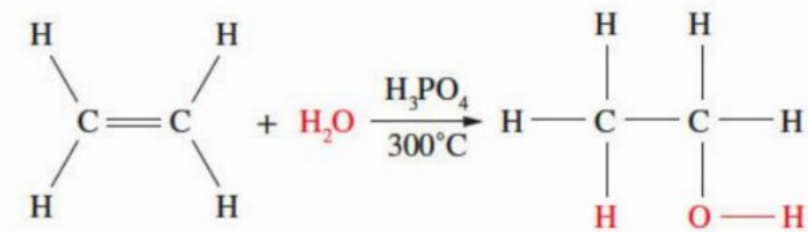
For example, ethanol can be produced industrially by the addition reaction of ethene with water (steam), using phosphoric acid () as a catalyst:
Note
Reaction conditions:
- Temperature:
- Catalyst: Phosphoric acid ()
- The gaseous reactants are passed over a solid bed of catalyst
- Gaseous ethanol is formed as the product
Industrial advantages:
This hydration reaction is widely used for the commercial manufacture of ethanol because:
- It is a one-step process
- It requires relatively little energy (apart from initial heating)
- The heterogeneous (solid-gas) nature of the reaction makes it easy to separate the product from the reaction mixture
- The catalyst remains intact and can be reused
Summary
Key Points to Remember:
- Addition reactions are the characteristic reactions of alkenes, where two molecules combine to form one product
- The carbon-carbon double bond in alkenes makes them more reactive than alkanes
- Four main types of addition reactions: with hydrogen (hydrogenation), with halogens, with hydrogen halides, and with water (hydration)
- The bromine test (rapid decolourisation of red-orange bromine) is a quick way to identify alkenes
- Asymmetrical alkenes can form isomeric products when reacting with asymmetrical reagents like hydrogen halides