Binary, Permutation, and Communication Matrices (VCE SSCE General Mathematics): Revision Notes
📚Revision Notes
Binary, Permutation, and Communication Matrices
Binary matrices
A binary matrix is a matrix that contains only two possible values: and . These matrices form the foundation for many practical applications in mathematics and computer science.
Note
Examples of binary matrices:
Binary matrices can be any size and shape - they can be row matrices, column matrices, or rectangular matrices. The key requirement is that every entry must be either 0 or 1.
Applications of binary matrices
Binary matrices are used extensively in:
- Analysing communication systems and networks
- Ranking players in sporting competitions using dominance concepts
- Computer science and digital logic
- Graph theory and network analysis
The power of binary matrices lies in their simplicity and the meaningful patterns they can represent when we perform operations like addition and multiplication.
Permutation matrices
A permutation matrix is a special type of binary matrix with a strict structure. It must satisfy two conditions:
- It is a square matrix (same number of rows and columns)
- There is exactly one 1 in each row and each column (with all other entries being )
The word "permutation" means rearrangement, which describes what these matrices do - they rearrange the elements of other matrices when multiplied together.
Note
Examples of permutation matrices:
Important
Notice that the identity matrix is a special permutation matrix. The identity matrix has s along its main diagonal and s everywhere else. It satisfies the permutation matrix rules and leaves other matrices unchanged when multiplied.
How permutation matrices work
When you multiply a matrix by a permutation matrix, the elements of the original matrix get rearranged according to the pattern of s in the permutation matrix.
Important terminology:
- Pre-multiplying means forming the product , where comes first
- Post-multiplying means forming the product , where comes second
Worked example: Applying a permutation matrix
Example
Worked Example: Applying a Permutation Matrix
Consider the column matrix and the permutation matrix .
Part (a)(i): Show that pre-multiplying by changes it to
Calculate :
For the first entry:
For the second entry:
For the third entry:
Therefore:
The permutation matrix has rearranged the elements from to .
Part (a)(ii): Show that pre-multiplying by leaves unchanged
Calculate :
The matrix remains unchanged.
Part (b): What can we deduce about ?
Since for any matrix , we can deduce that must be the identity matrix:
Finding permutation matrices
Sometimes you need to construct a permutation matrix that produces a specific rearrangement. The strategy is to think about where each element needs to move.
Example
Worked Example: Finding a Permutation Matrix
Find a permutation matrix that transforms into .
Solution strategy:
- (in position 4) needs to move to position 1 → place a in row 1, column 4
- (in position 3) needs to move to position 2 → place a in row 2, column 3
- (in position 2) needs to move to position 3 → place a in row 3, column 2
- (in position 1) needs to move to position 4 → place a in row 4, column 1
The permutation matrix is:
This matrix reverses the order of the elements - it's sometimes called a reversal matrix.
Inverses of permutation matrices
Every permutation matrix has a special property regarding its inverse. The inverse of a permutation matrix equals its transpose (also called the adjoint).
Important
Key property:
This means that if you swap the rows and columns of a permutation matrix, you get its inverse. This is a unique property that makes permutation matrices particularly useful in calculations.
Example
Worked Example: Using the Inverse Property
A permutation matrix is applied to a column matrix , giving the result . Determine matrix .
Solution:
We know that .
To find , we pre-multiply both sides by :
Since , we need to find the transpose of :
Therefore:
You can verify this using a calculator for larger or more complex matrices.
Communication matrices
A communication matrix is a square binary matrix that represents connections in a communication network. Each in the matrix represents a direct link between two people (or nodes) in the system, while indicates no direct connection.
Constructing a communication matrix
Let's work through a detailed example to understand how communication matrices are built and used.
Example
Worked Example: Constructing a Communication Matrix
Scenario:
Four students - Eva, Wong, Yumi and Kim - are staying in a backpacker's hostel. They face communication challenges because they speak different languages:
- Eva speaks English only
- Yumi speaks Japanese only
- Kim speaks Korean only
- Wong speaks English, Japanese and Korean
Network diagram:
We can represent this situation visually with a network diagram where arrows show who can communicate directly with whom.
Building the matrix:
To construct the communication matrix, follow these steps:
Step 1: Create a matrix (since there are four people). Label both rows and columns with the initials: E, W, Y, K.
Step 2: Label the rows as "Speaker" and columns as "Receiver".
Step 3: Fill in the matrix entries using these rules:
- Entry = if the two people can communicate directly (they share a common language)
- Entry = if they cannot communicate directly (no common language)
The completed communication matrix:
| Receiver | ||||
|---|---|---|---|---|
| Speaker | E | W | Y | K |
| E | 0 | 1 | 0 | 0 |
| W | 1 | 0 | 1 | 1 |
| Y | 0 | 1 | 0 | 0 |
| K | 0 | 1 | 0 | 0 |
Let's interpret some entries:
- Row E, column W = because Eva and Wong both speak English
- Row E, column Y = because Eva (English only) and Yumi (Japanese only) have no common language
- Row W, column Y = because Wong and Yumi both speak Japanese
- Notice the diagonal elements are - a person doesn't "communicate with themselves" in this context
One-step and two-step communication links
A one-step communication link is a direct connection between two people. In the communication matrix, these are represented by the s.
For example, Eva cannot communicate directly with Yumi (one-step) because they don't share a language. However, Eva can communicate with Yumi indirectly through Wong:
- Eva sends a message to Wong (in English)
- Wong translates and sends to Yumi (in Japanese)
This is called a two-step communication link.
Finding two-step links by squaring the matrix
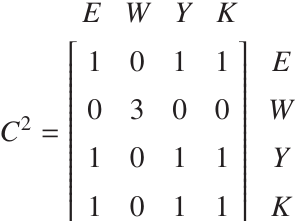
The powerful feature of communication matrices is that when you square the matrix (), you get a new matrix showing all possible two-step communication links.
Note
Using our example, if is the communication matrix:
Interpreting :
The in row E, column Y tells us there is a two-step link from Eva to Yumi. Specifically: Eva → Wong → Yumi.
The in row Y, column K tells us Yumi can send a message to Kim through a two-step link: Yumi → Wong → Kim.
Redundant communication links
Notice the in row E, column E of . This represents the two-step path Eva → Wong → Eva. This isn't useful because the message just comes back to the sender.
Important
Redundant communication links are links where the sender and receiver are the same person. These appear as non-zero elements along the leading diagonal (main diagonal) of the matrix.
Important rule: All diagonal elements in a communication matrix (or its powers) represent redundant links and should be ignored when analysing useful communication paths.
The element in row W, column W shows there are three different two-step ways Wong can send a message back to himself - all redundant!
Total communication links
To find the total number of one-step and two-step communication links in a network, calculate:
For our example:
This matrix shows the total number of ways each person can communicate with every other person using either one step or two steps. Again, ignore the diagonal elements as they represent redundant links.
Summary of communication matrix analysis
Summary
Key Points for Analysing Communication Matrices:
- The communication matrix is a square binary matrix where s represent direct (one-step) links
- To find two-step links, calculate (square the matrix)
- To find the total of one-step and two-step links, calculate
- Diagonal elements always represent redundant communication links (same sender and receiver)
- This approach can be extended: gives three-step links, gives four-step links, etc.
- For most practical networks, multi-step links quickly become redundant, so typically we only need to consider and
Important
Exam tip: Always identify and ignore redundant links (diagonal elements) when interpreting communication matrices. Focus on off-diagonal elements to find meaningful communication paths.
Remember!
Summary
Key Takeaways:
-
Binary matrices contain only s and s and are used in many practical applications including communication systems and ranking systems.
-
Permutation matrices are square binary matrices with exactly one in each row and each column. They rearrange elements when multiplied with other matrices.
-
For any permutation matrix , the inverse equals the transpose: .
-
Communication matrices use s to represent direct links in a communication network. Squaring the matrix () reveals all two-step communication paths.
-
Redundant links appear on the leading diagonal of communication matrices and their powers - these represent paths from a person back to themselves and should be ignored in analysis.
-
The total number of one-step and two-step links in a communication system is found by calculating .