Seasonal Indices (VCE SSCE General Mathematics): Revision Notes
📚Revision Notes
Seasonal Indices
Introduction to seasonal indices
When analysing time series data, we often notice patterns that repeat at regular intervals - like ice cream sales being higher in summer or heating costs rising in winter. These repeating patterns are called seasonal components, and they can make it difficult to see what's really happening with the overall trend of the data.
To better understand the underlying trend, we need to remove these seasonal effects from our data. This process is called deseasonalising, and we use seasonal indices to do it.
Note
Seasonal indices are numbers that tell us how a particular time period (such as a day, month, or quarter) typically compares to the average time period. They help us adjust data to remove seasonal patterns and reveal the true trend beneath.
Understanding seasonal indices
Key principle 1: Seasonal indices average to 1
Seasonal indices are calculated so that their average value equals 1. This has an important consequence: the sum of all seasonal indices equals the number of time periods.
For example:
- If you're working with monthly data, the 12 seasonal indices will add up to 12
- If you're working with quarterly data, the 4 seasonal indices will add up to 4
- If you're working with daily data for a week, the 7 seasonal indices will add up to 7
Key principle 2: Comparison to the average
A seasonal index shows how a particular time period compares to the average time period. Since the average seasonal index is 1 (or 100%), we can interpret any seasonal index by comparing it to this baseline.
Important
Interpreting seasonal indices:
- A seasonal index greater than 1 means that time period is typically above average
- A seasonal index less than 1 means that time period is typically below average
- A seasonal index equal to 1 means that time period is at the average
Example
Worked Example: Interpreting unemployment seasonal indices
Consider these monthly seasonal indices for unemployment:
| Jan | Feb | Mar | Apr | May | Jun | Jul | Aug | Sept | Oct | Nov | Dec | Total |
|---|---|---|---|---|---|---|---|---|---|---|---|---|
| 1.1 | 1.2 | 1.1 | 1.0 | 0.95 | 0.95 | 0.9 | 0.9 | 0.85 | 0.85 | 1.1 | 1.1 | 12.0 |
What does the February index tell us?
The seasonal index for February is or . This means February unemployment figures are typically 20% higher than the monthly average.
What does the August index tell us?
The seasonal index for August is or . This means August unemployment figures are typically 10% lower than the monthly average (they're only of the average).
Example
Worked Example: Electricity usage
Suppose the seasonal indices for electricity usage in someone's home are:
| Summer | Autumn | Winter | Spring |
|---|---|---|---|
| 1.16 | 0.94 | 1.26 | 0.64 |
Part a: What does the winter seasonal index tell us?
The seasonal index for winter is . This tells us that electricity usage in winter is typically 26% higher than the average season.
Part b: What does the spring seasonal index tell us?
The seasonal index for spring is . This tells us that electricity usage in spring is typically 36% lower than the average season (since ).
Using seasonal indices to adjust data
Once we have seasonal indices, we can use them in two important ways: to remove seasonal effects (deseasonalise) or to add them back in (reseasonalise).
Deseasonalising data
To remove the seasonal component from data, we use this formula:
This calculation adjusts each data point to show what it would have been without seasonal effects.
Note
Deseasonalising is also called "removing the seasonal component" or "seasonally adjusting" the data. The resulting values show the underlying trend without the regular seasonal fluctuations.
Reseasonalising data
To convert a deseasonalised value back into an actual data value, we use:
This calculation adds the seasonal component back into the data.
Example
Worked Example: Cold drink sales
The seasonal indices for cold drink sales at a kiosk are:
| Summer | Autumn | Winter | Spring |
|---|---|---|---|
| 1.75 | 0.66 | 0.46 | 1.13 |
Part a: If actual cold drink sales last summer totalled $21,653, what is the deseasonalised sales figure?
To deseasonalise, we divide by the seasonal index for summer ():
Part b: If the deseasonalised cold drink sales last spring totalled $10,870, what were the actual sales?
To find actual sales, we multiply by the seasonal index for spring ():
Percentage adjustments for seasonality
Sometimes we need to know by what percentage we should increase or decrease actual data to deseasonalise it. This is useful for understanding the size of seasonal effects.
Example
Worked Example: Heater sales
Consider these seasonal indices for heater sales at a discount store:
| Summer | Autumn | Winter | Spring |
|---|---|---|---|
| 0.65 | 1.25 | 1.35 | 0.75 |
Part a: By what percentage should summer sales be increased to deseasonalise the data?
Starting with the deseasonalising formula:
Rearranging this:
Multiplying by is equivalent to increasing by 53.8%.
Answer: To correct for seasonality, summer sales should be increased by 53.8%.
Part b: By what percentage should winter sales be adjusted to deseasonalise the data?
Starting with the deseasonalising formula:
Rearranging:
Multiplying by is equivalent to decreasing by .
Answer: To correct for seasonality, winter sales should be decreased by 25.9%.
Calculating seasonal indices from data
Now let's learn how to calculate seasonal indices from actual data. The basic approach is the same whether we have one year's data or multiple years' data.
The basic formula
For any time period:
Note
This formula is the foundation for calculating seasonal indices. It compares each period's value to the average of all periods, creating an index where 1 represents the average.
Method 1: Calculating seasonal indices from one year's data
Example
Worked Example: Calculating quarterly seasonal indices from one year
Suppose a shop owner wants to determine quarterly seasonal indices based on customer numbers over one year:
| Summer | Autumn | Winter | Spring |
|---|---|---|---|
| 920 | 1085 | 1241 | 446 |
Step 1: Find the average for all quarters
Step 2: Calculate the seasonal index for each quarter by dividing that quarter's value by the average
Step 3: Check that the seasonal indices sum to the number of seasons (4 for quarters)
The slight difference from exactly 4 is due to rounding - this is normal and acceptable.
Final result:
| Summer | Autumn | Winter | Spring |
|---|---|---|---|
| 0.997 | 1.176 | 1.345 | 0.483 |
Method 2: Calculating seasonal indices from multiple years' data
When we have data from several years, we calculate seasonal indices for each year separately, then average them. This gives us more reliable seasonal indices.
Example
Worked Example: Calculating seasonal indices from three years of data
Suppose we have 3 years of customer data:
| Year | Summer | Autumn | Winter | Spring |
|---|---|---|---|---|
| 1 | 920 | 1085 | 1241 | 446 |
| 2 | 1035 | 1180 | 1356 | 541 |
| 3 | 1299 | 1324 | 1450 | 659 |
Strategy:
- Calculate seasonal indices for each year separately
- Average the indices for each season across all years
For Year 1:
Quarterly average:
| Summer | Autumn | Winter | Spring |
|---|---|---|---|
| 0.997 | 1.176 | 1.345 | 0.483 |
For Year 2:
Quarterly average:
Check: ✓
| Summer | Autumn | Winter | Spring |
|---|---|---|---|
| 1.007 | 1.148 | 1.319 | 0.526 |
For Year 3:
Quarterly average:
Check: ✓
| Summer | Autumn | Winter | Spring |
|---|---|---|---|
| 1.098 | 1.119 | 1.226 | 0.557 |
Final step: Average the seasonal indices across all three years
Check: ✓
Final seasonal indices:
| Summer | Autumn | Winter | Spring |
|---|---|---|---|
| 1.03 | 1.15 | 1.30 | 0.52 |
Interpreting these indices:
- In summer, customer numbers are typically 3% above average
- In autumn, customer numbers are typically 15% above average
- In winter, customer numbers are typically 30% above average
- In spring, customer numbers are typically 48% below average
Deseasonalising a complete time series
Once we've calculated seasonal indices, we can deseasonalise all the data in our time series. This is done by dividing each actual value by its corresponding seasonal index.
Example
Worked Example: Deseasonalising three years of sales data
Using the quarterly sales data and seasonal indices from above:
Actual sales data:
| Year | Summer | Autumn | Winter | Spring |
|---|---|---|---|---|
| 1 | 920 | 1085 | 1241 | 446 |
| 2 | 1035 | 1180 | 1356 | 541 |
| 3 | 1299 | 1324 | 1450 | 659 |
Seasonal indices:
| Summer | Autumn | Winter | Spring |
|---|---|---|---|
| 1.03 | 1.15 | 1.30 | 0.52 |
Deseasonalised sales:
To deseasonalise each value, divide by the appropriate seasonal index.
For Summer values, divide by :
- Year 1:
- Year 2:
- Year 3:
Repeat this process for all seasons and all years:
| Year | Summer | Autumn | Winter | Spring |
|---|---|---|---|---|
| 1 | 893 | 943 | 955 | 858 |
| 2 | 1005 | 1026 | 1043 | 1040 |
| 3 | 1261 | 1151 | 1115 | 1267 |
Why deseasonalise data?
The main purpose of removing seasonal components from data is to reveal the underlying trend more clearly. Seasonal fluctuations can mask whether a business is growing, declining, or remaining stable.
Visual comparison: Actual vs deseasonalised data
When we plot both the actual data and the deseasonalised data, the difference becomes clear:
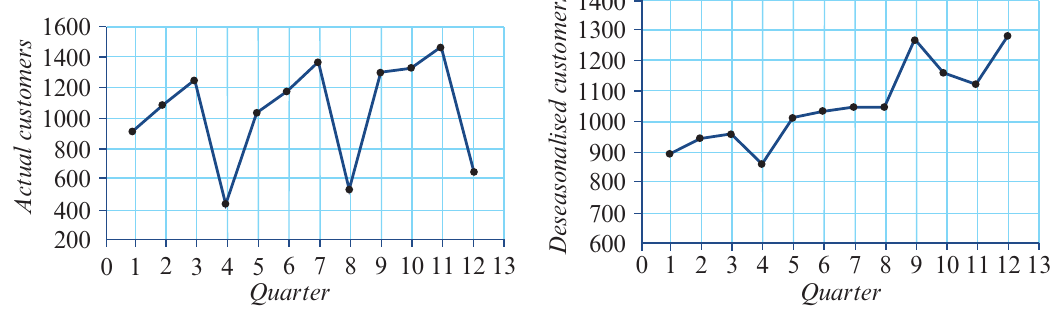
In the left graph (actual customers), the data jumps up and down dramatically due to seasonal effects. It's difficult to tell whether the business is growing or not.
In the right graph (deseasonalised customers), we can clearly see an upward trend. The business is growing steadily over time - this was hidden in the actual data by seasonal variations.
Note
This is why deseasonalising is so valuable: it helps us see the real trend in the data by removing the "noise" created by predictable seasonal patterns.
When to deseasonalise
Deseasonalising is particularly useful when you want to:
- Identify long-term trends in your data
- Compare performance across different time periods fairly
- Make predictions about future performance
- Fit trend lines to your data (covered in the next section)
Important
Common mistakes to avoid:
- Don't confuse deseasonalising (dividing) with reseasonalising (multiplying)
- Don't forget to use the correct seasonal index for each time period
- Don't round too early - keep full precision in intermediate calculations
Summary
Key Points to Remember:
- Seasonal indices tell us how each time period compares to the average, with an average value of 1
- The sum of seasonal indices equals the number of time periods (12 for months, 4 for quarters)
- Deseasonalise data by dividing:
- Reseasonalise data by multiplying:
- Calculate seasonal indices using:
- With multiple years of data, calculate indices for each year separately, then average them
- Deseasonalising reveals the underlying trend by removing predictable seasonal patterns
For interpreting seasonal indices:
- Remember that a seasonal index compares a period to the average
- To find percentage above/below average, subtract 1 from the index and convert to percentage
- If SI = , the period is above average
- If SI = , the period is below average
For calculations:
- Always check that seasonal indices sum to the number of periods
- Round answers sensibly - usually to 2 or 3 decimal places for indices
- When deseasonalising, divide by the seasonal index
- When reseasonalising, multiply by the seasonal index
- Keep track of units (dollars, customers, etc.)