Smoking and the Role of Health Promotion in Improving Population Health (VCE SSCE Health and Human Development): Revision Notes
📚Revision Notes
Smoking and the Role of Health Promotion in Improving Population Health
Introduction to smoking as a health concern
Smoking represents one of the most significant health challenges facing Australia today. The practice of tobacco smoking is strongly associated with increased likelihood of developing serious health conditions, including heart disease, numerous forms of cancer, and respiratory illnesses. The impact of smoking on the Australian population is substantial, accounting for approximately 9% of the nation's total burden of disease, primarily through deaths occurring earlier than expected.
Note
The burden of disease refers to the overall impact of health problems on a population, measured through factors such as financial costs, death rates, illness rates, and other health indicators. Smoking's contribution to this burden makes it a critical target for health promotion efforts across the country.
Why smoking is targeted by health promotion initiatives
The scale of the problem
The Department of Health estimates that tobacco smoking claims the lives of more than 20,000 Australians each year, whilst imposing a staggering $31.5 billion in combined social, health and economic costs on the nation. What makes these figures particularly troubling is that smoking is classified as a preventable risk factor, meaning that all smoking-related diseases and their consequences could theoretically be avoided through behaviour change.
As the leading preventable risk factor in Australia, smoking significantly contributes to the overall burden of disease by raising the risk of multiple health conditions. This preventable nature of smoking-related harm provides a clear justification for sustained health promotion efforts.
Important
A particularly tragic statistic highlights the severity of long-term smoking: approximately half of all people who smoke throughout their lives will die prematurely as a direct result of their tobacco use.
Vulnerable populations disproportionately affected
Smoking does not affect all Australians equally. Certain population groups experience higher rates of tobacco use, which contributes to the lower levels of health and wellbeing observed in these communities:
Geographic disparities: Rural and remote Australians face higher smoking rates. Approximately 10% of people living in major cities smoke, compared to roughly 18% of those residing in outer regional and remote areas. This nearly two-fold difference contributes to health inequities between urban and rural populations.
Aboriginal and Torres Strait Islander peoples: First Nations Australians experience smoking rates of around 27%, which represents two and a half times the rate observed in other Australian populations. This elevated prevalence contributes significantly to health gaps between Aboriginal and Torres Strait Islander peoples and other Australians.
Socioeconomic status: The relationship between income and smoking rates is striking. In 2019, people in the lowest socioeconomic group smoked at a rate almost four times higher than those in the highest socioeconomic group (19% compared to 5.1%). This disparity means that lower-income Australians bear a disproportionate burden of smoking-related disease.
Note
These disparities demonstrate that smoking is not just a health issue, but also a social justice issue. Health promotion initiatives must specifically target vulnerable populations to address these inequities and improve population health outcomes for all Australians.
Environmental tobacco smoke
The harmful effects of smoking extend beyond those who choose to smoke. Environmental tobacco smoke, also called secondhand smoke, causes disease and premature death in adults and children who do not smoke themselves. This exposure to tobacco smoke in the environment creates health risks for non-smokers, particularly in enclosed spaces and areas where children are present.

The serious health and economic impacts of smoking, combined with its preventable nature and disproportionate effects on vulnerable groups, have driven the implementation of numerous health promotion initiatives designed to change behaviours and reduce smoking's impact on population health.
Effectiveness of health promotion in improving population health
Overall success in reducing smoking rates
Health promotion activities targeting smoking have achieved remarkable success in Australia. Smoking rates have declined dramatically from approximately 44% for males and 33% for females in 1976 to 16.5% for males and 11.1% for females in 2017-18. This substantial reduction represents one of the most successful public health achievements in Australian history.
Australia's relatively low smoking rate results from sustained, coordinated health promotion efforts implemented by all levels of government working alongside public health organisations. This collaborative approach has maintained focus on reducing smoking rates over many decades.
Understanding population health
Note
When evaluating health promotion effectiveness, it's important to understand that population health refers to the health status or wellbeing of groups of people, rather than individuals. For example, population health might examine the mental wellbeing of young people, cancer rates among males, or health outcomes for people experiencing socioeconomic disadvantage. This focus on groups rather than individuals helps identify patterns and target interventions effectively.
The Ottawa Charter framework
The Ottawa Charter for Health Promotion is increasingly used to guide the development of health promotion interventions in Australia. This framework identifies five key action areas that work together to promote health:
Important
The Five Action Areas of the Ottawa Charter:
Build healthy public policy: Creating laws, regulations and organisational policies that make healthy choices easier and support better health outcomes.
Create supportive environments: Establishing physical and social settings that enable and encourage healthy behaviours and protect people from health threats.
Strengthen community action: Empowering communities through partnerships and collaboration, enabling them to take ownership of health issues and solutions.
Develop personal skills: Providing education, information and resources that enable individuals to make informed decisions and take action to improve their health.
Reorient health services: Shifting the focus of health services beyond treating illness to include prevention and health promotion activities.
Because smoking behaviour results from multiple influences including individual, social, economic and environmental factors, effective health promotion must address several or all of these action areas. The greatest improvements in population health occur when interventions target all five action areas simultaneously, rather than focusing on just one or two.
Government laws and policies
Legislative approaches to reducing smoking
Many of the most successful health promotion activities regarding smoking involve the introduction and enforcement of laws and policies. Since 1973, Australian governments have used legislation to address tobacco advertising, packaging requirements, smoke-free environments, and taxation levels. These legal approaches work to build healthy public policy by making not smoking the easier and healthier choice for Australians.
Evidence of policy effectiveness
Research demonstrates the effectiveness of various legislative approaches:
Tobacco taxation: Increasing taxes on tobacco products, which raises their price, is associated with lower smoking rates across all population groups. Evidence shows that a 10% rise in tobacco prices resulted in a 3.2% decline in smoking prevalence among low-income smokers, demonstrating that price increases can be particularly effective in reducing smoking among disadvantaged groups.
Smoke-free venue laws: Laws prohibiting smoking in pubs and clubs have shown significant impact on lower socioeconomic status populations, with 40% of smokers in these settings reporting reductions in their tobacco consumption following implementation of the bans.
Federal smoking legislation
Federal law in Australia bans smoking in specific settings including:
- All Australian Commonwealth Government buildings
- Public transport throughout the country
- All airports
- All international and domestic flights
Note
These nationwide restrictions create supportive environments by protecting non-smokers from environmental tobacco smoke exposure in commonly used public spaces.
State and territory legislation
Additional smoking restrictions are governed by individual states and territories. All Australian states and territories have implemented comprehensive bans on smoking in enclosed public places, with particular emphasis on workplaces and restaurants.
Victorian smoking laws as examples
Victoria provides numerous examples of progressive smoking legislation:
Children's recreational areas (April 2014): Smoking was banned at areas commonly used by children and young people for recreational and sporting activities. This legislation complements earlier bans implemented in December 2012 that prohibited smoking at all Victorian patrolled beaches.
Vehicles with minors (January 2010): It became an offence to smoke in a vehicle where any person under 18 years of age is present. This ban applies regardless of whether the vehicle is moving or stationary, whether windows are open or closed, or whether a convertible roof is up or down.
School grounds (July 2009): A ban on smoking in government school grounds took effect, protecting students and staff from environmental tobacco smoke exposure.
Enclosed public places (July 2007): A restriction on smoking in enclosed public places came into effect, significantly reducing exposure to secondhand smoke.
Public transport areas (2006): Smoking was banned in covered areas of train station platforms, tram stops and bus stops, protecting public transport users from environmental tobacco smoke.
Local government initiatives
Some local governments have extended smoking restrictions further by introducing laws prohibiting smoking in public outdoor places, including parks and beach areas. These local initiatives create supportive physical environments that protect non-smokers and denormalise smoking behaviour.
Ottawa Charter connections
Anti-smoking laws and policies demonstrate two key action areas of the Ottawa Charter:
Note
Building healthy public policy: Legislation creates a regulatory framework that makes not smoking the default, easier and legally enforced option in many settings.
Creating supportive environments: By reducing exposure to environmental tobacco smoke, these laws create physical environments that support the health of people who choose not to smoke, as well as making it more difficult and less convenient for people to smoke.
National Tobacco Campaigns
Overview of coordinated national efforts
National Tobacco Campaigns represent collaborative initiatives developed by federal and state/territory governments working together with the private sector. These campaigns aim to reduce smoking rates and associated health consequences through multiple, complementary interventions. The campaigns have been implemented since the 1970s and have contributed significantly to declining smoking rates across Australia.
Anti-smoking media campaigns
Media campaigns work primarily to develop personal skills by educating the population about the dangers and consequences of smoking. A recent example is the "Don't make smokes your story" campaign, which uses emotionally resonant messaging to discourage smoking.
These campaigns also create supportive environments by providing information on how to access resources and support services to assist with quitting smoking.
Important
Effectiveness evidence: Research into anti-smoking media campaigns has revealed:
- Highly emotional advertisements are remembered more effectively by viewers and are perceived as more impactful in changing attitudes and behaviours. These campaigns influence beliefs about smoking and increase the number of quit attempts.
- People from lower socioeconomic status groups are particularly responsive to emotional or personal testimonial style advertisements, suggesting these formats can help address health inequities.
- Greater exposure to anti-smoking advertisements correlates with increased likelihood of successfully quitting. For each ten additional times a person views an anti-smoking advertisement, their odds of quitting increase by 1.15 times.
How to quit smoking website
The How to quit smoking website, developed as part of the National Tobacco Campaign, serves multiple functions:
Strengthening community action: The website provides links to a range of community support services, including Quitline and QuitCoach, connecting individuals with collective resources and peer support.
Developing personal skills: The website produces extensive fact sheets and resources covering:
- Why quit smoking: This section explains the physical and social impacts of smoking and outlines the health benefits that occur when a person stops smoking.
- Quitting methods: Users receive guidance on preparing to quit, information about different cessation methods available, and details about support services they can access.
- Make a quit plan: Online tools and templates assist smokers in developing a personalised, structured plan for quitting smoking.
- Coping with quitting and staying smoke-free: This section provides strategies for overcoming setbacks, managing cravings, and planning another quit attempt if an initial attempt is unsuccessful.
My QuitBuddy smartphone application
Developed as part of the National Tobacco Campaign, the My QuitBuddy free smartphone app was created to assist Australian smokers of any age, gender and socioeconomic status in their efforts to quit smoking.
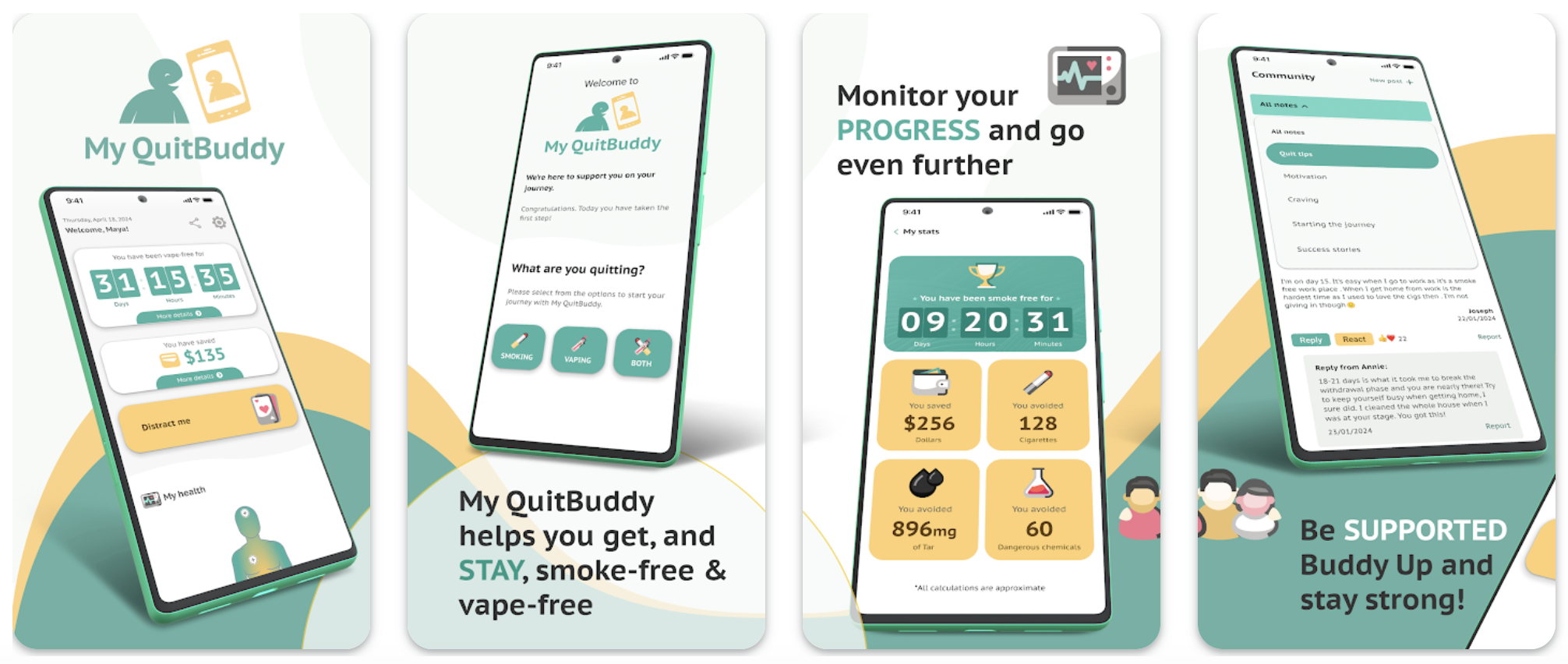
Developing personal skills: The app provides detailed feedback enabling users to track:
- How many cigarettes they have avoided smoking
- How many grams of tar they have not inhaled
- How much money they have saved each day
- How many days they have been smoke-free
Note
This information helps users understand their progress and provides tangible evidence of the health and financial benefits of quitting, which can assist in reducing the risk of smoking-related diseases.
Creating supportive environments: My QuitBuddy establishes support through several features:
- Users can record personal goals and motivation using pictures, words and audio messages, creating a personalised support system
- A community board allows users to gain motivation and support from thousands of other people who are also working to quit smoking
- Users can program "danger times" when cravings are likely, and the app will send automatic reminders of the health and wellbeing benefits of quitting
- Games are provided to play during times of craving, offering a distraction from the urge to smoke
- Users can share their quit journey and success stories with others through social media platforms like Facebook and Twitter, building social support networks
Quit for You, Quit for Two smartphone application
This free smartphone app, also developed as part of the National Tobacco Campaign, specifically targets Australian smokers who are pregnant or planning pregnancy.

Creating supportive environments: The app includes:
- Fun exercises and games designed to keep hands busy, helping to manage cravings physically
- Personalised daily reminders and words of encouragement tailored to the user
- By entering the baby's due date, the app automatically sends messages detailing the baby's growth and development, providing ongoing motivation
Developing personal skills: The app provides:
- Practical quit tips and advice specifically relevant to pregnant women
- A running tally of money saved by not smoking, along with suggestions for items that could be purchased with these savings, making the financial benefits concrete
- Facts about the baby's development at different stages, providing additional reasons to resist urges to smoke and helping users understand the direct benefits to their child
Timeline of interventions and declining smoking rates
Multiple interventions implemented over several decades have worked together to achieve substantial reductions in smoking prevalence. The graph below shows the relationship between key policy interventions and declining smoking rates in Australia.
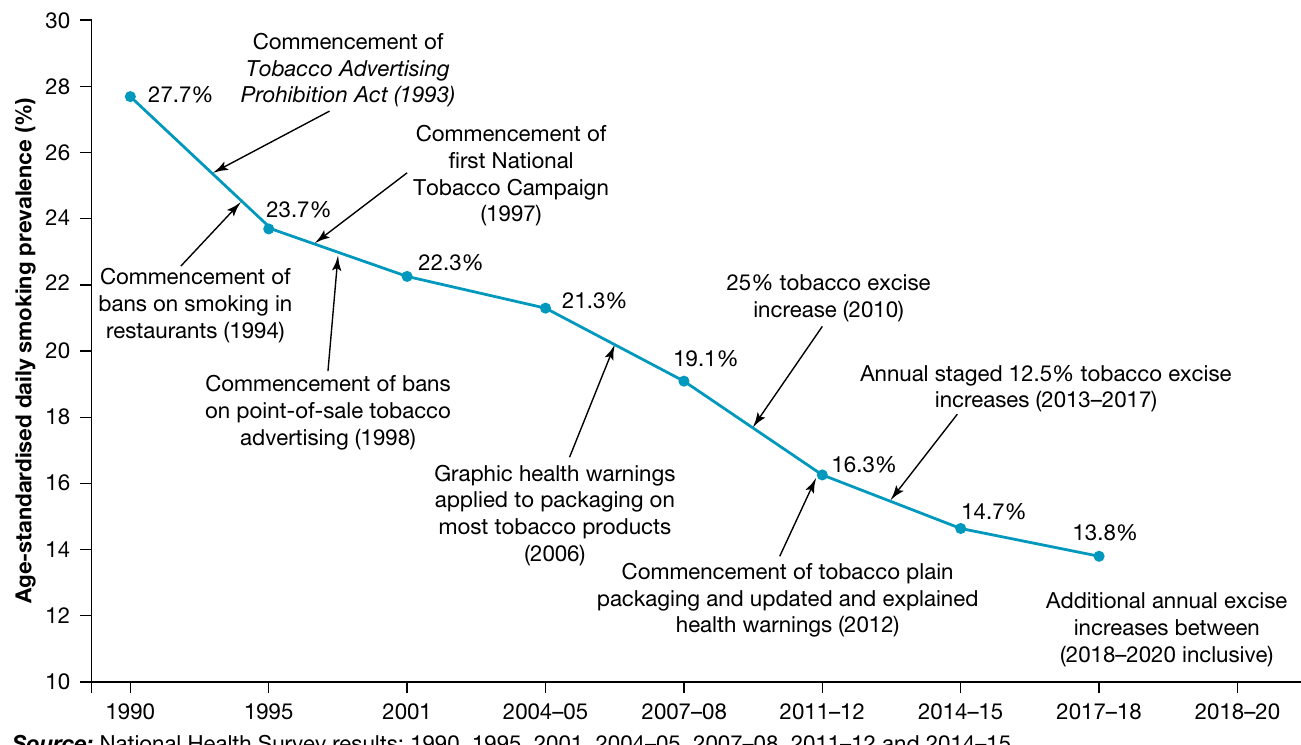
Major milestones shown in the timeline include:
- 1993: Tobacco Advertising Prohibition Act commenced
- 1994: Restaurant smoking bans began
- 1997: First National Tobacco Campaign launched
- 1998: Point-of-sale tobacco advertising bans implemented
- 2006: Graphic health warnings applied to most tobacco packaging
- 2010: 25% tobacco excise increase
- 2012: Plain packaging for tobacco products and updated health warnings introduced
- 2013-2017: Annual staged 12.5% tobacco excise increases
- 2018-2020: Additional annual excise increases
Note
This graph clearly demonstrates how smoking prevalence declined from 27.7% in 1990 to 13.8% in 2017-18, with each major intervention contributing to the overall downward trend.
Quit campaigns
Quit Victoria as a model program
Quit campaigns operate in each Australian state and territory, often as joint ventures between state or territory governments and the Cancer Council for that jurisdiction, although other organisations may be involved. Quit Victoria serves as an excellent example of state-level health promotion action.
Quit Victoria is a program delivered by the Cancer Council Victoria, funded by the Victorian Government and VicHealth. This partnership demonstrates strengthening community action by bringing together government and non-government organisations to address a shared health concern. Quit Victoria aims to decrease smoking prevalence by helping current smokers quit and preventing non-smokers from taking up smoking.
Information and education provision
Developing personal skills: Quit provides extensive information about tobacco smoking and the benefits associated with not smoking. This education is delivered through:
- Public education using mass media advertising campaigns
- Public relations activities
- Downloadable information and resources available on the Quit website
These resources help individuals understand the risks of smoking and the benefits of quitting, enabling them to make informed decisions about their health.
Quitline telephone counselling service
Funded by state and territory governments and implemented by Quit organisations around Australia, Quitline is a telephone counselling service that provides professional support to people wanting to quit smoking. As a clinical service staffed by highly trained specialists, Quitline demonstrates reorienting health services towards prevention and health promotion.
Creating supportive environments: Quitline provides ongoing support throughout the quitting process, offering encouragement and assistance when individuals face challenges or setbacks.
Developing personal skills: The service provides expert advice and practical strategies for quitting, helping callers develop the knowledge and skills needed to successfully stop smoking.
Important
Evidence of effectiveness: Evaluations of Quitline services run by Quit Victoria have produced positive results:
- 97% of callers rated the service as either very or somewhat friendly
- 86% found the service helpful
- 82% said they would recommend Quitline to friends
- When followed up six months after their call, 17% of callers had successfully stopped smoking
Aboriginal Quitline
Aboriginal Quitline is a specialised telephone helpline service providing advice and behaviour change support specifically for Aboriginal and Torres Strait Islander people who wish to quit smoking.
Note
Strengthening community action: Quit Victoria's Aboriginal Quitline employs Aboriginal and Torres Strait Islander quit specialists who have received additional training to assist people with smoking cessation in a culturally appropriate way. This culturally sensitive approach recognises that effective health promotion must respect and respond to the specific cultural contexts and needs of different communities.
Quitline specialists provide callers with quit plans tailored to their individual circumstances, information on different quitting methods and products, and written and other resources. Advisers can also connect callers with local support groups if requested.
Currently, dedicated Aboriginal Quitline services operate in New South Wales, Victoria and Queensland, although all Quitline services throughout Australia are funded to provide culturally sensitive services to Aboriginal and Torres Strait Islander peoples.
Online support services
In Victoria, additional support is available through QuitCoach and QuitTxt on the Quit website. Both services are provided free of charge to Victorians, whilst Quitline is available for the cost of a telephone call (or free if referred by a health professional). This means all services are accessible to Australians regardless of socioeconomic status or geographical location, helping to address health inequities.
In addition to these interactive services, the Quit Victoria website provides extensive materials to assist smokers at different stages:
- Recognising reasons to quit
- Preparing to quit
- Staying smoke-free
- Managing setbacks and planning another quit attempt if needed
These resources develop personal skills by providing easy-to-follow steps and practical strategies.
Support for health professionals and community groups
Strengthening community action: Quit assists health professionals, community groups and various population groups to create environments that support quitting. This is achieved by:
- Providing specialist training for health professionals to deliver proven "brief interventions" and make referrals to Quitline
- Working with community and population groups to create tailored public education materials, health information and treatment pathways for groups with high smoking rates, including Aboriginal and Torres Strait Islander peoples, people experiencing mental health conditions, and those with alcohol and other drug dependencies
Policy advice and research
Building healthy public policy: Quit undertakes research and provides evidence-based advice to the state government to inform the implementation of effective policies. Examples include:
- Laws relating to smoking in public places
- Tobacco advertising restrictions
- Display of cigarettes in retail outlets
- Tobacco packaging requirements
- Tobacco taxation levels
Quit also provides advice to the federal government to inform the development of national health policies.
Training for health professionals
Reorienting health services: Quit provides a free online learning training program for health professionals, helping to shift health services towards prevention and early intervention. The Smoking Cessation Essentials course and Smoking Cessation Brief Intervention videos provide health professionals with knowledge and skills to:
- Understand the important role of health professionals in addressing smoking and the effectiveness of smoking cessation interventions
- Inform patients and clients about the effects of smoking and the benefits of quitting
- Understand the behavioural aspects of smoking and addiction
- Carry out brief smoking cessation interventions effectively in clinical settings
- Access information about Quit Victoria's support services and how to refer patients and clients to these services
Summary of Ottawa Charter action areas applied to smoking
The table below provides concrete examples of how each action area of the Ottawa Charter is applied in smoking-related health promotion:
| Action area | Examples relating to smoking |
|---|---|
| Build healthy public policy | Anti-smoking laws and tobacco taxes make not smoking the easier and healthier choice. Quit provides evidence-based advice to state and federal governments to implement legislation related to smoking, including laws about smoking in public places, tobacco advertising restrictions, display of cigarettes in retail outlets, tobacco packaging requirements and tobacco taxation levels. |
| Create supportive environments | National Tobacco Campaigns provide information on how to access resources and support to assist with quitting at no cost. The My QuitBuddy app allows users to record personal goals and motivation using pictures, words and audio messages. A community board enables users to gain motivation and support from thousands of other people who are quitting. |
| Strengthen community action | Aboriginal Quitline strengthens community action by employing Aboriginal and Torres Strait Islander quit specialists with additional training to assist people with smoking cessation in a culturally appropriate way. Quit Victoria operates as a joint venture between the Victorian Government, VicHealth, the Heart Foundation and the Cancer Council Victoria. |
| Develop personal skills | National Tobacco Campaigns educate the population about the dangers and consequences of smoking. Recent campaigns include "Don't make smokes your story". Quit provides information about tobacco smoking and the benefits of not smoking through mass advertising campaigns and downloadable resources on its website. |
| Reorient health services | Quit invests in smoking prevention research, which provides best practice techniques for health professionals in preventing people from starting smoking and assisting current smokers to quit. Quit provides a free online learning training program including the Smoking Cessation Essentials course and Smoking Cessation Brief Intervention videos, which equip health professionals with knowledge and skills for helping patients quit. |
Case study: 30 years of Quit Victoria
Historical context
When Quit Victoria was established 30 years ago, smoking was deeply embedded in Australian culture. People smoked on aeroplanes, inside restaurants, at their desks at work, and even in hospitals. Tobacco advertising appeared in newspapers, at cinemas and on billboards, featuring healthy-looking young people smiling with friends whilst enjoying cigarettes. Melbourne television viewers saw, on average, one cigarette advertisement every eight minutes. Tobacco packaging carried only a small printed warning stating that smoking was a health hazard, a claim the tobacco industry vigorously denied.
Achievements and impact
Quit Victoria's sustained efforts have delivered substantial results. In 1985, 32% of Victorians were regular smokers. By 2012, this had fallen by more than half, with just 13% of Victorians smoking regularly. By 2016, the rate had declined further to 12%.
Note
Dr Sarah White, Quit Victoria Director, explained the significance of this achievement. If smoking rates had remained at 32%, Victoria would have had 1.4 million regular smokers in 2012. Instead, more than 800,000 Victorians are not smoking today, meaning more than half a million Victorians have been or will be saved from premature death thanks to Quit Victoria's work and the leadership of VicHealth, Cancer Council Victoria, and federal and state governments.
Key success factors
Cancer Council Victoria chief executive Todd Harper identified three vital measures that motivated smokers to quit and discouraged young people from taking up the habit:
- Anti-smoking advertisements with strong emotional messages
- Smoke-free areas protecting people from environmental tobacco smoke
- Increased cigarette prices making smoking less affordable
These measures reflect multiple action areas of the Ottawa Charter working together to achieve population health improvements.
Ongoing challenges
Despite remarkable progress, Dr White noted that smoking remained Victoria's leading cause of preventable disease and death in 2013, killing approximately 4,500 Victorians that year. At the time of the case study:
- Smoking killed 11 Victorians every day
- For every smoking-related death, an estimated 30 people were being treated for smoking-related illnesses
- More than 4,000 Victorian teenagers were still taking up smoking each year
Political support and future directions
Quit Victoria has enjoyed broad political support across different eras and political parties because politicians recognise both the human tragedy and the economic costs of smoking. Minister for Health Jill Hennessy congratulated Quit Victoria on its 30 years of success and expressed commitment to working with Quit Victoria and the Cancer Council to identify additional actions to further reduce the harms caused by smoking.
Note
This case study demonstrates the effectiveness of sustained, multi-faceted health promotion efforts in improving population health. The dramatic reduction in smoking rates over 30 years shows what can be achieved through coordinated action across all Ottawa Charter action areas, persistent implementation of evidence-based interventions, and sustained political and community support.
Remember!
Summary
Key takeaways about smoking and health promotion:
-
Smoking is Australia's leading preventable risk factor, responsible for approximately 9% of the total burden of disease and killing over 20,000 Australians annually at a cost of $31.5 billion.
-
Vulnerable populations including people in rural and remote areas, Aboriginal and Torres Strait Islander peoples, and those experiencing socioeconomic disadvantage have significantly higher smoking rates, contributing to health inequities.
-
Comprehensive health promotion addressing multiple Ottawa Charter action areas has successfully reduced Australian smoking rates from approximately 44% for males and 33% for females in 1976 to 16.5% for males and 11.1% for females in 2017-18.
-
Government laws and policies including tobacco taxes, advertising bans, smoke-free environments and plain packaging build healthy public policy and create supportive environments that make not smoking the easier choice.
-
Multi-level support services including National Tobacco Campaigns, smartphone applications (My QuitBuddy, Quit for You Quit for Two), Quitline counselling services, and Quit Victoria programs strengthen community action, develop personal skills, and reorient health services towards prevention, working together to help smokers quit and prevent uptake of smoking.