The Challenges in Bringing About Dietary Change (VCE SSCE Health and Human Development): Revision Notes
📚Revision Notes
The Challenges in Bringing About Dietary Change
Introduction to dietary change challenges
Australian eating patterns have undergone substantial changes over recent decades. There has been a notable shift away from whole foods rich in nutrients (nutrient-dense foods) towards processed foods that are high in energy but low in nutritional value (energy-dense foods). This transformation in dietary habits has played a significant role in the rising rates of obesity and diet-related diseases across Australia.
While numerous health promotion activities aim to improve food intake in Australia, achieving lasting dietary change remains difficult. The foods people choose to eat result from a complex interaction of multiple factors. Understanding these challenges is essential for developing effective health promotion strategies.
Note
The complexity of dietary change cannot be overstated. Unlike simple health behaviours that might involve a single decision, food choices are influenced by biological, psychological, economic, social, and environmental factors that interact in complex ways. This is why health promotion efforts focusing on only one aspect often fail to achieve lasting change.
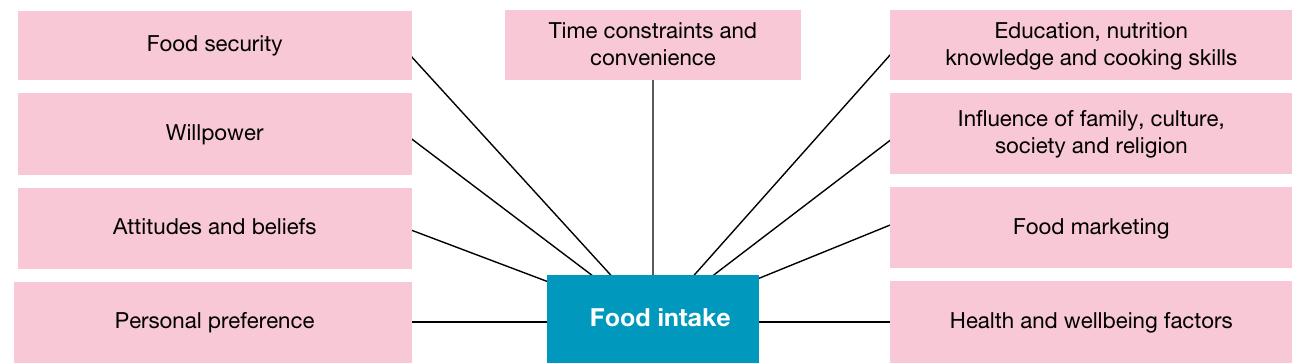
The diagram above illustrates the nine key factors that influence food intake. Each of these presents unique challenges when attempting to encourage healthier eating patterns among Australians.
Personal preference
Most individuals have specific food preferences that develop over time. These preferences emerge from various influences, including taste experiences and past memories associated with particular foods. One of the most significant challenges in dietary change relates to foods containing high amounts of fat, salt and sugar.
These substances act as flavour enhancers, meaning they activate our taste buds whilst simultaneously triggering the brain's reward pathways. When consumed, they stimulate the release of dopamine, a chemical messenger that creates feelings of pleasure and satisfaction. This biological response can establish a cycle of craving, where individuals actively seek out foods containing these substances.
Important
The Dopamine Reward Cycle
Flavour enhancers (foods high in fat, salt and sugar) create a powerful biological challenge to dietary change by:
- Stimulating the taste buds for immediate sensory pleasure
- Triggering the brain's reward system through dopamine release
- Creating feelings of satisfaction and pleasure
- Establishing cravings and reinforcing consumption patterns
- Making it difficult to choose healthier alternatives that don't provide the same reward
This is a biological mechanism, not simply a lack of willpower, which is why dietary change is genuinely challenging for most people.

Taste preferences typically become established over extended periods, often beginning in childhood. Once formed, these preferences can prove resistant to change, even when individuals understand the health benefits of consuming different foods. For many people, this makes altering their dietary patterns particularly challenging.
Note
Exam tip: Be prepared to explain how dopamine creates challenges for dietary change. Remember that it's not just about taste preferences, but also the biological reward mechanism that reinforces consumption of unhealthy foods. You should be able to describe the cycle: consumption → dopamine release → pleasure/satisfaction → craving → repeated consumption.
Attitudes and beliefs
People's perceptions about food significantly influence their dietary choices. Many individuals who have limited experience with healthier food options may hold beliefs that such foods are tasteless or unenjoyable. Additionally, some people maintain an optimistic bias, believing that negative health consequences from consuming unhealthy foods won't affect them personally. These attitudes reduce the likelihood of people experimenting with new, nutritious food options.
Philosophical beliefs also shape food consumption patterns. Some individuals follow vegetarianism, whilst others prefer consuming only organic products or Australian-made goods. Although these approaches can offer benefits, they don't automatically guarantee healthy overall food intake. Various other factors continue to influence specific food choices within these dietary frameworks.
Note
A common misconception is that following any specific dietary philosophy (vegetarian, organic, etc.) automatically results in a healthy diet. However, it's possible to follow these approaches while still consuming excessive amounts of processed foods, sugar, or unhealthy fats. Balanced nutrition requires attention to variety, portion sizes, and overall dietary patterns, not just restriction of certain food categories.
Most health promotion initiatives for healthy eating advocate consuming a balanced diet that includes foods from all major groups. When people restrict certain food categories based on beliefs or dietary philosophies, achieving this balance becomes more challenging. They may find it difficult to obtain adequate amounts of all essential nutrients.
Important
The Challenge of Restrictive Diets
The Australian Health Survey (2011-2012) found that over 2.3 million Australians aged 15 years and above reported following a diet to lose weight or for other health-related reasons.
While dieting can promote health and wellbeing, some popular diets significantly restrict certain food groups, making it harder for followers to adhere to nutritional advice. Examples include sugar-free diets and the Paleo diet, both of which eliminate specific categories of foods.
Paleo diet: A dietary approach based on consuming foods that would have been available to humans during the Paleolithic period, which spanned from approximately 2.5 million to 12,000 years ago. This diet restricts dairy products, refined grains such as bread and pasta, and refined sugars found in items like chocolate and soft drinks. The main components include meat, fish, nuts, vegetables and seeds.
Willpower
Willpower, closely related to self-control, is defined by the American Psychological Association as "the ability to resist short-term temptations in order to meet long-term goals". Modifying food intake demands commitment from individuals, and many people attempting dietary change remove tempting foods from their homes to reduce their exposure.
However, contemporary society presents numerous situations where less healthy foods become available and tempting. People encounter these foods at social gatherings, workplace functions, restaurants, school canteens and food outlets. Making healthy choices in these environments requires considerable willpower and can feel particularly challenging.

Important
Although consuming such foods occasionally or in small quantities can fit within a balanced diet, regular exposure creates a substantial barrier to achieving lasting dietary change. When unhealthy options appear frequently in various settings, maintaining commitment to healthier choices becomes increasingly difficult.
This represents one of the key differences between modern society and previous generations – the constant availability and accessibility of energy-dense, nutrient-poor foods in virtually every setting of daily life.
Note
Exam tip: Don't confuse willpower with other factors. Willpower specifically relates to an individual's internal ability to resist temptation, whereas other factors like food marketing or convenience relate to external influences on food choices. Be clear about this distinction in your exam responses.
Food security
The United Nation's Food and Agricultural Organization defines food security as existing "when all people, at all times, have access to sufficient, safe and nutritious food to meet their dietary needs for an active and healthy life". This concept encompasses having adequate financial resources to purchase nutritious foods and the practical means to access them, including geographical proximity and available transport.
Evidence suggests a connection between food spending and dietary quality. Generally, those who spend more money on food maintain healthier diets, according to the Australian Prevention Partnership Centre. People with higher incomes typically enjoy greater choice regarding their food purchases. Although they spend more per person on food in absolute terms, this represents a smaller proportion of their total income compared to lower-income earners.
Note
The GST and Food Costs
In Australia, most whole, healthy foods are exempt from the Goods and Services Tax. However, the cost of nutritious food has risen more rapidly than the cost of unhealthy alternatives. This creates a situation where financial constraints mean that people on lower incomes face higher rates of food insecurity compared to higher earners, reducing their capacity to follow nutritious dietary recommendations.
Geographic location also influences food security significantly. According to the Australian Institute of Health and Welfare, the cost of basic nutritious foods is approximately 30 percent higher in rural and remote areas compared to urban and metropolitan regions. The availability and quality of fresh fruit and vegetables diminishes in remote communities whilst prices increase. People without adequate transport face particular difficulty in changing their dietary behaviours due to decreased access to a range of food options.
Important
Food Insecurity in Australia
Food insecurity occurs when people lack reliable access to sufficient, safe and nutritious food due to economic or geographic barriers. This affects a significant portion of the Australian population and creates a fundamental barrier to dietary change.
Key factors contributing to food insecurity:
- Income disparities (lower earners spend higher proportion on food)
- Rising costs of nutritious foods relative to unhealthy alternatives
- Geographic disadvantage (30% higher costs in rural/remote areas)
- Reduced availability and quality of fresh produce in remote areas
- Inadequate transport options
Time constraints and convenience
Meal planning often reflects the time people have available and the convenience of different food options. In many households where both parents work, more time is allocated to employment and less time remains for food preparation. Consequently, convenience foods frequently feature in home meals because there isn't sufficient time to purchase fresh ingredients and prepare meals from basic components.
For employed people, meals consumed outside the home are similarly influenced by what foods they can access within their available time. Certain occupations, such as truck driving or trades work, may mean individuals rely on food outlets located near their workplace. Accessing fast food may prove more convenient for these workers, but it can reduce their ability to maintain a healthy diet.

Important
Socioeconomic Disadvantage and Fast-Food Access
Areas with greater socioeconomic disadvantage often contain the highest concentration of fast-food outlets. Fast food typically contains higher levels of fat, salt and sugar compared to other options. Living in close proximity to such establishments may increase the likelihood of people consuming these foods, influencing residents' capacity to change their dietary intake.
This creates a double barrier: limited time resources combined with increased availability of convenient but unhealthy options.
Example
Case Study: Why a fat tax is not enough to tackle the obesity problem
Discussions about Australia's growing obesity problem often include calls for implementing a junk food tax or 'fat tax'. The rationale behind such taxation is that it would enable governments to subsidise healthy foods, making them more affordable, whilst making unhealthy foods comparatively expensive to discourage their purchase.
But would this approach work? Is cost truly the most powerful factor determining which food products people buy?
Consider the likely effects of a junk food tax. Research suggests that a 20 percent tax on a can of soft drink would provide sufficient deterrent to purchasing it. This scenario is easy to visualize: someone approaches a convenience store refrigerator wanting to buy a drink and ready to decide based on taste and cost. If soft drink becomes more expensive than low-fat milk or water, it becomes less attractive and we might observe changes in buying behaviour, leading to reduced consumption of obesity-promoting products.

The Limitations of Price-Based Solutions
However, the junk food tax concept fails in other situations where food choices are made, particularly when factors beyond price come into consideration. Family dinner options, for instance, are rarely displayed together in one location for simple price comparison.
In lower-income areas, where obesity rates are disproportionately higher, main roads are lined with takeaway food outlets whilst the only greengrocer may lack a car park, let alone drive-through service. Part of takeaway food's attraction is that it provides instant satisfaction whilst demanding minimal cooking skills or nutritional knowledge.
Dinner options requiring food preparation may be impractical for people living in housing with inadequate cooking and food storage facilities. Therefore, although one might prepare a vegetable and lentil curry with brown rice, followed by apple crumble with egg custard, for approximately $3.39 per person, in disadvantaged communities this might not compare favorably with 'Five-dollar Meal Deals' offered by various takeaway chains, even if those meals were taxed until they became 'Ten-dollar Meal Deals'.
Regardless of price, it may prove difficult to promote a healthy $3.39 meal to someone accustomed to takeaway's addictively sweet, salty and fatty flavors, which are low in vegetables and high in soft starches.
The Real Cost of Home Cooking
When people claim that healthy food is expensive, they sometimes simply observe that processed foods labeled 'diet' carry higher prices, or that high-energy junk foods supply more (unneeded) calories per dollar than vegetables do. Both claims are accurate but trivial.
Sometimes, however, they correctly point out that the real cost of a home-cooked meal exceeds $3.39 because, unlike the takeaway alternative, this home-cooked dinner requires nearly an hour of time. Someone tired from a demanding low-income job whilst trying to feed hungry children might not be inclined to spare that hour.
Additionally, home-cooked meals require various skills and resources that might be taken for granted, such as cooking ability and a functional kitchen. The startup cost would exceed $50 if someone had to purchase all ingredients from scratch, including a kilogram of flour and bottle of oil, rather than using smaller amounts of items already available.
Nutritional Comparison
The $3.39 meal is highly nutritious. Unlike the takeaway meal, it provides the full spectrum of essential vitamins and minerals, along with beneficial fiber and health-protective plant substances, at around 2,800 kilojoules per serve. Five-dollar meal deals typically overfeed, with one meal providing 4,300 kilojoules or more (over half a day's requirement), along with less protein and more fat.
Comprehensive Solutions Required
Better food labeling might help consumers recognize this. However, labeling works best when options are equally convenient and equally available, sitting side by side for comparison on supermarket shelves or food outlet menus. When this isn't the case, labeling loses much of its power to influence food choices, just as price manipulation strategies like a 'fat tax' do.
Efforts to combat obesity need to look beyond simple pricing strategies to address the underlying knowledge and skills that influence food choices. Just as physical activity is now compulsory at school, basic cooking (genuine basics, not just biscuits and pizza) should form an integral part of the personal development and life skills curriculum for all students.
Rather than merely requiring a sink and food preparation area as they do now, building codes need updating so that adequate cooking facilities are mandatory in all dwellings. Communal kitchens represent another suggestion worth considering.
An emphasis on improving skills means that rather than just punishing poor food choices, we equip people to make better ones on a daily basis at home, not just in convenience stores.
Summary
Key Points from the Case Study:
- Price alone doesn't determine food choices – time, skills, facilities, and convenience are equally important
- Lower socioeconomic areas face multiple compounding barriers: concentration of fast-food outlets, limited cooking facilities, time constraints, and lack of skills
- Home-cooked meals require hidden costs: time investment (nearly an hour), cooking skills, functional kitchen facilities, and startup ingredient costs
- Takeaway foods are addictive due to high fat, salt, and sugar content that triggers dopamine release
- Comprehensive solutions must address: cooking education in schools, building code requirements for adequate kitchens, skills development programs
- Simple taxation strategies are insufficient without addressing underlying knowledge, skills, and infrastructure barriers
Education, nutrition knowledge and cooking skills
According to the Australian Institute of Health and Welfare, lack of nutritional knowledge and cooking skills often predisposes people to consume unhealthy meals. Inadequate education can also lead consumers to believe they are eating healthily when they lack the skills to accurately assess their current food intake. Difficulty reading food labels and lack of understanding about appropriate portion sizes are also common issues in Australia, creating further challenges to changing dietary patterns.

Important
Lower levels of education, nutritional knowledge and cooking skills mean that even people who wish to change their dietary choices may lack the resources to do so effectively. As a result, they may continue consuming familiar foods, which decreases their capacity to improve their food intake.
This creates a situation where motivation alone is insufficient – people need the practical knowledge and skills to translate their intentions into action.
Developing cooking skills can expand the range of healthy menu options available to people and improve overall food intake. When people possess the knowledge and skills to prepare nutritious meals, they become better equipped to make lasting dietary changes.
Note
Exam tip: Link this challenge to food security. Both factors often affect the same populations, with lower socioeconomic groups experiencing both limited financial resources and limited nutritional knowledge/cooking skills, creating compounding barriers to dietary change. Understanding how these factors interact and reinforce each other demonstrates sophisticated analysis in exam responses.
Family, culture, society and religion
Food represents an important aspect of human existence, and most people's earliest food experiences are shaped by their families. The cultural and religious background of families may include connections to traditional foods that have been consumed across generations. Family influences play a significant role in shaping personal preferences regarding food. Childhood is particularly recognized as a stage when many food preferences become established. Familiarity with specific foods can make it difficult to change to different, unfamiliar food items.

Food is often consumed in social settings, either in private homes or at commercial food outlets. The people with whom an individual shares food can influence what they consume. This proves particularly relevant to children and young people, who gain increasing independence as they develop. They may choose foods that their peers eat, and this can reduce their ability to select healthier options, regardless of their nutritional knowledge.
Note
Cultural and Religious Influences
Cultural and religious practices may prescribe or restrict certain foods, affecting dietary patterns across entire communities. These deeply held beliefs and practices form part of people's identity and social connections, making dietary change particularly sensitive and challenging.
Any health promotion strategy must be culturally sensitive and recognize that asking people to change traditional foods can feel like asking them to compromise their cultural identity or religious beliefs.
Food marketing and media
The food industry actively markets its products to consumers through numerous channels, including advertisements in newspapers and magazines, on television, radio and the internet, supermarket and point-of-sale promotions, sponsorships, websites, celebrity endorsements including celebrity chefs, product placement in cooking programs, emails and text messages. The information provided through marketing and media can create conflicting messages for individuals, potentially affecting their ability to choose healthy foods.
Important
Television Advertising and Children
Television advertising represents the most common form of food advertising in Australia, with children being the focus of many advertisements. According to the Australian Institute of Health and Welfare, television advertising influences children's:
- Food preferences
- Purchase requests
- Consumption patterns
Food advertising to children is increasing worldwide, with most promoting foods high in fat, sugar or salt. Australian children's exposure to television food advertising ranks among the highest globally. High-fat and high-sugar food advertisements on Australian television appear more frequently during children's viewing hours compared to adults' viewing hours, and during popular children's programs.

The messages provided through food marketing can cause confusion for many people, especially children, if they cannot distinguish between advertising and factual information. Children can significantly influence items purchased during shopping, a phenomenon sometimes called 'pester power'. This can impact the ability of all family members to consume a healthy diet.
Pester power: The influence children exert on parents' purchasing decisions by repeatedly requesting advertised products.
Food marketing and media influence food trends in Australia. Reality cooking shows, for example, have contributed to increased interest in food, particularly among young people. While these trends can promote healthy eating, the dominance of fast-food outlets in marketing often counteracts any positive effects.
Example
Case Study: How we get sucked in by junk food specials in supermarkets
Three in five Australian adults get influenced by promotions and specials on junk food and sugary drinks at supermarkets, according to research from LiveLighter, a health education campaign delivered by the Cancer Council and Heart Foundation. The research found that 53 percent of shoppers visit supermarkets several times weekly or daily.
This creates many occasions during which shoppers are influenced to purchase unhealthy foods through store layout, product placement and advertising.
From Healthy Intentions
Most people aspire to eat healthily. Two-thirds of the 2,000 Australians surveyed regularly plan their meals in advance. Around half compare supermarket products to determine which is healthier.
However, three in five respondents said they were likely to purchase junk foods (lollies, chocolate, chips, biscuits, ice cream and soft drinks) when these items were on sale or promotion. This is hardly surprising, given how cheaply and conveniently junk foods are positioned, not just in shops but also at transport hubs, workplaces and local neighborhoods.
Strategic Product Placement
In attempts to trigger impulse purchases in supermarkets, processed snack foods are available at:
- End-of-aisle displays
- In-island bin displays
- Checkouts
Sometimes these items are on special, or feature large promotional packages, multipacks or two-for-one offers, appealing to price-sensitive shoppers.
Shoppers may value the convenience, taste or brand of highly processed 'snack' foods. Discounted fruit or vegetables don't have the same persuasive power to increase purchases, nor do these products have equivalent profit margins. Supermarket catalogues and websites promote weekly specials which include some fresh produce but are dominated by unhealthy food promotions.
The Problem
Around 35 percent of Australians' daily energy intake now comes from unhealthy food. As a result, approximately 63 percent of Australian adults and 27 percent of children are overweight or obese.
What Needs to Be Done?
Supermarkets have a role in helping make the healthy choice the easy choice for Australian families.
Some supermarkets have introduced initiatives like confectionery-free checkouts and offering free fresh fruit to children in-store. More of this is needed.
Healthy food and drinks should feature more heavily in end-of-aisle promotions, catalogues and advertising.
Broader Comprehensive Action Required
Regarding obesity more broadly, comprehensive action is overdue. There is growing international consensus about measures most likely to have the biggest impact on promoting healthy eating:
- Restricting the advertising and promotion of discretionary junk foods and drinks to children and young people. Current self-regulation is seriously inadequate and should be addressed with more robust regulation.
- Introducing a sugary drinks tax to increase prices and reduce consumption. Funds raised could support obesity-prevention initiatives.
- Making the Health Star Rating System mandatory and refining it to ensure it reflects dietary guidelines.
- Limiting the promotion and availability of unhealthy foods and drinks in settings such as hospitals and public places, with particular attention to places frequented by children and young people.
- Supporting the reformulation of processed foods to reduce key nutrients of concern to health, with clear targets and timelines.
- Sustaining and increasing funding for evidence-based public education campaigns. Evaluation shows they can increase knowledge and understanding and shape attitudes, leading to intention to change behavior.
As a society, we are all responsible for ensuring measures are in place to protect the health of our children and our nation.
Summary
Key Points from the Case Study:
- 60 percent of Australian adults are influenced by junk food promotions at supermarkets
- 53 percent of shoppers visit supermarkets multiple times weekly, creating frequent exposure
- Strategic product placement (end-of-aisle, checkouts, bin displays) triggers impulse purchases
- 35 percent of daily energy intake comes from unhealthy food, contributing to high obesity rates
- Supermarket initiatives like confectionery-free checkouts and free fruit for children show promise
- Comprehensive regulatory action is needed beyond individual choice, including advertising restrictions, sugary drinks tax, mandatory Health Star Rating, and reformulation targets
Health and wellbeing factors
The health and wellbeing experienced by individuals can influence the foods they consume. In the Australian Health Survey conducted between 2011 and 2012, 3.7 million people reported avoiding certain foods due to allergy or intolerance. The most commonly reported food causing intolerance was cow's milk, followed by gluten. Omitting these foods may contribute to difficulty in following health promotion initiatives, such as the Healthy Eating Pyramid and the Australian Dietary Guidelines, especially if individuals lack knowledge of suitable substitutes that provide the nutrients they may be missing.
Note
The Two-Way Relationship Between Food and Wellbeing
As explored earlier, certain foods trigger the release of dopamine, a brain chemical that can enhance mood. Some people experiencing emotional and mental distress may subconsciously use this mechanism in an attempt to improve how they feel. If they have a difficult day or feel low, they may use food as a coping mechanism.
Until this relationship with food is addressed, such behavior can impact on individuals' ability to make changes to their dietary patterns. This creates a cycle: poor wellbeing → emotional eating → unhealthy food choices → potential weight gain/health issues → worsened wellbeing.
Note
Exam tip: Remember that health and wellbeing factors create a two-way relationship with dietary change. Not only can poor health affect food choices (through allergies, intolerances, or emotional eating), but food choices also affect health and wellbeing, creating a potential cycle that's difficult to break. Being able to explain this cyclical relationship demonstrates deeper understanding.
Summary
Remember!
Key Takeaways About Challenges in Bringing About Dietary Change:
Multiple Interconnected Factors
- Nine distinct factors influence food intake: personal preference, attitudes and beliefs, willpower, food security, time constraints, education and skills, family and culture, food marketing, and health factors
- These factors don't operate in isolation – they interact and often compound each other's effects
- Effective interventions must address multiple factors simultaneously rather than focusing on just one area
Biological Mechanisms Make Change Difficult
- Foods high in fat, salt and sugar act as flavour enhancers that trigger dopamine release
- This creates reward cycles that reinforce consumption and generate cravings
- The challenge is biological, not just psychological – it's a brain chemistry issue, not simply lack of willpower
Socioeconomic Disparities Create Significant Barriers
- Lower-income groups face compounding barriers:
- Higher rates of food insecurity (economic and geographic)
- Less access to healthy food options
- Lower nutritional knowledge and cooking skills
- Greater exposure to fast-food outlets in their neighborhoods
- Higher proportion of income spent on food
- 30 percent higher costs for basic nutritious foods in rural/remote areas
External Influences Are Powerful
- Food marketing, particularly to children through television advertising, significantly shapes preferences and purchase requests
- Australian children's exposure to food advertising ranks among the highest globally
- Supermarket product placement and promotions trigger impulse purchases (60 percent of adults affected)
- 'Pester power' – children's influence on family purchases after exposure to advertising
- Reality cooking shows and celebrity endorsements shape food trends and perceptions
Comprehensive Solutions Required
- Individual willpower alone is insufficient – effective solutions require addressing:
- Skills and knowledge (cooking education, nutritional literacy)
- Infrastructure and access (adequate kitchen facilities, transport, store locations)
- Regulation (advertising restrictions, product reformulation, Health Star Rating System)
- Economic factors (subsidies, taxation, income support)
- Policy across multiple settings (schools, workplaces, hospitals, public spaces)
- Price-based solutions (like 'fat taxes') are insufficient without addressing time, skills, facilities, and convenience
- Making the healthy choice the easy choice requires coordinated action from government, industry, and communities
Key Statistics to Remember:
- Over 2.3 million Australians follow restrictive diets
- 3.7 million people avoid foods due to allergies/intolerances
- 35 percent of daily energy intake comes from unhealthy food
- 63 percent of adults and 27 percent of children are overweight or obese
- 53 percent of shoppers visit supermarkets multiple times weekly
- 60 percent of adults are influenced by junk food promotions