Sampling with Replacement: The Binomial Distribution (VCE SSCE Mathematical Methods): Revision Notes
📚Revision Notes
Sampling with Replacement: The Binomial Distribution
Introduction to sampling with replacement
When we select an object from a group and then replace it before making another selection, this is called sampling with replacement. This concept also applies when we're selecting from an infinite population, or any situation where the probability of a particular outcome stays the same throughout the experiment.
Common examples include:
- Tossing a coin multiple times
- Rolling a die repeatedly
- Drawing cards from a deck with replacement
Note
The key feature is that each trial has the same probability of success because the conditions don't change between trials. This constant probability is what distinguishes sampling with replacement from sampling without replacement.
Building a binomial distribution from first principles
Let's explore how a binomial distribution develops by considering a concrete example.
Rolling a die three times
Suppose we roll a fair six-sided die three times and define a random variable as the number of 3s we observe. We can represent getting a 3 as T (target) and not getting a 3 as (not target).
Example
Worked Example: Building Probabilities from Outcomes
For each roll:
- Probability of getting a 3:
- Probability of not getting a 3:
Here's how we can list all possible outcomes:
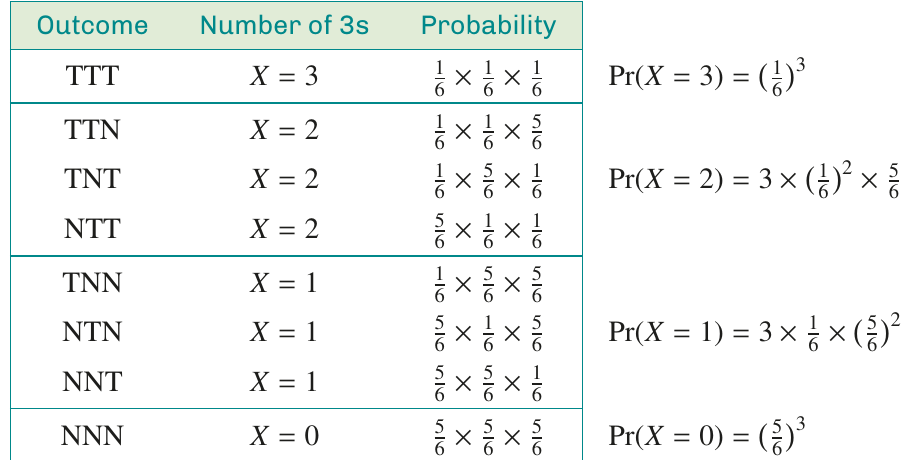
Notice the pattern in the probabilities. When we get exactly two 3s, there are three different ways this can happen (TTN, TNT, NTT), and each has the same probability. We can express this more efficiently:
The complete probability distribution looks like this:

Using combinations to count outcomes
We don't need to list every single outcome if we understand combinations. Consider when exactly one 3 is observed (). The single 3 could occur on the first, second, or third roll. This is equivalent to choosing 1 position from 3 available positions, which can be done in ways.
Similarly, when exactly two 3s are observed (), we're choosing 2 positions from 3 for the 3s to appear, which can be done in ways.
This leads us to a general formula for this specific example:
This is an example of a binomial probability distribution.
What makes an experiment binomial?
A binomial experiment has four essential properties:
Important
The Four Essential Properties of a Binomial Experiment:
-
Fixed number of trials: The experiment consists of identical trials.
-
Two outcomes per trial: Each trial results in exactly one of two outcomes, typically called:
- Success ()
- Failure ()
-
Constant probability: The probability of success on a single trial, denoted , remains the same for all trials. This means the probability of failure is for all trials.
-
Independence: The trials are independent, meaning the outcome of any trial doesn't affect the outcome of any other trial.
The binomial distribution formula
When we count the number of successes in trials of a binomial experiment, the random variable follows a binomial distribution.
The probability of exactly successes is given by:
where:
- = total number of trials
- = number of successes we're interested in
- = probability of success on a single trial
- = the number of ways to choose successes from trials
Note
Understanding the formula components:
- counts how many different ways we can get exactly successes
- is the probability of getting successes
- is the probability of getting failures
- We multiply these together to get the total probability
Worked example: rainfall in Melbourne
Example
Worked Example: Applying the Binomial Distribution
Problem: Rainfall records for Melbourne show that the probability of rain on any day in November is 0.4. Assuming rain on different days is independent, find the probability that rain falls on exactly three days in a chosen week.
Solution:
Define as the number of days with rain in a week.
We can identify this as a binomial experiment because:
- There are only two outcomes each day (rain or no rain)
- The probability of rain is constant (0.4)
- Days are independent
Therefore, follows a binomial distribution with and .
The probability formula becomes:
For exactly three days of rain:
Note: In this context, we're treating "rain" as a success, though the label doesn't imply any value judgement.
Using CAS calculators
Modern calculators can evaluate binomial probabilities quickly, which is especially useful for larger values of or when we need cumulative probabilities.
Calculator functions
Note
Binomial Pdf (Probability Distribution Function):
- Use this to find for a specific value of
- "Pdf" stands for probability distribution function
Note
Binomial Cdf (Cumulative Distribution Function):
- Use this to find for a range of values
- "Cdf" stands for cumulative distribution function
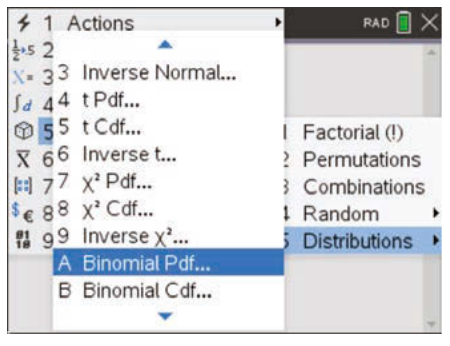
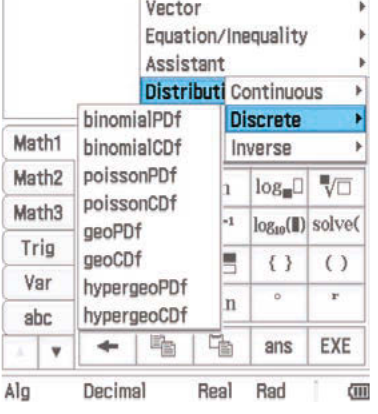
Extending the rainfall example with technology
Using the same scenario (7 days, probability 0.4):
a) Rain on exactly 3 days:
- Use Binomial Pdf with , ,
b) Rain on no more than 3 days:
- Use Binomial Cdf with , , lower bound = 0, upper bound = 3
c) Rain on at least 3 days:
- Use Binomial Cdf with , , lower bound = 3, upper bound = 7
Visualising binomial distributions
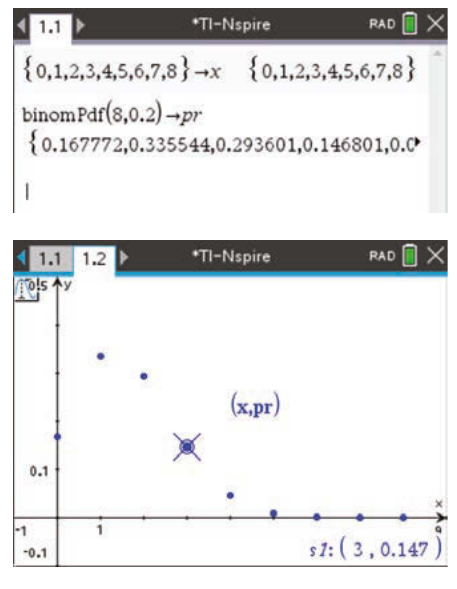
We can create graphs to visualise how probabilities are distributed across different values of .
For example, consider the distribution with and :
Note
The graph shows a scatter plot because is a discrete random variable (it can only take whole number values). Notice how the distribution is right-skewed when is small, with the highest probabilities occurring at lower values of .
Worked example: finding the minimum number of trials
Example
Worked Example: Finding Minimum Trials
Problem: The probability of winning a prize in a game of chance is 0.25. What is the least number of games that must be played to ensure the probability of winning at least twice is more than 0.9?
Solution:
This is a binomial experiment with . We need to find the smallest such that:
It's easier to work with the complement:
We can write:
Since and :
We need:
This equation cannot be solved algebraically, but we can solve it numerically using a CAS calculator. The solution shows that the game must be played 15 times to ensure the probability of winning at least twice exceeds 0.9.
Worked example: conditional probability with binomial distributions
Example
Worked Example: Conditional Probability with Binomial Distribution
Problem: The probability of an archer obtaining a maximum score from a shot is 0.4. Find the probability that out of five shots the archer obtains the maximum score:
a) exactly three times
b) exactly three times, given that she obtains the maximum score at least once
Solution:
Let be the number of maximum scores from five shots. Then has a binomial distribution with and .
Part a:
Part b:
This requires conditional probability. We need .
Using the conditional probability formula:
(correct to four decimal places)
Notice that the probability increases when we know at least one success has occurred, because this eliminates the possibility of zero successes.
Remember!
Summary
Key Points to Remember:
-
Sampling with replacement means the probability of success stays constant across all trials, like when tossing a coin or rolling a die.
-
A binomial experiment has four key properties: fixed number of trials (), two outcomes per trial, constant probability of success (), and independent trials.
-
The binomial distribution formula is: for
-
Use Binomial Pdf on your calculator to find the probability of exactly successes, and Binomial Cdf to find cumulative probabilities over a range of values.
-
Remember that in a binomial distribution, "success" is just a label for the outcome we're counting - it doesn't imply the outcome is desirable or positive.