Determining Rules for Graphs of Exponential and Logarithmic Functions (VCE SSCE Mathematical Methods): Revision Notes
📚Revision Notes
Determining Rules for Graphs of Exponential and Logarithmic Functions
When you're given a graph of an exponential or logarithmic function, you often need to find the rule that describes it. This process involves identifying the general form of the function and then using known points on the graph to determine the specific parameter values.
Understanding the general approach
Important
The key principle is that if you have two unknown parameters in your function rule, you need two points on the graph to find them. By substituting the coordinates of these points into the general form of the function, you create a system of two equations that you can solve simultaneously.
Exponential functions of the form
General form and parameters
The most common form for transformed exponential functions is:
where:
- controls the vertical stretch or compression
- represents the vertical shift (and gives the horizontal asymptote at )
Method for finding and
The following steps outline the systematic approach to finding parameters:
Step 1: Identify two points on the graph
Step 2: Substitute each point's coordinates into the general form to create two equations
Step 3: Solve the system of equations (often by subtraction to eliminate one variable)
Step 4: Find the other parameter by substitution
Example
Worked Example: Finding Parameters for an Exponential Function
Consider an exponential function with rule that passes through the points and .
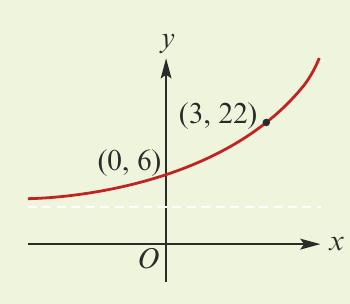
Substitute the first point :
Substitute the second point :
Subtract equation (1) from equation (2):
Substitute back into equation (1):
Therefore, the function has rule:
Logarithmic functions of the form
General form and parameters
For transformed logarithmic functions, the common form is:
where:
- controls the vertical stretch or compression
- represents the horizontal shift (the vertical asymptote occurs at )
Method for finding and
The approach is similar to exponential functions, but we use logarithmic properties to simplify.
Example
Worked Example: Finding Parameters for a Logarithmic Function
Consider a logarithmic function with rule that passes through the points and .
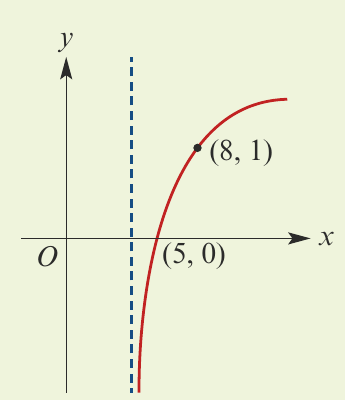
To find the values of and :
Substitute the first point :
Substitute the second point :
From equation (1):
Substitute into equation (2):
Therefore, the rule is:
Exponential functions of the form
Alternative exponential form
Sometimes exponential functions are written as:
This form is particularly useful for modelling growth and decay, where often represents time.
Note
When working with this form, division is often the most efficient method for solving the system of equations, as it eliminates the parameter and allows you to solve for directly.
Example
Worked Example: Finding Parameters Using Division Method
Given that with when and when , find and .
Substitute the first point :
Substitute the second point :
Divide equation (2) by equation (1):
Substitute back into equation (1):
Using the property :
Therefore, the rule is:
Note that this can also be written as:
Using technology to solve systems of equations
When solving systems of equations to find parameters, CAS calculators can be very helpful for checking your work and handling complex calculations efficiently.
TI-Nspire method
Navigate to: menu > Algebra > Solve System of Equations > Solve System of Equations
Enter your equations and the calculator will solve for the unknowns.
Important
Common Calculator Error to Avoid:
Don't use the 'e' from the alpha keys on your calculator, as it will be treated as a variable. Use the exponential function key instead to ensure correct calculations.
Casio ClassPad method
Select the simultaneous equations template, then enter your equations. Select from the Math1 keyboard and choose the parameters you're solving for from the Var keyboard.
Key tips for success
Note
Identifying the Correct Form
Look at the graph carefully to identify which form of function you're dealing with:
- Horizontal asymptote suggests (the asymptote is at )
- Vertical asymptote suggests logarithmic function (the asymptote is at )
Note
Using Special Points
Strategic point selection can simplify your calculations:
- For exponential functions, the -intercept (where ) is often helpful because
- For logarithmic functions, look for where (the -intercept) because this tells you when
Note
Essential Logarithmic Properties
Keep these properties in mind when solving:
- (because )
- for all
Note
Choosing Your Solution Method
You can solve systems by:
- Subtraction (to eliminate one variable)
- Division (particularly useful for exponential forms like )
- Using CAS calculator technology (for verification and complex systems)
Summary
Key Points to Remember:
- To find two unknown parameters, you need two points on the graph
- For , the parameter gives the horizontal asymptote
- For , the vertical asymptote is at
- When solving systems, look for efficient methods like division for exponential forms
- Use the property to simplify expressions
- CAS calculators can efficiently solve systems of equations, but ensure you're using the correct exponential function (not the variable 'e')