Graphs of Exponential Functions (VCE SSCE Mathematical Methods): Revision Notes
📚Revision Notes
Graphs of Exponential Functions
Introduction
Exponential functions create distinctive curved graphs that differ significantly from linear or polynomial functions. Understanding their shape and properties is essential for working with growth and decay models in mathematics and real-world applications.
There are two main types of exponential graphs to explore, determined by the value of the base.
Exponential growth: graphs of when
When the base of an exponential function is greater than 1, the graph displays exponential growth.
Example
Worked Example: Sketching
Let's plot the graph of by creating a table of values for .
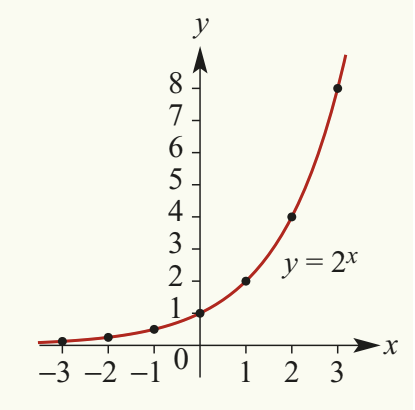
Notice how the y-values become very small (but positive) for negative x-values, and they increase rapidly as x becomes positive.
Key properties of exponential growth graphs
When examining graphs of the form where , several important features emerge:
Asymptotic behavior: As x takes increasingly large negative values, the y-values approach zero but never actually reach it. The graph gets closer and closer to the x-axis from above, making the x-axis a horizontal asymptote.
We write this as: As ,
Note
This notation means "as x approaches negative infinity, y approaches 0 from the positive side."
Increasing nature: As x-values increase, the y-values also increase. The function is always increasing across its entire domain.
Y-intercept: The graph always crosses the y-axis at the point (0, 1). This makes sense because for any positive base .
Domain and range:
- The domain is (all real numbers) - you can input any real value for x
- The range is (positive real numbers) - the output is always positive
Example
Worked Example: Sketching
Let's examine another exponential growth function with a larger base. For with :

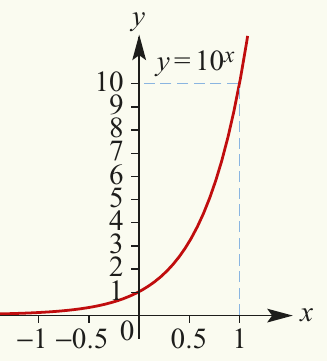
Observations:
- The x-axis remains an asymptote
- The y-intercept is still at
- As x increases, y increases
- For any given x-value, grows more rapidly than
Important
Larger bases produce steeper exponential growth. This is a key principle when comparing different exponential functions: the bigger the base (when ), the faster the function increases.
Relationship between different bases
All exponential functions with bases greater than 1 are related through horizontal dilations (stretches or compressions from the y-axis). For example, the graph of can be obtained from by applying a specific dilation factor from the y-axis.
Exponential decay: graphs of when
When the base lies between 0 and 1, the exponential function displays decay rather than growth.
Example
Worked Example: Sketching
Let's plot for . Note that this can also be written as .
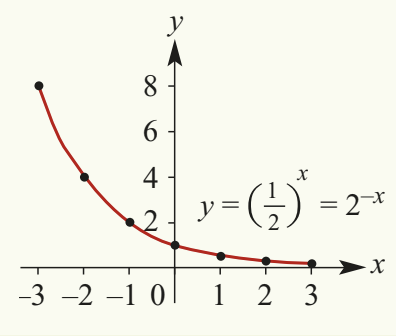
This graph slopes downward from left to right, opposite to the behavior when .
Key properties of exponential decay graphs
For graphs of the form where :
Asymptotic behavior: The x-axis is still a horizontal asymptote, but now the graph approaches it from above as x increases (rather than decreases).
We write: As ,
Decreasing nature: As x-values increase, the y-values decrease toward zero.
Y-intercept: The graph still passes through (0, 1).
Domain and range:
- Domain: (all real numbers)
- Range: (positive real numbers only)
General properties of exponential graphs
Comparing both types of exponential functions reveals their similarities and differences.
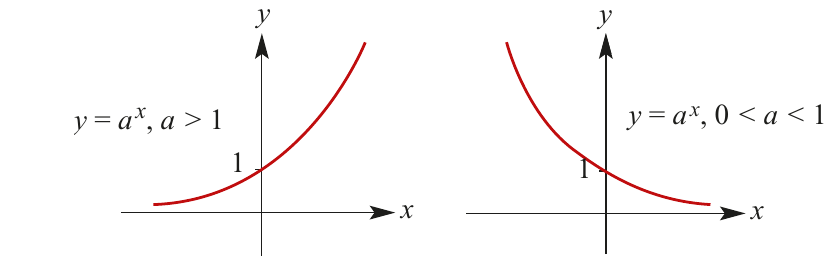
Note
Common features for all exponential functions (regardless of whether or ):
- The x-axis (line ) serves as a horizontal asymptote
- The y-intercept is always at
- The y-values are always positive - the graph never crosses or touches the x-axis
- There is no x-intercept
- The domain is
- The range is
Reflection relationship
An important connection exists between exponential growth and decay functions. For any exponential function, we can express as where .
For example, if and , then:
Important
This means the graph of is the reflection of in the y-axis, and vice versa.
Using technology to analyze exponential graphs
Graphing calculators provide powerful tools for investigating exponential functions in detail.
Finding specific coordinate values
Example
Worked Example: Finding y when x = 2.1
For the function , find the value of y when .
Using a graphing calculator:
- Plot the graph of
- Use the trace or evaluate function to find the point where
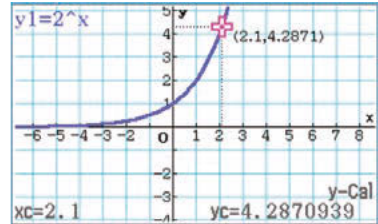
The result shows that when , (correct to three decimal places).
Finding intersection points
Example
Worked Example: Finding x when y = 9
For the function , find the value of x when .
Approach:
- Plot both and the horizontal line on the same screen
- Find their intersection point
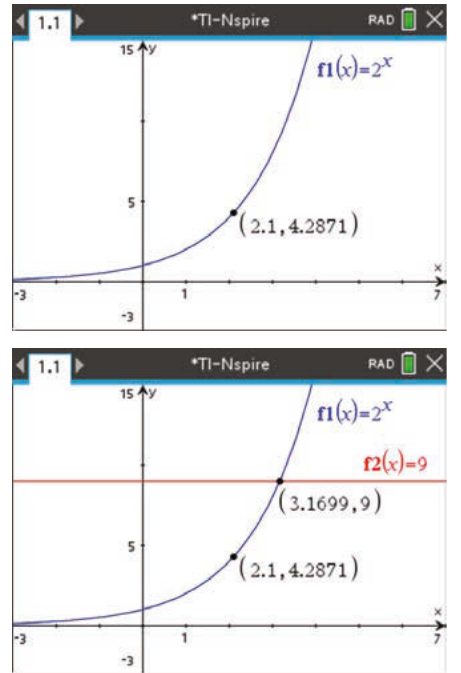
The calculator shows that when , (correct to three decimal places).
This technique is particularly useful for solving exponential equations graphically.
Transformations of exponential graphs
Exponential functions can be transformed using the same techniques applied to other function types: translations, dilations, and reflections.
Vertical translations
Adding a constant to an exponential function shifts the graph vertically and moves the asymptote.
Example
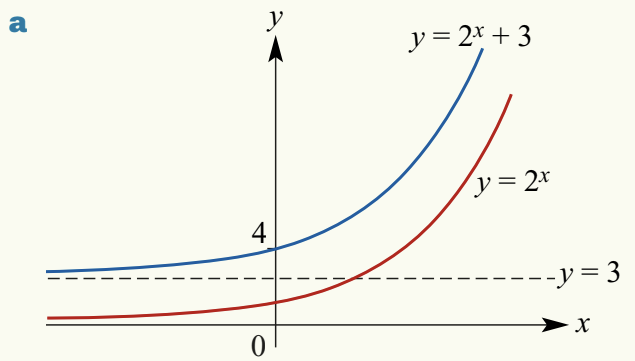
Worked Example: Vertical Translation
Compare and
The graph of is obtained by translating upward by 3 units.
Key features of :
- Asymptote: (shifted from )
- Y-intercept: since
- Range:
Vertical dilations
Multiplying an exponential function by a constant stretches or compresses it vertically.
Example
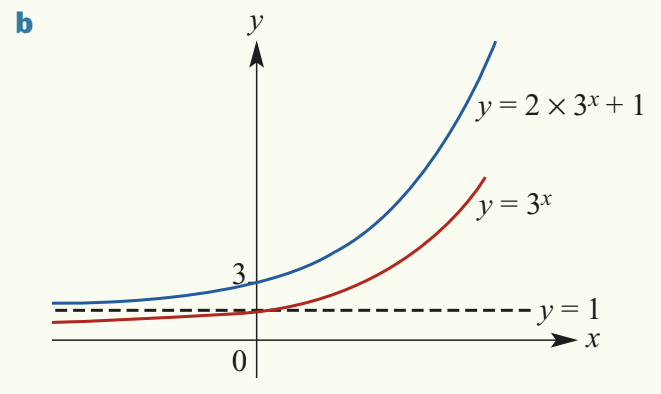
Worked Example: Vertical Dilation and Translation
Compare and
The graph of involves two transformations:
- Vertical dilation by factor 2 from the x-axis
- Vertical translation upward by 1 unit
Key features of :
-
Asymptote: (the translation affects the asymptote)
-
Y-intercept: since
-
Range:
Reflections in the x-axis
Multiplying by reflects the graph in the x-axis and reverses the range.
Example
Worked Example: Reflection in the x-axis
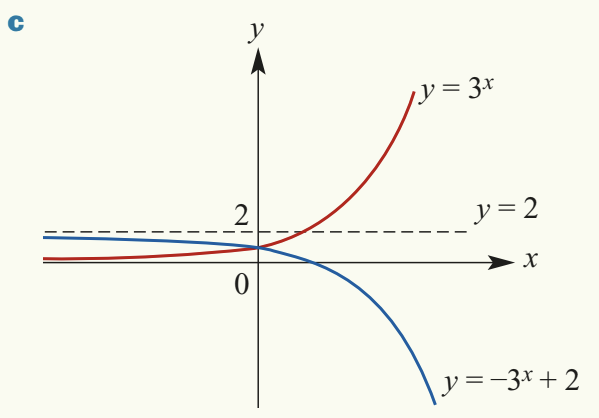
Compare and
The graph of is obtained through:
- Reflection in the x-axis (the negative sign)
- Vertical translation upward by 2 units
Key features of :
-
Asymptote: (shifted from )
-
Y-intercept: since
-
Range: (note the range is now bounded above instead of below)
Horizontal dilations
Modifying the exponent creates horizontal compressions or stretches.
Example
Worked Example: Horizontal Dilation
Compare and
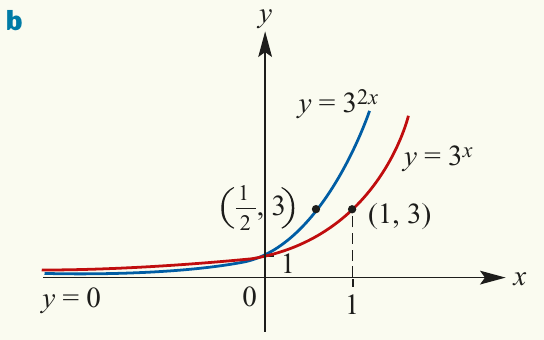
Both graphs share:
- The same asymptote:
- The same y-intercept:
However, increases more rapidly because the exponent is doubled.
Combined transformations
Multiple transformations can be applied in sequence.
Example
Worked Example: Multiple Transformations
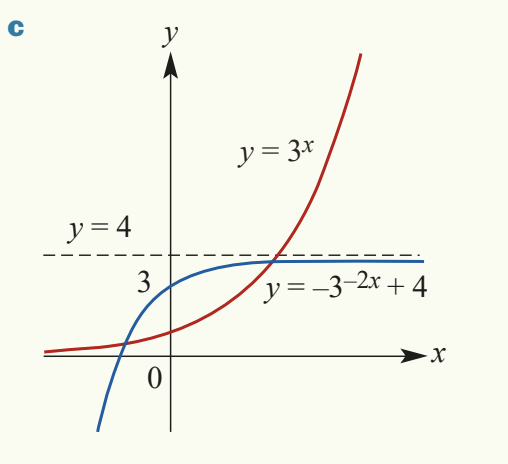
Sketch
Starting from , apply these transformations in order:
- Horizontal dilation by factor from the y-axis (giving )
- Reflection in the y-axis (giving )
- Reflection in the x-axis (giving )
- Vertical translation upward by 4 units (giving )
Key features:
-
Asymptote:
-
Range:
Important
The order of transformations matters when combining multiple changes to a function. Always apply transformations in the correct sequence to obtain the desired result.
Summary
Key Points to Remember:
- All exponential graphs of the form pass through the point (0, 1)
- For , the graph shows exponential growth (increasing from left to right)
- For , the graph shows exponential decay (decreasing from left to right)
- The x-axis is always a horizontal asymptote; exponential functions are always positive
- Larger bases (when ) produce steeper growth curves
- The graph of is the reflection in the y-axis of the graph
- Transformations affect the asymptote: vertical translations shift it, but horizontal transformations don't