Solving Exponential Equations and Inequalities (VCE SSCE Mathematical Methods): Revision Notes
📚Revision Notes
Solving Exponential Equations and Inequalities
Introduction
Exponential equations and inequalities are equations where the unknown variable appears in the exponent (or index). This note covers several methods for solving these types of problems, from algebraic techniques to using technology.
Note
Understanding exponential equations is crucial for many applications in science, finance, and real-world modeling. The techniques covered here build on your knowledge of indices and provide the foundation for logarithms.
Method 1: Using the same base
The most fundamental method for solving exponential equations is to express both sides of the equation using a common base. Once both sides have the same base, you can equate the exponents.
Key principle: If , then x = y (where )
This works because exponential functions are one-to-one - each output corresponds to exactly one input.
Example
Worked Example: Solving by Using the Same Base
Find the value of for which:
Part a:
Part b:
Part c:
Important
Exam tip: When solving exponential equations, always look for a common base first. Remember that , , , , , , etc.
Method 2: Using quadratic substitution
Sometimes exponential equations can be solved by first converting them into quadratic equations through substitution. This is particularly useful when the equation contains terms like and .
When to use this method:
- When you have an equation involving both a^(2x) and a^x
- When you can rewrite the equation in the form (a^x)^2 + ba^x + c = 0
Example
Worked Example: Solving Using Quadratic Substitution
Solve:
Part a:
We can rewrite this equation noting that
We have
Let . The equation becomes:
Therefore:
or
or
Hence or
and so x = 1 or x = 2
Part b:
We have
Let . The equation becomes:
Therefore:
or
Hence or
There is only one solution, x = 1, since for all values of .
Important
Always remember that exponential expressions are always positive. This means for all real values of (when ). Any solution that gives a negative value for the exponential expression must be rejected.
Using technology for approximate solutions
When equations cannot be solved algebraically to give exact solutions (such as ), calculators can provide accurate decimal approximations.
Example
Worked Example: Using a Calculator for Approximate Solutions
Solve correct to two decimal places.
The exact solution involves logarithms (covered in the next section), but we can find an approximate answer using a calculator.
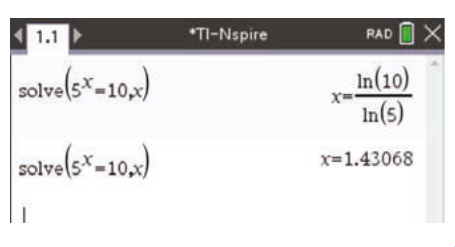
The solution is x = 1.43 (correct to two decimal places).
Note
Calculator tip: Most CAS calculators have a "solve" function that can handle exponential equations. You may need to convert the exact answer to a decimal approximation using the appropriate button or command.
Solving exponential inequalities
Exponential inequalities require special care because the direction of the inequality depends on whether the base is greater than or less than 1.
Key properties for inequalities
When solving inequalities of the form :
-
If : then
The inequality direction stays the same.
-
If : then
The inequality direction reverses.
Important
Why does this happen?
- When the base is greater than 1, the exponential function is increasing, so larger exponents give larger values
- When the base is between 0 and 1, the exponential function is decreasing, so larger exponents give smaller values
Example
Worked Example: Solving Exponential Inequalities
Solve for in each of the following:
Part a:
First, express both sides using the same base (base 2):
Since the base is 2 (which is greater than 1), the inequality direction stays the same:
Part b:
First, express both sides using the same base:
Since the base is 2 (which is greater than 1), the inequality direction stays the same:
Note: When dividing or multiplying both sides of an inequality by a negative number, remember to reverse the inequality sign.
Note
Visualization technique: You can use a CAS calculator to help visualize inequalities. For example, plot the graphs of and , then find the point of intersection. The solution to is where the graph of is above the line .
Remember!
Summary
Key Points to Remember:
-
Same base method: When solving , you can immediately conclude that (provided and ). Always try to express both sides using a common base first.
-
Quadratic substitution: For equations involving both and , substitute to create a quadratic equation. Don't forget to check your solutions - reject any that give negative values for the exponential expression.
-
Calculator for approximations: When exact solutions aren't required or involve logarithms, use a calculator to find decimal approximations. Always check the required level of accuracy.
-
Inequality direction: For exponential inequalities, the direction depends on the base. When , the inequality direction stays the same. When , the inequality direction reverses.
-
Always positive: Remember that for all real when . This is crucial when checking solutions to quadratic substitutions.