Using Logarithms to Solve Exponential Equations and Inequalities (VCE SSCE Mathematical Methods): Revision Notes
📚Revision Notes
Using Logarithms to Solve Exponential Equations and Inequalities
Understanding the fundamental relationship
When working with exponential equations and inequalities, logarithms provide a powerful tool for finding solutions. The key principle is the equivalence between exponential and logarithmic forms.
Note
For any positive number where , the following statements mean exactly the same thing:
- (exponential form)
- (logarithmic form)
This equivalence works because logarithms are defined as the inverse operation of exponentiation. When you see an exponential equation, you can immediately rewrite it as a logarithmic equation, and vice versa.
This relationship is the foundation for solving all exponential equations and inequalities.
Solving exponential equations
Method 1: Converting to logarithmic form
The most direct way to solve an exponential equation is to convert it to logarithmic form using the equivalence principle above.
Example
Worked Example: Simple exponential equation
Find the value of in the equation .
Solution:
Converting to logarithmic form gives us:
We can calculate this using a calculator:
This method is straightforward and works well when you have access to a calculator that can compute logarithms with different bases.
Method 2: Using the change of base formula
An alternative approach uses common logarithms (base 10) along with a useful formula called the change of base formula. This method is particularly helpful when your calculator only has buttons for or natural logarithms.
Using the same equation , we apply the logarithm base 10 to both sides:
Using the power law of logarithms, we bring down the exponent:
Solving for :
This demonstrates that:
Important
The change of base formula
In general, for any positive numbers , , and where and :
This formula allows you to convert any logarithm to a base you can work with (usually base 10 or base ). The numerator is the logarithm of the number you're interested in, and the denominator is the logarithm of the original base.
Worked example: Equations with expressions in the exponent
Example
Worked Example: Exponential equation with expression in exponent
Find the value of in the equation .
Solution:
Converting to logarithmic form:
When the exponent contains an expression like , we first convert to logarithmic form, then solve the resulting linear equation for .
Solving exponential inequalities
Exponential inequalities follow similar principles to equations, but we must be careful about the direction of the inequality sign.
The crucial rule about inequality direction
Important
Critical Rule: When to reverse inequality signs
When solving inequalities involving exponentials, the direction of the inequality sign depends on the base:
- If the base is greater than 1, the inequality direction stays the same
- If the base is between 0 and 1, the inequality direction reverses
Why this happens:
- When the base is greater than 1, larger exponents give larger values
- When the base is between 0 and 1, larger exponents give smaller values
Worked example: Inequality with base less than 1
Example
Worked Example: Inequality with fractional base
Solve the inequality .
Method 1: Using common logarithms
Apply the logarithm base 10 to both sides:
Now we divide both sides by . Because is negative (since ), the inequality sign flips:
Method 2: Direct conversion
We can also solve this by recognizing that . As decreases, increases (the function is decreasing). Therefore, the inequality holds for .
Both methods give the same answer, but Method 2 is more efficient once you understand the behaviour of exponential functions with bases less than 1.
Summary of inequality rules
Note
Pattern for exponential inequalities:
When base :
(inequality direction unchanged)
When base :
(inequality direction reversed)
Application to exponential graphs
Now that we can use logarithms, we can find exact -intercepts for exponential graphs. Previously, we could only estimate these intercepts or describe them as "somewhere between" certain values.
Finding intercepts using logarithms
When sketching exponential graphs, we typically need to find:
- The equation of any horizontal asymptote
- The -intercept (by substituting )
- The -intercept (by setting and solving)
The -intercept now requires logarithms to solve exactly.
Worked example: Complete graph sketch
Example
Worked Example: Sketching an exponential graph
Sketch the graph of , giving the equation of the asymptote and the axis intercepts.
Solution:
Finding the asymptote:
As , we have , so .
The equation of the horizontal asymptote is .
Finding the -intercept:
When :
The -intercept is at .
Finding the -intercept:
Set :
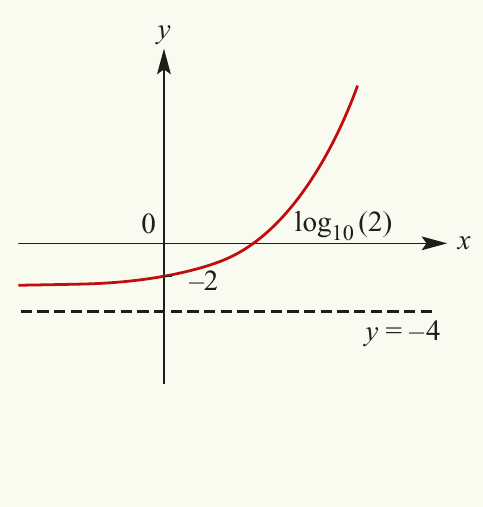
The graph crosses the -axis at exactly , crosses the -axis at , and has a horizontal asymptote at .
Key takeaways
Summary
Remember these essential points:
-
Equivalence principle: - use this to convert between exponential and logarithmic forms
-
Change of base formula: - use this to calculate logarithms with any base using base 10 or base
-
Inequality direction: When solving inequalities, flip the inequality sign if the base is between 0 and 1, or if you divide by a negative number
-
Finding -intercepts: Logarithms allow us to find exact -intercepts of exponential graphs by solving equations like
-
Always check your work: Substitute your answer back into the original equation to verify it's correct