Applications of Functions (VCE SSCE Mathematical Methods): Revision Notes
📚Revision Notes
Applications of Functions
Introduction
In real-world situations, we often need to create mathematical functions to model practical scenarios. This section focuses on using function notation to solve problems involving real-life contexts such as pricing structures, geometric shapes, and optimisation situations. When working with applications, it's crucial to consider not just the mathematical rule, but also the domain - ensuring our function makes sense in the physical context of the problem.
Note
Understanding the domain is essential in real-world applications. Unlike pure mathematical functions where we might consider all real numbers, practical problems have physical constraints that limit which values make sense. Always ask yourself: "What values of x are actually possible in this real-world scenario?"
Piecewise Functions in Real-World Contexts
Sometimes a function follows different rules over different intervals. These are called piecewise functions, and they're particularly useful for modelling situations where rates or conditions change at certain thresholds. Common examples include pricing structures with different rates for different quantities, tax brackets, and shipping costs.
Example
Worked Example: Taxi Fare
Problem: The cost of a taxi trip in a particular city is $1.75 up to and including 1 km. After 1 km, the passenger pays an additional 75 cents per kilometre. We need to find the function that describes this payment method and sketch the graph of .
Solution:
Let represent the length of the trip in kilometres.
For trips up to and including 1 km, the cost is simply $1.75 (a flat rate).
For trips longer than 1 km, we need to add 75 cents for each kilometre beyond the first kilometre.
The additional distance beyond 1 km is kilometres.
The additional cost is dollars.
The total cost is the initial $1.75 plus this additional amount.
Therefore, the cost in dollars is given by the piecewise function:
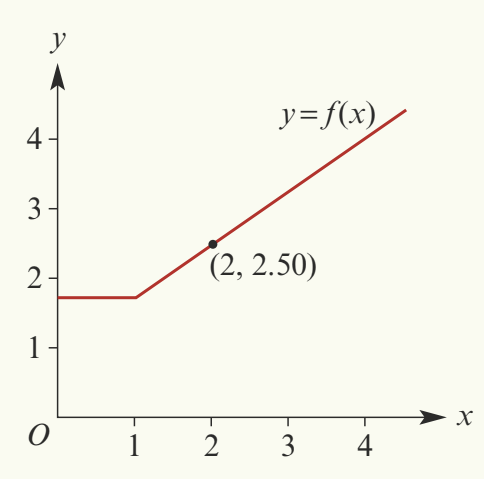
The graph shows a horizontal line segment at for , then continues as a straight line with positive gradient for . Notice that when , the cost is dollars, as shown by the point .
Important
When writing piecewise functions, make sure to:
- Clearly define the intervals for each piece using inequality notation
- Check that the function is defined for all values in the domain
- Verify that the pieces connect properly at boundary points (if continuity is required)
Volume Functions with Geometric Constraints
When creating functions from geometric situations, we must carefully consider the physical constraints that determine the domain. These constraints ensure that all dimensions remain positive and that the shape can actually be formed.
Example
Worked Example: Box Volume
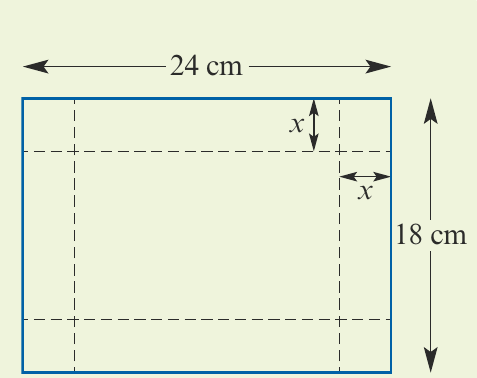
Problem: A rectangular piece of cardboard has dimensions 18 cm by 24 cm. Four squares, each cm by cm, are cut from the corners. An open box is formed by folding up the flaps. Find a function that gives the volume of the box in terms of , and state the domain of the function.
Solution:
When we cut out squares of side length from each corner and fold up the flaps, we create a box.
The length of the box becomes: (we remove from each end)
The width of the box becomes: (we remove from each side)
The height of the box is: (the size of the square we cut out)
The volume of a box is length × width × height, so:
Now we need to determine the domain by considering what values of make physical sense.
For the box to be formed, all dimensions must be non-negative:
From the first inequality:
From the second inequality:
From the third inequality:
The most restrictive upper bound is (since we need all three conditions to be satisfied).
Therefore, the domain of is .
Note
When determining domains for volume problems, remember that all physical dimensions (length, width, height) must be positive or zero. This means you need to solve inequalities for each dimension and find where all conditions are satisfied simultaneously.
Area Functions Using Similar Triangles
In problems involving inscribed shapes, we often need to use geometric relationships such as similar triangles to express one variable in terms of another. This technique is essential when we want to write an area or volume function in terms of a single variable.
Example
Worked Example: Rectangle Inscribed in Triangle
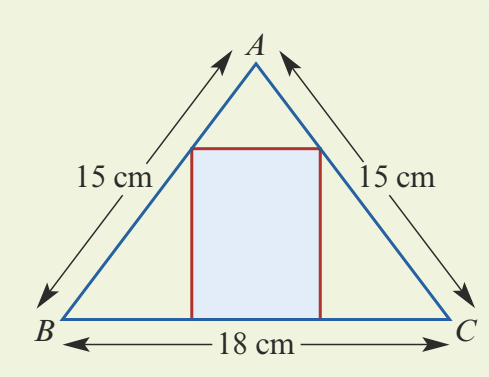
Problem: A rectangle is inscribed in an isosceles triangle with the dimensions shown below. Find an area function for the rectangle and state the domain.
Solution:
Let the height of the rectangle be cm and the width be cm.
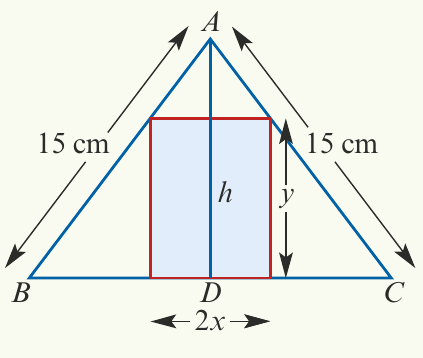
First, we need to find the height of the triangle. The base of the triangle is 18 cm, so the distance from the centre to either vertex B or C is 9 cm. The triangle is isosceles with slant heights of 15 cm.
Using Pythagoras' theorem:
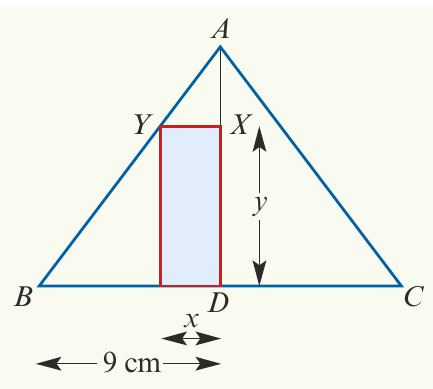
Now we need to relate and . Notice that triangle is similar to triangle (they share angle A and both have right angles).
For similar triangles, corresponding sides are in proportion:
Cross-multiplying:
The area of the rectangle is length × width:
Substituting our expression for :
Expanding:
Factoring:
For the rectangle to be formed, we need both and .
From :
Combined with , the domain is .
Therefore, the complete function is: ,
Important
When using similar triangles:
- Identify which triangles are similar by checking for equal angles
- Set up proportions using corresponding sides
- Make sure the ratios are written correctly (matching sides in numerators and denominators)
- Rearrange to express one variable in terms of the other before creating your main function
Summary
Key Points to Remember:
-
Piecewise functions use different rules for different intervals - make sure to specify the conditions clearly for each piece
-
Domain restrictions in applications come from physical constraints - always check that your mathematical domain makes sense in the real-world context
-
When working with geometric problems, identify relationships between variables using properties like similar triangles or Pythagoras' theorem
-
For volume and area functions, ensure all dimensions remain positive to determine the appropriate domain
-
Similar triangles have corresponding sides in proportion - use this to relate variables in inscribed shape problems