Composite Functions (VCE SSCE Mathematical Methods): Revision Notes
📚Revision Notes
Composite Functions
What is a composite function?
Think of a function like a machine that processes inputs to create outputs. The input values form the domain, and the output values form the range.
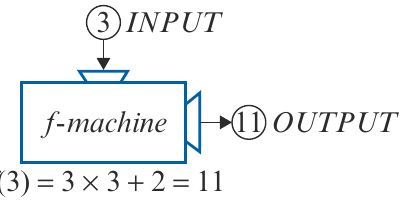
Note
The function machine analogy helps visualize how functions work: you feed in an input value, the machine processes it according to a rule, and out comes the output value. This visual model becomes especially useful when we start combining multiple functions together.
In many real-world situations, we need multiple operations to get from an input to a final output. When we apply one function and then apply another function to that result, we create a composite function.
For example, imagine you have:
- Function
- Function
If you put an input through first and then put that output through , you're creating a composite function. Using input :
- First,
- Then,
This creates a new function where .
Understanding composite function notation
When we combine functions in this way, we write it as g ∘ f, which we read as "the composition of followed by " or simply " of ".
Important
Read the notation from right to left!
In , you apply first, then apply to the result. This is the opposite of the order you might expect from reading left to right, so it's a common source of confusion.
The rule for the composite function is written as:
This means: take the input , apply function to get , then apply function to that result.
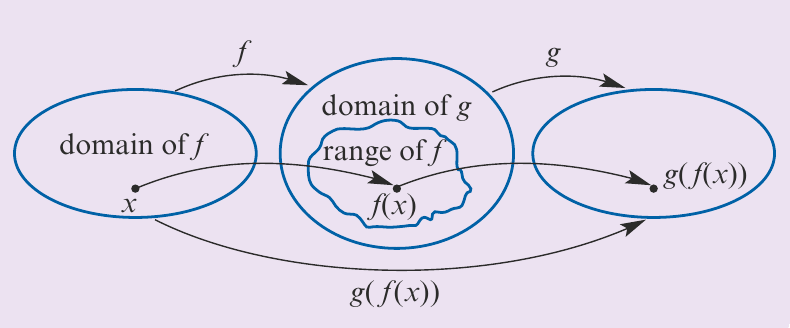
Conditions for composite functions to exist
Not all pairs of functions can be composed. For to exist, we need a crucial condition:
Important
The range of must be a subset of the domain of
In mathematical notation: ran f ⊆ dom g
This makes sense when you think about it - the outputs from need to be valid inputs for . If produces an output that can't accept as input, the composition won't work.
When the composite function exists, its domain is:
The domain of the composite function is the same as the domain of the first function applied.
Finding composite functions
To find a composite function, follow these steps:
- Check that the range of the first function fits within the domain of the second function
- Substitute the entire rule of the first function into the second function
- Simplify the resulting expression
- Determine the domain and range of the composite function
Example
Worked Example: Finding and Comparing Composite Functions
Find both and , stating the domain and range of each, where:
, and ,
Solution:
First, check if the compositions are defined by examining domains and ranges:
| Function | Domain | Range |
|---|---|---|
Since and , both and are defined.
Finding :
Finding :
Key observation: Notice that . The functions and are completely different! This shows that composite functions are not commutative - the order matters.
When composite functions aren't defined
Sometimes only one of the two possible compositions will be defined, or neither may be defined. Understanding why a composition fails to exist helps you recognize when function domains and ranges are incompatible.
Example
Worked Example: Identifying When Compositions Exist
For the functions , , and , :
a) State which of and is defined.
b) For the composite function that is defined, state the domain and rule.
Solution:
a) Check the domains and ranges:
| Function | Domain | Range |
|---|---|---|
For : We need
The range of is all real numbers, but the domain of only includes non-negative numbers. Since the range of is NOT a subset of the domain of , the composition is not defined.
For : We need
The range of is , and the domain of is . Since non-negative numbers are a subset of all real numbers, is defined.
b) Finding :
Function restrictions
Sometimes we need to restrict the domain of a function to make a composition work. This technique allows us to "fix" situations where ranges and domains don't naturally align.
Example
Worked Example: Restricting Functions for Valid Composition
For the functions , , and , :
a) State why is not defined.
b) Define a restriction of such that is defined, and find .
Solution:
a) Check domains and ranges:
| Function | Domain | Range |
|---|---|---|
The range of includes negative values (from upwards), but can only accept non-negative inputs. Since , the composition is not defined.
b) For to work, we need .
This means the range of must only include non-negative values. Looking at the graph of , the function equals zero when and is positive when or .
To ensure the range is non-negative, we restrict the domain to:
So we define by:
,
Then:
The composite function is: ,
Summary
Key Points to Remember:
- A composite function combines two functions: apply the first function, then apply the second function to that result
- The notation means "apply first, then " - read from right to left
- For to exist, the range of must be a subset of the domain of : ran f ⊆ dom g
- In general, - order matters in function composition
- The domain of equals the domain of :
- Sometimes you need to restrict a function's domain to make a composition possible