Inverse Functions (VCE SSCE Mathematical Methods): Revision Notes
📚Revision Notes
Inverse Functions
What is an inverse function?
An inverse function reverses the effect of the original function. If function takes an input and produces output , then the inverse function takes as input and produces as output.
However, not every function has an inverse. For an inverse function to exist, the original function must be one-to-one. This means that each output value corresponds to exactly one input value.
Note
A function is one-to-one if it passes the horizontal line test - any horizontal line intersects the graph at most once. This ensures that each output corresponds to exactly one input.
Definition: If is a one-to-one function, we can define its inverse by:
Important
The notation does not mean . It represents the inverse function, not the reciprocal. These are two completely different concepts!
Geometric interpretation
The relationship between a function and its inverse has a beautiful geometric property. A point lies on the graph of if and only if the point lies on the graph of . In other words, the coordinates are swapped.
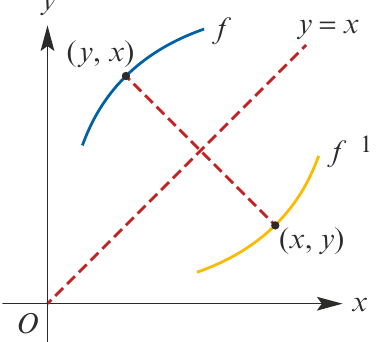
This means that to obtain the graph of from the graph of , you reflect the graph of across the line .
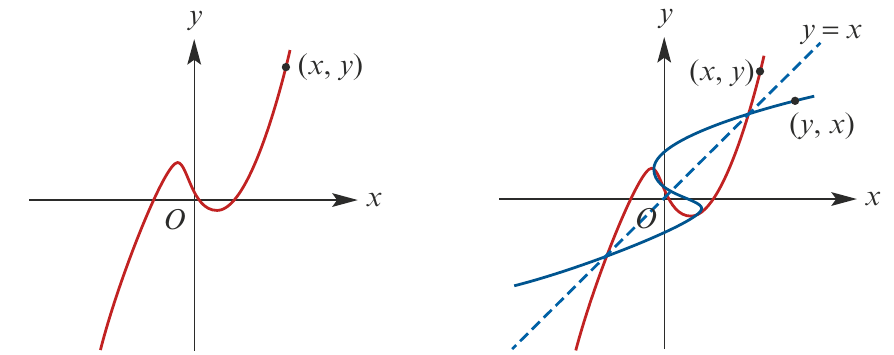
Note
Visual interpretation: Think of the line as a mirror. The graph of the inverse function is the mirror image of the original function across this diagonal line.
Domain and range relationships
The domain and range swap between a function and its inverse:
Note
This swap makes intuitive sense: the input values of the inverse are the output values of the original function, and vice versa. When finding an inverse, always identify the range of the original function to determine the domain of the inverse.
Composition properties
When you compose a function with its inverse, you get back the original input value:
Note
This property confirms that the inverse function truly undoes what the original function does. It's like pressing "undo" - you get back to where you started. This composition property is often used as an alternative method for finding inverse functions.
Finding inverse functions algebraically
There are two main methods for finding inverse functions:
Method 1: Interchange and solve
Step 1: Write the function equation as
Step 2: Interchange and to get
Step 3: Solve this equation for
Step 4: Replace with
Step 5: Determine the domain of (which equals the range of )
Method 2: Use composition
This method uses the property that .
Step 1: Set up the equation
Step 2: Substitute the rule for and solve for
Step 3: Determine the domain of
Note
Which method to choose? Method 1 (interchange and solve) is usually more straightforward and works well for most functions. Method 2 (composition) can be faster for simple functions and provides good practice with function composition.
Worked examples
Example
Worked Example: Linear function
Find the inverse function of the function .
Solution using Method 1:
The graph of has equation .
Interchange and :
Therefore and .
Solution using Method 2:
We require such that
Thus and .
Example
Worked Example: Functions with restricted domains
Find the inverse of each function, stating the domain and range:
a)
Solution:
Let . Interchange and :
Therefore
b)
Solution:
Let . Interchange and :
Therefore
c)
Solution:
Let . Interchange and :
Therefore
The positive square root is taken because the range of must equal the domain of , which is .
Important
When dealing with functions involving squares or square roots, pay careful attention to domain restrictions. The domain restriction determines which sign (positive or negative) to choose when taking square roots.
Graphing inverse functions
Reflection property
The graph of an inverse function is obtained by reflecting the original function's graph across the line . This reflection transforms every point on the original graph to the point on the inverse graph.
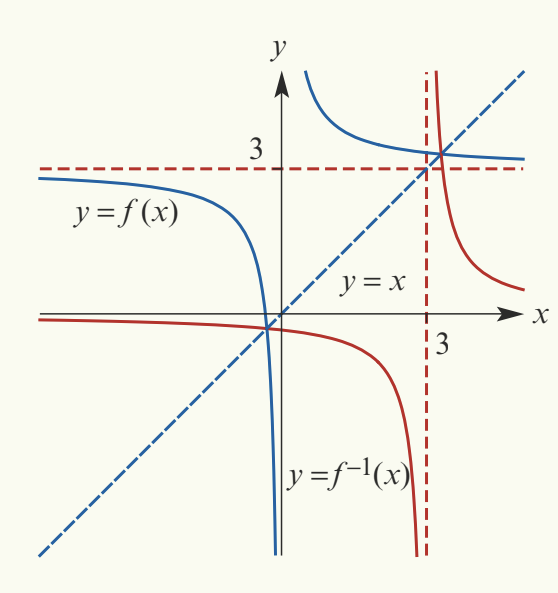
Note
When graphing a function and its inverse together, always include the line to show the line of symmetry. This makes the reflection relationship visually clear.
Finding intersection points
The graphs of and can intersect at points on the line (where ) and potentially at other points as well.
To find intersections on the line , solve .
To find all intersections, solve .
Example
Worked Example: Graphing a rational function and its inverse
Find the inverse of the function and sketch both functions, showing their points of intersection.
Solution:
Let . Then:
The inverse function is
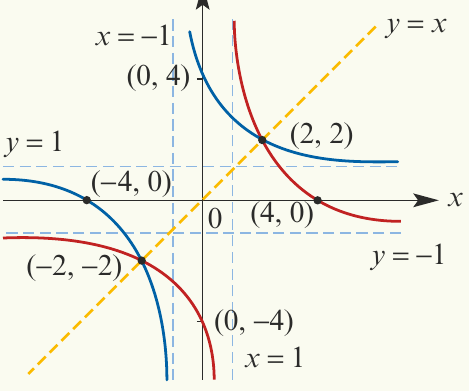
To find intersections, solve :
The points of intersection are and .
Note
Exam tip: You can often find intersection points more easily by solving rather than . Points on the line automatically satisfy both and have equal coordinates.
Example
Worked Example: Cube root function
Find the inverse of the function and sketch both functions.
Solution:
Consider and solve for :
The domain of equals the range of :
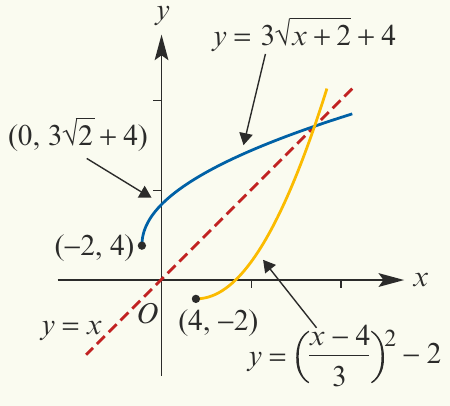
Which can also be written as:
Using technology
Modern calculators and software can help find and graph inverse functions.
Finding the inverse rule: Use the solve function to solve the equation for .
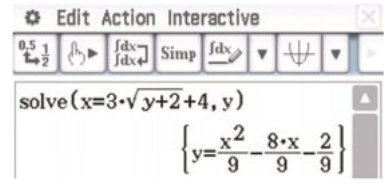
Graphing the inverse: Many graphing calculators have a built-in feature to graph the inverse of a function by reflection.
Example
Worked Example: Rational function in transformed form
Express in the form . Hence find the inverse of the function and sketch both functions.
Solution:
Consider and solve for :
The range of is , so:
The graphs meet where (for ), which gives .
The graphs intersect at (2, 2) and (-2, -2).
Note
For rational functions, expressing them in transformed form (like ) can make finding the inverse much easier. This form clearly shows the transformations applied to the basic reciprocal function.
Functions requiring domain restriction
Some functions are not one-to-one over their natural domain. To find an inverse, we must first restrict the domain to make the function one-to-one.
Example
Worked Example: Reciprocal squared function
Let be the function for . Define a suitable restriction of such that exists, and find .
Solution:
The function is not one-to-one because, for example, .
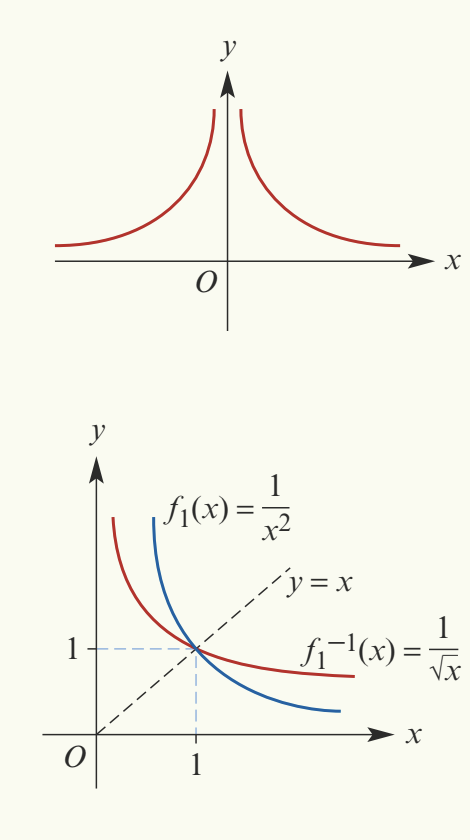
We can create one-to-one restrictions:
with range
with range
Let's find the inverse of :
Since , we take the positive square root:
Therefore
Important
When restricting the domain of a function to create a one-to-one function, choose the restriction based on the context of the problem. Common choices include:
- Restricting to positive values only or
- Restricting to negative values only or
- Choosing the principal branch for trigonometric functions
Summary
Remember! Key Points About Inverse Functions:
-
A function has an inverse if and only if it is one-to-one (passes the horizontal line test)
-
The domain and range swap: and
-
The graph of is the reflection of the graph of across the line
-
To find an inverse algebraically: interchange and , then solve for
-
The notation means inverse function, not reciprocal
-
When solving for inverses involving square roots, the domain restriction determines which sign to choose