One-to-One Functions and Implied Domains (VCE SSCE Mathematical Methods): Revision Notes
📚Revision Notes
One-to-One Functions and Implied Domains
One-to-one functions
A function is a special type of relationship where each -value maps to only one -value. But some functions have an additional property called being one-to-one.
A function is one-to-one when different x-values always produce different y-values. In mathematical terms, a function is one-to-one if whenever , then for all in the domain of .
Note
Another way to think about this: a one-to-one function cannot have two different ordered pairs that share the same second coordinate (the same -value). This is a useful way to check one-to-one functions when they're given as sets of ordered pairs.
Important
Common Mistake to Avoid:
Don't confuse the definition of a function with the definition of a one-to-one function. ALL functions require each to map to only one , but one-to-one functions go further — they also require each to come from only one .
Worked example
Example
Worked Example: Determining One-to-One Functions from Sets
Determine which of the following functions is one-to-one:
a)
b)
Solution:
a) This function is not one-to-one.
Looking at the ordered pairs, both and map to .
Since two different -values produce the same -value, the function fails the one-to-one test.
b) This function is one-to-one.
Each -value maps to a unique -value:
No two different -values share the same -value, so the function is one-to-one.
Horizontal-line test
Just as the vertical-line test determines whether a relation is a function, there's a visual test to check if a function is one-to-one.
Horizontal-line test: If any horizontal line drawn through the graph of a function intersects the graph at most once, then the function is one-to-one.
This test works because if a horizontal line crosses the graph more than once, it means multiple -values produce the same -value, violating the one-to-one property.
Important
Remember the Distinction:
- Vertical-line test → checks if a relation is a function
- Horizontal-line test → checks if a function is one-to-one
Don't mix these up!
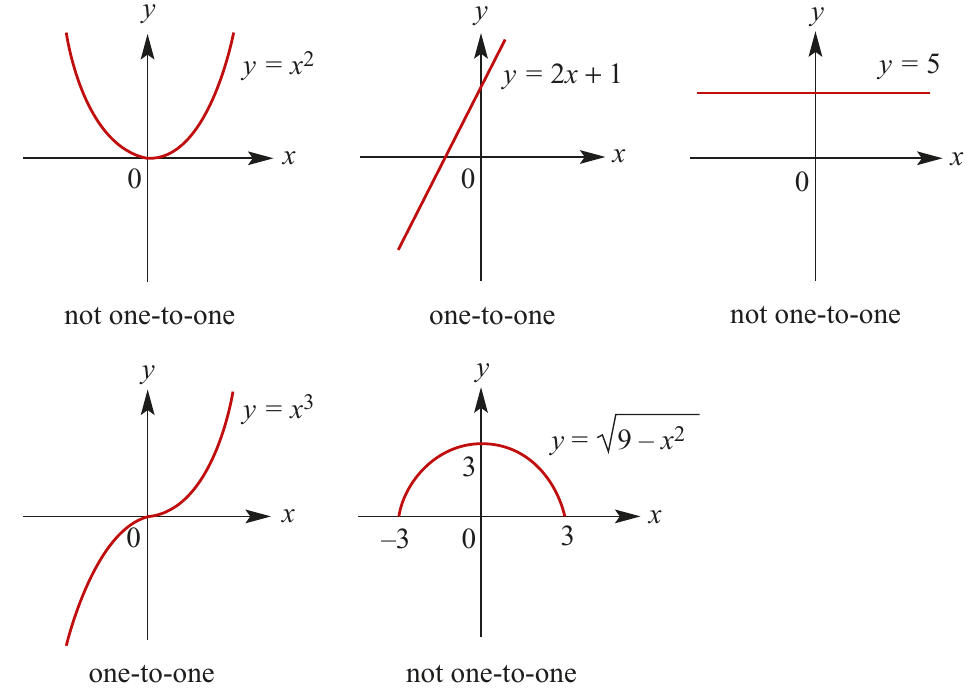
Let's examine these examples:
- (parabola): Not one-to-one — a horizontal line crosses it twice
- (linear): One-to-one — any horizontal line crosses it only once
- (horizontal line): Not one-to-one — this is itself a horizontal line
- (cubic): One-to-one — any horizontal line crosses it only once
- (semicircle): Not one-to-one — a horizontal line can cross it twice
Implied (maximal) domain
When a function is defined by a rule but no domain is explicitly stated, we need to find the implied domain (also called the maximal domain). This is the set of all real numbers for which the function rule makes mathematical sense.
Note
Different types of functions have different domain restrictions based on their mathematical properties. Understanding these restrictions is essential for working with functions correctly.
Common domain restrictions include:
- Polynomial functions like have implied domain (all real numbers) — no restrictions
- Square root functions like have implied domain because you cannot take the square root of negative numbers
- Rational functions have restrictions where the denominator cannot equal zero
Worked example
Example
Worked Example: Finding Implied Domains and Ranges
State the implied domain, sketch the graph and find the corresponding range of each function:
a)
b)
Solution:
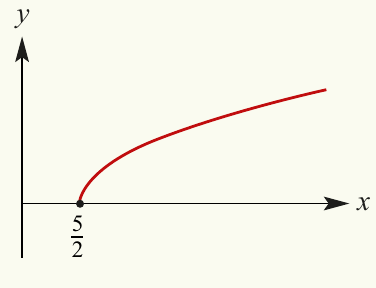
a) For to be defined, the expression under the square root must be non-negative.
We need:
The implied domain is [].
Since the function is a square root function starting at , the minimum value is , and the function increases without bound.
The range is [].
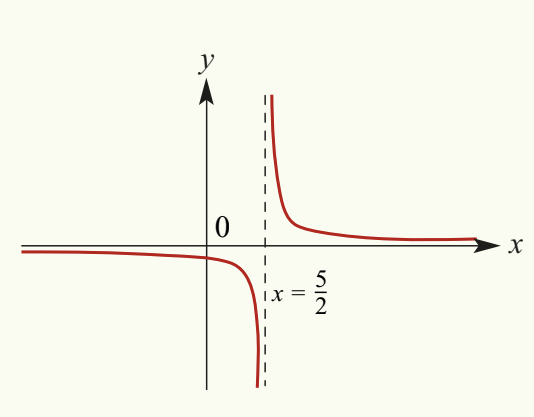
b) For to be defined, the denominator cannot equal zero.
We need:
The implied domain is .
This is a rational function with a vertical asymptote at . As approaches this value from either side, the function approaches positive or negative infinity. However, the function can never equal zero (there's a horizontal asymptote at ).
The range is .
Remember!
Summary
Key Points to Remember:
-
A function is one-to-one when different -values always produce different -values (if , then ).
-
Use the horizontal-line test to determine if a function is one-to-one: if any horizontal line crosses the graph at most once, the function is one-to-one.
-
The implied domain is the set of all real numbers for which a function's rule has meaning — find it by identifying what values make the function undefined (like negative numbers under square roots or zeros in denominators).
-
For square root functions, ensure the expression under the root is greater than or equal to zero.
-
For rational functions, ensure the denominator is never equal to zero.