Piecewise-Defined Functions (VCE SSCE Mathematical Methods): Revision Notes
📚Revision Notes
Piecewise-Defined Functions
What are piecewise-defined functions?
A piecewise-defined function applies different mathematical rules to different parts of its domain. These functions are also known as hybrid functions.
Instead of using a single rule across the entire domain, piecewise-defined functions break the domain into separate intervals, with each interval having its own specific rule or formula. This allows us to model situations where behaviour changes at certain points.
Note
Piecewise-defined functions are particularly useful for modelling real-world situations where behaviour changes at certain thresholds, such as:
- Tax brackets that apply different rates to different income levels
- Shipping costs that change based on package weight
- Pricing structures with volume discounts
Graphing piecewise-defined functions
To sketch a piecewise-defined function, you need to graph each piece separately over its specified domain interval.
Key steps:
- Identify each rule and its corresponding domain interval
- Sketch each piece individually, paying attention to the domain restrictions
- Check the endpoints carefully - determine whether they should be included (closed circle) or excluded (open circle)
- Ensure the overall graph shows all pieces correctly connected
Important
Watch for whether the inequalities include the equals sign ( or ) or not ( or ). This determines whether endpoints are filled in or left open.
Common mistake: Forgetting to check endpoint inclusion can lead to incorrectly drawn graphs and wrong range determinations.
Worked example: Linear piecewise function
Example
Worked Example: Graphing a Linear Piecewise Function
Consider the function:
Task: Sketch the graph and state the range.
Solution:
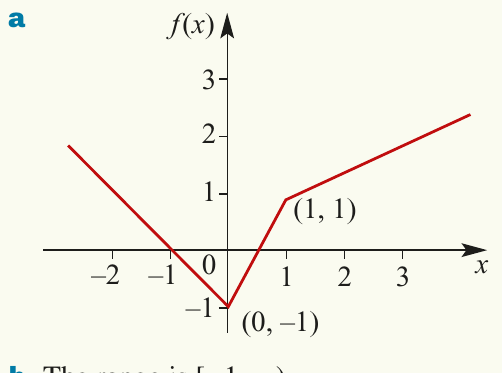
To create this graph:
First piece: For , we use the rule
This is a straight line with slope and -intercept at
We graph this line only for -values less than
At , the function value would be , but this point is not included (shown by an open circle)
Second piece: For , we use the rule
This is a straight line with slope and -intercept at
When , we get (this endpoint is included, shown by a closed circle at )
When , we get (this endpoint is also included, shown by a closed circle at )
Third piece: For , we use the rule
This is a straight line with slope and -intercept at
We graph this line only for -values greater than
At , the function value would be , but this point belongs to the previous piece (shown by an open circle here)
Range: By examining the graph, we can see that the lowest -value is (which is included), and the function continues upward indefinitely. Therefore, the range is .
Worked example: Mixed piecewise function
Example
Worked Example: Graphing a Mixed Piecewise Function
Consider the function:
Task: Sketch the graph and state the range.
Solution:
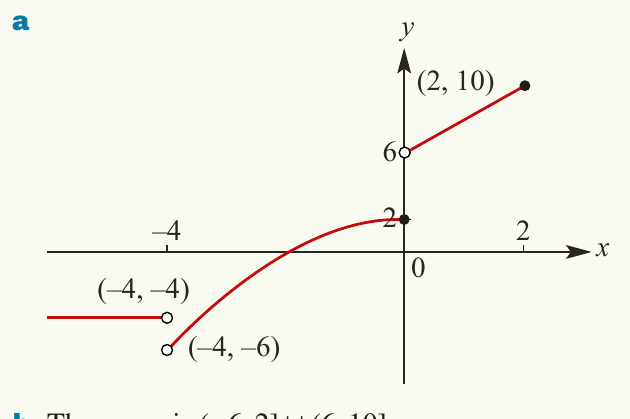
To create this graph:
First piece: For , we use the rule
This is a horizontal line at
We draw this line only for -values less than
At , there is an open circle at since this point is not included
Second piece: For , we use the rule
This is a downward-opening parabola
At , the value is (open circle at )
At , the value is (closed circle at )
Third piece: For , we use the rule
This is a straight line with slope
At , the value would be (open circle at - note the discontinuity)
At , the value is (closed circle at )
Range: This function has gaps in its -values. Looking at the graph:
The second piece covers values from just above up to and including :
The third piece covers values from just above up to and including :
Therefore, the range is (using union notation to combine the intervals).
Note
Notice how this function has a discontinuity at . The function "jumps" from to , creating a gap in the range. This is why we need union notation to express the range - it consists of two separate intervals.
Remember!
Summary
Key Points to Remember:
- Piecewise-defined functions use different rules for different parts of their domain - think of them as "switching" between different formulas at specified points
- Always check the inequality symbols carefully: or means open circle (point not included), while or means closed circle (point included)
- To sketch the graph, draw each piece separately over its specified domain interval
- The range is found by examining all -values that the complete graph covers - look for gaps or discontinuities
- When stating the range, use interval notation and union symbols () to join separate intervals if needed