Power Functions (VCE SSCE Mathematical Methods): Revision Notes
📚Revision Notes
Power Functions
Introduction
Power functions are mathematical functions with the form , where is a rational number. These functions appear frequently in mathematics and have different properties depending on the value and type of the exponent.
Examples of power functions include:
- (even positive integer power)
- (even negative integer power)
- (fractional power - fourth root)
- (odd positive integer power)
- (odd negative integer power)
- (fractional power - cube root)
Note
The behaviour of these functions varies significantly based on whether the exponent is positive or negative, odd or even, and whether it is an integer or a fraction.
Increasing and decreasing functions
Understanding whether a function is increasing or decreasing is fundamental to analysing power functions.
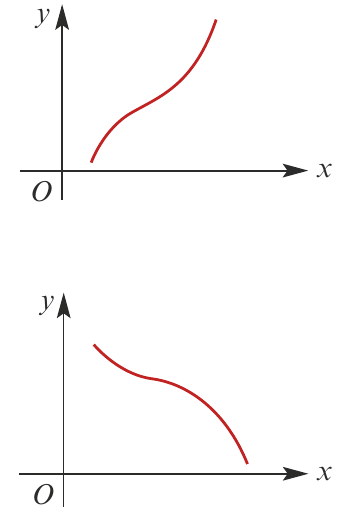
Strictly increasing functions
A function is strictly increasing on an interval when larger input values always produce larger output values. Mathematically, this means:
Important
If , then
Examples of strictly increasing functions:
- Any straight line with a positive gradient
- The function (on the non-negative domain)
Strictly decreasing functions
A function is strictly decreasing on an interval when larger input values always produce smaller output values. Mathematically, this means:
Important
If , then
Examples of strictly decreasing functions:
- Any straight line with a negative gradient
- The function (on the non-positive domain)
Power functions with positive integer index
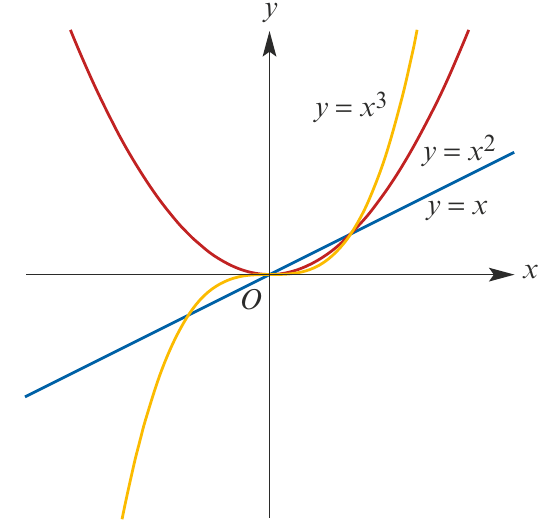
When we have where is a positive integer, the graph's shape depends critically on whether n is odd or even.
The simplest cases are familiar:
- : Linear function
- : Quadratic function
- : Cubic function
Functions with odd positive integer powers
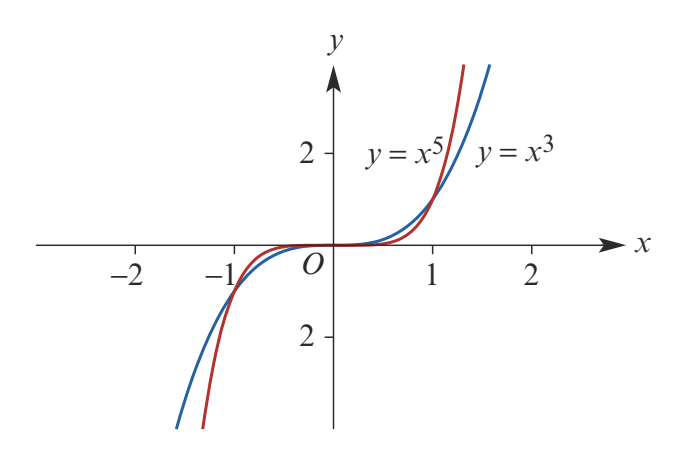
For where is an odd positive integer (such as ), the function has these important properties:
Domain and range:
- Maximal domain: All real numbers ()
- Range: All real numbers ()
Key properties:
- The function is odd, meaning it has rotational symmetry about the origin:
- The function is strictly increasing across its entire domain
- The function is one-to-one (each output corresponds to exactly one input)
- Special values: , , and
- As , we have
- As , we have
Note
The graphs show that as the power increases (from to ), the curve becomes steeper away from the origin and flatter near the origin.
Functions with even positive integer powers
For where is an even positive integer (such as ), the function has these important properties:
Domain and range:
- Maximal domain: All real numbers ()
- Range: Non-negative real numbers ()
Key properties:
- The function is even, meaning it has reflective symmetry about the y-axis:
- The function is strictly increasing for
- The function is strictly decreasing for
- Special values: , , and
- As , we have
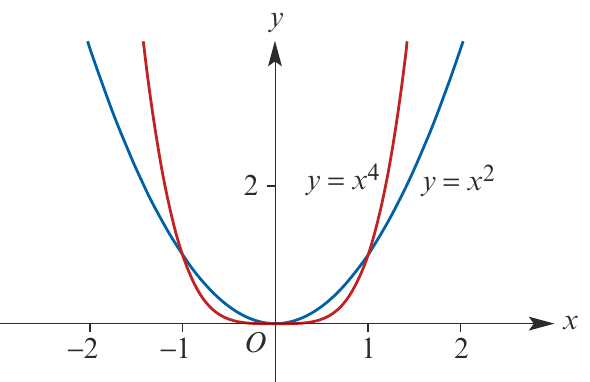
The graphs create U-shaped parabolas. Higher even powers produce curves that are flatter near the origin and steeper further from the origin.
Important
The function is strictly increasing on the interval and strictly decreasing on the interval .
Power functions with negative integer index
Power functions with negative integer exponents are reciprocal functions. Their behaviour also depends on whether the index is odd or even.
Functions with odd negative integer powers
For where is an odd negative integer, we can write for
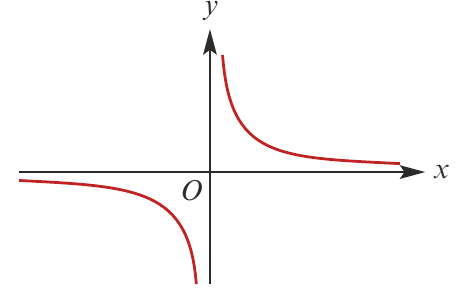
The simplest case is , which creates a rectangular hyperbola.
Domain and range:
- Maximal domain: (all real numbers except zero)
- Range: (all real numbers except zero)
Key properties:
- The function is odd:
- There is a horizontal asymptote with equation (the x-axis)
- There is a vertical asymptote with equation (the y-axis)
Note
The graph has two separate branches: one in the first quadrant (where both and are positive) and one in the third quadrant (where both are negative).
Example
Worked Example: Evaluating and graphing
Question: For the function with rule :
a) State the maximal domain and corresponding range
b) Evaluate: (i) (ii) (iii) (iv)
c) Sketch the graph
Solution:
a) The maximal domain is and the range is .
b) Evaluating the function at different values:
(i)
(ii)
(iii)
(iv)
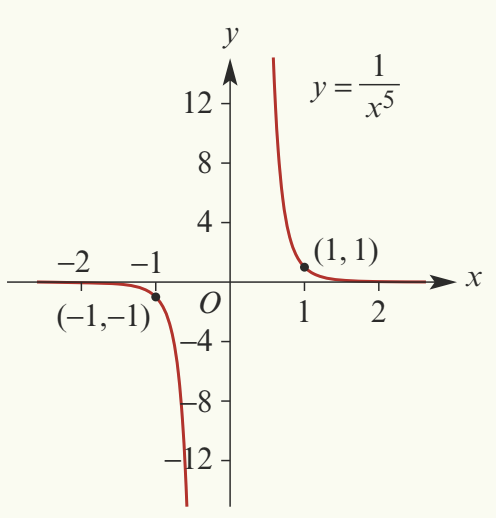
c) The graph is a hyperbola with two branches, passing through the points and , with asymptotes at both axes.
Example
Worked Example: Comparing and
Question: Let and .
a) Find the values of for which
b) Sketch both graphs on the same set of axes
Solution:
a) Setting the functions equal:
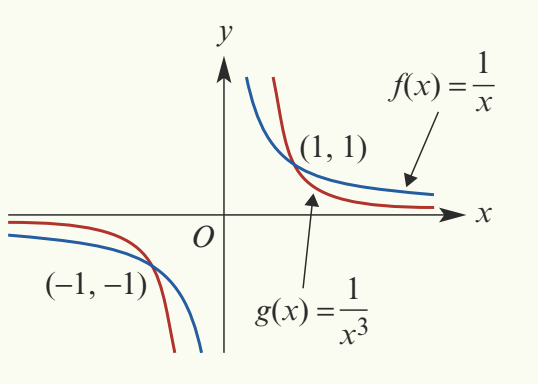
b) Both graphs are hyperbolas passing through and with asymptotes at both axes.
Note
Relationship between the curves:
The relationship between the curves changes depending on the region:
- When : , so
- When : , so
- When : , so
- When : , so
Functions with even negative integer powers
For where is an even negative integer, we can write for
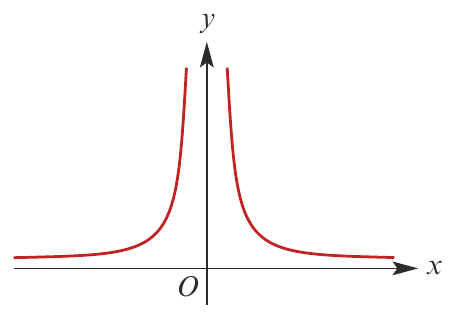
The simplest case is .
Domain and range:
- Maximal domain: (all real numbers except zero)
- Range: (positive real numbers only)
Key properties:
- The function is even:
- There is a horizontal asymptote with equation (the x-axis)
- There is a vertical asymptote with equation (the y-axis)
Important
Unlike odd negative powers, even negative powers produce graphs that are entirely above the x-axis, with symmetry about the y-axis.
Power functions with fractional index
When we have where is a positive integer, we are dealing with root functions.
Definition of fractional powers
For a positive real number and natural number , the expression represents the th root of . This is the positive number whose th power equals .
We can write this in two equivalent ways:
Examples:
- because
- because
Note
Special case: We define for each natural number , since .
Negative bases: When is odd, we can also define for negative values of . In this case, is the number whose th power equals .
For example: because
Graphs of root functions
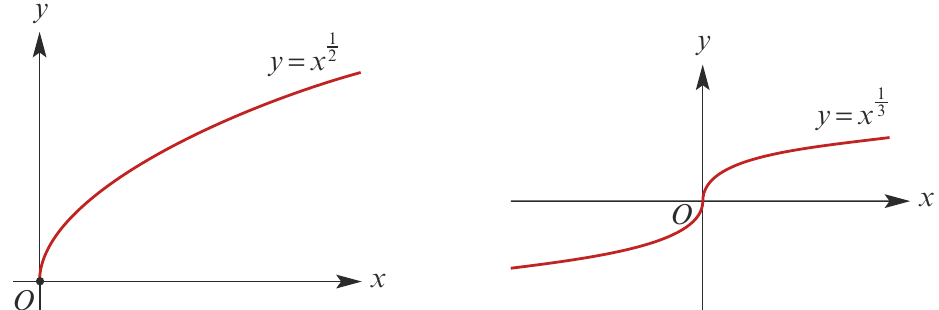
The domain of depends on whether is even or odd:
- When is even: maximal domain is (non-negative numbers only)
- When is odd: maximal domain is (all real numbers)
Note
The square root function only exists for non-negative values and increases gradually. The cube root function exists for all real numbers and passes through the origin with an S-shaped curve.
Example
Worked Example: Comparing root functions
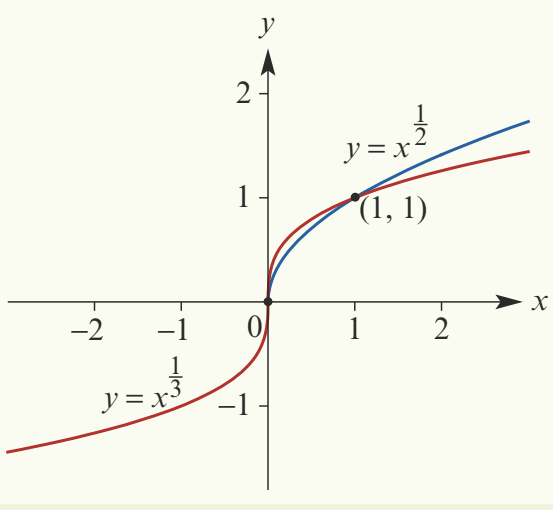
Question: Let and .
a) Find the values of for which
b) Sketch both graphs on the same set of axes
Solution:
a) Setting the functions equal:
b) Both functions pass through the origin and the point . The cube root function extends into negative values of , while the square root function is only defined for non-negative values.
Inverses of power functions
Power functions with odd positive integer exponents are strictly increasing across all real numbers, which makes them one-to-one functions. This means they have inverse functions.
Important property
An important mathematical result states:
Important
If is an odd positive integer, then is strictly increasing for all real numbers.
The proof of this involves showing that for any two values , we always have by considering various cases based on whether the values are positive, negative, or zero.
Inverse of odd functions
Another key property relates to odd functions:
Important
If is an odd one-to-one function, then is also an odd function.
This can be proved by showing that if , then from the odd property of , we get , which implies .
Because of this property, when is odd, the function is an odd function.
Example
Worked Example: Finding inverse functions
Question: Find the inverse of each of the following functions:
a)
b)
c)
d)
Solution:
a) For :
Write
Interchange and :
Solve for :
Therefore,
b) For :
Note that has range . Therefore has domain and range .
Write
Interchange and :
Solve for :
Since the range is , we take the negative root.
Therefore, []
c) For :
Write
Interchange and :
Solve for :
Therefore,
d) For :
Note that has range . Therefore has domain and range .
Write
Interchange and :
Solve for :
Since the range is , we take the positive root.
Therefore,
Remember!
Summary
Key Points to Remember:
-
Power functions have the form where is a rational number. Their behaviour depends critically on whether is positive/negative, odd/even, and integer/fractional.
-
Odd positive integer powers () create S-shaped curves that pass through the origin, are strictly increasing everywhere, and extend from to in both directions.
-
Even positive integer powers () create U-shaped parabolas that are symmetric about the y-axis, have a minimum at the origin, and are only non-negative.
-
Negative integer powers () create hyperbolas with asymptotes at both the x-axis and y-axis. Odd powers have two branches in opposite quadrants; even powers have two branches both above the x-axis.
-
Fractional powers () represent root functions. Even roots are only defined for non-negative numbers, while odd roots work for all real numbers.