Set Notation and Sets of Numbers (VCE SSCE Mathematical Methods): Revision Notes
📚Revision Notes
Set Notation and Sets of Numbers
Introduction to sets
A set is a collection of objects. The objects contained within a set are called elements or members of the set. Set notation provides a standardised way to describe and work with collections of mathematical objects.
Note
Set notation is fundamental to mathematics and provides a precise language for describing collections of objects. Mastering this notation will help you communicate mathematical ideas clearly and understand advanced mathematical concepts.
Element notation
When we want to indicate that a particular object belongs to a set, we use specific notation:
- If is an element of set , we write
- This can also be read as " is a member of set " or " belongs to "
- If is not an element of set , we write
For example, if , then but .
Subsets
A set is called a subset of set if every element of is also an element of . We write this as .
This expression can also be read as " is contained in " or " contains ".
Example
Understanding Subsets
Let and . Then because all elements of are also in .
We can verify this by checking each element:
- and ✓
- and ✓
- and ✓
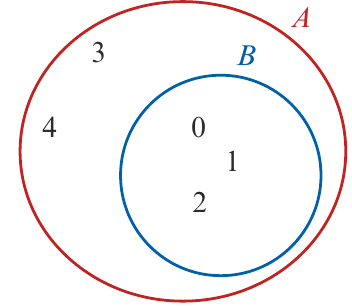
In the Venn diagram above, we can see that , , and .
Intersection of sets
The intersection of two sets and is the set of elements that are common to both sets. We denote this by .
Formally, if and only if and .
Important
If sets and have no elements in common, we say they are disjoint, and write , where is called the empty set.
Union of sets
The union of sets and is the set of elements that are in or in (or in both). We denote this by .
Note
The key difference between intersection and union:
- Intersection (): Elements must be in both sets
- Union (): Elements must be in at least one set
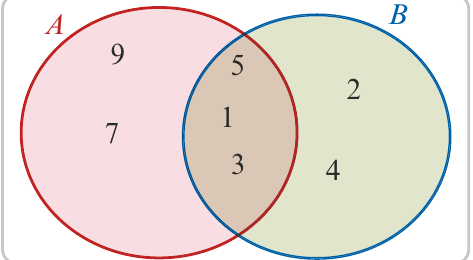
For example, let and . Then:
- (the common elements)
- (all elements from both sets)
Example
Worked Example: Finding Intersection and Union
For and , find:
a)
The elements and appear in both sets.
b)
The union contains all elements that belong to or (or both).
Set difference
The set difference of two sets and is given by:
The set contains the elements of that are not elements of .
Example
Worked Example: Finding Set Differences
For and , find:
a)
The elements and are in but not in .
b)
The elements , , and are in but not in .
Important
Notice: and are generally not the same! Set difference is not commutative.
Sets of numbers
Mathematics uses several important sets of numbers, each with its own notation and properties.
Natural numbers
The natural numbers are the counting numbers:
We denote the set of natural numbers by .
Integers
The integers include all whole numbers, both positive and negative, as well as zero:
We denote the set of integers by .
Note
The symbol comes from the German word "Zahlen," which means "numbers."
Rational numbers
Rational numbers are numbers that can be expressed as a fraction , where and are integers and .
We denote the set of rational numbers by .
An important characteristic of rational numbers is that they can be written as either terminating decimals (like or ) or recurring decimals (like or ).
Note
The symbol comes from the word "quotient," since rational numbers are quotients of integers.
Irrational numbers
Irrational numbers are real numbers that cannot be expressed as a fraction of two integers. Examples include and .
Important
Irrational numbers have decimal expansions that neither terminate nor repeat. For example, continues forever without any repeating pattern.
Real numbers
The real numbers include all rational and irrational numbers. We denote the set of real numbers by .
The hierarchy of number sets
These number sets form a hierarchy where each set is contained within the next:
Important
Understanding the Hierarchy:
- Every natural number is an integer ()
- Every integer is a rational number ()
- Every rational number is a real number ()
- But NOT every real number is rational (irrational numbers exist!)
This relationship can be visualised as follows:
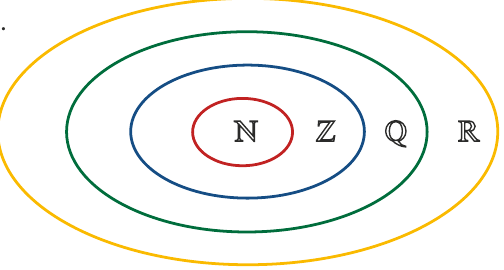
The diagram shows that natural numbers are a subset of integers, integers are a subset of rationals, and rationals are a subset of real numbers.
Describing sets using set-builder notation
When listing all elements of a set is impractical or impossible (particularly for infinite sets), we use set-builder notation. This notation uses the format , which reads as "the set of all such that condition holds".
Note
Set-builder notation provides a powerful and concise way to describe sets by specifying the properties their elements must satisfy, rather than listing every element.
Examples include:
- is the set of all real numbers strictly between and
- is the set of all real numbers greater than or equal to
- is the set of all positive rational numbers
- is the set of all non-negative even numbers
- is the set of all non-negative odd numbers
Interval notation
Among the most important subsets of are the intervals. Intervals represent continuous ranges of real numbers and use special notation involving brackets and parentheses.
For real numbers and where :
| Interval notation | Set-builder notation | Description |
|---|---|---|
| Open interval (excludes both endpoints) | ||
| Closed interval (includes both endpoints) | ||
| Half-open interval (excludes , includes ) | ||
| Half-open interval (includes , excludes ) | ||
| Infinite interval (all numbers greater than ) | ||
| Infinite interval (all numbers greater than or equal to ) | ||
| Infinite interval (all numbers less than ) | ||
| Infinite interval (all numbers less than or equal to ) |
Important
Bracket Notation Rules:
- Round brackets or exclude the endpoint (open)
- Square brackets or include the endpoint (closed)
- Infinity symbols ( and ) always use round brackets because infinity is not a real number
Visual representation of intervals
Intervals can be represented on number lines. The following conventions are used:
Note
Number Line Conventions:
- A closed circle (•) indicates that the number is included in the interval
- An open circle (◦) indicates that the number is not included in the interval
Special notation for real numbers
The following subsets of real numbers have special notation:
- Positive real numbers:
- Negative real numbers:
- Real numbers excluding zero:
Summary
Key Points to Remember:
- Element notation: Use to show is an element of set , and to show it is not
- Subset: means every element of is also in
- Intersection (): Contains only elements that appear in both sets
- Union (): Contains all elements from either set (or both)
- Set difference (): Contains elements in but not in
- Number hierarchy: (natural numbers ⊂ integers ⊂ rationals ⊂ real numbers)
- Interval notation: Round brackets or exclude endpoints, square brackets or include endpoints
- Set-builder notation: describes sets by specifying properties that elements must satisfy