Sums and Products of Functions (VCE SSCE Mathematical Methods): Revision Notes
📚Revision Notes
Sums and Products of Functions
Combining functions
When working with functions, we can create new functions by adding or multiplying them together. This is useful for analyzing complex relationships and for sketching graphs.
Sum of functions
If we have two functions and , we can add them to create a new function called f + g. To find the value of this new function at any point , we simply add together the values of and .
Formal definition:
Product of functions
Similarly, we can multiply two functions to create a product function . At any point , we multiply the values and together.
Formal definition:
Domain considerations
An important aspect of combining functions is determining where the new function is defined. Both and must be defined for the sum or product to exist.
Important
The domain of and the domain of is the intersection of the individual domains. This means both functions must be defined at that -value for the combination to exist.
The symbol means "intersection" - the values that belong to both domains.
Example
Worked Example: Combining Square Root Functions
Let's say we have for all and for all .
Step 1: Find the domain
First, we need to find where both functions are defined. The function requires and requires . The intersection of these domains is .
Step 2: Finding the sum
The domain is .
To evaluate at :
Step 3: Finding the product
The domain is .
To evaluate at :
Addition of ordinates
Addition of ordinates is a powerful graphical technique for sketching the sum of two functions. An ordinate is simply the y-value of a point on a graph. By adding the -values of two functions at each -value, we can construct the graph of .
Note
This technique works well with other graphing methods like finding intercepts, stationary points, and asymptotes. It's particularly useful when you can't easily simplify the algebraic form of the sum.
Example
Worked Example: Addition of Ordinates with Linear Functions
Let's sketch and , then use addition of ordinates to sketch .
Step 1: Find the rule for the sum
Step 2: Verify using ordinates
At any point, we can verify that the ordinate of equals the sum of the ordinates of and .
For example, at :
- ✓
Step 3: Create a table of values
We can create a table of values to help us plot points:
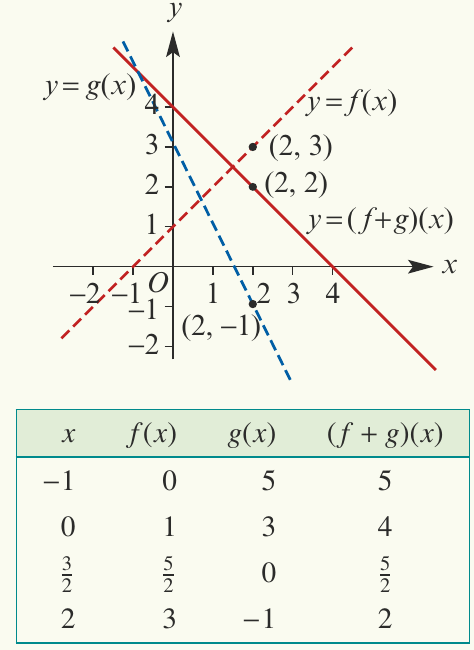
Notice on the graph how at each -value, the height of the red line equals the sum of the heights of the other two lines.
Example
Worked Example: Addition of Ordinates with Curved Functions
Now let's sketch where and .
Step 1: Find the sum
Step 2: Determine the domain
Since both functions require , the domain is .
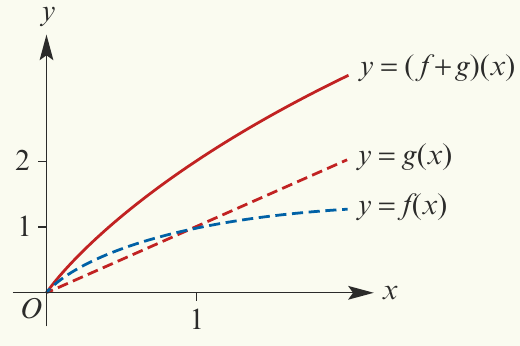
Notice that the graph of lies above both individual graphs since we're adding two positive functions together.
Example
Worked Example: Subtraction Using Addition of Ordinates
We can use the same technique for subtraction. Let's sketch where and .
Step 1: Find the difference
This is equivalent to adding and (the negative of ).
Step 2: Determine the domain
The domain is since both functions must be defined.
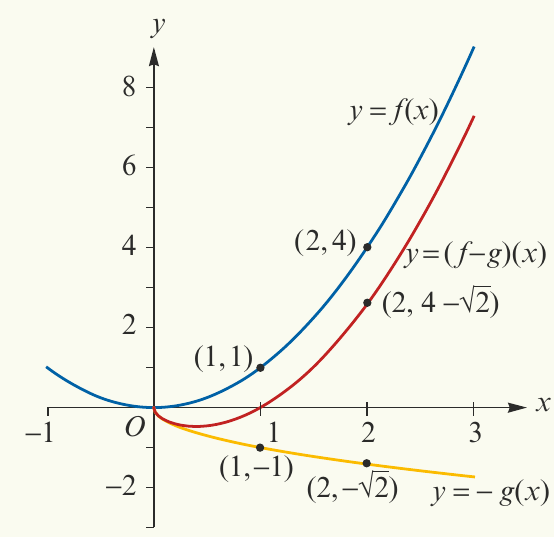
The graph shows in blue, in yellow-orange, and in red. At each -value, we add the ordinates of and to get the ordinate of .
Key points for sketching sums
When sketching using addition of ordinates, keep these important observations in mind:
Note
Critical Checkpoints When Sketching:
- When f(x) = 0, then - the sum graph touches the graph
- When g(x) = 0, then - the sum graph touches the graph
- If both f(x) and g(x) are positive, then and - the sum is above both graphs
- If both f(x) and g(x) are negative, then and - the sum is below both graphs
- If f(x) is positive and g(x) is negative, then - the sum is between the two graphs
- Look for values of where f(x) + g(x) = 0 - these are -intercepts of the sum
Summary
Key Points to Remember:
- The sum of functions is defined by
- The product of functions is defined by
- The domain of both sum and product is the intersection of the individual domains:
- Addition of ordinates is a graphical technique where you add the y-values of two functions at each -value to sketch their sum
- Key checkpoints: where one function equals zero, the sum equals the other function