Instantaneous Rate of Change (VCE SSCE Mathematical Methods): Revision Notes
📚Revision Notes
Instantaneous Rate of Change
Introduction
In previous sections, we explored the average rate of change of a function over an interval. We discovered that for non-linear functions, the average rate of change varies depending on which interval we choose. Now we'll investigate a more precise concept: the instantaneous rate of change at a specific point.
The instantaneous rate of change tells us how quickly a function is changing at a particular moment, rather than over an interval. This is fundamental in understanding motion, growth patterns, and many other real-world phenomena.
Note
Think of instantaneous rate of change like checking a car's speedometer at a specific moment - it tells you exactly how fast you're going right now, not your average speed over a trip.
Understanding tangent lines
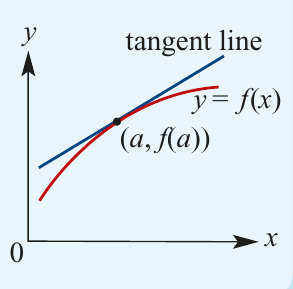
A tangent line to a curve at a point is a straight line that has the same slope as the curve at that exact point. Imagine zooming in very close to a point on a curve - the curve starts to look more and more like a straight line. This "local" straight line is what we call the tangent.
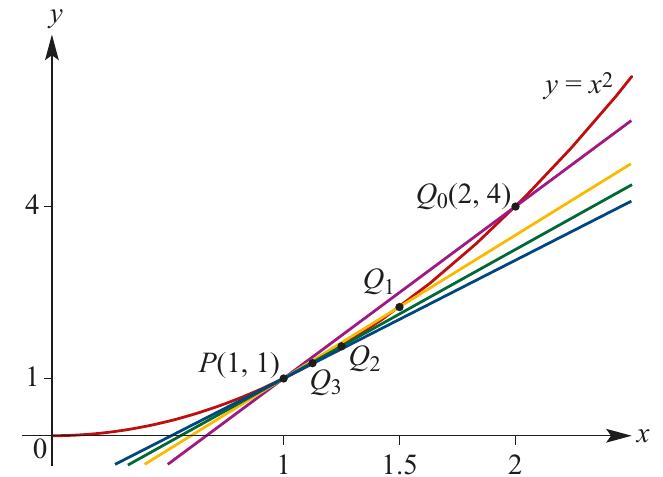
To understand this better, let's consider a specific example using the parabola and find the tangent line at point .
The secant line approach
We start by drawing a secant line - a line passing through two points on the curve. Let's begin with secant passing through and .
The gradient of is:
So the equation of secant is .
Important
The Key Idea: We'll create more points on the curve that get progressively closer to point . As these points get closer, the secant lines will approach the tangent line.
We calculate each point's -coordinate by finding the midpoint between and the previous point:
- -coordinate of
- -coordinate of
- -coordinate of
Observing the pattern
As we draw secant lines through and each of these points, something remarkable happens. Here's a table showing the gradient and equation of each secant:
| Step | Point on curve | Secant | Gradient | Equation of secant |
|---|---|---|---|---|
| 0 | ||||
| 1 | ||||
| 2 | ||||
| 3 | ||||
The sequence of gradients is:
Note
Observing the Convergence:
Notice what happens to the general gradient . As increases towards infinity, approaches zero, so the gradient approaches .
This tells us that the secant lines are getting closer and closer to a line with gradient and equation . This is our tangent line!
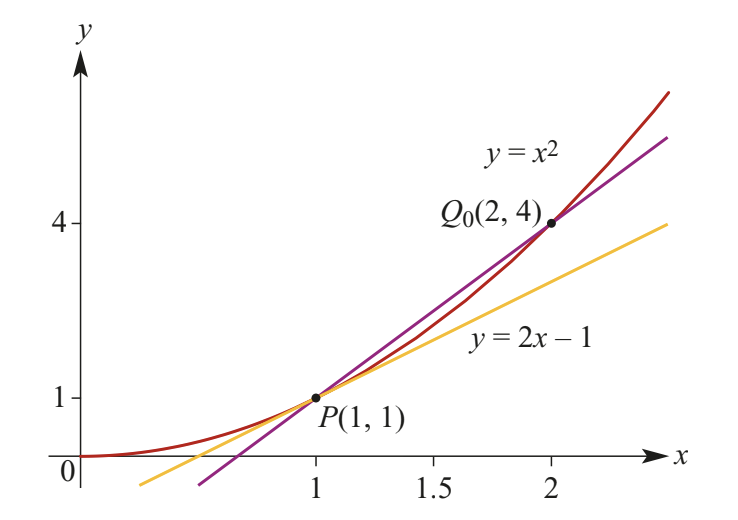
The gradient of the tangent line represents the instantaneous rate of change of with respect to at point .
Estimating instantaneous rate of change
In this course, we approximate the instantaneous rate of change by calculating the gradient of a secant line through two very close points.
Example
Worked Example: Estimating Instantaneous Rate of Change
Estimate the instantaneous rate of change of with respect to at point on the curve by considering the secant , where .
Solution:
Gradient of
Therefore, the instantaneous rate of change at is approximately 12.06.
Note
Improving Accuracy:
For even better accuracy, we could choose points closer together, such as and . This would give us . The closer the points, the better our approximation. The true instantaneous rate of change is actually .
Example
Worked Example: Plant Growth
The graph shows the area covered by a spreading plant, measured in square centimetres over time in weeks.
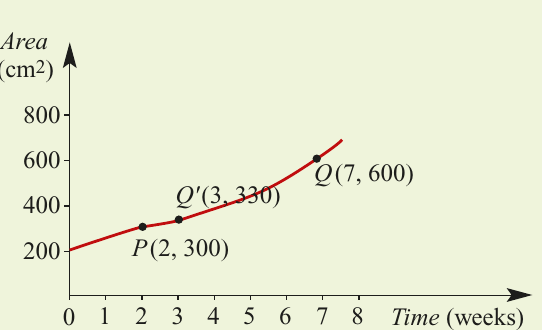
Part a: Find the gradient of secant .
Solution:
Gradient of
The average rate of change of area from to is cm² per week.
Part b: Point has coordinates . Find the average rate of change of area with respect to time for interval , and use this to estimate the instantaneous rate of change at .
Solution:
Gradient of
Therefore, the gradient at is approximately .
The instantaneous rate of change of the plant's area with respect to time when is approximately cm² per week.
Example
Worked Example: Exponential Function
Consider the curve .
Part a: Using the secant through points where and , estimate the instantaneous rate of change of with respect to where .
Solution:
When :
When : (to four decimal places)
The instantaneous rate of change at is approximately 5.742.
Part b: Repeat using points where and .
Solution:
When :
The closer points give us 5.547, which is nearer to the true value of (to four decimal places).
Using graphing technology
Graphing calculators provide another method for estimating instantaneous rate of change. By zooming in on a curve near a point, the curve appears increasingly linear, allowing us to estimate the gradient.
Note
Technology Approach:
For example, consider the function at point .
Starting with secant where and :
Using a closer point :
By zooming in further and using points and :
Therefore, the gradient at is approximately -2.
Key definition
Important
Definition: Instantaneous Rate of Change
For a function , the instantaneous rate of change of with respect to at point is the gradient of the tangent line to the graph of at that point.
Summary
Key Points to Remember:
-
The instantaneous rate of change at a point is the gradient of the tangent line at that point
-
We can approximate the instantaneous rate of change by finding the gradient of a secant through two nearby points
-
The closer the points are together, the better our approximation
-
Secant lines approach the tangent line as the second point gets closer to the first point
-
In practical applications, the instantaneous rate of change tells us the rate of change at a specific moment in time or at a specific value