Reflections (VCE SSCE Mathematical Methods): Revision Notes
📚Revision Notes
Reflections
Introduction
Reflections are transformations that flip a graph across a line called the mirror line. In this note, we focus on reflections in the -axis and -axis only.
When we reflect a graph, each point on the original graph is mapped to a new position on the opposite side of the mirror line. The distance from the point to the mirror line remains the same, but the point appears on the other side.
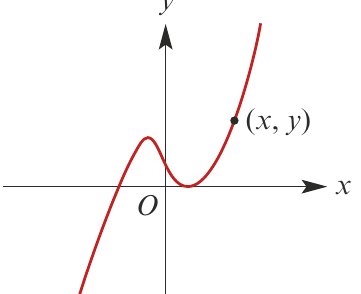
Let's explore what happens to a general point when we reflect it in each axis.
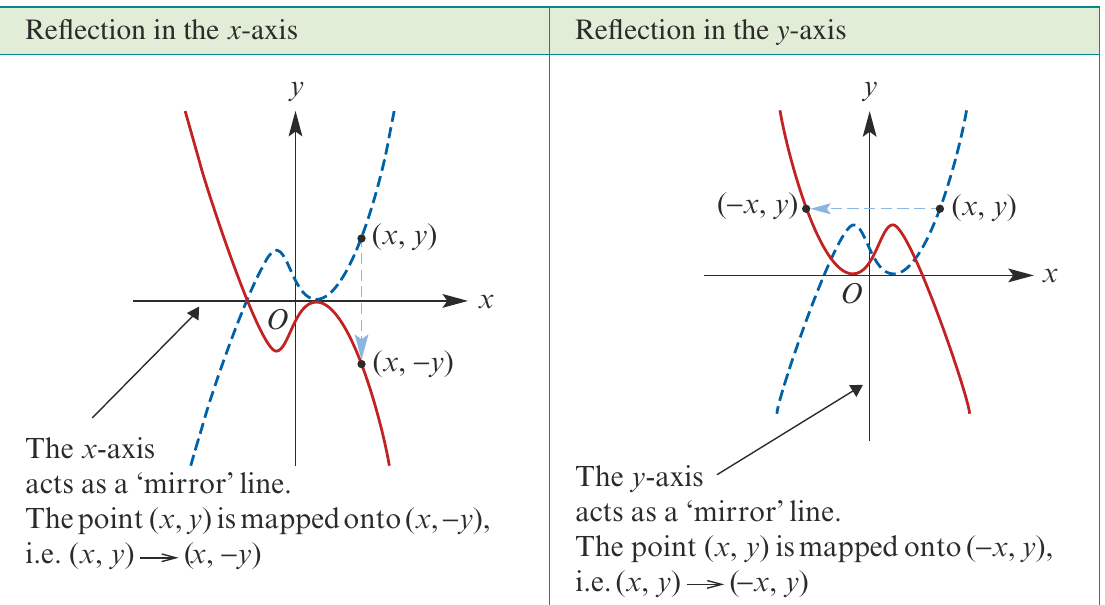
Note
Throughout this note, we'll only examine reflections in the -axis and -axis. Other types of reflections (such as in the line ) are covered in separate sections.
Reflection in the x-axis
When we reflect a graph in the -axis, the -axis acts as the mirror line. This means that each point flips vertically across the horizontal axis.
The transformation rule
A reflection in the -axis follows this mapping rule:
This can also be written as:
What this means: The x-coordinate stays exactly the same, but the y-coordinate changes sign (positive becomes negative, and vice versa).
For example, the point maps to when reflected in the -axis.
Effect on functions
For a function with equation , there are two equivalent ways to describe a reflection in the -axis:
- Apply the transformation rule to every point on the graph
- Replace with in the equation to get
Both methods produce the same result.
Example
Worked Example: Reflecting in the x-axis
Let's find the equation when is reflected in the -axis.
Using the transformation approach:
Let be the image point of .
Then and
Rearranging these equations: and
Since the original equation is , we can substitute to get:
Therefore:
The equation of the reflected graph is:
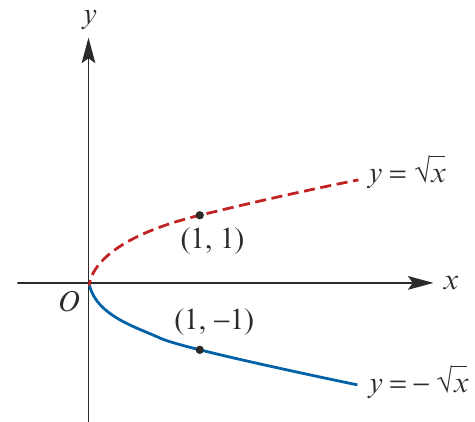
Notice how the reflected graph is upside down compared to the original. Every point that was above the -axis is now below it, and at the same distance from the axis.
Reflection in the y-axis
When we reflect a graph in the -axis, the -axis acts as the mirror line. This means that each point flips horizontally across the vertical axis.
The transformation rule
A reflection in the -axis follows this mapping rule:
This can also be written as:
What this means: The y-coordinate stays exactly the same, but the x-coordinate changes sign (positive becomes negative, and vice versa).
For example, the point maps to when reflected in the -axis.
Effect on functions
For a function with equation , there are two equivalent ways to describe a reflection in the -axis:
- Apply the transformation rule to every point on the graph
- Replace with in the equation to get
Both methods produce the same result.
Example
Worked Example: Reflecting in the y-axis
Let's find the equation when is reflected in the -axis.
Using the transformation approach:
Let be the image point of .
Then and
Rearranging these equations: and
Since the original equation is , we can substitute to get:
The equation of the reflected graph is:
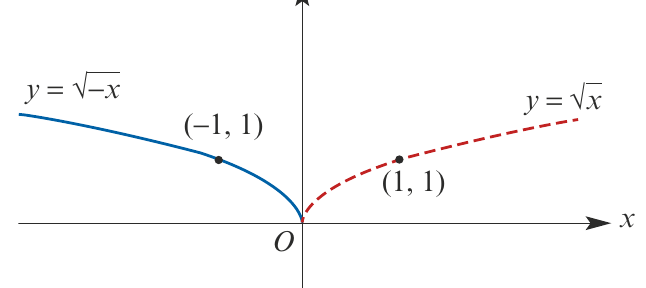
Notice how the reflected graph appears on the left side of the -axis. Every point that was to the right of the -axis is now to the left, at the same distance from the axis.
Summary
Summary of Reflection Rules
Reflection in the x-axis:
- Transformation rule:
- Equation form: becomes
- Effect: Flips the graph vertically (upside down)
Reflection in the y-axis:
- Transformation rule:
- Equation form: becomes
- Effect: Flips the graph horizontally (left to right)
Note
Exam Tips
- When asked to find the equation of a reflected graph, you can use either the coordinate method or the equation substitution method - both give the same answer
- Remember: the axis name tells you which coordinate stays the same (-axis reflection keeps the same, -axis reflection keeps the same)
- Always check your answer makes sense - if reflecting in the -axis, points above should now be below
- Sketch a quick diagram if you're unsure - visualising the transformation helps avoid mistakes
Important
Remember!
-
Reflection in the x-axis: Points map from to , giving equation . The x-coordinate stays the same, the y-coordinate changes sign.
-
Reflection in the y-axis: Points map from to , giving equation . The y-coordinate stays the same, the x-coordinate changes sign.
-
Memory aid: "Reflect in X-axis, change Y" and "Reflect in Y-axis, change X"
-
Two methods: You can find the reflected equation either by transforming coordinates or by substituting into the original equation - both work!
-
The mirror line: The axis you're reflecting in acts as the mirror line, with points flipping to the opposite side at equal distances.