Using Transformations to Sketch Graphs (VCE SSCE Mathematical Methods): Revision Notes
📚Revision Notes
Using Transformations to Sketch Graphs
Introduction
When faced with a complicated-looking function, we can often sketch its graph by viewing it as a transformed version of a simpler base function. By identifying the sequence of transformations applied to the base function, we can construct the graph step by step. This approach works for many types of functions, including rational functions, square root functions, and reciprocal functions.
Note
This method is particularly powerful because it allows you to build complex graphs from simple ones you already know well. Instead of plotting numerous points, you transform key features of the base function.
Identifying transformations algebraically
To find the transformations that map one function onto another, we can use an algebraic method. This involves rearranging the transformed function to match the form of the base function.
Example
Worked Example: Transforming the Reciprocal Function
Question: Identify a sequence of transformations that maps the graph of onto the graph of . Use this to sketch the graph, stating the equations of asymptotes and the coordinates of axis intercepts.
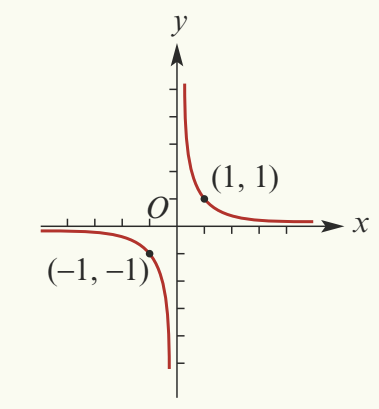
Solution:
First, we rearrange the transformed equation to have the same 'shape' as the base function :
where are the coordinates of the image of .
This gives us and .
Rearranging these equations:
The mapping is .
From this mapping, we can identify the sequence of transformations:
-
A dilation of factor 4 from the x-axis
-
A translation of 5 units in the negative direction of the x-axis
-
A translation of 3 units in the negative direction of the y-axis
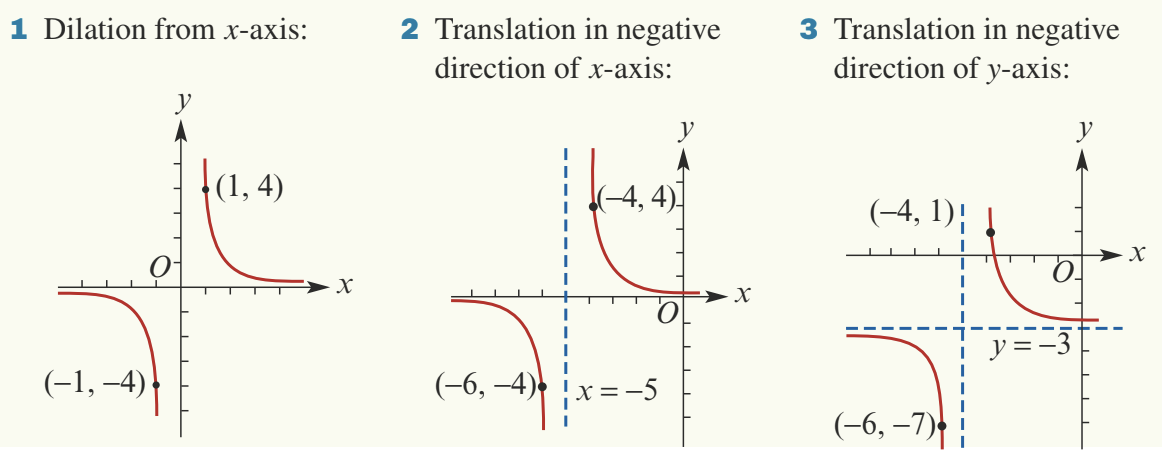
Applying the transformations
We start with the base function , which passes through the points and .
Step 1: Dilation from the x-axis by factor 4
This multiplies all y-coordinates by 4:
Step 2: Translation 5 units in negative x-direction
This shifts the graph units to the left:
The vertical asymptote moves from to .
Step 3: Translation 3 units in negative y-direction
This shifts the graph units down:
The horizontal asymptote moves from to .
Important
When applying multiple transformations, track both the key points AND the asymptotes through each step. This ensures your final graph is accurate.
Finding axis intercepts
To complete our sketch, we need to find where the graph crosses the axes.
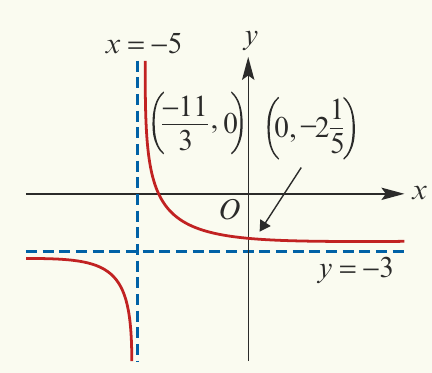
y-intercept (when ):
The -intercept is at .
x-intercept (when ):
The -intercept is at .
Final graph
The transformed graph has:
- Vertical asymptote:
- Horizontal asymptote:
- x-intercept:
- y-intercept:
Quick identification of transformations
Once you understand the basic process, you can identify transformations more quickly by carefully observing the rule of the transformed function and relating it to the base function in its family. The following examples demonstrate this quicker approach.
Note
With practice, you can identify transformations directly from the function's form without needing to go through the full algebraic rearrangement. Look for patterns in how the function differs from its base form.
Example
Worked Example: Square Root Function
Question: Sketch the graph of .
Solution:
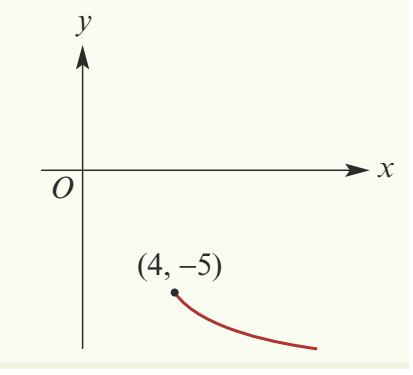
This is a transformation of the base function .
The transformations are:
- A reflection in the x-axis (due to the negative sign in front of the square root)
- A translation of 5 units in the negative direction of the y-axis (the at the end)
- A translation of 4 units in the positive direction of the x-axis (the inside the square root means we shift right)
The graph starts at the point (4, -5) and extends to the right, curving downward.
Example
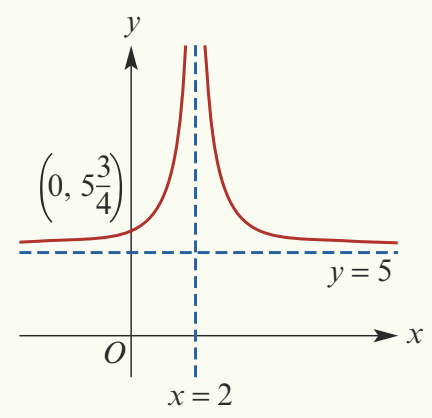
Worked Example: Reciprocal Squared Function
Question: Sketch the graph of .
Solution:
This is a transformation of the base function .
The transformations are:
- A dilation of factor 3 from the x-axis (the numerator multiplies the function)
- A translation of 5 units in the positive direction of the y-axis (the )
- A translation of 2 units in the positive direction of the x-axis (the in the denominator means we shift right)
The graph has:
-
Vertical asymptote:
-
Horizontal asymptote:
-
y-intercept: (found by substituting : )
Important
Common Mistake Alert!
When you see inside a function, the graph shifts h units to the RIGHT, not left. Similarly, shifts the graph h units to the LEFT. The direction is opposite to the sign!
Summary
Key Points to Remember:
- To sketch a transformed function, identify the base function first, then determine the sequence of transformations applied to it.
- Use algebraic rearrangement to find the mapping , which reveals the transformations clearly.
- Apply transformations in order: typically dilations first, then horizontal translations, then vertical translations.
- For rational functions in the form , the vertical asymptote is at and the horizontal asymptote is at .
- Always calculate and mark axis intercepts and asymptotes on your sketch to make it complete and accurate.