Newton’s Laws (VCE SSCE Physics): Revision Notes
📚Revision Notes
Newton's Laws
Introduction
Newton's three laws of motion form the foundation of classical mechanics. These laws describe how objects behave when forces act upon them, whether the objects are at rest, moving at constant velocity, or accelerating. Understanding these laws allows us to predict and explain motion in everyday situations, from cars on roads to aircraft in flight.
Forces can be classified as either contact forces (like friction or normal force) or non-contact forces (like gravity or magnetic forces). When analysing motion, we must consider all forces acting on an object and their combined effect.
Newton's first law
Important
Newton's first law states that an object in a state of rest or travelling at a constant velocity will remain in its state of motion unless acted upon by an unbalanced force.
This law is often called the law of inertia. Inertia is a body's ability to resist a change in its state of motion, and it depends only on the mass of the body. The greater the mass, the greater the inertia.
Understanding balanced forces
When an object is stationary or moving at constant velocity, the forces acting on it are balanced, meaning the net force equals zero.
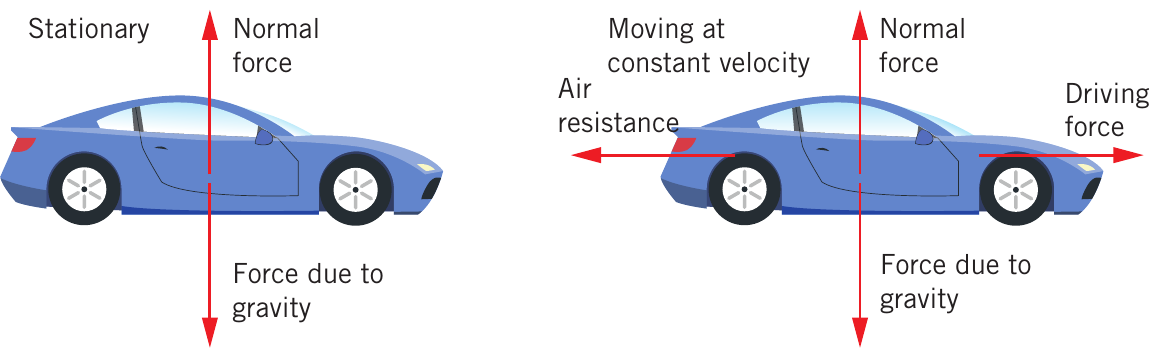
For a stationary car on the ground:
- The normal force (upward push from the ground) balances the force due to gravity (weight pulling downward)
- Since forces are balanced, the car remains at rest
For a car moving at constant velocity on a straight road:
- The normal force still balances the weight
- The driving force (pushing the car forward) balances air resistance and rolling resistance (opposing motion)
- Since forces are balanced, the car maintains constant velocity
Note
Common misconception
It may seem counter-intuitive that an object continues at constant velocity when forces are balanced. In everyday experience, objects slow down and stop due to friction. However, friction creates an unbalanced force that opposes motion. On a frictionless surface, an object would continue moving indefinitely at constant velocity once set in motion.
Newton's second law
Newton's second law states that the acceleration experienced by a body is directly proportional to the net force on the body and inversely proportional to the mass of the body.
The formula
Where:
- = Net force acting on the body (N)
- = Mass of the body (kg)
- = Acceleration of the body (m·s)
This is commonly rearranged to:
Net force is the vector sum of all forces acting on a body. It may also be called the unbalanced force or resultant force.
Free-body diagrams
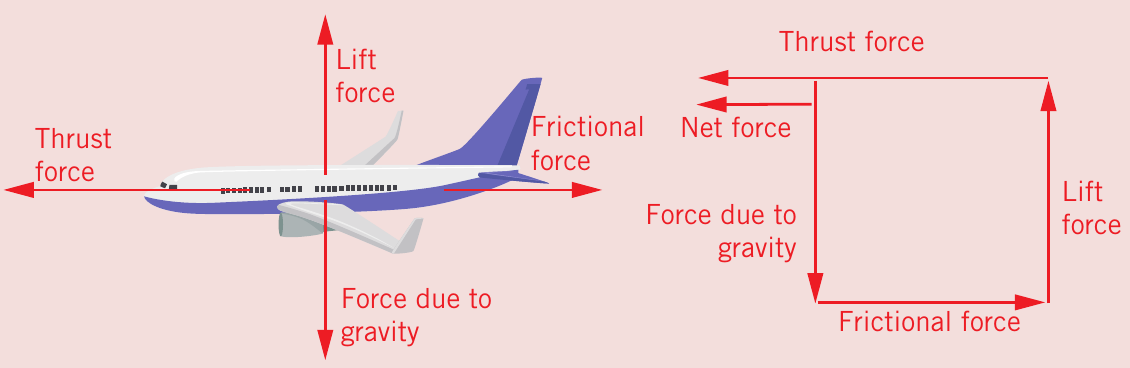
When determining the net force on a body, it helps to draw a free-body diagram—a diagram showing the relative magnitude and direction of all forces acting on a body.
Example
Worked Example: Calculating net force on an aircraft
An aircraft with mass kg travels in level horizontal flight with a forward thrust of kN and a backward frictional force of kN.
Solution:
The net force on the aircraft is:
The acceleration can then be determined:
Note: Since the aircraft travels in level horizontal flight, the gravitational force downward and lift force upward are balanced.
Example
Worked Example: Net force with a force at an angle
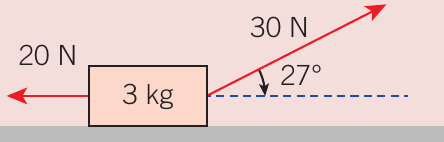
A kg block is pulled by a force of N at an angle of to the horizontal. A N friction force acts horizontally opposing the motion.
Solution:
Part a: The net horizontal force is the sum of all horizontal forces:
Part b: The horizontal acceleration is:
Forces on objects with different masses
When two or more bodies move with the same acceleration, the force on each body will differ unless the masses are equal. This is because —for the same acceleration, greater mass requires greater force.
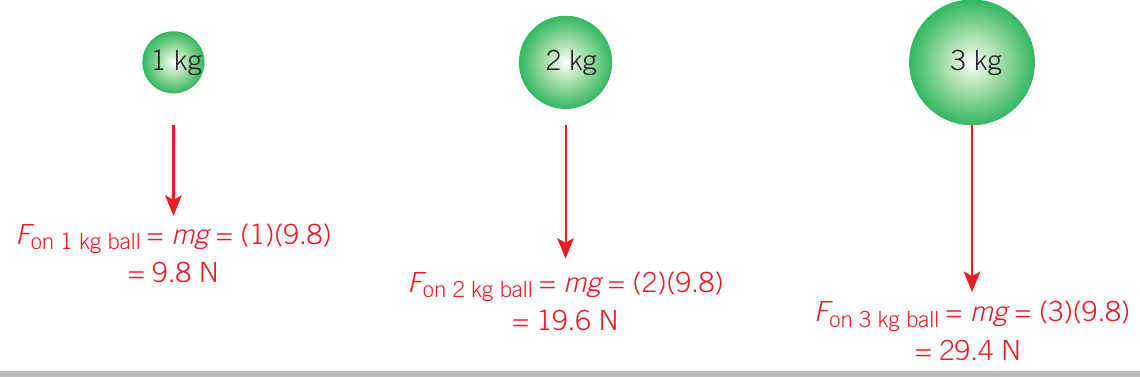
If three balls with masses kg, kg, and kg all drop from the same height (ignoring air resistance), they all accelerate at m·s toward Earth's surface. However, the forces differ:
- Force on kg ball: N
- Force on kg ball: N
- Force on kg ball: N
Direction of acceleration and velocity
Important
The only way to cause a body to accelerate is by applying a net force. The body accelerates in the same direction as the net force. Importantly, the direction of acceleration and velocity may differ.
Example 1: A car approaching a red light applies brakes. The car's velocity is forward, but the acceleration (and therefore net force) is backward, opposing the motion.
Example 2: When you throw a ball vertically upward, once it leaves your hand, the only force acting is gravity (if air resistance is ignored). The ball accelerates downward throughout its flight, even though initially it moves upward. The upward velocity decreases until the ball momentarily stops at maximum height, then the ball moves downward with increasing velocity—all while accelerating downward the entire time.
Inclined planes
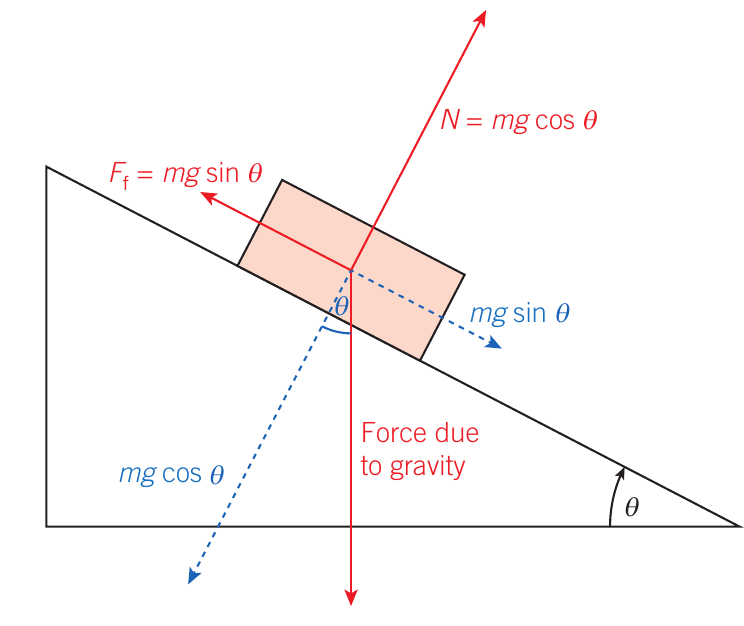
When an object rests on a slope, three forces act on it:
- Force due to gravity (vertically downward)
- Normal force (perpendicular to the surface)
- Friction force (parallel to the slope, opposing potential motion)
Note
The gravitational force can be resolved into two components using trigonometry:
- Perpendicular to the slope:
- Parallel to the slope (down):
Memory aid: "cos for perpendicular (Normal), sin for parallel (down slope)"
Normal force on an inclined plane
Where:
- = Normal force on the object by the surface (N)
- = Mass of the object (kg)
- = Gravitational field strength near Earth's surface, N·kg
- = Angle of the slope (°)
Gravitational force down the slope
Where:
- = Gravitational force component down the slope (N)
- = Mass of the object (kg)
- = Gravitational field strength, N·kg
- = Angle of the slope (°)
If the friction force is less than the gravitational force parallel to the slope, the object accelerates down the slope.
Acceleration on a frictionless slope
Where:
- = Gravitational acceleration down the slope (m·s)
- = Gravitational field strength, N·kg (or m·s)
- = Angle of the slope (°)

Example
Worked Example: Inclined plane
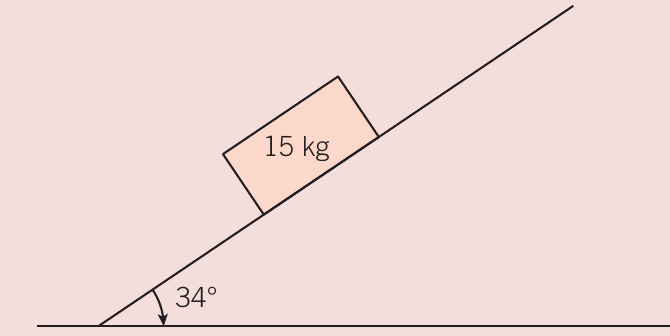
A kg box slides down a slope inclined at . The acceleration of the box is measured to be m·s.
Solution:
Part a: Calculate the magnitude of the normal force:
Part b: Calculate the gravitational force parallel to the slope:
Part c: Calculate the magnitude of the constant frictional force:
First, find the net force:
Then:
Newton's third law
Important
Newton's third law states that every action force has an equal and opposite reaction force.
When considering action-reaction force pairs, remember that these two forces always act on different bodies. This is crucial—action and reaction forces never act on the same object.
Examples of Newton's third law
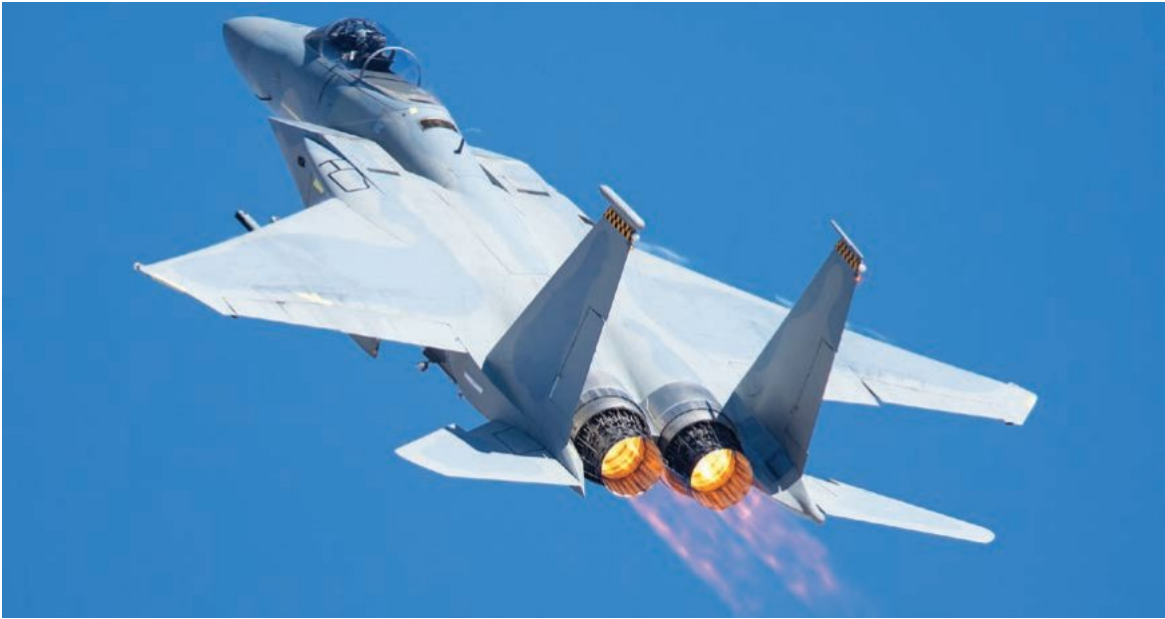
Fighter jet:
Note
The jet engines push extremely hot gas backward (action force on the gas). The hot gas pushes forward on the jet (reaction force on the jet), accelerating it forward.
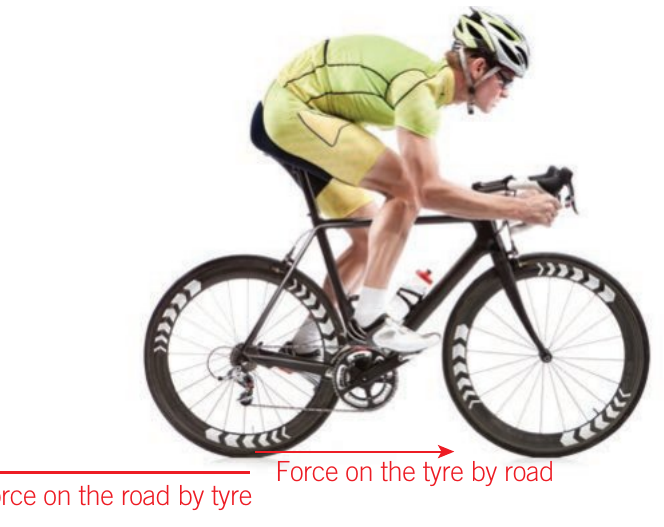
Bicycle:
Note
The tyre pushes backward on the road (action force). The road pushes forward on the tyre (reaction force), propelling the bicycle forward.
Free fall:
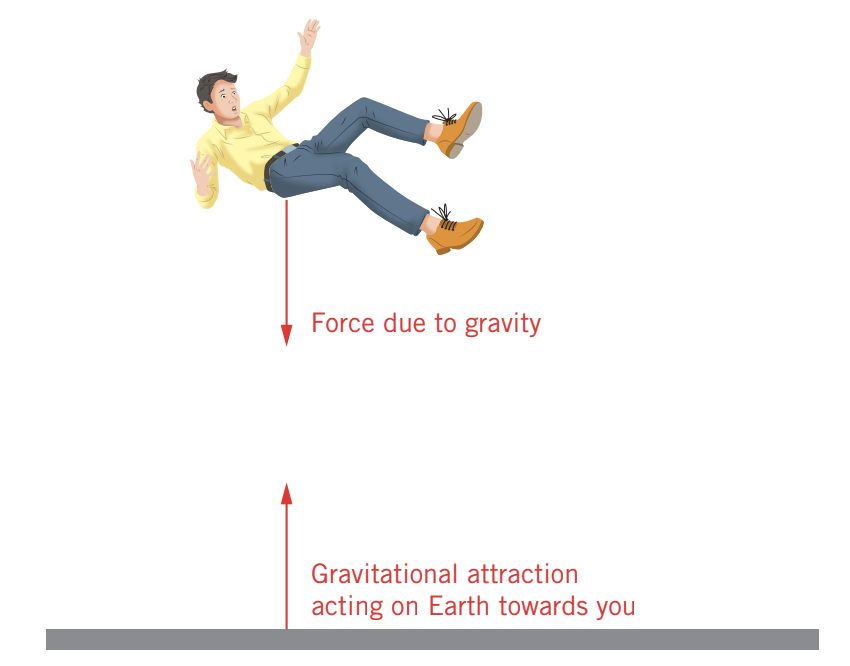
When you are in free fall, Earth pulls you downward due to gravity (action force on you). You simultaneously pull Earth upward with an equal and opposite force (reaction force on Earth). Although both forces are equal in magnitude, Earth's enormous mass means it experiences negligible acceleration.
Free fall occurs when an object falls and only the force of gravity acts on it.
Normal force
The normal force is the force that a surface applies to a body in contact with it. This force is always applied perpendicular to the surface and prevents the body from falling through the surface.
Understanding normal force through action-reaction pairs
Imagine you are standing on a tightrope. You apply a force downward on the rope (action), and the rope applies an equal and opposite force upward on you (reaction). This upward reaction force is the normal force.
Important
In this situation, there are actually two force pairs:
- Force of gravity on you (action) paired with force on Earth pulling it toward you (reaction)
- Force you apply on rope (action) paired with normal force from rope on you (reaction)
Critical concept: The force due to gravity and the normal force acting on you are not an action-reaction pair, even though they may be equal in magnitude and opposite in direction. This is because they both act on the same body (you). Action-reaction pairs always act on different bodies.
Vertical motion
Your normal force results from how hard you push on the ground. The normal force is not fixed and can vary depending on your motion.
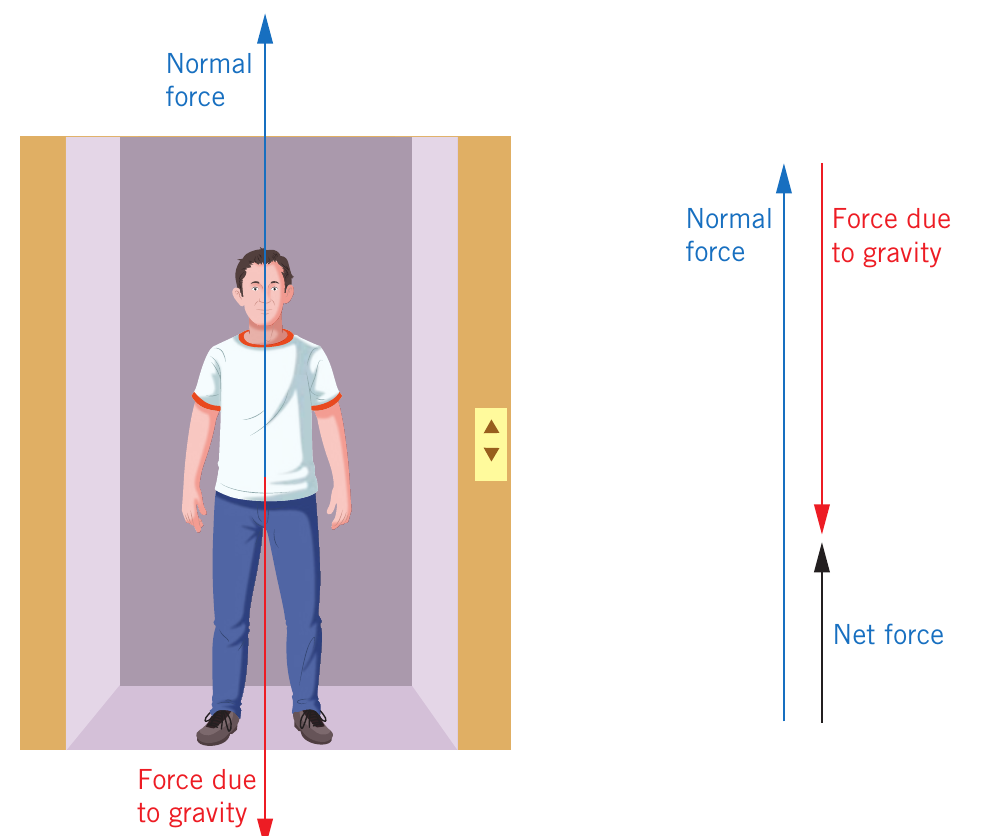
Note
Consider being in a lift:
- Stationary or constant velocity: Normal force equals the force due to gravity
- Accelerating upward: You feel heavier because the normal force increases to provide the upward net force needed for acceleration
- Accelerating downward: You feel lighter because the normal force decreases
- Free fall (cable breaks): You have no normal force at all
Normal force in vertical acceleration
Where:
- = Normal force from the surface (N)
- = Mass of the object (kg)
- = Acceleration in the vertical direction (m·s) [positive upward, negative downward]
- = Gravitational field strength, N·kg (or m·s)
Example
Worked Example: Normal force in a lift
A kg person stands on scales inside a lift. What force do the scales read when the lift is:
Solution:
a) At rest:
b) Moving at constant velocity of m·s downward:
Note: Constant velocity means zero acceleration
c) Moving with upward acceleration of m·s:
d) Moving with downward acceleration of m·s:
Applying Newton's laws
Newton's laws can be applied systematically to solve problems involving multiple objects.
Block systems
Example
Worked Example: Block system
A N force pushes two blocks (A: kg, B: kg) on a frictionless surface. Both blocks move together as one system.
Solution:
Part a: Calculate the acceleration of the two blocks.
Since the blocks move together, add the masses:
Part b: What is the force on block B by block A?
Block B accelerates at m·s, so:
Part c: What is the force on block A by block B?
By Newton's third law (action-reaction), this force is equal and opposite:
Pulley systems
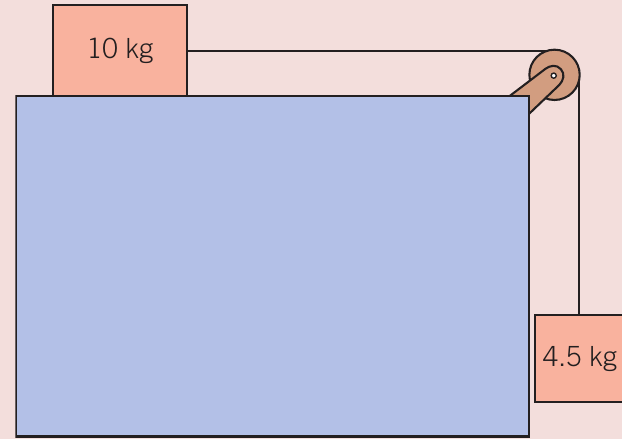
Note
A system is a collection of objects that interact with each other and are being studied together.
Example
Worked Example: Pulley system
A kg mass on a frictionless table is connected via a pulley to a kg hanging mass.
Solution:
Part a: What is the acceleration of the system?
The hanging kg mass provides the net force:
Apply Newton's second law to the entire system (add both masses):
Part b: Calculate the tension in the string.
The tension accelerates the kg mass at m·s:
Train carriage systems

Example
Worked Example: Train carriage system
An engine (mass kg) produces a driving force of kN while towing two carriages (each kg). Coupling A connects the engine to both carriages; coupling B connects the two carriages. Assume no friction.
Solution:
Part a: Calculate the acceleration of the system.
Convert to SI units: kN N
All parts accelerate together, so add all masses:
Part b: Calculate the tension in coupling A.
Coupling A tows both carriages at m·s:
Part c: Calculate the tension in coupling B.
Coupling B tows one carriage at m·s:
Skills: Determining the direction of a vector
In any problem involving vectors, you must consider direction. Direction can be incorporated using positive and negative signs.
Important
Key steps:
-
Choose which direction is positive (and which is negative). The choice is arbitrary—you can make up positive and down negative, or vice versa.
-
Stay consistent throughout the problem. Write down your choice clearly.
-
Interpret your answer: A positive result means the direction you chose as positive; a negative result means the opposite direction.
Example
A model rocket experiences a thrust force of N upward and a drag force of N downward. Calculate the net force.
Method 1: Let up be positive
The positive answer indicates upward direction: 425 N up
Method 2: Let up be negative
The negative answer indicates the direction we chose as negative (which is up): 425 N up
Both methods give the same physical result!
Summary
Key Points to Remember:
-
Newton's first law: Objects maintain their state of motion (rest or constant velocity) unless acted upon by an unbalanced force. This is the law of inertia.
-
Newton's second law: . The net force on an object determines its acceleration. The object accelerates in the direction of the net force, which may differ from the direction of velocity.
-
Newton's third law: Every action force has an equal and opposite reaction force. These forces act on different objects, never the same object.
-
Free-body diagrams help visualise all forces acting on an object, making it easier to calculate the net force and apply Newton's second law.
-
On inclined planes, resolve the gravitational force into components: perpendicular to the slope () and parallel to the slope ().
-
Normal force varies depending on acceleration, particularly in vertical motion like lifts. It increases when accelerating upward and decreases when accelerating downward.
-
When solving problems with connected systems (blocks, pulleys, trains), identify whether objects move together as one system or need individual analysis. Always maintain consistent sign conventions for vector directions.